
Abstract: The disposition of the foreign fighters who helped topple the Assad regime has become one of the defining tests of Syria’s transition, and of the West’s willingness to deal with the government that emerged from it. A provision in the U.S. Senate’s Fiscal Year 2027 National Defense Authorization Act would condition American support for Syria’s transitional government on its progress in disarming the foreign fighters and jihadis who remain inside the country. This article argues that the provision misdiagnoses the problem. Since the fall of the Assad regime in December 2024, Damascus has pursued an “integrate-or-arrest” strategy that has absorbed most of its foreign fighters (muhajirin) into state command structures rather than leaving them armed outside them. The foreign fighter population is internally differentiated (pro and adjacent to the new government or Islamic State-affiliated, which the government already fights with U.S. support) and fracturing (between those who integrate versus those who want to remain independent). The threats that have actually materialized in 2026 (an assassination campaign against integrated fighters, the repackaging of grievance toward anti-Israel mobilization, and the arrival of new foreigners exploiting post-Assad openness) are not addressed by a disarmament-by-headcount framing. The West’s experience in Bosnia, where an externally imposed expulsion clause and a later coerced denaturalization campaign both backfired, offers a direct and cautionary precedent: Ejection exported the threat, while anchoring largely retired it.
Few questions have proved as durable a test of Syria’s transition as what to do with the foreigners who fought in it. Tens of thousands of muhajirin traveled to Syria over the course of the war. The several thousand who remained after December 2024 are now distributed across the security forces, the marketplaces, and the mosques of the state they helped bring into being, and they sit at the intersection of three separate problems: a domestic one for Damascus, which must assert authority over armed men to whom it owes a debt; a diplomatic one, since Beijing, Moscow, Tashkent, Paris, and Washington each have claims on some portion of them; and a counterterrorism one, whose contours are widely asserted and rarely specified. How that population is managed, and by whom, will shape not only Syria’s internal consolidation, but the terms on which the West is prepared to engage a government that emerged from a jihadi insurgency.
In June 2026, the U.S. Senate Armed Services Committee approved its version of the Fiscal Year 2027 National Defense Authorization Act (NDAA) with a provision conditioning American support for Syria’s transitional government on its progress in disarming the foreign fighters and jihadis who remain inside the country. A narrower condition of this kind has been on the books since the FY2026 NDAA, which addressed foreign fighters in senior government roles. What is new in the FY2027 text is the extension of the requirement from senior appointments to the entire foreign fighter population, and the addition of disarmament and monitoring as the operative metrics.1 a The concern is not misplaced. Syria hosts one of the largest concentrations of foreign fighters in the world, a population whose skills in explosives, unmanned systems, and small-unit tactics have obvious transnational salience, and some whose relationship to a resurgent Islamic State remains a live counterterrorism question.2
Yet, the instrument the NDAA provision selects (disarmament, measured as a reduction in the weapons held by foreign fighters) rests on three assumptions that the evidence from post-Assad Syria does not support. The first is that the danger these men pose scales with the arms in their hands. The second is that those arms sit outside the Syrian state. The third is that removing weapons removes capability. In a country awash in weapons, with porous borders, informal arms markets, and officials who can be paid, disarmament is a transaction that can be reversed at modest cost, and the two capabilities most relevant to transnational plotting (improvised explosives and commercial drones) are the least susceptible of all to a confiscation metric.
Since Hayat Tahrir al-Sham (HTS) and its allies toppled Bashar al-Assad in December 2024, the government of President Ahmed al-Sharaa has neither disarmed its foreign fighters nor left them as free-floating armed formations. It has systematically absorbed the majority into its own security forces while selectively detaining those it judged liabilities.3 The consequence is that a demand to “disarm all remaining foreign fighters” would, if taken literally, pressure Damascus to dismantle the very command structures that now contain them and are part of the Syrian government. The provision draws no distinction between a foreign fighter and a foreign fighter in uniform. Its first certification requirement therefore reaches those serving in the military forces and other services of the Syrian government, which is to say the integrated cohort of foreign fighters specifically. Its second reaches all foreign fighters who remain in Syria. On the face of the text, integration is not an exit from the target set, but the first place the requirement looks.
It should be clarified and qualified that this discussion is not about the Islamic State. The Syrian government, and before that HTS, has been fighting against the Islamic State for more than a decade, which this author has laid out in this publication during the HTS years and in the aftermath of the fall of the Assad regime.4 For example, in the first two weeks of August 2026 alone, Damascus has arrested four Islamic State cells, with two of them containing foreign fighters.5 Further, while this discussion is broadly about foreign fighters, it is worth noting that the only attack on U.S. forces in Syria to cause casualties since the fall of the Assad regime was carried out by a Syrian rather than a foreigner: a suspected Islamic State member that infiltrated the Syrian security services, who ambushed a joint U.S.-Syrian patrol near Palmyra on December 13, 2025, killing two U.S. soldiers and an American interpreter.b Therefore, the issue of weapons outside state control and the state’s monopoly on violence in general is an important one that is relevant to Syrians, just as much as it relates to remaining foreigners who had been in HTS previously or adjacent to the group.
This article makes three empirical claims and one comparative argument. Empirically, it contends that Syria’s foreign fighter population that was in HTS or adjacent to the group prior to the fall of the regime: (1) has largely integrated into state structures rather than remaining armed outside them; (2) is not monolithic, but internally differentiated, and has actively fractured, with the key dividing line running between those that have joined the state and those seeking to remain independent of it; and (3) is increasingly defined by risks (assassinations of integrated fighters, ideological repackaging, and a new inflow of arrivals as well as the entrepreneurial freelancing of external attacks by non-integrated individuals) that a disarmament frame cannot capture. Comparatively, it argues that the closest historical precedent for the NDAA’s approach, the post-Dayton handling of the foreign foreigners in Bosnia and Herzegovina, demonstrates that externally imposed ejection of foreign fighters exported the threat while integration and anchoring largely neutralized it, and that a subsequent, U.S.-pressured campaign of coerced denaturalization produced negligible security gains and durable grievance. The article concludes with possible implications of the provision for U.S. policy.
The Foreign Fighter Population in Post-Assad Syria
Estimates of the total number of foreign fighters in Syria vary widely, but the composition of the population is better understood than its precise size. The largest single component is Uyghurs affiliated with the Turkistan Islamic Party (TIP). One International Crisis Group assessment holds that Uyghurs constitute roughly two-thirds of Syria’s foreign fighters when their families and affiliated media structures are included, living in significant part as a collective community with its own camps and institutions.6 According to another source, the second major bloc is Central Asian—principally Uzbeks associated with Katibat al-Tawhid wa-l-Jihad (KTJ) and related formations, followed by North Caucasians (Chechens and Dagestanis) linked to groups such as Junud al-Sham, a French-speaking contingent centered on Firqat al-Ghuraba, and smaller Turkish, Arab, and Western elements.7
This diversity matters analytically because the blocs differ in their degree of organizational cohesion, their relationship to the new state, and their exposure to external pressure. They differ, no less consequentially, in ideological orientation. The Turkistan Islamic Party’s program is bound to a Uyghur national cause and has always been oriented toward a homeland elsewhere; the Central Asian formations retain more of the transnational-jihadi frame from which they emerged; and Firqat al-Ghuraba’s outlook is that of a Francophone diaspora milieu with its own quarrel with Paris. These are not interchangeable constituencies, and they will not respond to the same pressure in the same way. The Uyghurs, entangled with both Beijing and Ankara, present Damascus with a delicate diplomatic problem that the government has managed partly through civilian channels, including a February 2025 decision exempting “Turkestan” students from university fees.8 The Central Asians have been the most publicly outspoken and the most internally divided, producing both the loudest denunciations of the government on Telegram and the most prominent pro-government foreign brigade.9 c The French contingent, though small, is disproportionately visible in propaganda terms. Running beneath all of this is the separate, but related population of Islamic State family members previously held in the northeast at the Al-Hol camp, whose members occasionally intersect with the integrated foreign fighters now serving in the Syrian army.10
A further complicating feature of the population is the persistence of independent ‘tactical’ formations that have continued to produce training content and propaganda well after the integration drive began. Groups such as Malhama Tactical, Musafeer/Mujahir Tactical, and the Uyghur-associated Yurtugh Tactical continued to publish training videos and imagery through fall 2025, but have since ceased their independent media activity.11 Their apparent dissolution follows the broader trajectory of other foreign fighter formations, whose members have mostly entered new state security structures, returned to civilian life, or a minority remained associated with groups operating outside the state. This matters for any assessment of the population’s trajectory: The existence of an ecosystem of independent brands more than a year into the integration process is direct evidence that absorption has been partial rather than total, and that the state’s writ over the foreign fighters is uneven. It is precisely this residual autonomy, rather than the arms held by integrated fighters, that constitutes the more plausible locus of future risk.
The Integrate-or-Arrest Strategy
The defining feature of Damascus’ approach to the foreign fighters residing in its territory, and to those who were adjacent to HTS before the fall of the regime, has been a dual-track strategy that can be summarized as integrate-or-arrest. The integration track was evident within weeks of the regime’s fall. In late December 2024, al-Sharaa promoted a slate of officers that included six foreigners to senior positions within the Ministry of Defense, a step that analysts read less as a reward than as a form of coup insulation, placing loyalists without independent Syrian constituencies at sensitive nodes of the security apparatus.12 The move was controversial enough, both domestically and in Western capitals, that the senior-rank appointments to foreign nationals were subsequently reported to have been partly rescinded.13
Over the following year, integration was institutionalized. In June 2025, Reuters reported that the United States had given a qualified green light to the incorporation of foreign ex-rebels into the Syrian armed forces, and the Turkistan Islamic Party formally announced its dissolution, with its fighters folded into the structure of the national army.14 Reporting at the time indicated that some 3,500 foreign fighters were to be integrated into a newly constituted division.d Foreign veterans also appeared in training roles within regular formations: Open-source researchers documented a Turkish citizen serving as a special-forces trainer for the 50th Division in May 2025.15 The bargain implicit in this integration was consistent: Foreign fighters were offered a place inside the state in exchange for accepting a Syria-centered-Damascene chain of command and surrendering their independent organizational identities.
The arrest track operated in parallel, and its selection logic appears to reveal the strategy’s underlying purpose. In January 2025, Syrian authorities swiftly jailed an Egyptian militant who had threatened Egyptian President Abdel Fattah al-Sisi, a signal that post-Assad Syria would not serve as a platform for destabilizing neighboring states.16 In August 2025, authorities detained the prominent Uzbek military trainer and media figure known as Abu Dujana, reportedly in the wake of a visit by Uzbek jihadis to the sensitive southern corridor around Daraa, Quneitra, and Suwayda. His detention generated significant discontent across Central Asian jihadi channels.17 In December 2025, Syrian security forces arrested the American Islamist media activist Bilal Abdul Kareem in al-Bab, in Aleppo province, who had publicly campaigned for the muhajirin to be granted citizenship.18 The framing of Abdul Kareem as merely a “journalist” penalized for citizenship advocacy, advanced by his supporters and repeated in much of the coverage of his arrest, is, however, incomplete: The more immediate trigger for his detention appears to have been his interview with and platforming of Hani al-Siba’i, a prominent pro-al-Qa`ida ideologue who had denounced al-Sharaa as an apostate, together with the associated accusation that Abdul Kareem had himself lent legitimacy to the excommunication (takfir) of the new government. This reframes the case as one of the state acting against jihadi-ideological media activity rather than simply suppressing an advocate for the muhajirin. Nearly eight months after the arrest, in August 2026, Abdul Kareem reportedly remained held without formal charge in a security prison in Aleppo city, with his wife indicating, in an interview published that month, that any release was conditioned on his signing an agreement severely curtailing his media activity.19 It is a case that concretely illustrates the opaque detention practices that fuel some “independent” muhajirin distrust of the state.20
What connects these cases is not foreignness as such but autonomy: The state armed and absorbed those who accepted its authority while detaining those who retained independent agendas, threatened third states, or became media liabilities. Damascus was, in effect, sorting its foreign fighters rather than expelling them. The citizenship question sits at the heart of this sorting. In August 2025, Reuters reported that foreign fighters had petitioned the new government for citizenship, fearing imprisonment or death if returned to their countries of origin—an appeal that both underscored their dependence on the Syrian state and highlighted the absence of any viable return pathway for much of the population.21 The government’s handling of that appeal has been ambivalent, granting a place inside the state to some while detaining prominent advocates of the broader demand.
The tension between absorption and suspicion has periodically spilled into the open. Central Asian Telegram channels raised funds for detained Islamic State families in August 2025, even as the government convened a Syrian-Uzbek Economic Forum in Aleppo only days after foreign fighter tensions had peaked.22 It was an illustration of Damascus’ effort to deepen state-to-state ties with Tashkent while simultaneously policing Uzbek nationals on the ground.23 The dual-track strategy, in short, is not a stable equilibrium, but a continual balancing act, and it is precisely this balance that an externally imposed disarmament mandate would likely destabilize.
From Battlefield to Marketplace
By mid-2026, a third dimension of integration had become visible: the movement of former fighters into civilian life. Analysts and open-source researchers documented a “battlefield-to-marketplace” trend, with former muhajirin opening restaurants and businesses and enrolling in higher education across the northwest.24 The most emblematic case was that of Abu Dujana, released in April 2026 after roughly eight months in detention, who by mid-2026 was operating a restaurant in the town of al-Fu’ah in the Idlib countryside.25
This civilian turn, however, should not be mistaken for depoliticized assimilation. In July 2026, open-source researchers noted that Abu Dujana’s restaurant prominently displayed a photograph of the Basmachi movement—the Turkic, largely Central Asian insurgency that fought Soviet consolidation between roughly 1916 and the early 1930s.26 The image is a reminder that integrated life and a preserved ideological-historical memory can coexist in the same individual. The broader analytical point is that the muhajirin are not converging on a single end-state, whether disarmed civilians or armed threats. They are dispersing across army units, businesses, universities, and independent enclaves while carrying their identities and networks with them. A metric that counts weapons alone is structurally incapable of registering this differentiated absorption, and a policy built around such a metric would only likely serve to disrupt it.
The civilian turn does not, however, move foreigners beyond the reach of state authority. It changes the domain in which that authority is exercised. Damascus has drawn red lines in the security sphere, visible in the arrests of independent fighters and in its friction with the French and independent Uzbek factions. It has drawn them in the civilian and religious sphere as well. In August 2026, the Ministry of Religious Affairs reportedly blocked a niqab-distribution event organized by an Egyptian Islamist known as al-Dhahabi, whose “religious outreach” (dawa) campaigns the ministry had previously tolerated. The refusal came amid a broader tightening around conservative public activism, including a hardliner backlash to a Lebanese content creator’s appearance at the same Damascus mall.27 The episode signals that a foreigner’s turn toward ostensibly civilian activity (commerce, education, or dawa) does not place him beyond the reach of the state’s authority. The red line simply shifts domains. Integration into the new Syria is conditional in the marketplace and the mosque as much as in the barracks, and for the muhajirin, the terms of that conditionality remain the state’s to set.
A Fractured Legion: The Central Asian Split
If the foreign fighter population were a monolith, the internal tensions of 2026 would be inexplicable. In fact, the most consequential development of the year within Syria’s foreign fighter population was the emergence of an open fracture within one of the larger and more restive blocs. The friction did not appear suddenly. Central Asian jihadi channels had voiced mounting discontent with the al-Sharaa government since at least August 2025, complaining that “muhajirin and mujahidin” were being imprisoned while other constituencies (Alawites and Druze) were courted.28 Tensions between independent Uzbek muhajirin and the government had been building toward a security campaign in May 2026 that targeted Uzbek fighters in the Idlib-countryside towns of Kafraya, al-Fu’ah, and Kafr Jalis, producing arrests, protests, and reported clashes.29 By early June 2026, Uzbek groups were publicly accusing the government of pressure, defamation, and marginalization, even as an Uzbek channel simultaneously reached out to Syrian “brothers” in an apparent effort to contain the rupture.30
Two months after the May campaign, the fracture was laid bare in a pair of competing public statements. On July 10, 2026, a pro-government formation, the Abu Obayda bin al-Jarrah Brigade, composed of Uzbeks drawn from the former Katibat al-Tawhid wa-l-Jihad and now incorporated into the Ministry of Defense, issued a statement defending its integration into the military. The following day, an independent channel styling itself the “Uzbek Muhajirin,” endorsed by the French Firqat al-Ghuraba, issued a rival statement condemning the government’s arrests and judicial process and rejecting what it characterized as oppression.31 As the analyst Aymenn Al-Tamimi observed, the decisive cleavage among the Uzbeks now runs not between foreigners and the state, but between muhajirin who have aligned with and been absorbed by the government and independent muhajirin who reject it.32 In the latter camp, primarily, are the French-majority Firqat al-Ghuraba and the independent Uzbek channel as the loudest of the dissenters.33
The policy implication is direct. “Foreign fighters and jihadists,” as the NDAA provision phrases it, are not a single target set, but at least two constituencies now in open conflict with one another. One set of Uzbeks holds rank within the Ministry of Defense. Another denounces that same ministry from channels aligned with Firqat al-Ghuraba, the French-majority formation that publicly endorsed the independent Uzbek statement. A blanket disarmament demand, applied as written, would reach both, pressing Damascus to break the loyal, integrated brigade in order to reach the independents, when it is precisely the integrated formations that furnish the state’s leverage over the remainder. Moreover, the independents’ grievance narrative (arbitrary arrests, opaque courts, betrayal by a government they bled for) is the precise seam that Islamic State counter-recruitment is positioned to exploit. A policy that manufactures more of that grievance would either aid or likely be performing the adversary’s outreach for it.
Violence Against Integrated Fighters
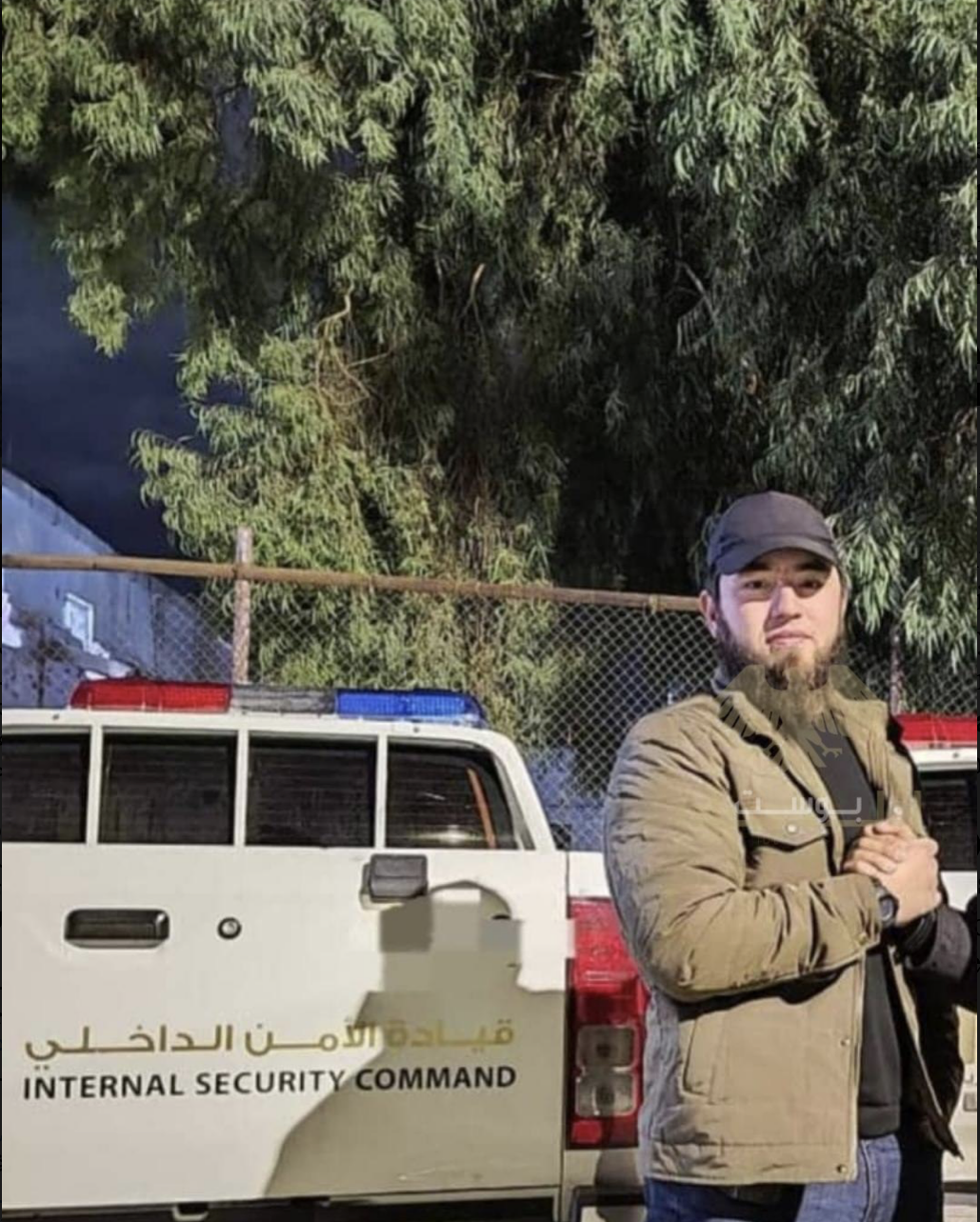
The gravest development of 2026, and the one that most directly inverts the NDAA provision’s threat model, has been the emergence of an assassination campaign against integrated and formerly HTS-aligned foreign fighters. An early indicator came in June 2025, when an Iraqi commander formerly affiliated with HTS was shot dead in Azmarin, in western Idlib.34 The pattern sharpened a year later. On June 6, 2026, unknown gunmen assassinated Mustafa al-Russi, a Chechen-origin commander of the “Red Bands” who had recently been serving within the Syrian Ministry of Defense.35 Twenty-two days later, on June 28, 2026, a second former foreign fighter of the same profile, an Uzbek ex-HTS “Red Bands” member, was killed in Idlib province.36 Two targets sharing a single profile, three weeks apart, suggest a pattern rather than a coincidence.
The strategic significance of these killings is difficult to overstate. Islamist commentators speculated openly about the death, with some mourning al-Russi and others attributing the killing to alleged hardliners within the security forces.37 It is possible, and in this author’s view likely, that the Islamic State was involved, and that it used the attack as a way to undermine the integration process, alienate foreigners, and take further advantage of that seam. If Damascus proves unable to protect the foreign fighters it has absorbed, the Islamic State acquires a ready-made narrative of abandonment with which to court the next recruit. In counterterrorism terms, the assassinations represent a form of involuntary ejection—ejection by other means. The fighters are being removed from the state’s protective umbrella by violence rather than by decree, and the historical record, examined below, indicates that ejection is the more dangerous outcome. It is worth underscoring the counterproductive, and presumably unintended, incentive structure that the NDAA foreign fighter disarmament would introduce here: A disarmament mandate that weakens the integrated formations would reduce the state’s capacity to protect its foreign fighters at exactly the moment an assassination campaign is testing that capacity, which could accelerate the very ejection dynamic that history warns against.
The Repackaging of Grievance
A further development complicates any assumption that the independent muhajirin will simply subside if pressured. As the paths to integration and Western recognition have narrowed, the most prominent independent faction has demonstrated an ability to repackage its grievance into a nationalist-defensive cause. In late July 2026, Firqatul Ghuraba abruptly shifted its messaging from demands for the release of jailed foreign prisoners to calls for Syrians to confront Israeli military strikes. On July 27, via its al-Faransiyin Telegram channel, the group released a video urging Syrians to resist alleged Israeli aggression and chiding both the al-Sharaa government and ordinary Syrian Muslims for their “silence.”38 The pivot is analytically significant because it arrives as Damascus is reportedly pursuing a security understanding with Israel, and because it demonstrates how quickly a foreign fighter grievance can be reframed into a banner: defense of Syrian Muslims against an external enemy that the state cannot easily suppress, at the very moment the government is courting Washington and negotiates with Israel.39 Coerced disarmament would likely accelerate exactly this kind of ideological repositioning, handing the independents a mobilizing cause at the moment they are most alienated from the state.
This capacity for reinvention points to a subtler and more durable danger than domestic mobilization: the potential for individuals within the non-integrated milieu to freelance external operations. One precedent lies in HTS’ own former territory. In October 2020, the French schoolteacher Samuel Paty was beheaded in Conflans-Sainte-Honorine after showing caricatures of the Prophet Muhammad in a lesson on free expression.e The last contact of the perpetrator, Abdoullakh Abouyedovich Anzorov, an 18-year-old Chechen immigrant, was allegedly Farouk al-Shami, a Tajik member of HTS based in Idlib. French investigators believe he may have influenced Anzorov to conduct the attack.40 It is unlikely that HTS as an organization had anything to do with the attack,41 and that distinction is precisely the point: The danger was entrepreneurial. An individual in the group’s territory independently encouraged a sympathizer abroad to commit violence. This was personal initiative, not an attack ordered by the group’s leadership. This is the vector that should most concern Washington, and it maps onto the independent and non-integrated fighters rather than the brigades absorbed into the Ministry of Defense. A disarmament mandate that fractured the integrated formations would move men out of formations in which their movements and contacts are visible to the state, and into precisely the autonomous, unaccountable space in which such freelancing incitement thrives, while leaving the entrepreneurs themselves untouched.
The New Inflow
The foreign fighter file in Syria is a problem of new arrivals as well as of legacy ones. In late July 2026, Australian media reported the case of Patrick Stevenson, a 20-year-old convert who had radicalized in Australia and traveled to Syria in late 2025 (a full year after the fall of the regime). He was subsequently detained in Idlib and charged with the premeditated murder of another Australian, Abdullah Glen Burgess, who had himself relocated to Syria with his family in 2025, after several months traveling in Afghanistan, and who was shot dead in the town of Darkush on December 31 of that year.42 Syrian authorities reportedly investigated, but stepped back from an Islamic State link, and the death-penalty charge signaled Damascus’ intent to police such cases severely.43
The case is not isolated, though the aggregate remains small and poorly measured, and it should not be overstated. French counterterrorism authorities identified at least seven French nationals who had reached or attempted to reach Syria in the five months after the regime fell, among them a former French army engineer arrested en route to join Firqat al-Ghuraba; French officials were explicit that this was a trickle rather than a resumption of the mass departures of 2013-2015.44 A far larger movement has taken place inside the country. After the Syrian government assumed control of the Al-Hol camp from the Syrian Democratic Forces in January 2026, many of the roughly 6,000 foreigners with Islamic State links previously held there reportedly relocated to Idlib and Aleppo. It is a redistribution of foreign personnel into the northwest that no disarmament count would register, and one that bears far more directly on the threat picture than the rifles held by an integrated brigade.45 f
Whatever the specific facts of the case, its significance lies in what it reveals about the broader environment. Post-Assad Syria’s openness and reduced border controls are drawing fresh foreign arrivals, including recently radicalized Westerners, into a permissive setting that the nascent state is poorly equipped to screen.46 This reframes the policy problem in a way the relevant section of the NDAA does not anticipate. The text itself draws no distinction between a legacy cohort and new entrants—it speaks of foreign fighters who remain in Syria, and its operative metric applies to a population already present—so reading it as a legacy-cohort provision is an inference about its practical effect rather than a distinction the drafters made. The danger, in any case, is no longer confined to a cohort that can be disarmed. It increasingly also includes an inflow to be screened. A metric fixated on the weapons of existing fighters does not account for who is now entering the country and why—arguably, the more consequential long-term counterterrorism concern.
The Recognition Bargain
These dynamics are unfolding against the backdrop of Syria’s broader reintegration into international politics, in which the foreign fighter file has become a form of currency. In early July 2026, Emmanuel Macron became the first Western head of state to visit post-Assad Damascus. Ahead of the visit, the dossier of French jihadis resurfaced prominently, and reporting indicated that the file (alongside counterterrorism cooperation and Syria’s undeclared chemical stockpiles) was among the issues on the bilateral agenda.47 French jihadis in Syria reacted to the visit with visible alarm on Telegram, with one channel noting that, for six years, every contact between French officials and Damascus had produced repercussions for them.48 To coincide with the visit, Firqat al-Ghuraba released a video—first in Arabic, and only subsequently in French, English, and Uzbek—reiterating demands for the release of jailed foreign prisoners, an ordering of languages that signaled a primarily Syrian intended audience.49
The Macron visit crystallized the central bargain now structuring the foreign fighter question: the interim government’s bid for Western recognition and rehabilitation, weighed against external pressure to resolve the residue of foreign fighters. This is the context against which the NDAA provision finds itself, and it is a context in which Washington’s conditions are read alongside, and weighed against, those of other governments with their own claims on Damascus. A demand that Syria cannot meet without unravelling its own security architecture does not compel compliance so much as it invites Damascus to bank the concession elsewhere. The recognition bargain also introduces a European dimension. France holds both equities and leverage that a purely American disarmament demand does not use: the commercial and infrastructure agreements advanced around the Macron visit, its weight in the European reconstruction and sanctions-relief discussions, its cooperation with Damascus on the chemical-weapons file, and the standing interest of French prosecutors in French nationals held in Syria, which gives Paris a concrete stake in a negotiated disposition rather than an abstract preference for one. None of this implies that Washington is without leverage of its own. It retains sanctions authorities, the counter-Islamic State partnership, security assistance, and the political recognition Damascus is seeking. The argument here concerns which variable that leverage should be aimed at, not whether it exists.
The recognition dynamic also shapes the incentives of the fighters themselves, which is why the timing of Firqat al-Ghuraba’s interventions is not incidental. The group calibrated its messaging to the visit, using a moment of maximum international attention to press its demands and, when those demands went unmet, to pivot toward a cause—resistance to Israel—calculated to embarrass a government seeking Western favor. This is the behavior of actors who understand that they have become bargaining chips and are maneuvering to raise their own price. A coercive disarmament condition would likely sharpen precisely this incentive, giving the most alienated factions both a grievance and an audience. Conversely, a managed, recognition-linked framework that offered credible pathways (citizenship for the anchored, monitored return or prosecution for the dangerous) would reduce the leverage available to spoilers by reducing the number of fighters with nothing to lose.
The Bosnian Precedent
The most instructive precedent for the foreign fighter provision contained in the NDAA is not to be found in Syria’s recent past, but in the West’s own experience in the Balkans. After the Bosnian war, the 1995 Dayton Peace Agreement required, under Annex 1A, the withdrawal of all foreign forces from Bosnia and Herzegovina within 30 days—the closest historical analogue to an externally imposed condition that makes the foreign fighter file the price of a political settlement.50 The requirement failed almost immediately in its intended effect. Bosniak authorities and the foreign fighters circumvented the deadline, with many fighters acquiring Bosnian citizenship (sometimes through irregular means), marrying local women, and settling in depopulated villages such as Bočinja near Maglaj, where they lived under their own religious codes until the settlement was wound up in 2000-2001, under international and domestic pressure, to accommodate returning Serb refugees.51
What the subsequent three decades demonstrated is the analytically crucial point. The recidivism record of Bosnia’s foreign fighter milieu split not along lines of ideology or nationality, but along a single axis: anchoring. Veterans who stayed, married, and embedded themselves into Bosnian society produced almost no subsequent operational violence. The single significant terrorist attack traceable to the wartime milieu, the 1997 car bombing in Mostar that wounded roughly two dozen people, was organized by a Saudi veteran, Ahmad Zuhair, who had already fled the country.52 Notably, every jihadi attack carried out inside Bosnia after 2005 (the 2010 Bugojno police-station bombing, the 2011 armed assault on the U.S. Embassy in Sarajevo, and the 2015 shootings at the Zvornik police station and at Rajlovac) was perpetrated by young local salafis with no service in the wartime El Mudžahid detachment,53 the unit into which the foreign volunteers were formally organized in 1993. Service in it is the closest available proxy for membership in the wartime Syrian muhajirin cohort.g
The individuals who became genuinely dangerous were, overwhelmingly, those who had been expelled or who had never anchored. The French converts of the so-called Roubaix gang, radicalized in Bosnia and pressed to leave after Dayton, resurfaced in a 1996 armed-robbery campaign and a failed car-bomb plot targeting a G7 summit in Lille; their Bosnia-veteran associate Fateh Kamel became a central figure in the Montreal network that produced Ahmad Ressam, perpetrator of the failed December 1999 Millennium plot against Los Angeles International Airport.54 The wider alumni of the Afghan-Bosnian network who transited Bosnia and cycled back into the global jihad included figures connected to the 1998 East Africa embassy bombings, the 2000 attack on the USS Cole, and, by several accounts, the September 11th plot.55 The pattern is unambiguous: Ejection exported the threat, dispersing it into transnational networks, while integration—for all its moral ugliness, and the El Mudžahid detachment was implicated in genuine wartime atrocities—largely retired it.56 That is a claim about the modal outcome rather than the universal one. A portion of any such cohort will refuse the bargain, in Bosnia as in Syria, and the record contains men who anchored and nonetheless remained dangerous. The policy question is not whether anchoring is complete, but whether the residual minority who will not anchor is best handled by measures that also break the majority who have.
Two objections to reading this pattern causally deserve to be met directly. The first is selection: Those who left may simply have been the men least disposed to settle in the first place, so that ejection and non-anchoring would be markers of prior intent rather than causes of subsequent violence. The objection has real force, and the Bosnia literature cannot resolve it cleanly. Some of those who departed were plainly looking for the next front rather than for a home. The second objection follows from the first: If anchoring merely describes the men who had already decided to stand down, then anchoring explains nothing. What answers both is Bosnia’s second act, examined below. The post-2001 denaturalization campaign did not fall on the self-selected leavers. It fell on men who had already anchored, who had married, settled, and in most cases held citizenship for a decade. Holding the population roughly constant and varying only the state’s treatment of it, the campaign produced no measurable security dividend or a durable, organized grievance. That is the closest thing the case offers to a natural experiment, and it points in the same direction as the raw pattern.
Bosnia’s second act delivers the sharper warning still, because it previews the consequences of a coerced reversal. After the September 11th attacks, under intense American pressure, Sarajevo turned against its own naturalized veterans. A state commission reviewed roughly 1,200 wartime naturalizations and revoked the citizenship of at least 300 individuals in proceedings widely criticized as opaque, offering neither adequate reasons nor meaningful avenues of appeal.57 Human Rights Watch and other observers documented deportees who were mistreated on return, detainees held for extended periods on secret evidence, and, most notoriously, six men of Algerian origin rendered from Bosnia to Guantánamo in January 2002 over the objections of Bosnian courts.58 The emblematic figure was Imad al-Husin (Abu Hamza), a Syrian veteran naturalized in the 1990s whom Bosnia could ultimately neither keep nor deport, after the European Court of Human Rights barred his removal to Syria on the grounds that he faced a real risk of ill-treatment there. He spent years in immigration detention, a muhajir with nowhere to go.59 The security dividend of the entire campaign was negligible.
The rendition cases are the sharpest illustration. In November 2008, after the Supreme Court restored habeas review in Boumediene v. Bush, a federal district judge ordered five of the six men released, finding that the government’s allegation—that they had planned to travel to Afghanistan to fight U.S. forces—rested on a single unidentified source whose reliability had not been established. The sixth, Belkacem Bensayah, was held on separate evidence of contact with an al-Qa`ida facilitator; that ruling was later vacated on appeal, and he was transferred to Algeria in December 2013. The distribution is instructive in both directions. It indicates that most of those the campaign swept up did not present the threat asserted, and it indicates equally that anchoring is not a guarantee: At least one man had settled in Bosnia and, on the government’s account, remained operationally connected. Anchoring lowers the base rate. It does not eliminate the tail, which is precisely why monitoring capacity and a credible accountability mechanism have to sit alongside it rather than be assumed away by it.60 h The grievance it generated was durable, sustained by an association of El Mudžahid veterans capable of mobilizing thousands.61
Why anchoring should reinforce and harden a decision to stand down is not mysterious, and the mechanism transfers directly to the Syrian case. The mechanism does not require anchoring to be the sole cause of pacification. Where a fighter has chosen to settle, it explains why that choice becomes durable, why the cost of reversing it rises over time, and why an external actor should be reluctant to reverse it on his behalf. A fighter embedded in a family, a livelihood, and a fixed community tends to accrue a set of hostages to fortune (dependents, property, reputation, and physical presence at a known address) that raises the personal cost of renewed violence and lowers his operational mobility.
This holds with particular force in Syria, where a substantial share of the muhajirin brought their families with them, gave up whatever property and standing they had at home, and have no safe return available to them. What they have built in Syria is, for many of them, all they have. Integration into a formal chain of command adds a further layer: It substitutes an accountable hierarchy for the autonomous cell, gives the state visibility into the fighter’s movements and associations, and creates a disciplinary mechanism short of prosecution. Ejection strips away all of these simultaneously. The expelled fighter retains his skills, his ideological commitments, and his transnational contacts, but loses the local ties, the surveillance, and the stake in stability that had constrained him—an almost optimal recipe for reactivation. This is why the Bosnian veterans who stayed overwhelmingly stood down while those pushed out disproportionately reappeared in later plots, and it is why the assassinations now removing integrated fighters from Syria’s protective structures should be read as a warning rather than as a convenient thinning of the foreign fighter ranks.
The Bosnian precedent does not establish that integration is clean, cost-free, or risk-free. It plainly is not, and some of the men now wearing Syrian uniforms bear responsibility for serious crimes. What it shows is narrower and more useful: that coerced reversal is worse than the disease it purports to cure. A disarm-and-remove push in Syria risks reproducing both Bosnian failures simultaneously: the ejection dynamic that led to various other jihadi plots in the mid- to late 1990s by alumni of the Bosnian jihad and the “denaturalization” backfire that the independent Uzbeks are already invoking to argue that the state cannot be trusted. The al-Husin case is not a distant analogy, but a near-exact template for the dilemma Syria’s muhajirin now present: a population that the host state can neither fully expel nor, in many cases, safely return to countries of origin.
Policy Implications
The alternative to a disarmament-by-headcount condition is not to ignore the foreign fighter threat, but to direct U.S. leverage toward the variables that actually govern it. Five implications follow from the analysis above. They are presented in the order in which they would be operationalized, though the second of them (differentiation among the muhajirin) is logically prior to the rest, since every other judgment here depends on it.
First, conditionality should be built around command-and-control rather than a disarmament count. The relevant question is not how many weapons are collected, but whether integrated fighters sit within a vetted, accountable chain of command. It is anchoring within such a structure, on the Bosnian evidence, that does the work of retiring the threat. Benchmarks centered on unit vetting, biometric enrollment, and documented accountability for formations such as the integrated division and the pro-government Uzbek brigade would advance U.S. counterterrorism interests more effectively than a disarmament target that would shatter the structures currently providing control.62 In practical terms, this means privileging measurable indicators of state control (registries of integrated personnel, clarity of command relationships, records of disciplinary action, and the absence of autonomous foreign fighter enclaves operating outside the formal hierarchy) over the aggregate-disarmament metric, which is both difficult to verify in practice (weapons handovers can be staged and reported, but stockpiles cannot readily be audited in a country where materiel is abundant and dispersed) and counterproductive in its effects. This would preserve the underlying intent of the foreign fighter disarmament provision contained in the NDAA, while replacing its operative language accordingly.
Second, U.S. policy should differentiate among the muhajirin rather than treating them as a single category, a distinction the fighters themselves have already drawn. The dueling July 2026 statements demonstrate that the population has fractured into an integrated, state-serving majority and an independent, oppositional minority. Pressure should fall on the narrow transnational-threat set, while explicitly protecting the integration track, and Washington should reject any framing that conflates a Ministry of Defense brigade with the cells it is meant to contain. This differentiation is not merely analytical: The gravest external-attack risk—the entrepreneurial incitement of operations abroad by individuals within the group’s former territory—concentrates in precisely the non-integrated minority, so a mandate that fractures the integrated formations would enlarge the autonomous space in which such freelancing thrives, while leaving the individuals most likely to engage in it, who hold no weapons a disarmament count would capture, entirely untouched.
Third, coerced removal is unlikely to serve U.S. objectives, and a managed alternative is available. Bosnia’s citizenship-review campaign purchased minimal security and lasting grievances, and the al-Husin trap (a foreigner who can be neither kept nor deported) is Syria’s dilemma in microcosm. The analogy has limits, and readers will reasonably note them. Bosnia’s postwar authorities were not led by a former jihadi commander, and al-Sharaa’s own history gives Damascus a set of incentives toward its foreign fighters that Sarajevo did not have. But the mechanism at issue—what happens to a foreign fighter population when an external power compels the host state to reverse an accommodation it has already made—does not depend on the biography of the government made to reverse it. A removal demand that Damascus cannot satisfy without exporting or further alienating the population in question is likely to yield neither removal nor security. The more promising course is to fold U.S. conditions into the European-brokered opening the Macron visit initiated, and to support a framework of monitored return, prosecution where warranted, and rehabilitation for the harder cases.
Fourth, the protection and accountability of integrated fighters should be treated as a measurable benchmark, even if an imperfect and partial one, and the grievance pipeline should be monitored as a leading indicator. The 2026 assassinations are ejection by other means. U.S. engagement should be conditioned on credible investigations, force-protection measures, while intelligence resources track the independent channels whose messaging (now turning toward anti-Israel mobilization) offers the earliest available warning of defection risk. Measuring this will be difficult. Investigations may be opaque, and an absence of reported incidents can reflect either effective protection or unreported killings. The benchmark is nonetheless more tractable than a weapons count, because it can be assessed against observable state conduct, whether investigations are opened, whether findings are published, whether commanders are held to account, rather than against an inventory that no one can audit.
Fifth, U.S. assistance should prioritize screening and vetting, with emphasis on both the legacy foreign fighter cohort and the new inflow. The Stevenson case signals that post-Assad Syria’s openness is drawing new arrivals that a fragile state cannot yet vet. The most forward-looking and concrete assistance Washington can offer is capacity-building for border screening, biometric enrollment, and watch-list integration.
Conclusion
Syria’s foreign fighters are not a stockpile of weapons to be confiscated. They are a differentiated, fracturing population that has been substantially absorbed into the state, that is drawing new arrivals, and that now sits at the center of Syria’s contested reintegration into international politics. The muhajirin have functioned, over the 20 months since the fall of the regime, as a barometer of the new state’s consolidation rather than as a detonator of instability. The risks that have actually materialized (an assassination campaign against integrated fighters, the ideological repackaging of the alienated, and a nascent inflow of new foreigners) would not be addressed by the NDAA’s foreign fighter disarmament condition, which would pressure Damascus to dismantle the command structures that contain the population it seeks to neutralize. If there is a genuine detonator in this population, it is not the arsenal of the integrated brigades, but the capacity of non-integrated individuals to freelance attacks abroad—a danger that a fracturing disarmament mandate would arguably enlarge rather than contain.
While different in context, the Bosnian precedent is unambiguous on the essential point: An externally imposed program of ejection and denaturalization exported the threat and seeded durable grievances, while anchoring largely retired it. None of this implies that Washington should be indifferent to the foreign fighter presence, or that Damascus deserves a blank check. The Syrian government’s own conduct, including the opaque detentions and the unanswered assassinations, warrants continued scrutiny. It implies, rather, that the United States should apply its considerable leverage to the variables that determine the threat (command, accountability, differentiation, and screening) rather than to a symbolic metric that would arguably degrade the state’s capacity on each of them. The choice facing Washington is not whether Syria’s foreign fighters retain their weapons, but whether they remain tethered to a state that can be pressed to account for them, or are cut loose to become, as their predecessors in Bosnia did, someone else’s problem. On that question, the historical record does not leave much room for ambiguity. CTC
Aaron Y. Zelin is the Gloria and Ken Levy Senior Fellow at The Washington Institute for Near East Policy and a visiting research scholar in the Department of Politics at Brandeis University. He is the founder of the website Jihadology and the author of The Age of Political Jihadism: A Study of Hayat Tahrir al-Sham (2022) and Your Sons Are at Your Service: Tunisia’s Missionaries of Jihad (2020). X: @azelin
© 2026 Aaron Zelin
Substantive Notes
[a] The operative language appears in the committee-reported bill’s Syria section, which provides that no funds may be expended for cooperation with the Government of Syria until the Secretary of Defense certifies to the congressional defense committees that Damascus has taken credible steps “(1) to remove all foreign fighters and jihadists from the military forces of Syria and from other services of the Government of Syria; (2) to disarm all foreign fighters and jihadists who remain in Syria; (3) to implement a system to monitor foreign fighters and jihadists so as to prevent attacks on the United States and allies and partners of the United States, including the Kurdish-led Syrian Democratic Forces.” S. 4784, 119th Congress (2026). The provision, introduced by Senator Ted Budd, is not without precedent: The FY2026 NDAA required certification that the Syrian government “has removed, or is taking steps to remove, foreign fighters from senior roles in the Government of Syria, including those in the state and security institutions of Syria.” S. 1071, 119th Congress (2025). The differences between the two are of scope, standard, and instrument rather than of subject. The FY2026 formulation reached senior appointments only and accepted demonstrable progress (“is taking steps”) against a sanctions-relief backdrop. The FY2027 text reaches every foreign fighter in the country, adds affirmative disarmament and monitoring obligations to removal, and attaches them to defense-cooperation funding.
[b] The assailant was a recently recruited member of the Ministry of Interior’s forces who had reportedly been flagged for suspected extremist sympathies days before the attack, a detail that bears directly on the screening and vetting argument developed here. U.S. Central Command responded with Operation Hawkeye Strike, a series of retaliatory strikes on Islamic State targets beginning on December 19, 2025. See Taylor Luck, “Attack on US forces in Syria tests anti-ISIS mission, warming ties,” Christian Science Monitor, December 15, 2025, and “Syria arrests five suspects over shooting of US, Syrian troops in Palmyra,” Reuters, December 14, 2025.
[c] The point is not that Central Asians are more hostile to the state than other blocs, but that their public argument is conducted openly and on both sides of the integration question.
[d] The figure refers to the newly formed 84th Division, which Syrian and Western analysts have described as the principal vehicle for absorbing foreign personnel and which is projected to grow larger. See “Will foreign fighters test the stability of post-Assad Syria?” New Arab, October 29, 2025, and “The Struggle to Pacify Syria’s Foreign Legions,” International Crisis Group, which estimates that roughly 5,000 foreign fighters remained under arms in Syria as of May 2026.
[e] Before showing them, Paty allowed any Muslim student to leave beforehand if they wanted to. Kim Willsher, “Teacher Decapitated in Paris Named as Samuel Paty, 47,” Guardian, October 17, 2020.
[f] The case concerned a former French army engineer indicted on April 29, 2025, for attempting to travel with his wife to join Omar Diaby’s Firqat al-Ghuraba, which Le Figaro described as comprising some 50 identified and closely monitored French nationals. The same report noted that no mass departures had occurred. On the movement out of Al-Hol, see “Exodus of ISIL-linked detainees from Syria camp sparks security concerns,” Al-Jazeera, February 17, 2026, and “Syria: Security Situation,” EUAA, July 2026, section 2.2.3. Reliable aggregate data on post-December 2024 arrivals does not presently exist in open sources, and the figures cited here should be read as floors derived from prosecutions and camp reporting rather than as estimates of the whole.
[g] The El Mudžahid detachment was the formation, attached to the Third Corps of the Army of the Republic of Bosnia and Herzegovina in August 1993, into which the Arab and other foreign volunteers were organized. Its wartime conduct was the subject of proceedings before the International Criminal Tribunal for the former Yugoslavia. It should also be noted that the Bosnia literature is uneven: Several of the standard accounts are advocacy-adjacent or rely on a small number of overlapping secondary sources, and the figures given here are best treated as orders of magnitude.
[h] Judge Richard J. Leon found that the government’s allegation rested on a single unidentified source whose reliability had not been established. Bensayah’s detention was upheld at first instance on separate evidence, vacated by the D.C. Circuit in June 2010, and he was transferred to Algeria on December 5, 2013.
Citations
[1] “SASC Completes Markup of National Defense Authorization Act for Fiscal Year 2027,” United States Senate Armed Services Committee, June 11, 2026.
[2] Omar Abdel-Baqui, “Foreign Jihadists Helped Syria’s Rebels Take Power. Now They’re a Problem,” Wall Street Journal, April 30, 2025; Louisa Loveluck and Zakaria Zakaria, “Syrian leader faces challenge of foreign militants who helped him win power,” Washington Post, May 31, 2025.
[3] The integrate-and-arrest framing is developed at length below. For a contemporaneous analysis emphasizing integration, see “Foreign Fighters in Syria: Quiet Integration Amid Unfounded Concerns,” Levant24, May 17, 2025. This article is no longer online, but the author retains an archived version.
[4] Aaron Y. Zelin, “Jihadi ‘Counterterrorism:’ Hayat Tahrir al-Sham Versus the Islamic State,” CTC Sentinel 16:2 (2023); Aaron Y. Zelin, “The New Syrian Government’s Fight Against the Islamic State, Hezbollah, and Captagon,” CTC Sentinel 18:3 (2025).
[5] Aaron Y. Zelin’s “HTS/New Syrian Government Arrests Against The Islamic State, July 2017-Present,” last updated August 18, 2026.
[6] “The Struggle to Pacify Syria’s Foreign Legions,” International Crisis Group, May 13, 2026.
[7] Abdulaziz Kilani and Alex Shams Wright, “Explainer: Foreign Fighters and Syrian Factions Fighting Alongside HTS,” BBC Monitoring, December 24, 2024; Umar Farooq, “What Are Uyghurs Doing in Syria?” Foreign Policy, April 4, 2025; Neil Hauer, “What future for Chechen and North Caucasian fighters in Syria?” Riddle, January 31, 2025.
[8] See Benjamin Fève, “Turning Foreign Fighters into University Students? In a bizarre move, the Syrian Council of Higher Education published …,” X, February 12, 2025, and Farooq.
[9] On the volume and direction of Central Asian commentary, see “Explainer: What’s Driving Unrest Among Foreign Fighters in Syria?” BBC Monitoring, July 23, 2026, and Aymenn Jawad Al-Tamimi, “Internal Tensions Among Uzbek ‘Migrants’ in Syria.”
[10] Cagatay Cebe, “Azerbaijani soldiers serving in the Syrian Army visited Azerbaijani women and children at the al-Hol camp,” X, February 1, 2026.
[11] Tam Hussein, “From The Battlefield to The Marketplace,” Blood-Rep, June 29, 2026. See also Daniele Garofalo, “The jihadist Musafeer Tactical group, a group composed of Kazakhs and Tajiks, published …,” X, June 24, 2025, and Daniele Garofalo, “Yurtugh Tactical, a Uyghur jihadist tactical group, published photos …,” X, November 28, 2025.
[12] Loveluck and Zakaria.
[13] Ibid.
[14] Timour Azhari and Suleiman Al-Khalidi, “US gives nod to Syria to bring foreign jihadist ex-rebels into army,” Reuters, June 2, 2025.
[15] See Cagatay Cebe, “One of the special forces trainers of the 50th Division of the Syrian Armed Forces is a Turkish citizen …,” X, May 3, 2025.
[16] Aaron Y. Zelin, “The New Syrian Government Draws A Line In The Sand About Foreign Fighter Freelancing,” Jihadology+, January 19, 2025.
[17] “Briefing: Hardliners react to ‘arrest’ of Central Asian militant in Syria,” BBC Monitoring, August 20, 2025; Aymenn Jawad Al-Tamimi, “The ‘Muhajirin’ in the New Syria: The Case of ‘Abu Dujana al-Turkistani,’” Aymenn’s Monstrous Publications, October 10, 2025; Wassim Nasr, “#Syrie il n’est pas clair si une causalité existe, mais …,” X, August 18, 2025.
[18] “Syria detains prominent American Islamist journalist, sources say,” Reuters, December 23, 2025; “Briefing: Islamists denounce Syrian authorities for arrest of US media activist,” BBC Monitoring, December 23, 2025; Aymenn Jawad Al-Tamimi, “The Arrest of Bilal Abdul Kareem in Syria,” Aymenn’s Monstrous Publications, December 23, 2025.
[19] Aymenn Jawad Al-Tamimi, “An Interview with a Wife of Bilal Abdul Kareem,” Aymenn’s Monstrous Publications, August 10, 2026.
[20] Ibid.
[21] Timour Azhari, “Foreign Islamists Petition Syrian State for Citizenship,” Reuters, August 15, 2025.
[22] “Briefing: Uzbek Telegram channels raise funds for detained IS ‘families,’” BBC Monitoring, August 22, 2025; “Syrian-Uzbek Economic Forum Amid Tensions With Uzbek Fighters,” Syria Report, May 26, 2026.
[23] Ibid.
[24] Hussein, “From The Battlefield to The Marketplace.” See also Abu Ahmad, “With the war in Syria over many Foreign fighters have pursued other lives …,” X, July 22, 2026.
[25] See Qalaat Al Mudiq, “#Syria: Abu Dujana, a former Uzbek military trainer who later moved into media work, has been released …,” X, April 8, 2026, and Qalaat Al Mudiq, “#Syria: Abu Dujana, former Uzbek military trainer who fought against pro-Assad forces, has now his own restaurant …,” X, June 27, 2026.
[26] See Cagatay Cebe, “There is an interesting detail at the restaurant opened by Abu Dujanah al-Turkistani in the town of al-Fu’ah in Syria …,” X, July 1, 2026.
[27] “Briefing: Niqab Campaign Organiser Protests Alleged Ban by Syrian Ministry,” BBC Monitoring, August 18, 2026.
[28] See Daniele Garofalo, “In the Central Asian jihadist channels still operating and active in #Syria, there is growing discontent …,” X, August 19, 2025.
[29] “Briefing: Syria security campaign targets foreign fighters in Idlib,” BBC Monitoring, May 6, 2026. See also X posts by Hamid Al-Qawsi, whose account has since been taken offline; however, the author retains copies in his archives.
[30] Uzbek Muhajirin, “Oh People of al-Sham,” June 3, 2026, available via Jihadology; “Briefing: Tensions Rise Between Syrian Government, Uzbek Fighters,” BBC Monitoring, June 7, 2026.
[31] Aymenn Jawad Al-Tamimi, “Internal Tensions Among Uzbek ‘Migrants’ in Syria,” Aymenn’s Monstrous Publications, July 12, 2026.
[32] Ibid.
[33] “Explainer: What’s Driving Unrest Among Foreign Fighters in Syria?” BBC Monitoring, July 23, 2026.
[34] See Qalaat Al Mudiq, “#Syria: a member of the Security forces was shot dead last night in the city of #Aleppo …,” X, May 14, 2025.
[35] See Al-Qawsi for Studies, “#Syria | Unknown gunmen assassinated the foreign fighter of Chechen origin ‘Mustafa al-Russi,’ one of the leaders of the ‘Red Bands’ …,” X, June 6, 2026 (account since suspended; post archived by the author) and Qalaat Al Mudiq, “#Syria: a foreign fighter, former member of #HTS Red Bands, was shot dead last night …,” X, June 6, 2026.
[36] See Qalaat Al Mudiq, “#Syria: another assassination targeted a former foreign fighter in #Idlib province …,” X, June 28, 2026.
[37] “Briefing: Islamists Speculate on Death of Chechen Foreign Fighter in Syria,” BBC Monitoring, June 8, 2026.
[38] “French Fighter Group Urges Syrian Muslims to Counter Israeli Military Attacks,” BBC Monitoring, July 28, 2026.
[39] Firqat al-Ghuraba, “Political Prisoners,” available via Jihadology, July 8, 2026.
[40] Jean-Michel Décugis and Jérémie Pham-Lê, “‘[I Beheaded the Teacher’: The Last Contact of the Killer of Samuel Paty Identified in Syria],” Parisien, March 8, 2021.
[41] For more on this topic, see Aaron Y. Zelin, “The Age of Political Jihadism: A Study of Hayat Tahrir al-Sham,” Washington Institute for Near East Policy, May 2022.
[42] Sean Rubinsztein-Dunlop, Meghna Bali, and Cherine Yazbeck, “Gold Coast man faces possible death penalty in Syria over alleged murder of fellow Australian,” ABC News (Australia), July 29, 2026.
[43] Ibid.
[44] Jean Chichizola, “Terrorisme: un ancien militaire français devenu djihadiste interpellé alors qu’il voulait rejoindre la Syrie,” Figaro, May 9, 2025.
[45] Ibid.
[46] On the permissiveness of the post-Assad frontier and the limits of the new state’s screening capacity, see “The Struggle to Pacify Syria’s Foreign Legions,” International Crisis Group, May 13, 2026, and Rubinsztein-Dunlop, Bali, and Yazbeck, “Gold Coast man faces possible death penalty in Syria over alleged murder of fellow Australian,” which reports that the case raised the question of whether Syria could again become a destination for radicalized Australians.
[47] “French Jihadists File Resurfaces Before Macron Visit,” Enab Baladi, July 6, 2026.
[48] See Hussam Hamoud, “On Telegram, French jihadists in Syria are reacting with alarm. One channel writes …,” X, July 6, 2026.
[49] Firqat al-Ghuraba, “Political Prisoners.”
[50] General Framework Agreement for Peace in Bosnia and Herzegovina (Dayton Agreement), Annex 1-A, Article III, 1995.
[51] Evan F. Kohlmann, Al-Qaida’s Jihad in Europe: The Afghan-Bosnian Network (Oxford: Berg Publishers, 2004).
[52] Ibid.
[53] Vlado Azinovic, “Bosnia and Herzegovina and Terrorism 1996-2011: Defining the Threat, Devising Counterterrorism Strategy” in John Le Beau ed., The Dangerous Landscape: International Perspectives on Twenty-First Century Terrorism: Transnational Challenge, International Responses (Sofia: Procon, 2013); Vlado Azinovic and Muahamed Jusic, “The New Lure of the Syrian War the Foreign Fighter’ Bosnian Contingent,” Sarajevo: The Atlantic Initiative, 2015.
[54] Kohlmann.
[55] Report of the National Commission on Terrorist Attacks Upon the United States (9/11 Commission Report), 2004.
[56] On the wartime conduct of the El Mudžahid detachment, see the findings of the International Criminal Tribunal for the former Yugoslavia in the relevant proceedings concerning the unit’s operations at www.icty.org
[57] “Bosnia revokes soldier citizenships,” Al-Jazeera, April 12, 2007; “Bosnia and Herzegovina: Events of 2008,” Human Rights Watch, 2009; “Human Rights Watch UPR Submission on Bosnia and Herzegovina,” Human Rights Watch, August 24, 2009; “Bosnia: Citizenship and Detention,” Human Rights Watch, January 12, 2010.
[58] Boumediene and Others v. Bosnia and Herzegovina, December 2006; Conor Gaffney and Nadzida Cano, “‘Algerian Six’ Hope Court Will Hasten Release,” Balkin Insight, June 11, 2008.
[59] Al Husin v. Bosnia and Herzegovina, Council of Europe: European Court of Human Rights (ECtHR), February 7, 2012; Elvira M. Jukic, “Bosnia Told Not to Deport Abu Hamza to Syria,” Balkin Insight, February 8, 2012; Case of Al Husin v. Bosnia and Herzegovina (No. 2), June 25, 2019, ECtHR.
[60] Boumediene v. Bush, 553 U.S. 723 (2008); “Five of ‘Algerian Six’ Freed from Guantanamo,” Balkan Insight, November 21, 2008.
[61] Azinovic and Jusic; Vlado Azinovic ed., “Between Salvation and Terror: Radicalization and the Foreign Fighter Phenomenon in the Western Balkans,” The Atlantic Initiative, 2017.
[62] Azhari and al-Khalidi; Uran Botobekov, “Abdul Aziz al-Uzbeki: KTJ’s Trusted Ally of Ahmed al-Sharaa in Syria,” Jamestown Foundation, June 25, 2026.
