
Abstract: Protected areas in Africa are increasingly becoming contested security spaces rather than merely sites of conservation governance. Across several regions, jihadi organizations, separatist movements, militias, and other violent non-state actors use national parks as sanctuaries, transit corridors, logistical hubs, and sources of revenue. Consequently, attacks on park rangers should not be understood solely as conservation-related crime. Instead, patterns of ranger fatalities may reveal shifts in territorial contestation, insurgent penetration, and the evolving security dynamics of protected areas. These patterns often mirror broader trends in armed conflict, banditry, and weak state control. As protected areas become increasingly embedded within wider ecosystems of violent non-state conflict, terrorism emerges as one important dimension of this transformation, highlighting the under-recognized intersection between conservation and political violence.
While armed conflict and protected areas have attracted increasing scholarly attention, terrorism-specific analysis of threats to conservation remains limited.1 Existing literature has focused more on civil conflict, insurgency, and contested claims about wildlife trafficking as a source of terrorism financing2 than on the broader strategic use of protected areas by violent extremist groups. In the conservation science and policy field, there is an emerging realization that the threats from violent extremism to protected areas are increasing with significant implications for local people, conservation efforts, and wildlife populations.3
This article argues that rangera fatalities are an often overlooked and underused indicator of changing insecurity in and around Africa’s protected areas. Drawing on the Game Rangers Association of Africa (GRAA) Honour Roll for 2017-2026, it makes three claims. First, targeted violence constitutes a major share of recorded ranger deaths. Second, a significant proportion of these fatalities are linked to violent non-state actors, even if the responsible organization often cannot be identified precisely. Third, case evidence from the Democratic Republic of the Congo (DRC), Benin, Mozambique, and Nigeria suggests that protected areas continue to be embedded within wider conflict systems and, in some cases, are being used strategically by insurgent and terrorist groups.
The article first examines the GRAA dataset as a source for scholarly inquiry, followed by an in-depth analysis of what the Honour Roll reveals about ranger fatalities in contexts where violent non-state actors constitute a significant cause of ranger casualties. It then turns to the conflict contexts of the Democratic Republic of the Congo (DRC), Benin, Mozambique, and Nigeria, in which these fatalities occur, to identify potential cross-cutting factors and dynamics underlying ranger deaths.
Data and Methodological Considerations
Founded in 1970, the Game Rangers Association of Africa is the oldest and most representative ranger association on the continent.4 Since 2017, it has published an annual Honour Roll to coincide with World Ranger Day on July 31. The Honour Roll5 records rangers who died while performing conservation duties, from injuries sustained in the course of duty, and in some cases from other causes while serving as rangers.
The database is compiled from reports submitted by protected area authorities, ranger associations, employers, conservation organizations, and the International Ranger Federation.b Each entry typically includes the ranger’s name, country, and recorded cause of death. Causes are described in non-standardized terms such as “killed by poachers,” “killed by militia,” “killed by assailants,” “vehicle accident,” “wildlife attack,” or “snake bite.”
The dataset has important limitations. GRAA explicitly acknowledges that many ranger deaths are never formally reported, especially in remote conflict-affected areas. Reporting standards differ between countries, definitions of who qualifies as a ranger are not always consistent, and information on perpetrators is often incomplete. Editions even include a symbolic “Unknown African Ranger” entry to recognize unrecorded deaths. The Honour rolls also include a section that acknowledges previously not recorded ranger fatalities. For these reasons, the Honour Roll should be treated as a minimum verified count rather than a complete census. These limitations matter for interpretation. The dataset is useful for identifying broad patterns and trends, but it is less suitable for precise causal attribution. In particular, generic categories such as “militia,” “insurgents,” “terrorists,” “assailants,” or, in the 2025 edition, the umbrella category “homicide,” often obscure important distinctions between poaching-related violence, organized criminal attacks, communal conflict, and ideologically or politically motivated violence.
To make the data analytically usable, this analysis groups fatalities into six broad categories by the stated cause of death and perpetrating actor given as follows (see also Appendix I):
violent non-state actors, described as “militia,” “rebels,” “insurgents,” or “jihadis;”
poachers and other resource-related offenders, including illegal loggers, miners, cattle rustlers, and armed herders;
non-attributed willful attacks, including assailants, criminals, bandits, mobs, and similar descriptions;
accidents;
wildlife-related incidents; and
illness, suicide, or other causes.
These groupings are interpretive and do not eliminate ambiguity. In some settings, particularly eastern DRC and parts of the Sahel, the line between terrorist insurgency and resource-related offenders is blurred. The findings should therefore be read as indicative rather than definitive.
Ranger Fatalities in Africa, 2017-2026
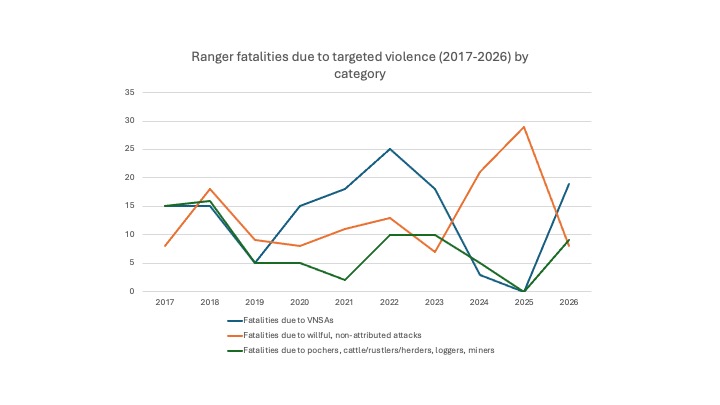
Between 2017 and 2026, the GRAA Honour Roll recorded 792 verified ranger fatalities across Africa. Of these, 133 deaths, or 16.8 percent, were attributed to violent non-state actors such as “militias,” “rebels,” “insurgents,” or “jihadis.” A further 132 deaths, or 16.7 percent, were attributed to non-attributed willful attacks by “assailants,” “criminals,” “bandits,” or “mobs.” Together, these categories account for 33.5 percent of all recorded ranger fatalities. (See Appendix II.)
If deaths caused by poachers and other armed resource offenders are included, deliberate violence rises to 43.2 percent of all verified ranger fatalities during the period. By comparison, accidents accounted for 19.4 percent, wildlife incidents for 9.9 percent, and illness or other causes for 27.5 percent. The central finding is therefore clear: Deliberate human violence constitutes the most common occupational threat facing African rangers. This is an important departure from the conventional image of ranger work as being defined primarily by wildlife encounters, harsh terrain, and accidental injury.
There is also evidence, albeit requiring caution, that fatalities linked to violent non-state actors became more prominent in the later years of the dataset. In 2022, the militia/insurgent/jihadi category accounted for 24 percent of all recorded ranger deaths; in 2023, it accounted for 25 percent. These were the highest proportions in the period under review. The rise coincides broadly with the spread of jihadi and insurgent violence across parts of the Sahel, the Lake Chad basin, northern Mozambique, and continued instability in eastern and southern DRC. In 2024 and 2025, ranger fatalities linked to armed non-state actors seemed to decline dramatically, with only three reported fatalities in 2024 and none in 2025. However, this was almost certainly due to a change in categorizing, as the category of “willful, non-attributed attacks” correspondingly increased notably in the same years. In the most recent Honour Roll of 2026, fatalities linked to armed non-state actors returned to the pre-2024 level.
At the same time, attribution remains a major weakness in the GRAA dataset. Only a small proportion of fatal incidents identify a specific armed organization, with only four named organizations appearing explicitly: Mai-Mai,c M23,d al-Shabaab,e and Boko Haram.f Using open-source reporting as corroboration allows tentative attribution in some additional cases, particularly to Islamic State Mozambique Province in northern Mozambique, but most incidents remain unattributed.
This means the data supports a careful rather than maximalist conclusion. It shows that rangers are increasingly exposed to deliberate violence and that a substantial share of this violence occurs in environments shaped by armed non-state actors. They do not always allow firm identification of whether a given incident was driven by terrorism, insurgency, local militia conflict, retaliatory criminal violence, or some combination of these.
Interpreting the Geography of Violence
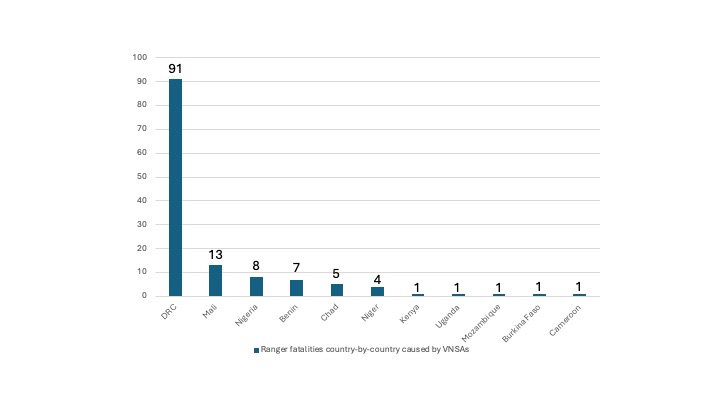
Violent non-state actor-related ranger fatalities were recorded in at least 11 African countries during the study period. The distribution is heavily concentrated on the DRC, with 68.4 percent of all ranger fatalities in this category taking place in the country. (See Appendix III.) Moreover, in the DRC, ranger fatalities show a remarkable continuity, with almost annual ranger fatalities throughout the examined 10-year period.
The DRC is followed by states in the greater Sahel, including Mali, Burkina Faso, Niger, Chad, and Benin, counting together 22.6 percent of ranger fatalities of the dataset. New countries appear over time: Mali in 2017, Chad in 2018, Burkina Faso and Niger in 2021, Benin and Mozambique in 2022, Uganda in 2024, and Nigeria in 2026. This pattern broadly mirrors the territorial expansion of armed Islamist and insurgent violence across West, Central, and Southern Africa.
The DRC is the single most complex case. Labels such as “militia,” “rebel,” “insurgent,” and “Mai-Mai” often overlap in reality. “Mai-Mai” itself is not one organization, but a broad term applied to various community-based militia formations, especially in eastern Congo.6 These groups operate alongside foreign insurgent organizations, criminal networks, and movements, often pursuing overlapping objectives related to territory, local authority, taxation, and access to mineral resources. In such settings, fine-grained categorization is inherently difficult.
The Sahel presents a different but related problem. In countries such as Burkina Faso and Niger, protected areas have increasingly become part of cross-border jihadi operating environments. The security situation in the Sahel rapidly deteriorated from 2019 onwards, with the geographical spread of Islamic State affiliate groups in sub-Saharan Africa leading to a surge in terrorism in many countries in the region.7 This was especially true with the W-Arly-Pendjari complex, spanning a vast territory cross the border area of Burkina Faso, Niger, and Benin. Yet, the dataset likely understates this because fatalities are often attributed only to “assailants” or “bandits.” For example, Burkina Faso’s wider security context would suggest that at least some unattributed attacks on rangers in the years 2018-2023—in total, nine ranger fatalities due to “assailants,” “kidnapped and murdered,” or “missing on anti-poaching patrol”—may have occurred within jihadi theaters of operation, but the available data does not permit confident reclassification. That possibility should therefore be treated as informed inference rather than established fact.
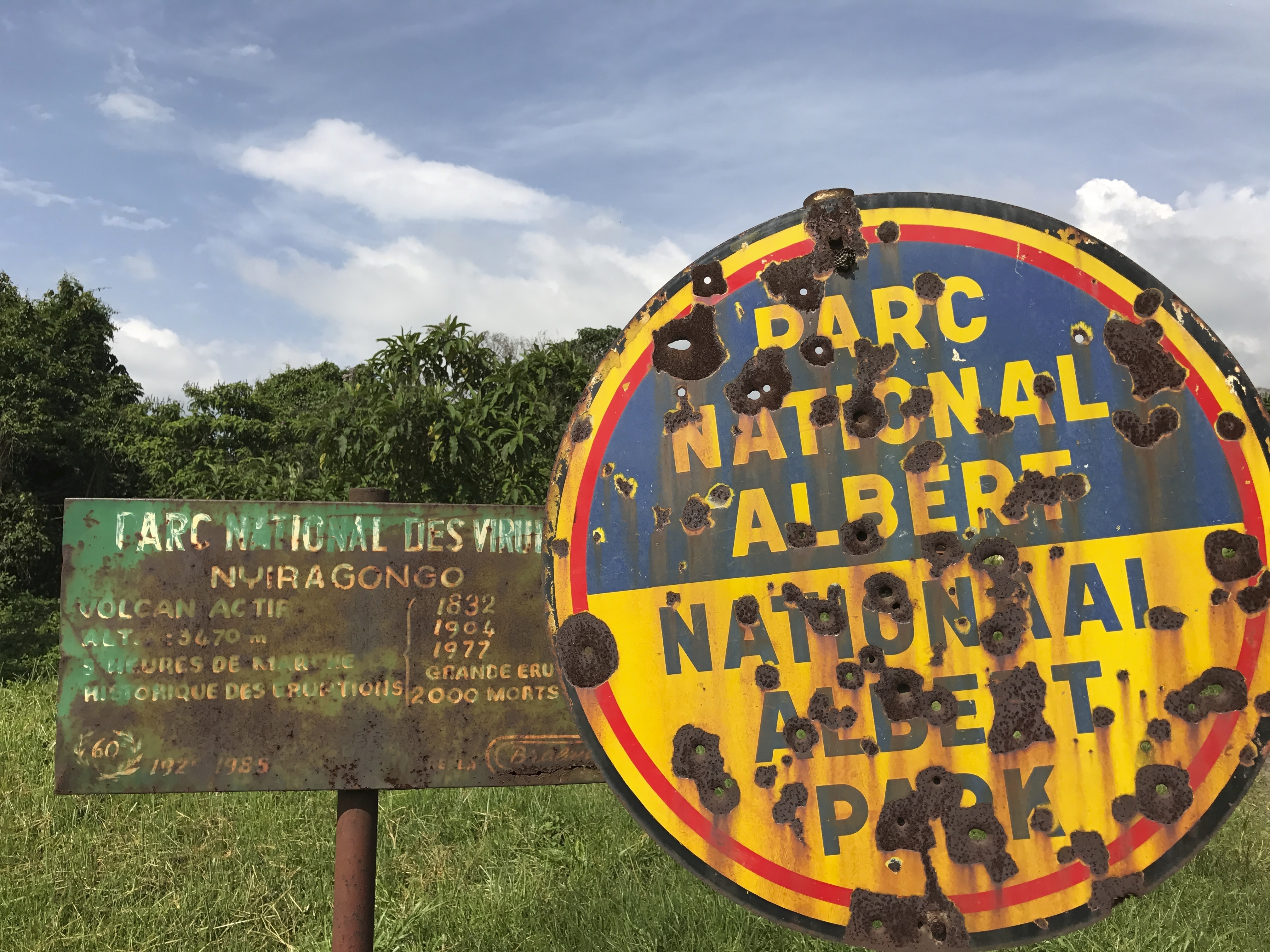
in North Kivu, Democratic Republic of the Congo. (J’rgen B’tz/picture-alliance/dpa/AP Images)
Case Studies from DRC, Benin, Mozambique, and Nigeria: Conservation in Wider Conflict Systems
Democratic Republic of the Congo
Within the GRAA dataset, the Democratic Republic of the Congo provides one of the clearest examples of protected areas operating within a long-running, armed-conflict environment. Across the country, large, protected areas overlap with territories contested by armed groups, weak state authority, and competition over natural resources. In this context, conservation personnel are exposed to violence through several distinct pathways: They may be directly targeted because of their institutional role (including when preventing or intervening in illegal activities), killed while responding to attacks against local communities, or become casualties of armed confrontations and ambushes conducted within protected areas. The concentration of ranger casualties from violent non-state actors in the DRC therefore represents not an isolated pattern, but a continuum of conflict-related exposure.
The experience of Upemba National Park (UNP) in southeastern DRC illustrates how conservation infrastructure can become directly implicated in local political and armed conflict. The park—once called “the Triangle of Death”8—operates within a contested political landscape shaped by the interaction of conservation governance, central government authority, and armed local movements. Among the most significant of these are the Bakata Katanga, also known as Mai-Mai Kata Katanga, a Katangese separatist movement that has challenged the authority of the central government in Kinshasa.9 The Bakata Katanga infiltrated the park in 1998.10
The history of violence against Upemba’s rangers and civilian personnel predates the most recent escalation. In December 2012, the park’s chief warden, Atamato Madrandele, was killed in an ambush. The loss contributed to a prolonged period in which the park lacked sufficient resources and capacity to secure its operations.11 In June 2023, a ranger was killed while on patrol.g In January 2024, a four-person ranger patrol was attacked by approximately 16 suspected members of the Bakata Katanga militia; one ranger was killed and another wounded.12 Another ranger was killed in June 2024.h In November 2024, two trackers working for the park were abducted and killed by a Mai-Mai militia.13 These incidents demonstrate that ranger casualties in Upemba have emerged through repeated encounters between conservation personnel and armed actors.
In this pattern, the March 2026 assault on the park headquarters represented a significant escalation.14 On March 3, seven people including rangers and conservation personnel were killed during an assault on the park headquarters, marking the deadliest single event in African conservation since 2020.15 The attackers temporarily took control of the headquarters before looting weapons, ammunition, food, and other supplies.16 According to witness accounts, the attackers also sought the park’s director, Christine Lain, and communicated demands that the park should cease its activities against armed groups and poachers and should stop its recruitment of rangers.17 It is noteworthy that the attackers appeared to distinguish between foreign and Congolese staff.18 According to witness accounts, the attackers seemed to avoid the targeted killing of foreign nationals.19 This could be interpreted as pointing to a localized agenda of the attackers and to an attempt to mitigate the risk of negative international repercussions.
Reporting has attributed the assault to fighters linked to Bakata Katanga, although another Katangese movement, the Mouvement Debout Katanga pour la Libération du Congo (MDKC), also claimed involvement.20 The precise attribution of the attack therefore remains uncertain. The DRC government’s public statements sought to associate the attack with M23, although the precise nature of the alleged connection has not been clearly established.21 This competing attribution is important because it illustrates the difficulty of assigning responsibility for violence in a fragmented conflict system where armed movements, splinter groups, and local militias may operate across overlapping territorial and political networks. The analytical significance of the Upemba attack does not, however, depend entirely on resolving the question of attribution. Regardless of which armed faction ultimately bears responsibility, the assault demonstrated that conservation infrastructure can itself become relevant to armed actors’ political and territorial objectives.
The attack also illustrates several ways in which conservation can become incorporated into conflict dynamics. The headquarters contained weapons, ammunition, food, and other supplies, making it a potential source of material resources. At the same time, the attackers’ reported demands concerning park operations indicate that conservation enforcement itself had become politically salient. By regulating access to protected land and restricting activities such as poaching, conservation institutions can affect the interests and freedom of movement of armed groups and other actors operating within the park. In this sense, the park’s institutional presence represents both a material resource and an expression of territorial authority.
Eastern DRC presents an even more entrenched pattern. Virunga National Park, internationally known for its mountain gorillas and a UNESCO World Heritage site, remains one of the world’s deadliest protected areas for conservation personnel. More than 200 rangers have been killed there since the park’s creation in the year 1925.22
The pattern of casualties in recent years demonstrates that ranger exposure occurs through multiple pathways rather than through a single form of deliberate targeting. In April 2018, a ranger unit traveling in a vehicle was ambushed in Oro, killing five rangers and one civilian driver.23 In March 2020, a Mai-Mai militia attack on a ranger post near Nyamilima killed one ranger.24 The following month, on April 24, fighters associated with the Democratic Forces for the Liberation of Rwanda (FDLR) killed 13 park rangers and four civilians.25 In this case, the rangers were reportedly not the primary targets of the assault; they were killed while responding to an attack in defense of the surrounding population.26 This distinction is analytically important. It demonstrates that conservation personnel can become casualties of conflict even when armed groups are not specifically seeking to attack the conservation institution itself or symbols of it.
Further attacks during 2020 and 2021 demonstrate a different pattern. In October 2020, another ranger was killed in an attack on a ranger post, with local reporting attributing the incident to the FDLR splinter group Rally for Unity and Democracy (FDLR-RUD).27 In January 2021, six rangersi on patrol were killed in an ambush attributed to Mai-Mai militia.28 In February 2023, a suspected Mai-Mai attack killed another ranger,j while a series of attacks29 attributed to the Mai-Mai in May 2023 resulted in the deaths of seven rangers and a civilian employee.k
These incidents indicate that patrols and fixed conservation positions can expose personnel to direct armed attack, particularly where armed groups maintain access to protected areas and where conservation patrols intersect with their activities. The pattern has continued into 2026. On May 21, two Virunga rangersl were killed when an unidentified heavily armed group attacked the Kamuhororo ranger post.30 The perpetrators were not conclusively identified, again demonstrating that uncertainty over attribution does not eliminate the broader evidence of conflict-related exposure among conservation personnel.
Farther northeast, the Epulu National Park, a UNESCO World Heritage site, was recently infiltrated by the Allied Democratic Forces (ADF), an armed group operating in eastern DRC that pledged allegiance to the Islamic State in 2019 and has since been recognized as its Central Africa affiliate, known as Islamic State Central Africa Province (ISCAP).31
Like Upemba and Virunga, the Epulu National Park has a history of non-state armed group attacks against its rangers. On June 24, 2012, the Epulu Conservation and Research Center was attacked by the “Mai-Mai Simba” militia, which killed at least six people, including two rangers, and 13 rare okapis.32 m Five years later, on July 14, 2017, an attack, likely perpetrated by Mai-Mai rebels, killed five local reserve employees (four wardens and a tracker).33 In June 2023, one ranger was killed in the vicinity of “Mondial,” an illegal mining site established in the central sector of the reserve.34
In December 2024, the UN Group of Experts on the DRC warned the UN Security Council that a joint military offensive by the DRC and Uganda against the ADF had pushed the group into areas with minimal state security presence in Ituri and North Kivu provinces.35 The experts warned that the leader of the ADF, Musa Baluku, had the intention to find refuge in the Epulu forest inside the Okapi Wildlife Reserve, a densely forested area with difficult access and without Armed Forces of the Democratic Republic of the Congo (FARDC) and Uganda People’s Defence Force (UPDF) presence and outside the officially agreed area of the joint operation “Shujaa.”36 A year later, the 37th report of the ISIL and Al-Qaida Analytical Support and Sanctions Monitoring Team stated that Musa Baluku and his Madina Camp were now located in the Epulu National Park.37 In March 2026, a local Congolese NGO continued to warn about the presence of ADF in the park.38 Then, in the beginning of October, the ADF attacked the Nduye Patrol Substation in the Okapi Wildlife Reserve, resulting in the death of one ranger.n
The threat posed by the ADF to protected areas is not limited to Epulu National Park or indeed the DRC. On October 17, 2023, two foreign honeymooning tourists and their local guide were killed in an attack in Queen Elizabeth National Park in southwestern Uganda (close to the border to DRC) that was carried out by ADF fighters.39
Taken together, the Upemba, Virunga, and Epulu cases demonstrate several distinct mechanisms through which protected areas become embedded in armed conflict. First, their territorial extent can provide armed groups with areas in which state presence is limited and movement is difficult to monitor. Second, conservation personnel represent an institutional presence associated with territorial governance and, indirectly, the authority of the state. Third, park facilities can contain material resources that armed actors seek to capture or loot. Finally, conservation enforcement can directly affect armed groups’ access to land, wildlife, and other natural resources, creating incentives for groups to resist or disrupt park operations.
The Congolese cases therefore suggest that ranger casualties should not be understood simply as an incidental consequence of violence occurring around protected areas. Rangers may become exposed because of the functions they perform within contested territories. Their patrols, ranger posts, headquarters, supply routes, and enforcement activities can intersect with armed groups’ territorial and economic interests. At the same time, as the 2020 Virunga attack demonstrates, rangers may also be killed while responding to violence against surrounding communities rather than because they were themselves the intended targets.
This distinction is important for understanding conservation in conflict environments. Protected areas are not merely landscapes in which armed conflict happens to occur. In some circumstances, they function as institutional, territorial, and resource arenas within the conflict itself. Rangers consequently occupy a particularly exposed position at the intersection of conservation, state authority, territorial control, and access to natural resources. Their casualties are therefore not peripheral to the conflict environment; they are, in important cases, an expression of how that conflict operates within protected areas.
Benin
The W-Arly-Pendjari complex (WAP), spanning Benin, Burkina Faso, and Niger, provides a particularly important example of a protected area system becoming integrated into a regional jihadi theater. The W and two adjacent national parks, Pendjari and Arly, comprise West Africa’s largest protected wilderness with 1.7 million total hectares. Since 2019, jihadi groups, especially those linked to JNIM and the Islamic State Sahel Province (ISGS), have increasingly operated in and around parts of the complex, using it as a sanctuary and corridor for cross-border movement.40
The security implications of this development became particularly visible first in Burkina Faso, where state forestry officers were among the first targets of jihadis looking to establish a foothold in the WAP complex, both to eliminate prying eyes and to capitalize on local resentment over regulations that prevented hunting and cattle grazing inside the parks.41 The deteriorating security situation made international headlines on April 26, 2021, when an ambush against a joint army, police, and forestry anti-poaching patrol in the Arly area killed two Spanish journalists and an Irish conservationist.o The victims were traveling with the unit when jihadi militants on motorcycles and pickup trucks ambushed them.42
The conflict subsequently became increasingly visible also in Benin, where the expanding presence of JNIM and Islamic State Sahel Province jihadis brought sustained violence against rangers and park staff. The GRAA dataset recorded the first conflict-related ranger casualties in Benin in 2022.43 However, the first major security event predated these when in Pendjari a local guide was killed and two French tourists were kidnapped on May 1, 2019.44 Fearing that the hostages would be handed over to the Macina Liberation Front (FLM), a jihadi group formed in 2015 and aligned with al-Qa`ida in the region, a French-led Special Forces operation succeeded in rescuing the two French hostages along with an American hostage and a South Korean hostage being held by the same group.45 The incident marked an early indication that the deterioration of the security in Sahel was extending into Benin’s protected areas.
Violence against park rangers intensified thereafter. In February 2022, coordinated improvised explosive device attacks in Pendjari killed four African Parksp rangers, two drivers, one French instructor, and one Beninese soldier, while injuring 12 others.46 In September 2023, one ranger was killed during a ranger patrol after a confrontation with unidentified individuals. In the same clash, two Beninese military personnel were killed, while one ranger and two other military personnel sustained injuries.47 In July 2024, five African Parks rangers and seven members of the Beninese armed forces were killed near the Mékrou River in W National Park.48 While the attribution of individual incidents varies and should not automatically be assigned to a particular jihadi organization, the cumulative pattern demonstrates the increasing exposure of conservation and security personnel to armed violence within the WAP. Here, the February 2022 attacks are noteworthy as rangers were ambushed using improvised explosive devises, indicating a certain level of technical and tactical sophisticationq beyond the more common threats of ambushes and armed confrontations.
The significance of these attacks lies not only in their lethality but in their intended strategic effect. Rangers perform functions that are directly relevant to territorial control: They patrol remote areas, gather information, monitor movement, and provide a continuing state or quasi-state presence in areas where government access is otherwise limited. By targeting ranger patrols and conservation infrastructure, armed groups can degrade surveillance, restrict state mobility, and create more permissive conditions for operating with greater freedom and assert control over communities living in or close to protected areas. The WAP should therefore be understood not simply as a location in which jihadi violence occurs, but as a contested operational environment in which the erosion of conservation and state capacity can potentially facilitate militant mobility and territorial consolidation.
The Benin example also reflects the interaction between jihadi activity and pre-existing disputes over access to natural resources. In and around Pendjari and W National Park, tensions have existed between park authorities and sections of surrounding communities over restrictions on hunting and access to land and natural resources. Jihadi groups have reportedly sought to exploit these grievances by establishing relationships with local hunters and people living near the Pendjari and W national parks. Reports since at least 2019 indicate forms of cooperation between jihadis and some Beninese hunters.49 Jihadis reportedly authorized hunters to operate in the WAP complex, claiming to defend an alleged divine right to kill animals that no government can deny from anyone.50 The jihadis imposed numerous conditions, including the conversion to Islam and the delivery of supplies in turn for the right to hunt in areas under jihadi control.51 After establishing their presence in the WAP, the jihadis welcomed herders to live inside the park: These growing ties to local communities can undermine efforts of the Beninese military as well as park rangers to protect the security and ecology of the park.52
Mozambique
As in Benin, northern Mozambique shows how protected areas may become both operational targets and prospective sanctuaries for jihadi groups. In the dataset, Mozambique emerged for the first time in 2022. The Niassa Special Reserve, Mozambique’s largest protected area, borders Cabo Delgado, where an Islamist insurgency first aligned with and then incorporated into the Islamic State as its Mozambique Province (IS-M) has operated for several years.53
The Niassa Special Reserve became increasingly exposed as insurgent activity crossed into the province in late 2021. The first major incursions into Niassa occurred in November and December 2021 as insurgents dispersed westward from areas of Cabo Delgado under pressure from Mozambican, Rwandan, and Southern African Development Community (SADC) forces. On November 25, armed men intercepted and burned a vehicle carrying salaries of employees of the Niassa Special Reserve near Gomba in Mecula district, killing at least one police officer. Subsequent attacks occurred within and around the reserve, including an assault on Naulala in which five people were killed with a ranger among the victims.54
Initial interpretations described these raids as opportunistic resource-gathering operations by the Cabo Delgado-based IS-M jihadis.55 Later analysis suggested that insurgents may also have been probing the reserve as a potential zone of influence or sanctuary.56 The role of Maulana Ali Cassimo, the alleged leader of the infiltrating force, could further illustrate the interaction between insurgency, local grievances, and the conservation landscape. Cassimo, whom Mozambican authorities identified as one of the principal insurgent figures in Niassa, had previously worked as an agricultural officer in Mecula and was known locally for his advocacy on behalf of artisanal miners and grievances concerning their treatment in the Niassa Special Reserve.57 Thus, it is plausible that Cassimo planned to instrumentalize these existing tensions surrounding access to the Niassa Special Reserve for propaganda and recruitment purposes, in a similar manner as jihadis did in Benin. Cassimo was killed in an encounter with Mozambican government forces in late 2021.58
The 2021 incursion was relatively short-lived, with insurgents remaining in Niassa for less than two months. A renewed push came in April-May 2025, when Islamic State Mozambique fighters crossed again into Niassa, attacking sites near the Lugenda River and the Mariri Environmental Centre, killing guards and four park rangers, abducting civilians, looting supplies, and burning infrastructure.59 The Islamic State, which claimed the attack via its Amaq News Agency propaganda outlet, justified the targeting of the Mariri Environmental Centre by claiming it to have been “an important Christian tourist site” and framing the attack as part of its “war against Mozambique’s Christians, government and economy.”60 The Islamic State published pictures from the attack and claimed the deaths of Mozambican soldiers.61 Some Mozambican military (FADM) members were indeed killed, with estimates ranging from at least four to possibly six,62 but IS-M mischaracterized all killed as soldiers, while four of the fatalities were in fact rangers.63
The attack against the Mariri Environmental Centre illustrates the difficulty of consistently identifying and classifying conservation casualties within fragmented conflict environments. The GRAA dataset acknowledged the death of the four park rangersr in its Honour Roll of 2025 but categorized their deaths as resulting from “homicide.”64 This classification issue is important for interpreting the GRAA dataset. If ranger deaths resulting from insurgent attacks are coded as “homicide” rather than as conflict-related killings, the apparent scale of violent non-state actor perpetrated violence against conservation personnel may be understated as it is distributed across different categories. Furthermore, if the ranger casualties would have been categorized more specifically as resulting from an insurgent attack, in the country-by-country comparison Mozambique would have moved up, reflecting statistically a comparable situation with Niger and Chad. The threat posed by Islamic State Mozambique to the Niassa Special Reserve continued into 2026: On September 3, jihadis attacked a tourist huntings camp near Nanlixa village, inside the Niassa Special Reserve. Two camp staff of the Marangira Game Reserve were killed; other staff fled, while three American tourists who were away from the camp were subsequently evacuated. The attackers burned the camp and took at least two vehicles, which were later abandoned.65
The attack against Marangira Game Reserve was assessed to have been motivated by a desire to challenge the perception of state control, disrupt logistical resupply of security forces, cause economic damage, and generate international publicity.66 At the same time, the attack highlights an interesting paradox: The conservation sector is simultaneously a potential target of IS-M and an important component of the security architecture protecting the reserve, as security forces in Niassa rely partly on the aircraft, helicopters, and trained rangers associated with tourism and conservation organizations for their counterinsurgency efforts.67
The Niassa case consequently illustrates two related but distinct developments. First, protected-area infrastructure can become an operational target because it offers a concentration of personnel, equipment, supplies, and institutional authority. Second, remote reserves can provide armed groups with operational depth: space in which they can move, conceal themselves, interact with local networks, obtain supplies, and temporarily evade state pressure. Mozambique is an important example of another type of relationship that can exist between conservation and armed conflict. In the DRC, protected areas have become deeply embedded in long-running struggles over territorial control, state authority, and resources. In northern Mozambique, the Niassa case instead demonstrates how conflict can spill into protected areas that were not initially central to the insurgency. Once that occurs, conservation infrastructure and personnel can acquire strategic significance of their own.
Nigeria
In the GRAA dataset, ranger deaths in Nigeria—30 fatalities between 2017 and 2025 due to targeted violence—were reported variously as “homicides” or perpetrated by “herdsmen,” “assailants,” “bandits,” “cultists,” or “mobs.”68 Nigeria thus illustrates how protected areas can become embedded in hybrid security environments where insurgency, banditry, and transnational pastoral violence overlap. This trend continued in 2026: On January 6, armed attackers killed five rangerst at a National Park Service outpost in Old Oyo National Park. Initial reporting attributed the assault to bandits,69 while later reporting suggested possible links to jihadi elements displaced southwards by military pressure in other parts of the country.70 Subsequent investigations indicated that the immediate trigger may instead have been the detention of armed herders who had entered the park illegally.71 In the Honour Roll of 2026, all five rangers have been categorized as fatalities of Boko Haram.72 The exact perpetrator’s identity remains uncertain.
What the incident demonstrates more clearly is that the park had become part of a wider zone of armed contestation in which several types of violent actor operated or were feared to be operating.73 In such settings, rangers are vulnerable not only because they enforce conservation rules, but because they represent one of the few visible forms of state authority in poorly governed forest terrain.
This pattern is not unique to Old Oyo. Sambisa Forest in northeastern Nigeria, a protected area, became Boko Haram’s most important sanctuary after 2013 when the group was dislodged from Maiduguri town by military forces.74 The security guards staffing the gate were killed and the remaining staff fled for their lives.75 The terrorists then set up various camps in the forest, which stretches across multiple Nigerian northeastern states, including Borno, Yobe, Gombe, and Bauchi, and is also relatively close to the borders of Chad and Cameroon.76 The Sambisa Forest remains strategically relevant to both Boko Haram and Islamic State West Africa Province.77 The broader implication is that forested protected areas in Nigeria can function as refuge zones, transit routes, and operational spaces for both insurgent and criminal actors.
Conclusion
While the GRAA Honour Rolls are subject to limitations and contain some inaccuracies, they nevertheless provide a useful basis for identifying broader patterns in ranger fatalities and, more specifically, for examining the actors and motivations associated with targeted violence against African park rangers. The data underscores the extent to which ranger work takes place within a highly violent security environment. Breaking down fatalities according to the apparent identity and motivation of perpetrators also reveals important differences in this violence. Most notably, the dataset indicates that at least 39 percent of rangers killed in targeted acts of violence were killed by organized, politically or ideologically motivated violent non-state actors. This suggests that ranger fatalities cannot be understood solely through the lens of wildlife crime. Instead, a substantial proportion of targeted violence occurs within broader contexts of political or ideological conflict, in which protected areas and their personnel become entangled in wider patterns of armed violence. The relatively consistent occurrence of fatalities attributed to such groups further distinguishes this category from violence perpetrated by poachers and other armed resource offenders.
At the same time, the dataset highlights the difficulty of establishing perpetrator motivations. In 38.6 percent of recorded ranger fatalities caused by violence, the motivation for targeting the ranger remains undetermined. This limits the extent to which observed patterns can be confidently attributed to particular forms of violence. The GRAA Honour Rolls should therefore be understood as indicative of broader patterns rather than as a definitive account of the motivations underlying ranger fatalities. The high proportion of cases for which motive remains unknown also underscores the need for more systematic collection and verification of information concerning ranger deaths.
For violent extremist groups, protected areas can offer a combination of strategic, political, and economic advantages. Many protected parks are in remote and contested areas characterized by limited state presence and longstanding struggles over governance and territorial authority. In areas such as Virunga and Upemba, protected areas are embedded within broader conflicts over territorial control and political authority. The developments in Benin illustrate how jihadi organizations can exploit protected areas for their strategic value while also capitalizing on local grievances surrounding conservation restrictions by presenting themselves as defenders of local livelihoods against the imposed restrictions. Conservation disputes can consequently become embedded within broader struggles over governance, identity, and political authority. The jihadi attacks in Niassa, in turn, demonstrate how park facilities can become sources of supplies or targeted for propaganda purposes. Taken together, these cases suggest that the strategic value of protected areas lies not in any single characteristic, but in the combination of difficult terrain, difficult seasonal conditions, weak state presence, valuable resources, local grievances, and opportunities for mobility and concealment.
This context helps explain why rangers become strategically important targets. Rangers are not merely wildlife custodians; in many remote protected areas, they function as agents of territorial governance by monitoring movement, gathering intelligence, restricting illicit access, and representing state or para-state authority. For armed groups seeking freedom of movement or control over territory and resources, rangers can therefore constitute direct obstacles to their activities. Attacks against rangers can consequently have effects extending beyond the immediate casualties. Killing or intimidating rangers weakens surveillance, reduces patrol coverage, discourages personnel from operating in high-risk areas, and can create opportunities for armed actors to establish camps, smuggling routes, or temporary safe havens. Ranger fatalities may therefore also indicate broader changes in the security environment, including the gradual penetration of remote areas by armed non-state actors.
These dynamics have important implications for conservation and security policy. Strengthening ranger capabilities through improved intelligence sharing, surveillance, communications, and emergency medical support remains important, but conservation agencies cannot substitute for effective security institutions where violence is rooted in broader conflicts over territory and governance.
Ultimately, the evidence suggests that, in parts of Africa, park rangers increasingly operate at the intersection of struggles over territory, resources, governance, and political authority. Recognizing protected areas as contested strategic spaces, rather than simply ecological landscapes, is therefore essential to understanding ranger insecurity and developing more comprehensive approaches to conservation, security, and counterterrorism. CTC
Dr. Christian Jokinen received his doctorate from the Department for Contemporary History at the University of Turku in Finland. He specializes in researching political violence and terrorism.
The views expressed are those of the author and do not necessarily reflect those of his current or former employers.
© 2026 Christian Jokinen
Appendix I: Dataset of Ranger Fatalities (2017-2026), based on the GRAA Honour Rolls
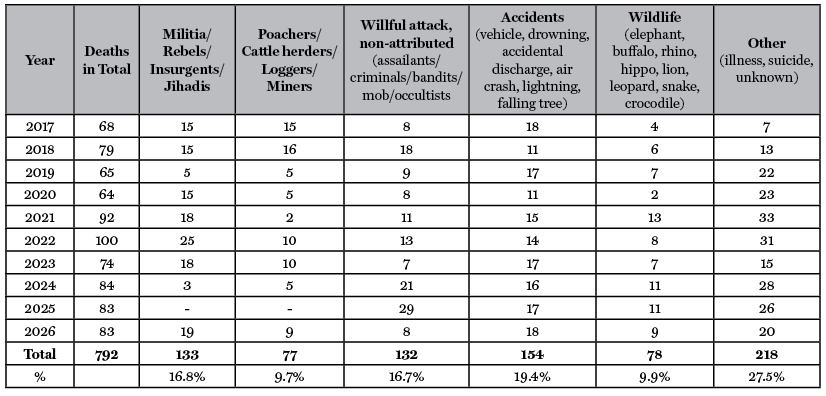
Appendix II: Ranger fatalities due to targeted violence (2017-2026), by category
Appendix III: Ranger fatalities by country, caused by VNSAs
Substantive Notes
[a] A ranger is a person who protects and manages Africa’s protected areas and natural resources, including wildlife, forests, habitats, and the communities that depend on them. The terminology is not completely uniform. For example, national wildlife authorities, forestry departments, community conservancies, and NGOs may use different titles for people performing similar conservation functions.
[b] The International Ranger Federation (IRF) is a global organization that represents and supports rangers and ranger associations working to protect wildlife, ecosystems, cultural heritage, and communities. It promotes professional standards, training, welfare, recognition, and international cooperation among rangers and the organizations that support them. See the International Ranger Federation’s website at internationalrangers.org
[c] Mai-Mai is a broad term used in the DRC for various locally based armed groups, often organized around particular communities, leaders, or territories. The term does not describe a single unified organization; Mai-Mai groups have had different political aims and have been involved in both resistance and conflict, including in eastern DRC. Franck van Acker and Koen Vlassenroot, “Les ‘maï-maï’ et les fonctions de la violence milicienne dans l’est du Congo,” Politique Africaine 84 (2001/4); Judith Verweijen, “Inclusion amid fragmentation: the Mai-Mai in the DRC,” Accord 28 (2019).
[d] The March 23 Movement (M23), or the Mouvement du 23 Mars in French, is an armed group that operates in eastern DRC, where it has become the most active non-state armed group and often fights alongside the Rwanda Defence Force (RDF). For analysis on M23, see Ladd Serwat, “The enemy of my enemy is my friend: How armed group alliances are shaping the battle for South Kivu,” ACLED, March 27, 2026.
[e] Al-Shabaab is an internationally sanctioned armed Islamist extremist organization based primarily in Somalia and active in parts of East Africa. It is affiliated with al-Qa`ida and has carried out insurgency, terrorist attacks, and other forms of violence, particularly in Somalia and against regional and international targets. “Al-Shabaab,” UN Security Council, October 29, 2014.
[f] Boko Haram refers to an Islamist militant organization originating in northeastern Nigeria. Founded in the early 2000s, the group is also known as Jama’atu Ahlis Sunna Lidda’awati wal-Jihad (“People Committed to the Propagation of the Prophet’s Teachings and Jihad”). The group is listed by the UN Security Council under its ISIL (Da’esh) and Al-Qaida sanctions regime. Boko Haram had historical links to al-Qa`ida; in March 2015, it pledged allegiance to the Islamic State, after which the al-Barnawi faction became Islamic State-West Africa (ISWAP). Following a 2016 split, the remaining Shekau faction continued under the name Boko Haram. “Jama’atu Ahlis-Sunna Lidda’awati wal-Jihad (Boko Haram),” UN Security Council, May 22, 2014; “Islamic State West Africa Province (ISWAP),” UN Security Council, February 23, 2020.
[g] The ranger was named as Banze Mupafu Erasme. “The High Cost of Conservation in the DRC,” Upemba National Park, June 16, 2024.
[h] The killed ranger was named as Mukambilwa Bunia Mustapha. “The High Cost of Conservation in the DRC,” Upemba National Park, June 16, 2024.
[i] The six rangers were identified as Burhani Abdou Surumwe, Kamate Mundunaenda Alexis, Maneno Kataghalirwa Reagan, Kibanja Bashekere Eric, Paluku Budoyi Innocent, and Nzabonimpa Ntamakiriro Prince. “Virunga Rangers Killed In an Ambush,” Virunga National Park, n.d.
[j] The ranger was identified as Tulinabo Fatakanwe Pascal. “Tulinabo Fatakanwe Pascal,” Virunga National Park, February 7, 2023.
[k] The killed rangers were identified as Kakule Nzonda Djiku, Ngerageze Kamzungu Daniel, Paluku Kiyana, Paluku Mahamba Ovide, Musubao Mubulya Justin, and Muhindo Kasay Nickson. “Déclaration du Parc National des Virunga sur les attaques récentes,” Virunga National Park, June 12, 2023.
[l] The killed rangers were identified as Kasereka Valyathire Baraka and Munguakonkwa Mihigo Jacques. “Two Rangers Killed in Armed Attack at Kamuhororo,” Virunga National Park, May 21, 2026.
[m] The intentional killing of protected species as a form of “ecological terrorism” is not limited to this single case. In May 2007, a Mai-Mai militia threatened to kill all remaining mountain gorillas in Virunga National Park if government forces continued military operations against the group following the killing of park rangers. In July 2007, several gorillas were killed. “DR Congo rebel threat to gorillas,” BBC, May 21, 2007; Mark Kniver, “Missing DR Congo gorillas ‘dead,’” BBC, August 17, 2007.
[n] The ranger was identified as Jean Tandu Koliwa. “Mambasa: un écogarde de la RFO tué lors d’une attaque ADF,” 7sur7.cd, October 1, 2026.
[o] The victims were Spanish journalists David Beriain and Roberto Fraile, and the Irish wildlife activist Rory Young, director of the Chengeta Wildlife Foundation. “Rory Young tribute,” Chengeta Wildlife Foundation, n.d.; “Burkina Faso ambush: Spaniards and Irishman killed after abduction,” BBC, April 28, 2021.
[p] African Parks is South Africa-based nonprofit conservation organization that partners with governments to manage and restore protected areas across Africa, focusing on wildlife conservation, habitat protection, anti-poaching efforts, and community development.
[q] The only other example was when an IED attack by al-Shabaab caused one ranger fatality in Kenya. The death of ranger Ali Hamza Kimango in an IED-attack on November 1, 2021, was recorded in the GRAA Honour Roll of 2023. “Ranger killed, driver and student injured in Lamu IED attack,” Star, November 2, 2021.
[r] The casualties included the rangers Carlitos Cuteiua, Pires Tahane, Fernando Wirson, and Domingos Daude. “Reflections from Niassa: One Year after the Insurgent Attacks,” WCN, June 15, 2026.
[s] Hunting tourism is permitted in designated areas of the Niassa Special Reserve under Mozambique’s sustainable-use conservation framework. It is conducted through licensed concessions and government-approved species quotas, with revenues intended to support conservation management and provide benefits to local communities.
[t] Identified as Moses Areo, Mukthar Ajiboye, Ololade Hassan, Akinade Alawode, and Solomon Ajiaa. Nurudeen Akewushola, “Retaliatory attack by armed herdsmen triggers brutal massacre at Oyo park,” International Center for Investigative Journalism, February 14, 2026.
Citations
[1] Examples include Kurt Steiner, “Terror, Rebellion and Insurgency: The Impact on Conservation in Africa,” Directions in International Terrorism: Theories, trends and trajectories (2021); Gitanjali Reddy, “Bullets and Biodiversity: African National Parks as a Key Counterterrorism Strategy,” Lawfare, October 6, 2023.
[2] Examples include “Ivory and terrorism: Africa’s White Gold of Jihad,” Elephant Action League (EAL), 2013; Tom Maguire and Cathy Haenlein, “An Illusion of Complicity. Terrorism and the Illegal Ivory Trade in East Africa,” RUSI Occasional Paper, September 2015; Vanda Felbab-Brown, “Wildlife and drug trafficking, terrorism and human security,” Brookings, November 8, 2018; and Kristof Titeca and Patric Edmond, “Outside the Frame: Looking Beyond the Myth of Garamba’s LRA Ivory-Terrorism Nexus,” Conservation and Society, AOP 1-12, 2019.
[3] For example, Simon Lhoest, Julie Linchant, Meredith L. Gore, and Cedric Vermeulen, “Conservation science and policy should care about violent extremism,” Global Environmental Change 76 (2022). Other conservationists continue to warn against a forceful “guns and gates” approach to protecting wildlife. See Rosaleen Duffy, “Foreign ‘conservation armies’ in Africa may be doing more harm than good,” Conversation, July 12, 2017, and Security and Conservation: The Politics of the Illegal Wildlife Trade (New Haven: Yale University Press, 2022).
[4] Game Rangers Association of Africa, “Our History,” n.d.
[5] Game Rangers Association of Africa, “Ranger Roll,” n.d.
[6] Judith Verweijen, “Inclusion amid fragmentation: the Mai-Mai in the DRC,” Accord 28 (2019).
[7] “Global Terrorism Index 2019, 2021, 2022 and 2023,” Institute for Economics & Peace.
[8] Emmet Livingstone, “The rangers turning the DRC’s ‘triangle of death’ back into a thriving wildlife reserve,” Guardian, August 20, 2024.
[9] “Katanga: Tensions in DRC’s Mineral Heartland,” International Crisis Group, Report 239, August 3, 2016.
[10] Livingstone, “The rangers turning the DRC’s ‘triangle of death’ back into a thriving wildlife reserve.”
[11] “Honouring the Guardians: A Short History of Africa’s Wildlife Rangers,” Upemba National Park, July 30, 2026.
[12] Livingstone, “The rangers turning the DRC’s ‘triangle of death’ back into a thriving wildlife reserve.”
[13] “Tragic Loss of Two Dedicated Trackers in Upemba National Park,” Upemba National Park, November 23, 2024.
[14] Ashoka Mukpo, “Upemba National Park staff recount assault that left seven dead,” Mongabay News, March 24, 2026.
[15] “Fatal Attack on Upemba National Park Headquarters,” African Parks, March 7, 2026; Mukpo, “Upemba National Park staff recount assault that left seven dead.”
[16] “Strategic Warning Notice: Security Incident – Lusinga, Upemba National Park Headquarters, Haut-Katanga, DRC,” African Security Analysis, March 3, 2026.
[17] Mukpo, “Upemba National Park staff recount assault that left seven dead.”
[18] Ibid.
[19] Ibid.
[20] Emmet Livingstone, “‘She gave her life to protect the richness of Congo’: inside the deadly assault on Upemba wildlife park,” Guardian, March 22, 2026.
[21] Lionel Kibuluku, “RDC : Kinshasa soupçonne l’AFC/M23 derrière l’attaque meurtrière du parc de l’Upemba,” FNTV.CD, March 14, 2026.
[22] “Virunga’s Rangers,” Virunga Park, n.d.; Vivienne Nunis and Sarah Treanor, “DR Congo’s Virunga National Park: The deadly job of protecting gorillas,” BBC, March 3, 2021.
[23] “He survived a deadly attack, now he is calling for better working conditions for rangers in DRC,” Mongabay News, May 19, 2026.
[24] “Virunga National Park Ranger Kambale Vyasahi Germain Killed in the Line of Duty,” Virunga National Park, March 6, 2020.
[25] “Twelve Rangers among 16 killed in ambush at DRC gorilla Park,” Guardian, April 24, 2020.
[26] “Update on armed attack on Rumangabo village,” Virunga National Park, April 24, 2020.
[27] “Virunga National Park Ranger Bagurubumwe Chuhoze Deogene Killed in the Line of Duty,” Virunga National Park, October 11, 2020.
[28] “Six rangers killed in DR Congo’s Virunga National Park,” BBC, January 10, 2021.
[29] “Statement from Virunga National Park on the Recent Attacks,” Virunga National Park, June 12, 2023.
[30] Ibid.
[31] “Letter dated 29 December 2025 from the Analytical Support and Sanctions Monitoring Team addressed to the Chair of the Security Council Committee pursuant to resolutions 1267 (1999), 1989 (2011) and 2253 (2015) concerning Islamic State in Iraq and the Levant (Da’esh), Al-Qaida and associated individuals, groups, undertakings and entities,” United Nations Security Council, December 29, 2025.
[32] “Militia massacres Rangers, 13 endangered Okapi at Congo Wildlife Reserve,” Mongabay News, June 29, 2012; Jeremy Hance: “Poacher known as ‘Morgan’ behind devastating massacre at Okapi Wildlife Reserve,” Mongabay News, July 5, 2012.
[33] Naomi Larsson Piñeda, “Five park rangers killed in DRC in tragic weekend for wildlife defenders,” Guardian, July 17, 2017.
[34] “Fatal Attack on Eco-guard in DRC’s Okapi Wildlife Reserve,” WCN News, June 30, 2023.
[35] “Letter dated 27. December 2024 from the Group of Experts on Democratic Republic of the Congo to President of the Security Council,” 2024 and Annex 2.
[36] Ibid.
[37] “Letter dated 29 December 2025 from the Analytical Support and Sanctions Monitoring Team.”
[38] “Les ADF menacent d’extinction l’Okapi à Mambasa, alerte de l’ONG COSAE,” Radio Okapi, March 23, 2026.
[39] “Two tourists, from UK and South Africa, and guide killed in attack in Uganda,” Guardian, October 17, 2023.
[40] Ella A. Abatan and William Assanvo, “Links between violent extremism and illicit activities in Benin,” ISS, West Africa Report 42, June 2023.
[41] Remi Carayol, “Sahel. L’héritage colonial des eaux et forêts, une arme aux mains des djihadistes,” Orient XXI, April 28, 2021.
[42] “Europeans killed in Burkina Faso after gunmen ambush anti-poaching patrol,” France24, April 27, 2021.
[43] GRAA Honour Roll 2022.
[44] “Kidnapped French tourists were in Benin ‘red zone’: minister,” France24, May 11, 2019.
[45] Sophie Douce, Nathalie Guibert, and Cyril Bensimon, “Une opération de sauvetage complexe, deux militaires français tués : le récit de la libération des otages au Burkina Faso,” Monde, May 11, 2019.
[46] “Incident in W National Park,” African Parks Press Statement, February 9, 2022; “Update on Incidents in W National Park, Benin,” African Parks Press Statement, February 11, 2022.
[47] “Statement Regarding the Death of Ranger Gnami Kouga Inocent,” African Parks Press Statement, September 20, 2023.
[48] “Statement Regarding Incident at the W National Park in Benin,” African Parks Press Statement, July 27, 2024.
[49] Abatan and Assanvo; “Benin’s W National Park Becomes ‘Headquarters’ for Terrorists,” Africa Defence Forum, May 7, 2024.
[50] Ashoka Mukpo, “In Benin, the line between conservation and counterinsurgency blurs,” Mongabay News, March 29, 2022; Abatan and Assanvo.
[51] Abatan and Assanvo.
[52] “Benin’s W National Park Becomes ‘Headquarters’ for Terrorists,” Africa Defence Forum, May 7, 2024.
[53] On the insurgency in Cabo Delgado, see, for example, Tim Lister: “Jihadi Insurgency in Mozambique Grows in Sophistication and Reach,” CTC Sentinel 13:10 (2020); Julia Stanyard, Alastair Nelson, Greg Arde, and Julian Rademeyer, “Insurgency, illicit markets and Corruption. The Cabo Delgado conflict and its regional implications,” Global Initiative, February 2022; and Emilia Columbo, “The Enduring Counterterrorism Challenge in Mozambique,” CTC Sentinel 16:3 (2023).
[54] “Cabo Ligado Weekly Report 22 – 28 November 2021,” ACLED, November 30, 2021.
[55] Ibid.
[56] “Crisis Watch,” International Crisis Group, December 2021.
[57] Lenin Ndebele, “The Big Read: Five years on, Cabo Delgado in Mozambique still a hotbed of insurgency,” News24, June 30, 2022.
[58] Sergio Chichava, “Maulana Ali Cassimo: insurgence in the North of Mozambique seen from Niassa,” IESE IDeIAS Nº 147E, March 9, 2022.
[59] Andrea van Wyk, “Isis allegedly behind beheadings, destruction of luxury SA-owned hunting camp in Mozambique,” Caxton Network News, May 4, 2025.
[60] “ISIS Claims Its Fighters Seized Helicopter In Deadly Attack On Christian Tourist Site in Mozambique´s Niassa Region,” Jihad & Terrorism Threat Monitor, MEMRI, May 1, 2025.
[61] Ibid.
[62] “Cabo Ligado Weekly Report, 21 April-4 May 2025,” ACLED, May 8, 2025.
[63] Ibid.; Wildlife Conservation Network, July 10, 2025, and June 15, 2026.
[64] GRAA Honour Roll 2025.
[65] “Mozambique Conflict Monitor Update,” ACLED, September 8, 2026.
[66] “Mozambique: Niassa hunting lodge attack seeks to disrupt economy – analyst,” LUSA, September 9, 2026.
[67] Ibid.
[68] GRAA Honour Rolls 2017, 2018, 2021, and 2022.
[69] Folashade Ogunrinde, “Five National Park Officers killed in bandit attack in Oyo – Governor Makinde,” Premium Times Nigeria, January 7, 2026.
[70] “Oyo Park Killing Linked to Boko Haram Expansion Unit: Analysts,” TruthNigeria.com, January 20, 2026.
[71] Nurudeen Akewushola, “Retaliatory attack by armed herdsmen triggers brutal massacre at Oyo park,” International Center for Investigative Journalism, February 14, 2026.
[72] GRAA Honour Roll 2026.
[73] James Barnett and Umar Musa, “Kachallas and Kinship: Understanding Jihadi Expansion and Diffusion in Nigeria,” CTC Sentinel 19:1 (2026).
[74] Olaniyan Azeez, “Once Upon a Game Reserve: Sambisa and the Tragedy of a Forested Landscape,” Environment & Society Portal, Arcadia 2 (2018).
[75] Ibid.
[76] Abioudun Jamiu, “Why extremists take cover in Nigeria’s forests,” Deutsche Welle, January 26, 2026.
[77] “Boko Haram and ISWAP Fight For Control of Sambisa Forest,” Africa Defence Forum, May 19, 2026.
