
From the Editors
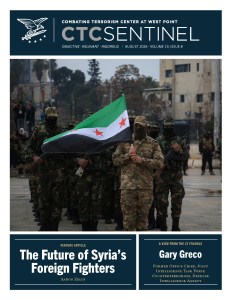
Managing the foreign fighters who remain in Syria has emerged as a defining test of the country’s transition, Aaron Zelin writes in this month’s cover article. It is a complicated, nuanced task, one that Zelin finds would not be made easier and could in fact be made far more difficult with a “disarmament-by-headcount framing.” “Syria’s foreign fighters are not a stockpile of weapons to be confiscated,” he cautions. “They are a differentiated, fracturing population that has been substantially absorbed into the state, that is drawing new arrivals, and that now sits at the center of Syria’s contested reintegration into international politics.”
Our interview is with Gary Greco, who served for over 40 years in the U.S. intelligence community with the Defense Intelligence Agency and the Office of the Director of National Intelligence. Ahead of the 25th anniversary of 9/11, he reflects on the events of that day and also considers future threats: “Terrorists are always going to be opportunists, but they are also technology driven, and we’re always a step behind,” he warns.
James Khalil, Andrew Glazzard, John Horgan, and Alastair Reed examine the utility of “Exit Comms,” communication campaigns aimed at individual or group-level disengagement from violent extremist (VE) organizations or movements during active conflicts. They offer an analytical framework based on five dimensions—audience, messenger, channel, format, and content—to inform Exit Comms’ design and evaluation. “Despite [a] lack of attention to date,” they write, “emerging evidence from cases such as Colombia, Nigeria, and Somalia suggests that Exit Comms can provide an effective tool for increasing exit rates from VE organizations.”
Don Rassler and Kristina Hummel, Editors-in-Chief
