
Abstract: In the Afghanistan-Pakistan militant landscape, where suicide attacks are overwhelmingly justified through religion, the Balochistan Liberation Army stands apart: It asks its bombers to die for a secular nationalist cause. This article examines how BLA makes that case, drawing on two of its own publications: Tojeel, the 2024 training manual for its suicide wing, the Majeed Brigade; and Dhak, its 2025 annual review of operations. Tojeel builds a secular genealogy of self-sacrifice, drawing on the history of the kamikaze, the Tamil Tigers, and the PKK, and borrowing selectively from Just War theory and the strategic thought of Sun Tzu, Mao, and Che Guevara to situate itself within a global tradition of nationalist resistance. Dhak reproduces the manual’s secular nationalism faithfully in its eulogies and its portrait of a disciplined national army, yet its account of the year’s fighting departs from the restraint the manual professes: prisoners executed after ad hoc trials, “agents” killed, mine workers threatened, and a suicide wing spent on mass-casualty strikes against troops rather than selective targets. The article closes with implications for Pakistan’s counterinsurgency strategy, for counter-messaging against a non-religious insurgency, and for U.S. interests in a region where American-financed projects now sit inside the BLA’s declared target set.
In August 2025, the U.S. State Department designated the Balochistan Liberation Army (BLA) and its suicide wing, the Majeed Brigade, a foreign terrorist organization (FTO). The separatist militant organization, based in Pakistan’s southwestern province of Balochistan, rejected the designation via its annual review magazine, Dhak,1 asserting that the BLA is “an organized military force” that operates in compliance with “Common Article III of the Geneva Conventions,” which prohibits the targeting of civilians. Its message went further, arguing for the United States to recognize it as an ally: “If the United States seeks genuine stability, grounded relations and lasting regional interests, it must recognize its natural allies—the Baloch nation, with its modern and principled resistance, and the Baloch Liberation Army, committed solely to the liberation and justice of its motherland.”
That response highlights a much-overlooked characteristic of the BLA: While much has been written about the group’s escalating capabilities and aggressive operations, from coordinated multi-district offensives, the seizure of towns, to the March 2025 hijacking of the Jaffar Express passenger train in Pakistan, far less has been said about the ideas that drive it. The BLA’s ideology does not rest on religion, an anomaly in a militant landscape where others like the Tehrik-i-Taliban Pakistan (TTP), al-Qa`ida in the Indian Subcontinent, and the Islamic State Khorasan ground violence and self-sacrifice in jihad. This raises two related questions. First, what ideological principles motivate BLA fighters, especially those associated with the Majeed Brigade, the BLA’s suicide wing whose members must be persuaded not merely to fight but to die? Second, how consistently does that doctrine appear in the BLA’s outward account of itself? Together, these questions examine both the sources of the BLA’s internal motivation and the extent to which that ideology survives in its public self-presentation.
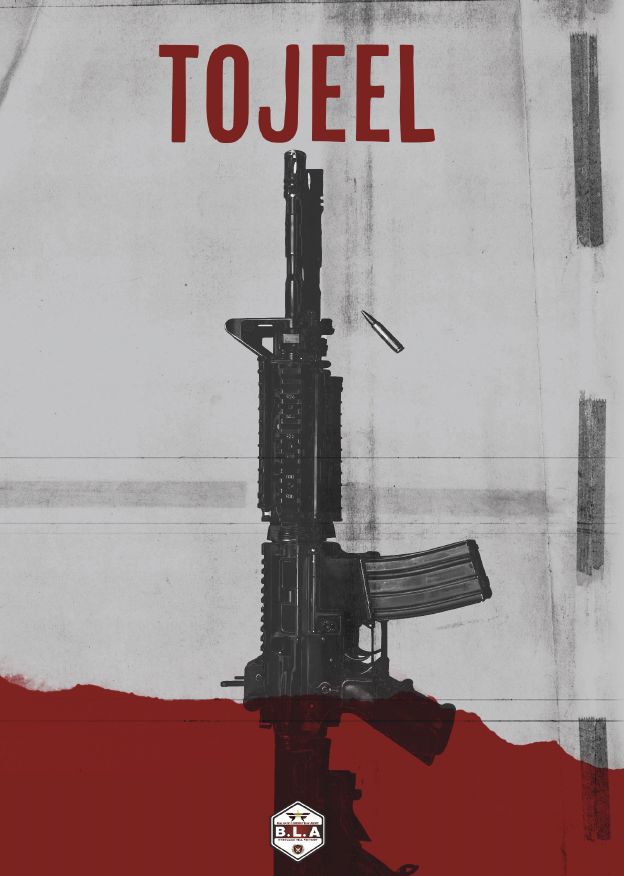
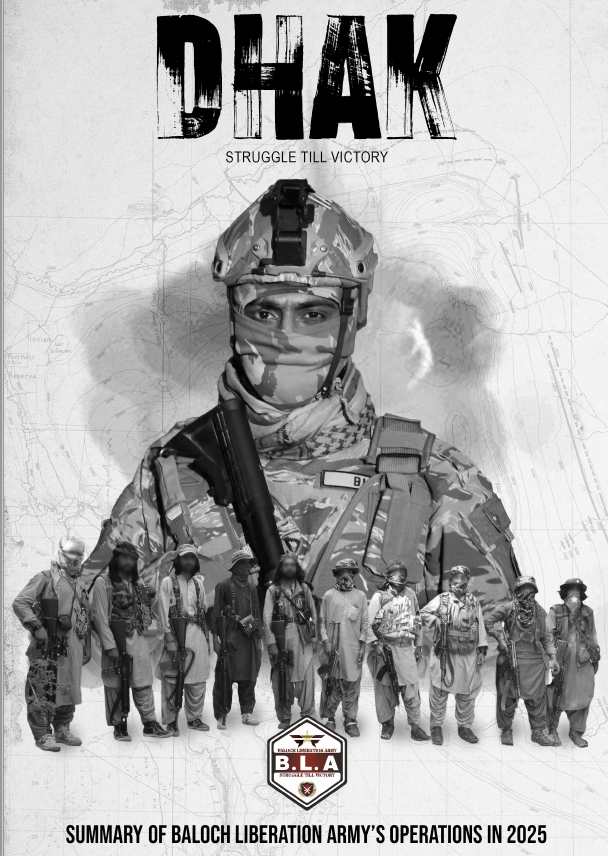
This article explores these questions by drawing on primary materials, specifically two of the group’s own documents. The first is Tojeel (meaning justification in Balochi), a training and indoctrination guidebook for the Majeed Brigade published by the BLA’s media wing, Hakkal, in August 2024. The second is Dhak (meaning blow or strike in Balochi), the group’s 2025 annual review, an account of its operational activities during the year. The article proceeds in four parts. First, it briefly traces the wider Baloch insurgency’s origins and evolution, highlighting the role of the BLA within the movement, before turning to an examination of the ideas and guidelines embedded within Tojeel, highlighting the group’s constructed genealogy of self-sacrifice, its philosophical framework, and organizational doctrine. The article then explores the doctrine against the group’s own record of 2025. The article concludes with the implications, both for regional counterterrorism and for U.S. interests.
The Evolution of the Baloch Insurgency
While the Baloch insurgency has existed for decades in Pakistan’s Balochistan province, its current level of activity represents a notable resurgence in its overall trajectory, often labeled as its fifth wave since 1948. The origins of the insurgency are rooted in the contested accession of the princely state of Kalat, which covered much of present-day central and southern Balochistan. Upon the departure of the British from the Indian subcontinent in 1947, which was partitioned into the independent states of India and Pakistan, Kalat declared its own independence.2 This was short-lived, as Kalat acceded to Pakistan in March 1948 under conditions characterized as coercive by Baloch nationalists.a The manner of the accession became a founding grievance, one sustained over the decades by politicians and tribal leaders through narratives of resource exploitation, and adopted by Baloch militants more broadly. That narrative has a material basis: While Balochistan has supplied Pakistan with natural gas for decades, holds large reserves of copper and gold, and hosts a critical stretch of the China-Pakistan Economic Corridor, it remains one of the country’s poorest and most underdeveloped regions.3
Prior to its current resurgence, Baloch militancy has ebbed and flowed in four earlier waves. Arguably, each wave was triggered by state actions that were perceived by Baloch nationalists as an attack on their autonomy (from a forced accession, to increased military presence and the dismissal of the provincial elected government) and met by state force rather than through peace talks and negotiations.b The insurgency’s ideology has also shifted with each wave. The first two were dynastic and tribal, where revolts were framed in defense of princely sovereignty, and the tribal leaders’ authority.4 The third introduced Marxism-Leninism ideas, which were further reinforced during the fourth wave, with Khair Bakhsh Marri’s fighters regrouping in Afghan exile under Soviet patronage as the Baloch People’s Liberation Front.5 The fifth wave of Baloch militancy, generally dated from the mid-2000s to the present period, differs from its predecessors in character as well as intensity. Not only has the secular ethnonational militancy increasingly sought to draw support from an educated, middle-class sector of the Baloch population (incorporating women into its ranks to broaden that base), it has also shifted its ideological ground.6 The BLA, the largest and one of the deadliest of the Baloch militant groups, offers a clear case of this transformation. As its own publications show, the group justifies its violence not through religion but through secular rationalism, comparing its fighters not to jihadi movements but to the kamikaze, the Algerian National Liberation Front, the Tamil Tigers, and the Kurdistan Workers’ Party, among others. Its martyrdom doctrine, which is not linked to any religious doctrine, represents a stark deviation in the broader Afghanistan-Pakistan militant landscape.
The BLA’s Rise Within the Current Insurgency
Revived in the mid-2000s, in part as a reaction to military ruler Pervez Musharraf’s plans for Pakistan’s Gwadar port and new army cantonments, the current wave is dominated by two organizations: the Baloch Liberation Army and the Baloch Liberation Front (BLF).7 The BLA, historically strongest in the Marri-Bugti tribal belt and the central Bolan-Kalat-Khuzdar corridor in Balochistan, now operates across the province and into Karachi, while the BLF remains the strongest in the Makran coastal belt.8
The BLA itself grew out of the Marri tribal leadership, and is generally understood to have emerged in the late 1990s among followers of Nawab Khair Bakhsh Marri, the Marxist tribal chief who was the leader of the 1970s revolt.9 It turned to violence after Marri’s arrest on murder charges in 2000, and as the state responded with crackdowns and military operations in subsequent years. Two moments shaped the BLA’s trajectory, one external to the group and one internal. First, the 2006 killing of Nawab Akbar Bugti, the chief of the Bugti tribe and a former chief minister of Balochistan who had taken up arms against Musharraf’s government, reinforced widespread grievances against state coercion of the Baloch population.10 Around this time period, the BLA grew more diffuse after Khair Bakhsh’s son, Balach Marri, was killed in November 2007, and his other son Hyrbyair Marri lived in exile in London.11 However, the more important turn came a decade later, inside the BLA itself. Its 2017 split (between the exiled, tribally rooted leadership of Hyrbyair Marri and the ground commanders led by Aslam Baloch) produced two factions: BLA-Azad, under Marri, and Aslam’s faction, known as BLA-Jeeyand (or BLA-Achu), which became the dominant BLA.12 It was this faction that transformed the Majeed Brigade, its suicide unit, into the group’s signature weapon.13
For years, the BLA, like the other Baloch groups, had fought as a classic guerrilla force, relying on ambushes, roadside bombs, and attacks on pipelines and rail lines. Since 2024, however, their tactics and methods have shifted notably, especially the scale and coordination of its operations. The BLA’s Operation Herof in August 2024 struck dozens of locations across more than a dozen districts,14 and the March 2025 hijacking of the Jaffar Express, the first hijacking of a passenger train in Pakistan’s history, demonstrated an unprecedented level of coordination and control.15 At the center of this escalation is the Majeed Brigade, the BLA’s fidayee wing.c Founded in 2010, the unit was dormant until Aslam Baloch revived it in August 2018, with his own son as the bomber in an attack on Chinese engineers in Dalbandin.16 Since then, it has carried out the BLA’s most consequential operations such as the 2018 assault on the Chinese consulate in Karachi,17 the 2022 Karachi University bombing by Shari Baloch18 (the group’s first female suicide attacker), and the Jaffar Express hijacking itself.
By late 2025, temporarily seizing and holding towns had become a signature tactic rather than a one-off,19 and by January 2026, the template matured into Operation Herof 2.0: simultaneous attacks across at least nine districts involving hundreds of fighters.20 The group’s arsenal has modernized alongside its tactics: Reports indicate that the insurgency has acquired American weapons left behind in Afghanistan,21 and in 2026, the BLA announced aspirational drone and naval wings.22 The targeting has shifted in parallel, increasingly toward economic warfare against actors engaged in mineral extraction and transportation routes.23 After the 2025 U.S. designation of the BLA (and the Majeed Brigade) as an FTO, in December 2025, the U.S. Export-Import Bank approved $1.25 billion in financing for the Reko Diq copper-gold mine in Chagai, inside the insurgents’ declared target set.24
The aggregate picture is stark: Pakistan recorded a 34 percent rise in terrorist attacks in 2025, over 95 percent of them concentrated in Khyber Pakhtunkhwa and Balochistan,25 and in the 2026 Global Terrorism Index, the country ranked for the first time as the country most affected by terrorism globally.26
The BLA’s Messaging Machine: Fighters, Sympathizers, and the World
Over the last several years, the BLA has also professionalized its messaging apparatus, largely through its media wing, Hakkal, that now produces pre-recorded final statements from suicide attackers, battle footage shot on helmet cameras and drones, tributes to fallen fighters, and infographics tallying monthly and yearly attacks, alongside annual reviews.27 These are typically released in Balochi, Urdu, and English and distributed through various social media apps.d The two documents analyzed in this article appear to be directed at different audiences. Tojeel, published by Hakkal Media in August 2024, is an inward-facing text, a doctrinal manual written to shape the fighter before the attack. Dhak, the group’s 2025 annual review, faces outward: an account of the year’s operations addressed to sympathizers and adversaries alike. When read together, they show both what the BLA tells its recruits and how it portrays its results.28
Though existing analysis has documented the group’s operations and profiled its attackers, it has rarely focused on the doctrinal messaging employed by the group to motivate its attackers, especially those who are a part of its Majeed Brigade. The brigade is the sharpest test of that messaging as its members must be persuaded not merely to fight but to die for a cause that offers no promise of an afterlife. What ideas then does the BLA draw upon? And how does the group present that same violence to the outside world?
Inside Tojeel: Indoctrination of a Suicide Operative
In the preface of Tojeel, the BLA’s training and indoctrination guidebook for its elite fidayee (suicide-attack) unit, the Majeed Brigade states the manual’s purpose plainly: to teach recruits “the history and philosophy of different nationalist and secular Fidayee units like Majeed Brigade.” The rest of the manual is organized in three parts. Part One traces a global history of fidayee attacks in an attempt to situate the Majeed Brigade among other secular and nationalist precedents. Part Two lays out the “philosophical fundamentals,” justifying self-sacrifice through rationality, symbolic resistance, cost-benefit, and asymmetric-warfare logic, focusing on nationalism and collective identity. Part Three covers the Brigade itself: its origin story, its selection and training procedures, its rules, and its chain of command. Each part is discussed below.
The Sacred Without the Divine: Holy Language in the Service of the Nation
The preface borrows the language of religion but carefully avoids any explicit religious content. Self-sacrifice is “deeply embedded in sacredness;” the fidayee’s death is “a holy pledge” and “a sacred trust;” to honor the fallen is “to recognize the divine in human courage, to respect the holy bond that connects the individual to the collective.” The language also reaches for the agricultural imagery common to martyrdom literature across traditions: The fidayeen “enrich the soil of the nation’s heritage and make it fertile for the seeds of hope and growth,” and their sacrifice will “nurture the roots of freedom and justice” so that “the nation’s tree” may “blossom under the sun of freedom.” Yet, nowhere does the preface invoke God, scripture, or an afterlife. The sacred object is the nation itself, and the reward for dying is not paradise but what is left behind: land, sustained by sacrifice. Though appropriating the vocabulary of the holy, the manual places fidayee attacks within a self-consciously secular ethnonationalism.
Placing the Baloch Fidayee Outside the Jihadi Tradition
Part One, History of Fidayee Attacks, constructs a genealogy for the Majeed Brigade, discussing 12 historical precedents for self-sacrificial attacks drawn almost entirely from secular and nationalist movements. The omissions are as revealing as the inclusions: The manual passes over every jihadi or Islamist organization most associated with modern suicide bombing (the Taliban, Tehrik-i-Taliban, al-Qa`ida, Hamas, and Hezbollah), naming none of them. Even in the case of Palestine, it cites only the secular, nationalist organizations: the Marxist-Leninist Popular Front for the Liberation of Palestine (PFLP) and al-Fatah’s al-Aqsa Martyrs’ Brigades while noting only in passing that “various factions of religious groups used such attack tactics.” The selection clearly appears to be deliberate, as it situates the Baloch fidayee in the context of secular anti-colonial resistance and, pointedly, apart from the jihadi groups that dominate its own immediate environment.
The section cites several historical precedents for fidayee attacks: the Sicarii, Samurai and seppuku, the Jewish Revolts culminating at Masada, Russian revolutionaries, Japanese kamikaze pilots, the Algerian War, the Tamil Tigers, Palestinian nationalism, the Kurdistan Workers’ Party (PKK), Chechen separatists, the Irish Republican Army (IRA), and the Basque Independence Movement. Not all of these precedents hold up: Some of the movements the manual claims never carried out suicide attacks, revealing a genealogy chosen more for its secular pedigree than for its precision.
The section opens with the Sicarii, a Jewish faction in Roman-controlled Judea, whom it presents as the earliest fidayeen. In the manual’s telling, a Sicarii operative would approach a Roman commander in disguise, stab him in the neck, and then kill himself with the same dagger to escape capture by Roman forces. The act is framed as “one of the earliest examples of sacrifice for a nationalist cause.” Arguably, this misrepresents the group. The Sicarii (named for the sica, the concealed dagger they carried) used assassination to incite revolt against Roman rule,29 striking officials and collaborators in crowded settings and then blending back into the crowd to escape.30 Mass suicide entered their history only at the Siege of Masada in 72 AD, as a last resort against capture rather than a standard method.31 The manual, in this case, overstates suicide as a routine Sicarii tactic.
In its account of the Algerian War of Independence (1954–1962), Tojeel credits the National Liberation Front (FLN) with a campaign of “suicide bombing and fidayee attacks” against the French. This, too, misrepresents the group. In fact, the FLN did not lean on the use of suicide tactics. Its operatives planted bombs and escaped rather than intending to die in the attack, while the broader campaign relied on guerrilla warfare and targeted assassinations.32 The genuinely comparable case of female suicide attackers appears elsewhere, the Chechen “Black Widows,” widows of separatist fighters killed in the war with Russia, who did conduct suicide bombings.33 The section then turns to the Russian revolutionary group Narodnaya Volya (People’s Will), whose 1881 assassination of Tsar Alexander II, carried out by a bomber who died in his own blast, is presented as the origin of the modern fidayee attack.34 It then notes two Japanese cases: the samurai, whose Bushido code prescribed ritual suicide (seppuku) over the disgrace of defeat or capture, and the kamikaze pilots of the Second World War, who flew explosive-laden planes into Allied ships.35 From these, the manual draws the “spirit of nationalism” in sacrificing oneself for one’s nation.
Tojeel also draws on a cluster of secular armed movements that adopted suicide bombing: the Tamil Tigers’ suicide wing, the Black Tigers, and the secular Palestinian factions including the PFLP, Al-Fateh’s Al-Aqsa Brigade; and the PKK. In each case, the manual treats suicide bombings not as a spiritual act, but as a calculated instrument of nationalist resistance. On the Irish Republican Army (IRA), the manual draws a comparison between IRA members’ hunger strikese and self-sacrifice. Similarly, the Euskadi Ta Askatasuna (ETA), which fought for an independent Basque state in Spain and France, never used suicide attacks; however, Tojeel characterizes ETA operations as missions with “no chance of survival,” and therefore as self-sacrificial acts for independence.36 In both cases, the manual redefines self-sacrifice broadly enough to absorb tactics that fall outside actual suicide attacks.
Across these 12 cases, a pattern emerges: The manual is less concerned with historical precision than with pedigree, assembling a lineage that links the Baloch fidayee to a global secular tradition of national sacrifice, rather than any religious one. The manual next turns from history to theory, in order to establish the justification for fidayee attacks.
The Intellectual Scaffolding of Sacrifice: Sartre, Sun Tzu, and Just War
Part Two, Philosophical Fundamentals of Fidayee Attacks, opens by naming the misconception the manual exists to correct—that suicide attacks “are usually considered to be linked to religious extremism.” After four short framing sections on rationality, symbolism, moral status, and political messaging, the section unfolds in three chapters: “Strategic Considerations,” “Ethical Considerations,” and “Psychosocial and Cultural Dynamics” that draw on guerrilla strategists, Just War theory, and the existentialist philosophy of Sartre and Camus. Yet, as the following section shows, the manual cites these thinkers more for intellectual credibility than for genuine guidance.
Fedayeen Attacks and Guerrilla Warfare
The manual connects the BLA’s use of fidayee attacks to the guerrilla warfare described in Mao Zedong’s On Guerrilla Warfare and Che Guevara’s Guerrilla Warfare. Yet, its view of fidayee attacks as “the epitome of asymmetric warfare” and “the most effective form of guerrilla warfare” sits uncomfortably with what these works advocated. Neither Guevara nor Mao treated the self-sacrifice of trained fighters as the highest form of guerrilla struggle; both, in different ways, cautioned against it.
Guevara’s model of guerrilla warfare rested on preserving fighters, withdrawing to fight another day rather than confronting a superior enemy head-on, treating deliberate self-sacrifice as an exception. He allowed attacks on individuals only “in very special circumstances” that would eliminate a key opponent, and cautioned against expending “specially trained, heroic, self-sacrificing” fighters on lesser targets whose deaths might invite reprisals against the whole movement.37 Where Guevara sought to conserve his fighters, the Majeed Brigade is built around their planned, certain death, making self-sacrifice not a last resort but the unit’s defining method.
The manual’s invocation of Mao is looser than its use of Guevara. Mao did not see guerrilla warfare as capable of winning on its own, but as one phase during conflicts. In On Guerrilla Warfare, guerrilla operations are viewed as auxiliary to conventional ones, meant to complement regular forces rather than replace them, with guerrilla units expected to eventually evolve into conventional formations.38 Tojeel borrows Mao’s authority as a theorist of asymmetric warfare, without offering an account of how self-sacrifice attacks fit into any such longer strategic progression.
Of the strategists the manual invokes, Sun Tzu is the closest fit. Tojeel cites The Art of War under the heading of psychological warfare, noting that it “advocates strategies that weaken the opponent’s will to fight.” An even closer parallel, though, lies in a concept the manual does not name: Sun Tzu’s The Art of War discusses the concept of “desperate ground,” a battlefield condition where troops are surrounded and must fight to avoid death. This resembles the logic of fidayee attacks more than anything else the manual reaches for. Per Sun Tzu, “Throw your soldiers into positions whence there is no escape, and they will prefer death to flight. If they will face death, there is nothing they may not achieve … Soldiers when in desperate straits lose the sense of fear. If there is no place of refuge, they will stand firm.”39 Although soldiers fighting on desperate ground are expected to survive rather than intentionally sacrifice themselves, the political and psychological logic of fidayee attacks bears some similarities to Sun Tzu’s concept. Through these attacks, the Majeed Brigade seeks to demonstrate its willingness to inflict enemy casualties and break enemy morale, much as Sun Tzu describes.
Justifying Fidayeen Attacks
Just War theory is conventionally divided into two sets of principles: those governing when a war may justly be initiated (jus ad bellum) and those governing how it must be fought (jus in bello).40 Each contains criteria, some of which Tojeel addresses. The manual invokes the jus ad bellum criteria of just cause and last resort, along with proportionality. Yet, it engages the framework selectively, without deliberating on how the BLA’s insurgency meets the standards of a just war. In effect, it claims Just War theory’s permissions while passing over its constraints, taking an ends-justify-the-means approach in which fidayee attacks are defensible simply because the goal is independence. That gap becomes clearer in practice, as discussed further below.
Existential Considerations: The French Connection
Generally speaking, existentialism is a philosophical tradition centered on individual freedom: the idea that life has no meaning given in advance, and that each person must create meaning through their own choices and actions.41 The BLA reaches for this tradition to justify Majeed Brigade’s self-sacrifice. In a single, brief passage, the manual groups Albert Camus and Jean-Paul Sartre together as authorities on “the ethics of suicide,” reasoning that because existential ethics emphasizes “individual freedom and the creation of meaning through action,” the fidayee’s self-sacrifice becomes “a deep assertion of their freedom” that gives “meaning and purpose to life.” However, in The Myth of Sisyphus, Camus opposed suicide, viewing it as a way to escape life rather than face it.42 In The Myth of Sisyphus, he argues that the right response to life’s absurdity is not to end one’s life but to keep living in defiance of it.43 The manual also mislabels him: Camus rejected the “existentialist” label.44 f Sartre is a more complicated case. In Being and Nothingness, he treats suicide as an act of freedom but denies that it can create meaning.45 Because suicide is the final act of a life, it is cut off from the future that alone could give it significance. Death, for Sartre, is “that which on principle removes all meaning from life.”46 The manual, by contrast, claims that the fidayee makes his own life meaningful through the act of dying, by choosing self-sacrifice for Balochistan.
The Illusion of Choice: Discipline and Control in the Majeed Brigade
Part Three, Majeed Brigade, has five chapters. “Introduction” opens with a quote from BLA commander Bashir Zeb framing the Majeed Brigade as “the most modern form of Baloch resistance.” “History” dates the unit’s founding to March 17, 2010, its first operation to December 2011, and its “revival” to the August 2018 attack on Chinese engineers from the Saindak mine. “Selection Procedure” covers the vetting of applicants, and “Rules and Regulations” is the most granular chapter, which notes a minimum age of 18 and a voluntariness requirement. The part closes with “Operations of Majeed Brigade,” which describes three named campaigns launched between 2019 and 2024.
Any BLA member (at least 18 years of age), regardless of gender, may put their name forward for a fidayee attack, but the final decision rests with the BLA’s central command. The manual presents the fidayee as retaining considerable agency over the act itself: When “an ideological militant gets to decide when, how and where to sacrifice himself,” he becomes “more dangerous than the enemy’s most advanced weaponry.” Although Bashir Zeb frames the fidayee as free to decide “when, how and where” to strike, the brigade’s own rules describe something closer to the opposite. The volunteer’s only real choice is whether to join the Majeed Brigade and whether to accept a given mission; target, timing, and purpose all remain with central command, and a fighter may wait years for the leadership to settle on an operation. Joining guarantees no immediate mission: The central command may withdraw its decision or assign the volunteer elsewhere while they wait, and they may step away before an operation’s details are disclosed—but at this stage, the volunteer is largely passive, with their agency limited to the right to withdraw. When the leadership does decide on an operation, the volunteer may accept or refuse it.
Overall, Tojeel describes a doctrine that is coherent in its aims but uneven in its foundations. It gives the Baloch fidayee a secular lineage, assembled more for pedigree than for precision; it dresses self-sacrifice in the authority of strategists and philosophers, and it grants the fighter a rhetoric of agency while reserving every consequential decision to central command. What the manual establishes clearly though is the kind of movement the BLA understands itself to be: secular, nationalist, disciplined, and lawful in its own eyes. Whether the group fights the way it teaches is a separate question, and the next section turns to it by reading Tojeel against Dhak, the BLA’s own account of its operations—a self-serving source, but one whose contradictions with doctrine cannot be attributed to external biased reporting.
A Window Into Doctrine Against Practice: BLA’s 2025 Annual Review
To gain a perspective on whether the commitments Tojeel lays out are reflected in how the BLA portrays its own fighting, the manual is reviewed against the group’s own record of its operations. Each year, the BLA’s media wing publishes a review of the year’s fighting; the 2025 edition of Dhak catalogues the year’s attacks, casualties, and losses alongside the group’s political messaging. Reading the two together provides a window of insight into whether the group honors that code in its own telling. The answer is mixed. As a propaganda document, Dhak captures what the BLA is willing to claim about itself, curated to serve the organization, rather than providing an objective account of its activities. As such, the group’s compliance with its own code cannot, of course, be confirmed from its own output. However, if the group’s self-portrait diverges from its doctrine, the divergence is its own admission rather than an outside accusation, and reality is unlikely to sit closer to the code than the group’s own account of it.
In the document, the BLA claims 521 attacks in 2025, more than 1,060 enemy personnel “eliminated” and 556 wounded, 75 “agents” killed, and 15 special operations run through its named units: four by the Majeed Brigade, six by the Fateh Squad, five by the Special Tactical Operations Squad, all coordinated, it reports, by its intelligence wing, Zypher Research and Analyses Bureau (ZIRAB). Further, it records its own dead: 72 fighters “attained the status of martyrdom,” among them 11 Majeed Brigade fidayeen. An account this granular, complete with admitted losses, appears intended to be read as the after-action report of a disciplined national army, and as such, seems to illustrate Tojeel’s central claim to institutional discipline. Dhak presents the Majeed Brigade’s operations of 2025 as organizationally directed and intelligence-led, aimed at what the group describes as military targets. Whether or not the portrayal is accurate, publishing the record in this form is itself a performance of that discipline, seeking to shape perceptions of the BLA as a legitimate armed force.
Legitimacy Performance: Claiming the Laws of War
The 2025 review adopts the language of the laws of war (the international rules, set out in the Geneva Conventions) that govern how fighting may be conducted. The group presents itself as “an organized military force” that operates “in strict compliance” with “Common Article III of the Geneva Conventions,” which it describes as protecting the rights of combatants and the safety of civilians. Yet, set against the group’s own account of its operations, the claim does not hold, and the review itself supplies the evidence:
Jaffar Express executions. In March 2025, Majeed Brigade fighters stopped a passenger train in Balochistan and seized its passengers. The review states that the fighters “safely released all women, children, the elderly, the sick and civilians on the first day,” keeping only soldiers, whose “service cards fully identified them.” Told this way, the operation looks exactly like what the laws of war require, sparing civilians and holding only enemy combatants. But the same account then undoes it. Of the soldiers held at Jaffar Express, the review says 214 were taken prisoner and that “all the hostages were executed.” The review also outlines a deliberate process preceding the executions: a death sentence from a “Baloch National Court,” an offer to exchange prisoners, and a 48-hour deadline, with the captives executed only after Pakistan refused to negotiate and moved against the fighters. But under the very rule the BLA invokes, that sequence is no defense. Common Article III forbids by name the taking of hostages, the killing of captives, and executions carried out without judgment from a regularly constituted court.47 It allows no exception for an enemy’s refusal to bargain, nor is a militant group’s ad hoc tribunal the regularly constituted court the article requires.
Release by ethnicity, not status. The laws of war distinguish between combatants and civilians; the review shows the BLA drawing a different line. On several occasions during the year, fighters captured personnel of the Levies—a state security force—and, in the review’s own words, “released [them] after … warning, as they were Baloch.” Whatever the group’s stated commitment to the rules of war, its mercy in practice tracked ethnicity rather than legal status: The deciding question was not whether a captive was a combatant, but whether they were of Baloch ethnicity.
Executing “agents.” Over the year, the BLA reports killing 75 “agents:” locals it accuses of working for the Pakistani army or its intelligence services, some of whom were “arrested in raids and sentenced to death by Baloch National Court after confessing.” The review justifies these killings with accounts of torture cells, drug networks, and enforced disappearances the accused are said to have aided. But regardless of the allegations, these are extrajudicial executions of non-combatants, precisely the category the laws of war are meant to shield.
Threatening mine workers. The same tension runs through the group’s economic warfare campaign. Companies working the Saindak and Reko Diq mining projects are, in the review’s words, told to leave Balochistan or “face more fierce attacks.” The threat is aimed not at soldiers but at the civilian employees of commercial ventures, the very category the BLA insists it never targets.
Fidayeen Attacks Appear to Serve Mass-Casualty Strikes More Than the Exceptional Targets the Doctrine Describes
Tojeel presents the Majeed Brigade as a precision instrument. Its purpose, in Bashir Zeb’s words, is to reach “targets that are not possible in traditional guerrilla warfare;” its attacks are “more for political success than military” and its fighters may wait months or years for the critical target at the critical time. Additionally, the manual emphasizes that a fidayee attack is simultaneously rational, symbolic, and political. It is a cost-effective means of demonstrating “commitment” that can win “wider support for a cause;” it is symbolic as the “ultimate commitment to the nationalist cause,” fostering collective identity and purpose; and finally, it serves as a political message that conveys “strength and resilience,” while delegitimizing “the opponent’s authority.”
The 2025 review shows the fidayeen served some of these purposes, but not others, with success reported largely in causalities figures. The review accounts for more than 1,060 enemy personnel killed over the year, “over 354” in the single week of Operation Dara-e-Bolan, and each fidayee strike tallied by its dead. Some operations are framed in Tojeel’s terms, as demonstrations of capability and as political messages: The March 2025 hijacking of the Jaffar Express as proof of the emergence of a “professional, disciplined and national military force” in Balochistan, and the September 2025 army convoy attack at Dasht as a response to Pakistan’s failed bid to have the BLA listed as a terrorist organization at the United Nations. However, the accounts of the Turbat and Noshki attacks consist almost entirely of casualty figures with little political framing.
The year’s Majeed Brigade operations appear to be, above all, mass-casualty strikes on soldiers in transit: a vehicle-borne bomb driven into a convoy of buses carrying troops to the Frontier Corps headquarters in Turbat, which the review says killed 47 and wounded more than 30, and a fidayee attack on eight army buses at Noshki, which it credits with more than 90 dead. While Tojeel claims to reserve fidayeen attacks for targets beyond the reach of conventional guerrilla methods, the record arguably indicates it is a tactic used to maximize casualties among rank-and-file troops. The BLA might consider mass-casualty strikes on troop concentrations to be precisely what conventional methods cannot achieve, but the manual’s own precedents point toward selective targets rather than scale.g
Doctrine in the Eulogies
The review’s commemorative content is where Tojeel’s ideology appears most faithfully. Dhak carries dozens of tributes to fighters killed during the year, each in a standardized form, “Martyr Sangat” (comrade), a nom de guerre, home village, year of joining, and operations fought. Three doctrinal echoes stand out.
The first is secularism. Across more than a hundred references to martyrdom, the eulogies never invoke God, paradise, or jihad; “Allah” and “Islam” appear only in place names and a university’s title. The fallen die for the “motherland,” and their reward is the nation’s memory. This is Tojeel’s preface enacted, and it suggests the manual’s secular framing is the group’s working language for its own dead. The second is the “philosophy of the last bullet.” Tributes praise fighters who, facing capture, “chose the status of martyrdom with their own hands,” and the Jaffar Express fidayeen are said to have “embraced martyrdom with their last bullets” once their ammunition ran out. The third is the educated recruit. The eulogies foreground schooling as a virtue (e.g., an M.Phil in political science, a master’s in social work, a physics undergraduate, several who came to arms through the Baloch Students Organization) and praise one fighter for having “transformed political consciousness into combat skills.” This is a depiction of the Tojeel’s “conscious,” volunteer fighter and the group’s shift toward educated recruits.
Implications: A Doctrine That Shapes Identity but Not Restraint
Together, Tojeel and Dhak answer both questions this article set out to address. On the first, what motivates the BLA’s fighters in the absence of religion, the manual is unambiguous: a secular ethnonationalism that borrows, however imprecisely, the authority of Just War theory, guerrilla strategists, and existentialist philosophy, promises no afterlife, and asks the fidayee to die for the nation. On the second, whether that doctrine survives in the group’s outward account of itself, the answer is divided.
Where the doctrine concerns what the BLA is, Dhak reproduces it faithfully: secular in its commemoration, educated recruits, and centrally directed operations. Where it concerns how the BLA fights, the outward account contradicts the inward teaching: The restraint it professes does not hold in practice, and the selectivity it claims for its suicide wing gives way, on the group’s own record, to mass-casualty strikes on troops. The principles the BLA instills in its fighters, in short, shape its identity and its self-presentation, but does not necessarily define the limits of its violence. The doctrine, in short, is a reliable guide to what kind of group the BLA is, but an unreliable guide to what it will refrain from doing. Three implications follow.
The first concerns the Pakistani state. Islamabad’s response has remained overwhelmingly kinetic, accompanied by enforced disappearances that the Human Rights Commission of Pakistan describes as producing a climate of fear.48 The BLA’s own eulogies show how repression feeds the movement, tracing fighter after fighter’s path to arms through detention, torture, or a disappeared relative.49 A strategy that answers grievances with force and repression, and frames the insurgency as an Indian proxy war, further fuels the group’s propaganda while mobilizing its sympathizers.50 In the views of the authors, the Pakistani state would benefit from reopening political space for peaceful dissent, giving Balochistan a real stake in the projects built on its resources, and offering accountability mechanisms for disappearances and extrajudicial killings.
The second is with respect to counter narratives. The counter-messaging toolkit developed over two decades against violent jihadi extremism, since the start of the War on Terror, transfers unevenly to the Baloch insurgency. While theological rebuttals have little relevance for BLA, the toolkit’s most durable element, exposing the gap between the ideals a group espouses and its conduct in practice, applies directly. BLA’s vulnerabilities lie exactly where its doctrine and its conduct diverge: A group that claims compliance with the laws of war while executing prisoners, threatening mine workers, and killing “agents” after ad hoc trials undercuts its own legitimacy narratives. Any such effort must be designed for the audience BLA addresses: a younger, more educated population drawn not by religious conviction but by grievances over enforced disappearances, resource extraction, and political marginalization.
The third concerns the United States. The U.S. FTO designation was rejected by the BLA, a posture that it seems adamant to sustain. The Reko Diq mine, financed by the U.S. Export-Import Bank four months after the designation, sits inside the target set the BLA has declared. The lineage the BLA venerates is instructive here: The Tamil Tigers were prolific users of suicide attacks and built naval and air wings (the BLA has announced maritime and drone ambitions of its own). If the BLA continues to follow that trajectory, U.S.-financed projects in the province, including American companies and/or citizens, are likely to face an elevated risk. Washington therefore has a direct stake in how Islamabad manages the conflict, with its financing providing it leverage to attach conditions to its investments. CTC
Amira Jadoon is an Associate Professor of Political Science at Clemson University and a Harry Frank Guggenheim Distinguished Scholar. She specializes in international security, terrorism and violent extremism, and the strategic dissemination of disinformation.
David Reas is a Rising Practitioner at American University’s Repository for Open Source Research and Analysis (AURORA) and holds an M.S. in Terrorism and Homeland Security Policy from the university’s School of Public Affairs. His research focuses on jihadist organizations worldwide.
Natalie Tarby is a graduate student at American University’s School of Public Affairs and Chief of Staff at its Repository for Open Source Research and Analysis (AURORA). Her research focuses on terrorism and South Asian security.
© 2026 Amira Jadoon, David Reas, Natalie Tarby
Substantive Notes
[a] The accession followed a series of events: a vote by Kalat’s assembly against joining Pakistan, the separate accession of its feudatory territories, and the movement of Pakistani troops into the Makran coast that were seen as coercive actions by Baloch nationalists. See Yaqoob Khan Bangash, A Princely Affair: The Accession and Integration of the Princely States of Pakistan, 1947–1955 (Karachi: Oxford University Press, 2015) and Martin Axmann, Back to the Future: The Khanate of Kalat and the Genesis of Baloch Nationalism, 1915–1955 (Karachi: Oxford University Press, 2008).
[b] The first followed Kalat’s accession in 1948, when the Khan of Kalat’s (Ahmed Yar Khan) younger brother, Prince Abdul Karim, led a brief revolt against the accession his brother had signed. The second, in 1958-1959, was Nawab Nauroz Khan’s uprising against the One Unit scheme that had dissolved Balochistan’s separate status. The third wave, from 1963 to 1969, was led by the tribal leader Sher Muhammad Marri, whose guerrilla campaigns employed a Marxist-Leninist ideology, characterizing the tribal-nationalist movement as a class war against state exploitation, rather than as simply a tribal grievance. The fourth and largest wave, from 1973 to 1977, was triggered by the dismissal of Balochistan’s elected government by Bhutto’s government, drawing in a full army campaign. Each wave, tribally led, was largely confined to the region and ultimately contained. For further information, see Paul Titus and Nina Swidler, “Knights, Not Pawns: Ethno-Nationalism and Regional Dynamics in Post-Colonial Balochistan,” International Journal of Middle East Studies 32:1 (2000): pp. 47-69; Ayush Verma, Imtiaz Baloch, and Riccardo Valle, “The Baloch Insurgency in Pakistan: Evolution, Tactics, and Regional Security Implications,” CTC Sentinel 18:4 (2025).
[c] Fidayee (plural fidayeen; Arabic fidā’ī, “one who sacrifices himself”) denotes a fighter on a mission where there is no expectation of survival. The BLA uses the term for Majeed Brigade members and its suicide attacks generally.
[d] While much of its publications featuring biographies and training guidelines appear to be targeted inwards, toward recruits and other sympathizers, others carry messages that appear specifically directed toward journalists, diaspora, and foreign governments.
[e] In 1981, imprisoned IRA members staged a hunger strike that killed 10 of them, while dozens more died in the wave of street violence that accompanied it. See Sara Relli, “IRA Hunger Strike: What Were the Prisoners’ Demands?” The Collector, August 31, 2026.
[f] Camus famously states, “No, I am not an existentialist. Sartre and I are always surprised to see our names linked.”
[g] Tojeel does not define which targets lie beyond “traditional guerrilla warfare” or what constitutes a “critical target.” The only guide is the lineage and the operations the manual claims for the Majeed Brigade. As lineage, it cites the 1974 grenade attack on Zulfikar Ali Bhutto by Majeed Langove, decades before the BLA’s formation, as the first Baloch fidayee attack. As the Brigade’s own operations, it lists the 2011 bombing of Shafiq Mengal’s residence in Quetta, the 2018 attack on Chinese engineers at Dalbandin, Operation Zirpahazag’s strikes on Chinese personnel and on intelligence and naval installations in Gwadar and Turbat (2019-2024), the 2022 assaults on Frontier Corps camps in Panjgur and Nushki, and the 2024 seizure of Mach. Most are political figures, foreign nationals, fortified installations, or territorial seizures. (See Tojeel, Part Three).
Citations
[1] Baloch Liberation Army, Dhak (2025 annual review), Hakkal Publication, p. 74 (“statement on the US Foreign Terrorist Organization designation”).
[2] “Inside Kalat,” Dawn, May 31, 2009.
[3] Shahbaz Khan, “The gas that built Pakistan but left Balochistan behind,” Express Tribune, August 17, 2026; Ayush Verma, Imtiaz Baloch, and Riccardo Valle, “The Baloch Insurgency in Pakistan: Evolution, Tactics, and Regional Security Implications,” CTC Sentinel 18:4 (2025); Human Rights Commission of Pakistan, Balochistan’s Crisis of Trust: An HRCP Fact-Finding Report (Lahore: HRCP, 2025).
[4] Martin Axmann, Back to the Future: The Khanate of Kalat and the Genesis of Baloch Nationalism, 1915–1955 (Karachi: Oxford University Press, 2008).
[5] Selig S. Harrison, In Afghanistan’s Shadow: Baluch Nationalism and Soviet Temptations (Washington, D.C.: Carnegie Endowment for International Peace, 1981); “Baloch nationalist leader Khair Bakhsh Marri passes away,” Dawn, June 11, 2014.
[6] Shiraz Shaikh, “From tribal to the middle class: redefining leadership, strategy and ideological transformation in Balochistan insurgency,” Small Wars & Insurgencies 37:1 (2026).
[7] For a full breakdown of the smaller Baloch militant factions and the BRAS umbrella coalition, see Verma, Baloch, and Valle.
[8] Amira Jadoon and Saif Tahir, “Baloch Insurgency: Suicide Bombs and Uptick in Violence Threaten Pakistan, Regional Security,” Conversation, May 14, 2026.
[9] Abubakar Siddique, “Baluch Separatist Insurgency Torn By Internal Conflict Over Class,” RFE/RL Gandhara, July 4, 2020.
[10] Shah Meer Baloch, “Akbar Bugti’s death and the revival of the Baloch insurgency,” Herald, September 16, 2017.
[11] Saleem Shahid, “Balach Marri killed: Violence in Quetta, schools closed,” Dawn, November 2007.
[12] “Balochistan Liberation Army (BLA),” Soufan Center, November 2024; Siddique, “Baluch Separatist Insurgency Torn By Internal Conflict Over Class.”
[13] Abdul Basit, “The Majeed Brigade: The Baluch Liberation Army’s Suicide Squad,” Terrorism Monitor 20:13 (2022).
[14] Safar Khan Baloch, “Operation Herof: The changing landscape of Baloch resistance,” International Affairs Review, October 1, 2024.
[15] Abid Hussain, “Deadly Pakistan train hijack: What happened, who was rescued, what’s next?” Al Jazeera, March 11, 2025.
[16] Basit.
[17] Nazia Hussain, “Attack on the Chinese Consulate in Karachi: Not the First Nor the Last,” Diplomat, December 2018.
[18] Amira Jadoon, “Why Pakistani Militants Are Turning to Women Recruits,” Durand Dispatch, December 2, 2025.
[19] “Pakistan Confirms Major Military Operation in Baloch Fighter-Controlled Zehri,” Balochistan Post, October 2025.
[20] “Simultaneous Attacks Reported Across Balochistan After BLA Launches ‘Operation Herof 2.0,’” Balochistan Post, January 2026.
[21] Rick Noack, Alex Horton, Haq Nawaz Khan, and Shaiq Hussain, “U.S. Weapons from Afghan War Give Pakistani Militants a Deadly Advantage,” Washington Post, April 14, 2025.
[22] “BLA Announces First Air and Drone Warfare Unit ‘QAHR’ as Operational,” Balochistan Post, February 2026; Abdul Basit and Rueben Dass, “Why Have Baloch Separatists Not Weaponized Drones Yet?” Diplomat, November 20, 2025.
[23] Kiyya Baloch, “Why Pakistan’s Once Little-Known Baloch Insurgency Now Matters in Washington,” Small Wars Journal, April 14, 2026; Amira Jadoon, David Reas, and Anne Marie Arthington, “Why Kinetic Operations & Repression Alone Won’t End Balochistan’s Insurgency,” Durand Dispatch, June 26, 2026.
[24] “US Backs Pakistan’s Reko Diq Mine With $1.25 Billion Export-Import Bank Package,” Media Line, December 2025.
[25] Pak Institute for Peace Studies, Pakistan Security Report 2025 (Islamabad: PIPS, 2026).
[26] Global Terrorism Index 2026, Institute for Economics and Peace, March 2026.
[27] Sajid Aziz, “Virtual Battlegrounds: Understanding the Online Campaign of Baloch Separatist Groups in Pakistan,” GNET, April 2, 2024; Sajid Aziz, “Digital Warfare: The Baloch Liberation Army’s Tactical Use of Social Media in the Herof Attack,” GNET, November 8, 2024.
[28] Baloch Liberation Army, Tojeel: A BLA–Majeed Brigade Guidebook (Hakkal Publication, August 2024), English edition (Telegram); Baloch Liberation Army, Dhak: Annual Report 2025 (Hakkal Publication, January 2026), English edition.
[29] Kent P. Jackson, “Revolutionaries in the First Century,” BYU Studies Quarterly 36:3 (1997): p. 129.
[30] Matthew A. McIntosh, “The Sicarii and Political Violence in Roman Judaea,” Brewminate, March 18, 2026.
[31] Tom Ames, “The History of Masada: Judaea’s Last Stronghold Against Rome,” History Hit, December 22, 2022.
[32] Laura McMahon, “Religion, Multiculturalism, and Phenomenology as a Critical Practice: Lessons from the Algerian War of Independence,” Puncta: Journal of Critical Phenomenology 3:1 (2020).
[33] Leela Jacinto, “Chechen ‘Black Widows’ Bring New Fears,” ABC News, October 28, 2002.
[34] National Counterterrorism Center, “Did You Know the First Suicide Bombing May Have Occurred in 1881?” Worldwide Incidents Tracking System fact sheet, December 12, 2007.
[35] See Mark Cartwright, “Why Japan’s Kamikaze Attacks Failed in WWII,” World History Encyclopedia, last modified September 10, 2026.
[36] Denyse Lemaire and David Kasserman, “Basque Separatist Organization Is Formed,” EBSCO Research Starters, 2021.
[37] Ernesto “Che” Guevara, Guerrilla Warfare, 1961.
[38] Mao Zedong, On Guerrilla Warfare, translated by Brigadier General Samuel B. Griffith, 1961.
[39] Sun Tzu, The Art of War, translated by Lionel Giles, 1910.
[40] Carnegie Council for Ethics in International Affairs, “Just war: Definition & Introduction.”
[41] Jean-Paul Sartre, Existentialism Is a Humanism, trans. Carol Macomber (New Haven: Yale University Press, 2007).
[42] Erik Van Aken, “Albert Camus on the Absurd: The Myth of Sisyphus,” 1000-Word Philosophy, May 1, 2019.
[43] Albert Camus, The Myth of Sisyphus and Other Essays, translated by Justin O’Brien, 1955.
[44] Albert Camus, interview by Jeanine Delpech, Les Nouvelles littéraires, November 15, 1945, reprinted in Lyrical and Critical Essays, ed. Philip Thody, trans. Ellen Conroy Kennedy (New York: Alfred A. Knopf, 1968), 345.
[45] Jean-Paul Sartre, Being and Nothingness: A Phenomenological Essay on Ontology, translated by Hazel E. Barnes (New York: Philosophical Library, 1956), Part Four, Ch. 1, §II (“Freedom and Facticity: The Situation”), subsection “My Death.”
[46] Sartre, Being and Nothingness.
[47] Geneva Convention (III) relative to the Treatment of Prisoners of War, Aug. 12, 1949, 75 U.N.T.S. 135, art. 3 (common to all four Geneva Conventions).
[48] Human Rights Commission of Pakistan, Balochistan’s Crisis of Trust: An HRCP Fact-Finding Report (Lahore: HRCP, 2025), p. 18.
[49] Baloch Liberation Army, Dhak (2025 annual review), Hakkal Publication, pp. 27, 33, 60-61, 99.
[50] Amira Jadoon, “Beyond Counterterrorism: A Legitimacy-Centered Framework for Pakistan’s Security Crisis,” Hudson Institute, October 6, 2025.
