
Abstract: ‘Exit comms’ are communication campaigns designed to promote individual or group-level disengagement from violent extremist (VE) organizations or movements during active conflicts. Despite representing a key component of many contemporary disarmament, demobilization, and reintegration (DDR) programs, Exit Comms often remain under-resourced and siloed from wider interventions, and they continue to be underexplored in the associated literature. This reflects the historical legacy of DDR, with early interventions occurring only after the belligerent parties had agreed to demobilize their forces, making such communications largely unnecessary. By contrast, the current generation of DDR interventions also operate in contexts where conflict remains ongoing, resulting in the need for communications campaigns to promote exits. Despite this lack of attention to date, emerging evidence from cases such as Colombia, Nigeria, and Somalia suggests that Exit Comms can provide an effective tool for increasing exit rates from VE organizations. As such, the first objective of this article is to present this evidence and to advocate for Exit Comms to receive greater resources. The second is to provide a structured framework to help practitioners optimize the design and evaluation of Exit Comms by unpacking these campaigns into five key dimensions: audience, messenger, channel, format, and content. This latter aim is of particular importance in the current context of donor withdrawal and shrinking budgets, with DDR and related interventions facing increasing pressure to justify their spending.
Although evidence regarding the effectiveness of ‘Exit Comms’—communication campaigns designed to promote individual or group-level disengagement from violent extremist (VE) organizations or movements during active conflicts—remains scarce, current indications are positive. For instance, a 2023 study from Somalia revealed that communications played a critical role in influencing 15 of 16 former al-Shabaab associates to disengage, with radio campaigns and phone calls with family members providing the most effective channels.1 Similarly, a 2018 study on radio campaigns in the borderlands of the Central African Republic (CAR), the Democratic Republic of Congo (DRC), South Sudan, and Uganda revealed a statistically significant correlation (p < 0.05) between the intensity of ‘defection messaging’ and disengagement rates from the Lord’s Resistance Army (LRA).2 A 2023 study from Colombia similarly revealed a substantial increase in the number of exits from Las Fuerzas Armadas Revolucionarias de Colombia (FARC) on days immediately after national soccer games during which the state aired messages promoting demobilization.3 This effect was most pronounced for evening games, with the hypothesis being that this was because these events occurred during the FARC associates’ leisure time, increasing their exposure to the message. To be clear, not all Exit Comms are equally successful, with Enzo Nussio and Juan E. Ugarriza identifying no link between Christmas campaigns and demobilization rates in Colombia between 2010 and 2012.4 Nevertheless, these diverse cases suggest that Exit Comms can meaningfully influence the rate of disengagement under specific conditions.
These findings are particularly remarkable when contrasted with evidence regarding the effectiveness of preventative communications campaigns typically implemented under the preventing and countering violent extremism (PCVE) framework. For instance, based on her review of the existing literature, Kate Ferguson concludes that “the hypothesis that VE narratives or the real-life threat of VE can be countered by an alternative set of communications is an assumption that remains unproven.”5 Considering ‘live campaigns,’ Samantha Treacy et al. similarly conclude that “whilst there is some evidence of positive impacts from these campaigns, the evidence is limited and must be interpreted with caution due to the low and moderate quality of the evaluations [of these campaigns].”6 Focusing specifically on experimental and quasi-experimental campaigns, Sarah L. Carthy et al. also highlight the inconclusive nature of evidence regarding whether these interventions actually reduce the intent to act violently.7 Taken together, this inconclusive evidence concerning the effectiveness of preventative communications campaigns, alongside the growing body of research revealing the positive impact of Exit Comms, provides a basis for the reallocation of resources from the former to the latter in many contexts.
Having now briefly considered the existing evidence pertaining to Exit Comms, the following section provides a structured framework to help practitioners interpret these campaigns, before then considering how they can be optimized. This is followed by policy considerations concerning the application of Exit Comms, including the importance of alignment between information provided through these campaigns and the practical realities of DDR interventions on the ground, and the contexts in which policymakers should consider channelling additional resources to these interventions.
The Dimensions of Exit Comms
Drawing insight from key works within the communications studies literature,8 in this section, the authors offer an analytical framework that distinguishes between five dimensions of Exit Comms to inform their design and evaluation. The first of these dimensions (audience) is the target of the campaign, with the remaining four (messenger, channel, format, and content) pertaining to how the communications are constructed and delivered. Considering these in turn, the primary audience of Exit Comms are individuals directly or indirectly involved in ongoing VE campaigns. These individuals differ dramatically in terms of their motives for involvement, role (including combatant and non-combatant positions), rank, duration of involvement, and locations of operation, with this having substantial implications for the other four dimensions. In Somalia and Nigeria, Exit Comms tend to target individuals already inclined to leave al-Shabaab, Jama’atu Ahlis Sunna Lidda’awati Wal-Jihad (widely known as Boko Haram), and the Islamic State West Africa Province (ISWAP), as opposed to ideologues within the ranks of these organizations.9 Such individuals represent the ‘lowest-hanging fruit’ for these campaigns, with many only remaining with their respective organizations because they fear being punished, potentially by death, for attempting to escape.10 Aside from these primary targets, Exit Comms also often have an indirect audience of family members, peers, and other intermediaries who may transmit the content of these communications to individuals directly involved in VE. Exit Comms specifically aim to target these indirect audiences in certain cases—for instance, with this applying to hotlines designed to offer practical guidance on exit processes to family members and others in Somalia.11
The second dimension is messenger, which, depending on context, may include political figures, community leaders, family members, former participants in VE (widely known as ‘formers’), and others. Political leaders were among the most effective messengers in the case of Somalia, including current and former presidents discussing the National Defectors Program on the radio.12 This is also true for the ‘Borno Model’ program run by state authorities in northeast Nigeria from 2021, with government actors playing a key communicative role. This contradicts a prevailing opinion among many communications experts that state officials lack credibility. Many former associates of both al-Shabaab and Boko Haram also observed that phone conversations with family members played a key role in their decisions to exit.13 Formers often also played a critical role in influencing others to disengage in these two cases, by recounting their own ‘success stories’ of exit on the radio and through private phone conversations with existing associates.a These processes are more formalized in Nigeria’s federally-run Operation Safe Corridor (OPSC) program, which also involves formers helping to facilitate the disengagement of others.14 Family members and formers also acted as key messengers through the abovementioned radio campaign to promote exits from the LRA.15 The initiative during soccer games in Colombia featured various messengers, including military commanders inviting guerrillas to demobilize so that they could “watch the best football together.”16
The third dimension is channel, which, again depending on context, may include leaflets, radio, television, classic mobile phones (also referred to as dumbphones), social media, and face-to-face conversations. For the purposes of the current discussion, the authors treat the internet (and devices through which it can be accessed, including smartphones) as a broader platform that encompasses multiple of these channels. As previously indicated, the 2023 research in Somalia revealed that radios and classic mobile phones were by far the most relevant of these channels, with access to the remainder limited by a combination of restrictions imposed by al-Shabaab and technical constraints in many remote locations where the insurgents were based.17 Research into disengagement through Nigeria’s OPSC revealed similar patterns, but with leaflet campaigns also playing an important role.18 The Colombian military experimented with less conventional channels during their Christmas campaigns, including LED-illuminated balls containing personal letters that they released down rivers in insurgent territory, and trees on pathways frequented by guerrillas decorated with Christmas lights and emotive messages.19 Other channels in Colombia have included loudspeakers attached to helicopters, soccer balls containing messages released from planes, and fake peso bills with appeals to exit on their reverse.20
The fourth dimension is format, with this including speeches, social media posts, news bulletins, dramas, poems, personal conversations, visual images, and so on. Although perhaps obvious, it is worth observing that this dimension is substantially contingent on the communications channel. For instance, radio broadcasts provide a suitable avenue for speeches, news bulletins, and dramas, but not visual images or personal conversations. Remaining with the Christmas campaigns in Colombia, the LED-illuminated balls and decorated trees lent themselves to a broad range of visual formats, including messages on banners, personal written appeals to guerrillas, and photos of families missing members due to their involvement with the FARC and other groups.21 Leaving aside the highly reductive nature of this final example, Colombian authorities also used faux lipstick advertisements in an effort to entice female rebels to demobilize, claiming that this would make them “feel like a woman again.”22
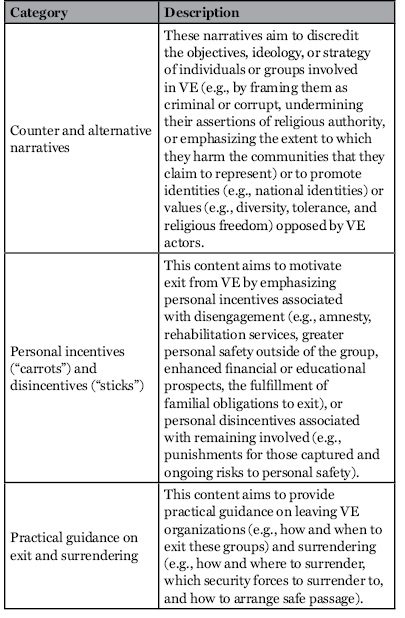
The fifth and final dimension is content, with the prevailing norm in PCVE communications being to distinguish between counter and alternative narratives. As first formulated by Rachel Briggs and Sebastien Feve, and frequently reproduced since, the former are designed to “deconstruct, discredit and demystify violent extremist messaging,” whereas the latter aim to undercut these narratives “by focusing on what we are ‘for’ rather than ‘against.’”23 This binary distinction is poorly suited to Exit Comms as it actually excludes most of the content used to promote disengagement. Specifically, it neglects content emphasizing personal incentives for those leaving these organizations (“carrots”), as well as threats of punishment and other negative consequences for those who fail to voluntarily disengage (“sticks”). It also disregards the practical guidance that these campaigns often provide on how to escape from VE organizations and surrender to the security forces, rather than why they should do so. With these issues in mind, Table 1 presents an alternative classification system of content specifically for Exit Comms, drawing on an earlier version of this typology developed through the 2023 research in Somalia.24
Table 1: Typology of Exit Comms Content
Optimizing Exit Comms
Having now outlined the five dimensions of Exit Comms, this section explores how to optimize these campaigns to increase disengagement rates. Without denying the importance of lessons learned from comparable cases, it is worth explicitly observing that those tasked with designing Exit Comms should avoid assuming that an effective campaign in one location will also succeed in another. As an obvious example, while an online campaign may deliver positive results in locations where internet access is common, it is unlikely to be as effective in remote parts of Nigeria or Somalia. Similarly, while appeals from political leaders may encourage exits in certain locations (including Somalia, as discussed above), their effectiveness is likely to be reduced in locations where these leaders are deemed to be hostile to members of specific groups on account of their religion, ethnicity, or other identity markers. It is worth also observing that many VE organizations and movements adapt to changing contexts, meaning that efforts to optimize Exit Comms must remain ongoing. For instance, some former members of al-Shabaab observed that their commanders reduced their access to mobile phones when the threat from the state security forces was at a peak.25 Of course, campaigns that rely on access to potential defectors through mobile phones are likely to be less effective under such circumstances. With such issues in mind, localized research and continuous learning are essential to the design of Exit Comms.
Beyond these broad principles, Exit Comms practitioners should be primarily concerned with two fundamental questions: whether specific campaigns achieve their desired effect, and how and why these initiatives succeed or fail. Many researchers consider randomized controlled trials (RCTs) to be the gold standard for answering the first of these questions as they randomly assign participants to treatment and control groups. However, RCTs face many practical and ethical challenges when applied to security interventions,26 and the authors are unaware of any research that has utilized these approaches in relation to Exit Comms. Instead, the above-mentioned initiative during soccer games in Colombia, and the research into radio campaigns against the LRA, applied quasi-experimental methods. These approaches are generally regarded as the strongest practical alternative to RCTs when random assignment is not possible. However, even quasi-experimental methods are likely to remain infeasible in contexts such as Somalia due to the opaque and decentralized nature of Exit Comms against al-Shabaab. While a third option is to collect data through perceptions surveys with formers, this approach cannot deliver definitive causal conclusions about the effectiveness of specific campaigns because it runs into a methodological issue known as ‘selecting on the dependent variable.’b Nevertheless, perception surveys can provide tentative or indicative findings—for instance, if only a minute proportion of formers reported that leaflets influenced their decision to disengage in locations where these flyers were widely distributed, it would be reasonable to infer that this campaign did not substantially contribute to the exit rate.
Moving to the second question identified above, those tasked with optimizing Exit Comms campaigns should also aim to understand the underlying causal mechanisms that explain how and why specific initiatives succeed or fail. Remaining with the illustrative example of the unsuccessful leaflet campaign, these practitioners would benefit from knowing whether the problem was with the messenger (the leaflets may have featured an untrustworthy source), the channel (perhaps flyers are associated with propaganda in the location in question), the format (they may have benefited from more imagery and less text), or the content (they may have delivered better results by offering practical guidance on surrendering, rather than trying to motivate exits). This plays to the strengths of qualitative research, which is designed to deliver nuanced information of this nature. For instance, the 2023 Somalia study revealed that members of some al-Shabaab units were permitted to access radio stations of their choice, others were prohibited from listening to state-run stations, and yet others were only allowed to access those that were sympathetic to the insurgents.27 This research also revealed that units maintained substantially different policies regarding when and for how long foot soldiers were allowed to use traditional mobile phones to contact their families.28 Of course, this sort of information is invaluable for helping ensure that Exit Comms campaigns actually reach their intended audience.
Policy Considerations
Exit Comms do not necessarily need to be associated with structured DDR programs because in many locations, associates instead elect to escape from their VE entities and return to communities via ‘informal’ routes. However, where DDR programs do exist, policymakers and practitioners should be acutely aware of the potential negative effects of misalignments between information provided through these campaigns and the practical realities of DDR interventions on the ground (commonly referred to as a ‘say-do gap’).29 For instance, if the rehabilitation and reintegration services provided through these programs are not as comprehensive as advertised, this information is likely to reach potential defectors and it may disincentivize some from exiting. More fundamentally, this is also true if former associates of VE entities experience unlawful detention, physical punishment, or other human rights abuses upon exit. Indeed, the fact that many OPSC defectors were processed through Giwa Barracks, a facility with a history of inhumane conditions, undoubtedly reduced the disengagement rate in Nigeria, at least until the period of mass exits from 2021.30
Policymakers should also consider ramping up Exit Comms during periods when the VE entities in question are in decline or are experiencing military reversals as these communications may be more effective under such conditions. Research from Somalia has demonstrated that this can occur for multiple reasons, including because such organizations may be less able to enforce compliance at such times, as their associates are more likely to seek exit during periods of intense confrontations, and because the ‘chaos of battle’ often creates opportunities to flee.31 Conversely, there may also be periods when policymakers should consider reducing their focus on Exit Comms because their finite resources are more urgently needed to support other aspects of the disengagement pathway. For instance, this was arguably the case during the period of mass exits in Nigeria, where the critical weaknesses in the Borno Model were in the screening, rehabilitation, and reintegration phases, rather than in the communications efforts to promote exits in the first place.32 Taken together, these observations highlight the importance of aligning Exit Comms with realities on the ground.
Conclusion
This article has presented emerging evidence suggesting that Exit Comms can provide an effective tool for increasing exit rates from violent extremism. It also delivered a structured framework to help practitioners optimize the design and evaluation of these campaigns by unpacking them into five key dimensions: audience, messenger, channel, format, and content. The core conclusion of this article is that Exit Comms should receive greater resources to strengthen their delivery and to test whether they can provide comparable results in other contexts. In an era of donor withdrawal and shrinking budgets, failing to do so risks neglecting what appears to be a highly effective tool for reducing participation in violent extremism. CTC
James Khalil is an independent DDR and PCVE practitioner who has supported interventions funded by the European Union, United Kingdom, United States, United Nations, and other donors in locations such as Afghanistan, Australia, Iraq, Kenya, Lebanon, Mali, Nigeria, Pakistan, Somalia, South Sudan, and Syria.
Andrew Glazzard is Director of the Centre for Peace and Security at Coventry University. His research examines various aspects of terrorism and counterterrorism, including terrorist disengagement programs.
John Horgan is Distinguished University Professor at Georgia State University’s Department of Psychology where he directs the Violent Extremism Research Group. His research examines the psychology of terrorist behavior.
Alastair Reed is Professor of Security and Strategic Communications at the Centre for Peace and Security at Coventry University. His research examines the role of communication strategy in counterterrorism and countering violent extremism.
© 2026 Khalil, Glazzard, Horgan, Reed
Substantive Notes
[a] It is important not to overlook the ethical issues associated with communications through formers, including how such campaigns can potentially expose them to an increased risk of being targeted by their former colleagues.
[b] The specific issue is that such samples consist only of individuals who have already exited the VE organizations in question. Without comparable data from individuals who remained with the groups, it is impossible to determine whether exposure to a given campaign was more common among those who exited than among those who did not.
Citations
[1] James Khalil, Yahye Abdi, Andrew Glazzard, Abdullahi Ahmed Nor, and Martine Zeuthen, “Reaching behind Frontlines: Promoting Exit from al-Shabaab through Communications Campaigns,” RESOLVE Network, December 2023.
[2] Alex Armand, Paul Atwell, and Joseph F. Gomes, “The Reach of Radio: Ending Civil Conflict through Rebel Demobilization,” Households in Conflict Network, July 2018.
[3] Juan P. Aparicio, Michael Jetter, and Christopher Parsons, “Peacefully Demobilizing Rebels: Identity, Emotional Cues, and the FARC,” Institute of Labor Economics, April 2023.
[4] Enzo Nussio and Juan E. Ugarriza, “Why Rebels Stop Fighting: Organizational Decline and Desertion in Colombia’s Insurgency,” International Security 45/4 (2021): pp. 167-203.
[5] Kate Ferguson, “Countering Violent Extremism through Media and Communication Strategies: A Review of the Evidence,” Partnership for Conflict, Crime and Security Research, March 2016.
[6] Samantha Treacy, Alastair Reed, and Andrew Glazzard, “A Systematic Integrative Review of Counter-Messaging Communication Campaigns Targeting Terrorism or Violent Extremism,” Behavioral Sciences of Terrorism and Political Aggression (2024).
[7] Sarah L. Carthy, Colm B. Doody, Katie Cox, Denis O’Hora, and Kiran M. Sarma, “Counter-Narratives for the Prevention of Violent Radicalisation: A Systematic Review of Targeted Interventions,” Campbell Systematic Reviews (2020).
[8] Joel P. Bowman, and Andrew S. Targowski, “Modelling the Communication Process: The Map is not the Territory,” Journal of Business Communication 24/4 (1987): pp. 21-34; James W. Carey and G. Stuart Adam, Communication as Culture: Essays on Media and Society (New York: Routledge, 2008); Harold D. Lasswell, “The Structure and Function of Communication in Society” in Lyman Bryson ed., The Communication of Ideas (New York: Harper, 1948); Claude E. Shannon and Warren Weaver, The Mathematical Theory of Communication (Urbana, IL: University of Illinois Press, 1963).
[9] Sif Heide-Ottosen, Yahye Abdi, Abdullahi Ahmed Nor, James Khalil, and Martine Zeuthen, “Journeys through Extremism: The Experiences of Former Members of Al-Shabaab,” RESOLVE Network, 2022; Khalil et al., “Reaching behind Frontlines;” James Khalil, MaryAnne Iwara, and Martine Zeuthen, “Journeys through Extremism: The Experiences of Forced Recruits into Boko Haram,” RESOLVE Network, 2022.
[10] Ibid.
[11] Khalil et al., “Reaching behind Frontlines.”
[12] Ibid.
[13] Ibid.; Khalil et al., “Journeys through Extremism.”
[14] Khalil et al., “Journeys through Extremism.”
[15] Armand, Atwell, and Gome.
[16] Aparicio, Jetter, and Parsons.
[17] Khalil et al., “Journeys through Extremism.”
[18] “An Exit from Boko Haram? Assessing Nigeria’s Operation Safe Corridor,” International Crisis Group, 2021, p. 4; Khalil et al., “Journeys through Extremism,” pp. 22-24; “Demobilization, Disassociation, Reintegration, and Reconciliation (DDRR) in Northeast Nigeria,” USAID, 2020, p. 28; Kato Van Broeckhoven, Anamika Madhuraj, Francesca Batault, Jessica Caus, Fatima Ajimi Badu, Mohammed Bukar, and Siobhan O’Neil, “Picturing Conflict: Child Perspectives from their Time with Boko Haram and their Exit Journeys,” United Nations Institute for Disarmament Research, 2024, pp. 25-27.
[19] Alexander L. Fattal, Guerrilla Marketing: Counterinsurgency and Capitalism in Colombia (Chicago: University of Chicago Press, 2018): pp. 79-110.
[20] Ibid., pp. 81-82.
[21] Ibid.
[22] Ibid.
[23] Rachel Briggs and Sebastien Feve, “Review of Programmes to Counter Narratives of Violent Extremism,” Institute for Strategic Dialogue, 2013.
[24] Khalil et al., “Journeys through Extremism.”
[25] Khalil et al., “Reaching behind Frontlines.”
[26] James Khalil and Martine Zeuthen, “Countering Violent Extremism and Risk Reduction: A Guide to Programme Design and Evaluation,” Royal United Services Institute, 2016, p. 32.
[27] Khalil et al., “Reaching behind Frontlines.”
[28] Ibid.
[29] Haroro J. Ingram and Alastair Reed, “Lessons from History for Counter-Terrorism Strategic Communications,” International Centre for Counter-Terrorism, June 2016.
[30] Khalil et al., “Journeys through Extremism.”
[31] James Khalil, Yahye Abdi, Sif Heide-Ottosen, Abdullahi Ahmed Nor, and Martine Zeuthen, “The ‘Off-Ramp’ from Al-Shabaab: Disengagement during the Offensive in Somalia,” RESOLVE Network, December 2023.
[32] Taiwo Adebayo and Abi Watson, “Managing Armed Group Defections: Lessons from the Borno Model,” Global Public Policy Institute and Institute for Security Studies, September 11, 2025.
