
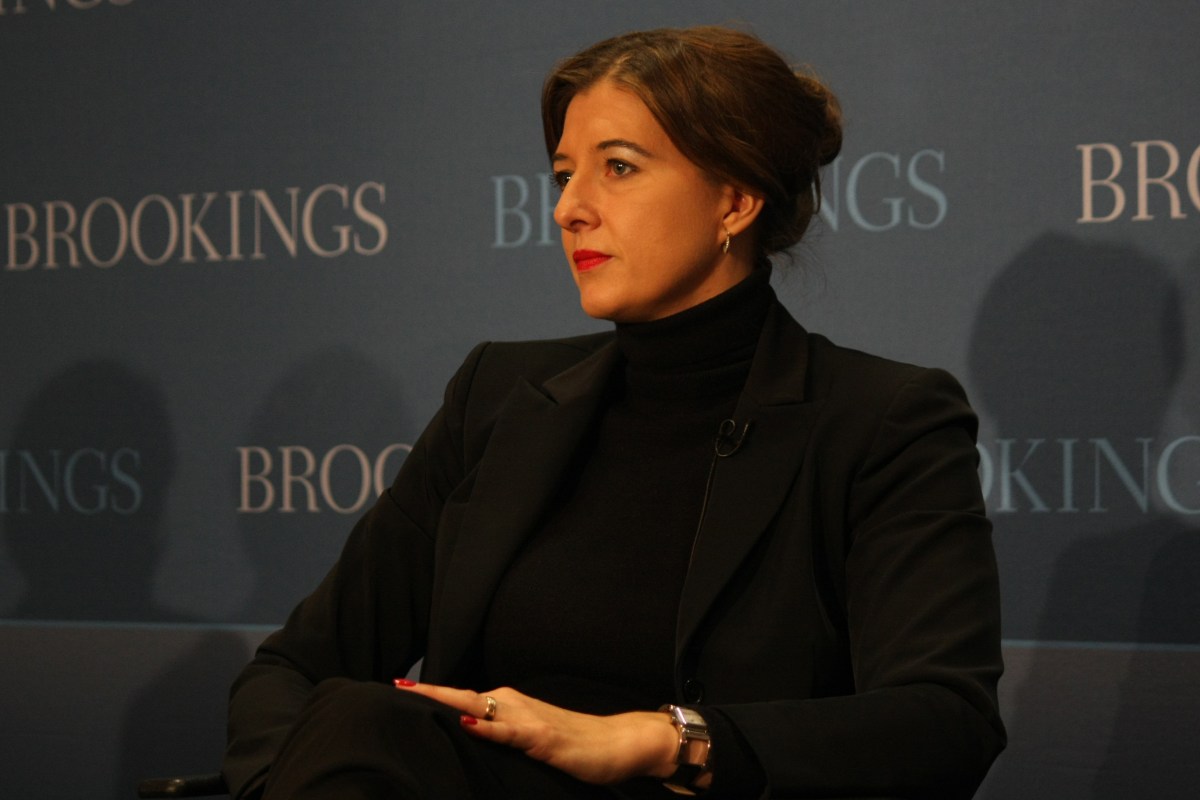
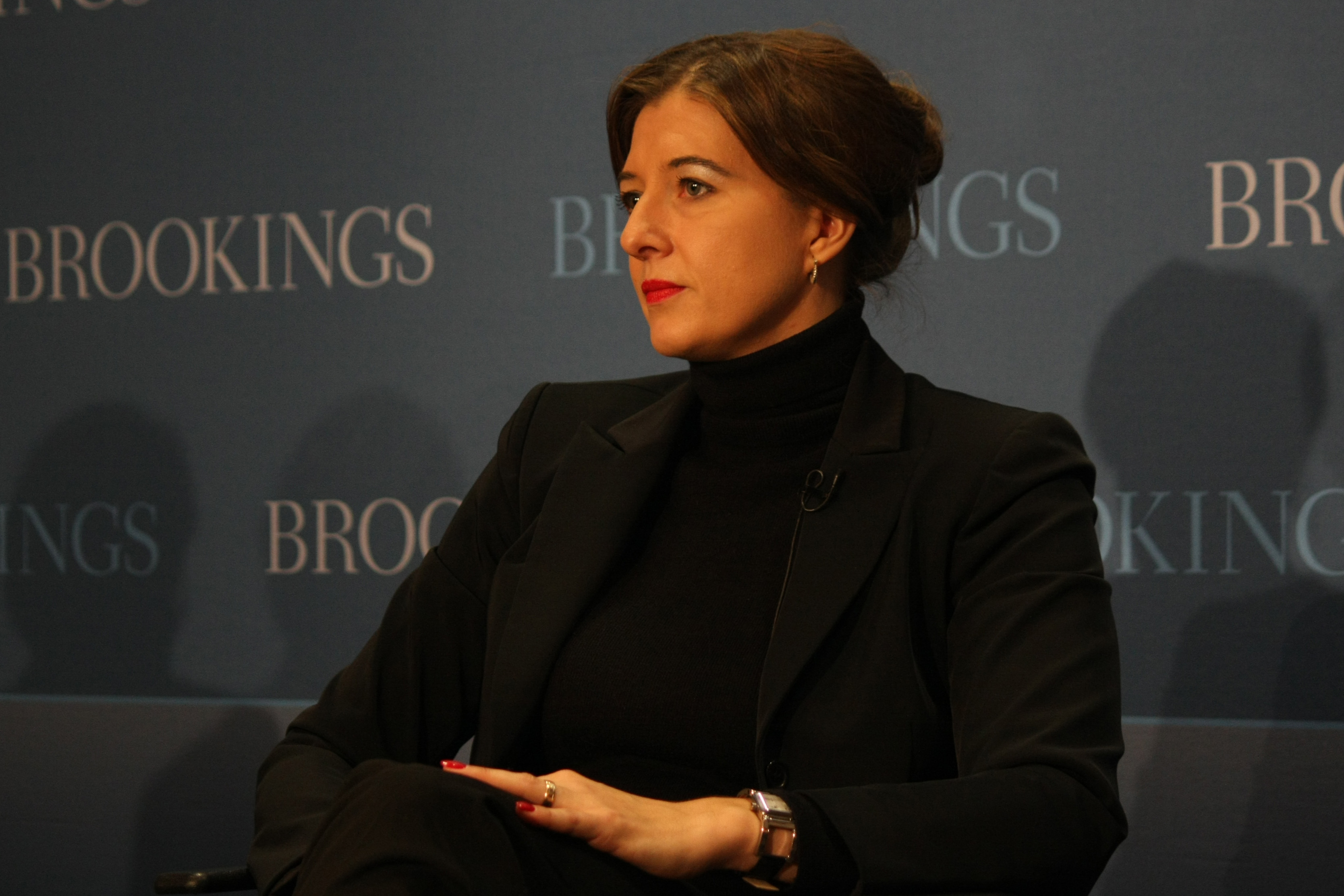
Vanda Felbab-Brown is a senior fellow in Foreign Policy at the Brookings Institution. She is also the director of Brookings’ Initiative on Nonstate Armed Actors and co-director of the Africa Security Initiative at Brookings. She directs the Brookings series “The Fentanyl Crisis in North America and the Global Reach of Synthetic Drugs” and is the host of the podcast show “The Killing Drugs.” She was also the co-director of the “Opioid Crisis in America: Domestic and International Dimensions” series.
Felbab-Brown is an expert on international and internal conflicts, insurgency, terrorism, urban violence, and illicit economies. Her fieldwork has covered Afghanistan, South Asia, Myanmar, Indonesia, the Andean region, Mexico, Iraq, Somalia and the Horn of Africa, Nigeria, and other African regions. She is the author of Narco Noir: Mexico’s Cartels, Cops, and Corruption (The Brookings Institution Press, forthcoming) and The Extinction Market: Wildlife Trafficking and How to Counter It (Hurst, 2018), among numerous other publications. Felbab-Brown received her doctorate in political science from MIT and her bachelor’s in government from Harvard University.
CTC: You are currently the director of the Initiative on Non-State Armed Actors, the co-director of the Africa Security Initiative, and a senior fellow at the Brookings Institution. You’re a renowned expert on internal conflicts, non-traditional security threats, and the author of several books. What first drew you to this field and to this problem set?
Felbab-Brown: I started working on what was then called low-intensity conflict during my undergrad time at Harvard in the late 1990s, and I was really doing two lines of work. One was nuclear strategic deterrence issues and the other was low-intensity conflict before it became counterinsurgency again. And it was a funny time to work on those issues because both seemed very emblematic of the Cold War. I was really torn about which direction I would go: nuclear strategic issues arms control or the low-intensity side. When I started my PhD at MIT, I had made the decision that I would work on the intersection of low intensity conflict and illicit economies—drugs being the one that was receiving the most attention, but illicit economies broadly. That was the year 2000, and I had a very senior political science professor who was my advisor, who said something along the lines, ‘This is an absolutely disastrous topic. What did they teach you at Harvard? Both topics are completely obsolete; you’ll never get any kind of job. Nuclear deterrence is gone but sort of still around, but low intensity conflict and illicit economies, no one will ever hire you.’ I said, ‘No, I really think there is something to it.’
I ended up working early on the issues of Afghanistan and the Taliban and suppression of poppy in 1999, 2000. And of course, a year later, you have 9/11, and I was one of the few people in the country, relatively speaking, who knew anything about the topic and ended up working early on during my PhD years on policy issues and ended up briefing the U.S. government on that and a wider set of issues.
CTC: You’ve studied cartels and TCOs (transnational criminal organizations) for many years, in addition to more traditional terrorist organizations. What have been the benefits of the U.S. government’s designation of a number of cartels as foreign terrorist organizations (FTOs) over the past year and a half?
Felbab-Brown: The issue of whether to designate criminal groups such as the Mexican cartels as foreign terrorist organizations is not a new topic. The Obama administration was exploring it. The first Trump administration was exploring it. The Biden administration was exploring it. And each of those administrations made the decision not to do it for essentially two reasons. One was that there was a sense that the designation of the cartels as Significant Transnational Criminal Groups provided sufficient powers in terms of law enforcement. And the second was that there was very strong opposition from governments—most importantly, the government of Mexico—to that designation. There was a sense that it was not worth rocking the bilateral relationship for the marginal gains. And this was, of course, also from the perspective that the right tool for dealing with the groups was law enforcement.
So, what has the designation meaningfully done? You often hear a lot of arguments that this vastly expands law enforcement powers. But when you probe people about how it expands law enforcement powers, you really don’t get very much of a substantive difference. The big difference is that now the U.S. military is allowed to deal with the organizations in terms of intelligence provision and potentially more in terms of direct military actions. We have seen that strikes against drug boats are now justified in terms of the FTO designations—that those are strikes on foreign terrorist organizations and they can be done by the military. You have a lot of legal experts questioning the legality of whether even, in the context of the war—if there are no immediate self-defense issues—the strikes on the boats are legal. But nonetheless, that’s the justification.
I would say that there are also less tangible differences. One is that even in the context of intelligence gathering, the designation kicked up the priority for intelligence gathering. And it, in some ways, also increases the importance of the cases for U.S. prosecutors. If a prosecutor can prosecute a criminal case or a terrorist case, there is often greater incentive structure for prosecuting the terrorist cases.
The designation also relates to a very important element, which is the material support clauses. U.S. counterterrorism material support clauses are enormously potent statutes, where any kind of material provision to a designated terrorist group can lead to prison sentences of decades and enormous financial penalties, as well as other issues such as visa denial if it’s a foreign entity or being cut off from the U.S. banking system if it’s an external business, for example. Now, material support is anything as little as a pencil and a cup of water, and it also includes potentially verbal advice that can be construed as material support. My view is that this has sometimes been effective, but very often it has not been effective in depriving terrorist groups of financing. But it creates this vast system of available pressure points, intelligence gathering points, and leverage, not just with the group itself, but with all kinds of auxiliary actors around the group, such as governments that might be providing support or corrupt individual government officials.
Here’s where I need to give more context again. The designation of a criminal group as a transnational criminal organization also comes with very potent material support clauses. They might be perhaps a tinge less potent than the FTO designation, but they are also very potent if an administration chooses to activate them. So, what we have seen with the Trump administration—starting in the last year of the Biden administration, but more so with the second Trump administration—is the Treasury Department being in overdrive in looking for entities to charge. I think a lot of it is very good. It’s actually great that we see Treasury indicting just today more entities on smuggling fuel to Cártel de Jalisco Nueva Generación (CJNG).1 We’ve seen narcocorrido singers being sanctioned,2 and a lot of the sanctions and the indictments, in my view, have been very well targeted. But the material support clauses are so wide that you could charge a U.S. drug user with material support. You could take a 16-year-old or 17-year-old and charge them under material support clauses that might be punishable, for adults anyway, with prison terms of several decades. We have not seen such crazy charges, but it could be possible.
Similarly, the Trump administration could potentially use the designation as a mechanism to further limit U.S.-Mexico trade. We have not seen such charges or sanctions. But take a money transfer business that sends remittances to Mexico, such as a family living, say, in Michoacán—a Mexican state with a strong criminal presence. The family might well face extortion pressures from criminal groups, because the narcos rule the life of the family, as they rule the lives of many people in Mexico. Well, if one wanted to exercise the material support clauses, whether under the FTO designation or the TCO label, you could be charging the money exchange, the financial institutions that send the money, as indirectly complicit in the financing of the terrorist group. So, there’s a vast scope of sanctioning that could take place, that could be used as a tool for limiting trade, for example. The one really good outcome with the FTO designations is that, presumably, at least financial institutions and even business institutions in Mexico will be facing greater pressure to do due diligence to avoid processing or laundering money or otherwise cooperating with criminal groups.
CTC: Going back to the designation itself, can you help our readers understand a little bit more about where there is overlap between the objectives of the cartels and the objectives of traditional terrorist organizations. Which motivations of these two types of organizations are similar and which are dissimilar?
Felbab-Brown: Very early in my work, including what became my dissertation and my first book, I made the argument that all non-state actors, if they hold a territory or they need a territory or resource base for their functioning, will need to decide how they rule. They face the classic Machiavellian choice: Do they rule through brutality alone, or do they want to be feared and loved? But that also means that there was too much overemphasis on the political versus economic motivations. Back in the early 2000s, you had the work started by Paul Collier that talked about wars for profits, for greed.3 Collier and people who followed in his school made famous arguments that wars in the 1990s had stopped being about ideology—that they became about money. I argued that even non-state armed actors that are presumably only motivated by money will still have political implications and political inclinations.4 That doesn’t mean that they—the narcos in Mexico and the criminal groups—have an ideology and that they want to topple a government. Most of the world’s criminals do not necessarily want to bring a government down and hang up the flag of a criminal actor. That said, you actually have places like this in Mexico that are run by so-called militias, but they are essentially indistinguishable from criminal groups, often just criminal groups posing as militias, that hang up the flag of its ‘independent’ territory and set up barriers around it. The territory is not just de facto controlled by a criminal group, but also comes with barriers and flags proclaiming an independent entity. And they will say, ‘This is the Republic of X, Y, and Z militias, and the government cannot formally enter here.’ But those are still exceptions. Most of the time, the criminal ruler does not seek to claim that the government is no longer present and, instead, seeks to control the government.
So even criminal groups have political implications of many kinds, and sometimes they have political ambitions and political inclinations. They certainly need to build political capital. Or they may make the choice to rule through brutality alone. But many will try to build political capital with the population. They will also seek to shape the government, to prevent the government from interfering with their business. And so, a formal ideology in the way that we understand ideologies of at least some terrorist groups, such as al-Qa`ida, for example, as a quintessential example, or al-Shabaab, might not be there. But the political focus for some criminal groups is very much there, even if the objective is not to topple the government.
Certainly today, you have criminal groups—and it’s not new and it’s not just true about Mexico—that rule territories that try to keep the government out, that rule populations, that sometimes come even with an ideology. In Michoacán, for example, you have a group called Guerreros Unidos or Carteles Unidos—they go by different names—telling teachers what to teach at school, such as the equivalent of omertà [strict silence] and obedience and family. They talk about the trifecta of the teacher, the doctor, and the priest as the core influencers who will take orders from them on how societal rule is going to take place. So, you have a real ideological element here, even if the motivation is at the end, principally not a heavenly afterlife and 70 virgins, but money and profit in one’s time here on Earth. You have groups in Mexico like La Familia Michoacana, which was one of the earlier criminal groups, and the Templarios that will surround their rituals with all kinds of ideological elements, mythology, visual ritualistic elements. This is the cult of Jesús Malverde and similar ideological rituals such as La Santa Muerte. The imagery is created toward external actors; it’s externally oriented to intimidate other groups and the populations. But it’s also internally oriented, meant to shape the behavior of members to motivate them to be fearless and to be obedient to the leader.
So, more and more, I would say that a lot of the traditional understandings and distinctions between terrorist and criminal groups don’t hold and haven’t held for a long time in my view. And it’s also equally true that you have some terrorist groups like Abu Sayyaf in the Philippines, which go through these changes of Islamists/not-so-Islamists, material for profit, then flip from al-Qa`ida to ISIS, then come back to nationalist/semi-separatist. They just shop for whatever ideology seems more resilient while the economic motivation stays.
CTC: How have criminal groups in Latin America exploited governance gaps? And beyond trafficking and extortion, in what ways do they work with those local populations, as you were mentioning, and emulate state-like governance structures, creating forms of hybrid governance that may complicate traditional counterterrorism and security responses?
Felbab-Brown: The bottom-line answer is ‘very much,’ but I would say it’s also not just about Latin American groups. If you think of the Italian mafia groups, of which there are many—the Sicily-based groups, the Napoli-based groups—all along, they were about governance. And their emergence way back in the 13th century and resurrections in the 20th century during World War II and after World War II, they were all about governance in a system where governance is either extremely feudal and skewed or very sporadic and insufficient for basic functionality.
You have similar phenomena among groups in Asia; for example, the Pakistani groups in places like Karachi are a classic example, or in India in a place like Mumbai. We have a lot of groups that don’t come in simply with muscle and extortion, but that focus on the under-provision of public services, whether it’s security, whether it’s the predictability of rules and some system of order, or whether it’s the absence of particular physical goods, which could be roads, hospitals, clinics. All of them come in with the provision of rule, the provision of safety. That might be very ethnically skewed, it might be serving particular sub-populations, it might be highly discriminatory, it might be highly abusive, it’s obviously to some extent arbitrary. There are no or limited checks and balances on it, and adherence to issues like civil liberties, human rights, and due process are just non-existent.
But in the context of vast under-provision of any kind of rule, the predictable, if authoritarian rule might be well tolerated and even welcomed by populations. In some cases, you will have the extra provision. The narcos in Mexico, the Pablo Escobars and its many descendants of paramilitary groups in Colombia, the FARC [Fuerzas Armadas Revolucionarias de Colombia], are they terrorist groups, criminal groups, insurgent groups? At some point, some have been all of it—the FARC dissident groups are also all of the above, although you don’t have the formal terrorist label now. But sometimes the groups provide cleaning of streets, cleaning of sewage. They might give money to a fiesta, they might give money to schools. The narcos in Mexico are notorious for providing funding for schools, for local churches, building local churches, soccer stadia—all of which is not that radically different than what the mafiosi would be doing in Sicily or southern Italy more broadly for several centuries.
CTC: Could you explain the roles that these traditional terrorist groups play in Latin America and how their presence might impact cartel activities? One example is Hezbollah’s continued presence in Latin America, specifically in the Tri-Border Area and Venezuela. How do these groups collaborate, and what are the roles that these groups are playing?
Felbab-Brown: Certainly, Hezbollah is the group that is best documented to operate in Latin America, primarily in the Tri-Border Region. Hamas would be the second group. Both groups, particularly Hezbollah, have extensively used the Tri-Border Area for financing, for laundering money, for participating in the drug trade. Now, Hezbollah does the same thing across Africa, where you have a lot of car dealerships linked to Hezbollah, where you have the infamous diamond trade, just a wider variety of other ordinary commodities that are not drugs and that are not high value goods like gold or diamonds, where the trade is a mechanism of financing. That is also what predominantly goes on in Latin America.
You have other instances of the use of spaces in Latin America by terrorist groups. In Brazil, for example, the criminal market is famous for high-quality, fake biometric passports. High-level Brazilian law enforcement officials told me of ISIS fighters going through Brazil to obtain fake passports there because of their high quality and then traveling with those passports to Europe. That’s one example. And then you have the 1994 bombing in Argentina of a Jewish center in Buenos Aires, an actual large terrorist attack linked to the Middle Eastern terrorist group, Hezbollah, likely at the direction of Iran. And Latin America had its own terrorists: Remember the takeover of the Japanese Embassy in Peru in 1996 by the Túpac Amaru Revolutionary Movement?
However, the big controversial issue is how tight those relationships are with Latin criminal groups. In my view, we have really not seen very tight relations. Some criminal groups in Latin America might opportunistically flirt with terrorist groups. But, for example, the fake biometric passports in Brazil have not, at least until now, been controlled by an entity like the Brazilian Primeiro Comando da Capital (PCC), perhaps the most potent criminal group in South America. The fake passport production appears to be run by individual entrepreneurs who serve a wide variety of clients, be they criminal or terrorist, as opposed to representing a big criminal group like the PCC making a lasting alliance with, say, Hezbollah. Venezuela is a place where a lot of groups come together and where you might have linkages between Hezbollah and its presence in West Africa, shipments of drugs from Latin America to West Africa to Europe. So, connections are made and they’re undesirable. But we have really not seen any large Latin American criminal group, or for that matter, any large European criminal group, cooperate with Hezbollah and saying, ‘Okay, we now have an alliance with Hezbollah or with al-Shabaab or with ISIS, and we are going to be part of the jihad.’
That is actually an important difference between the two sets of actors. Latin American criminal groups have been very willing to engage in brutal, spectacular violence, starting with Pablo Escobar and the bombing of the Avianca plane in 1989, which was the first time the term narco-terrorism is used by then U.S. ambassador to Colombia. But all of this has stayed within the country. We really haven’t seen the situations where Mexican cartels or the PCC, which is now designated as an FTO, go outside of their home country and blow up an embassy or a ship. The focus on the enemy—being the state—has always been inward. We have not seen Latin American criminal groups, even facing intense counter-narcotics pressures from the United States, going after ‘the far enemy’ like al-Qa`ida wanted to go after the U.S. in order to bring down the apostate government at home in the Middle East. Or Shabaab just falling into the eternal temptation of Somali jihadists going back to the 1990s. They always had some Ogadena or Ethiopia expansionist views; they will strike in Kenya, they will strike in Ethiopia. We haven’t seen that from any of the large cartels or criminal groups. And not just in Latin America. I really cannot think of any other globally than the D-Company, which is the Indian criminal group led by Dodwell Dawood Ibrahim. That’s the epicenter of Indian policymakers’ focus, where you have direct connections between Dodwell Dawood Ibrahim and his criminal group and terrorism from Pakistan and support for terrorist actors in Pakistan.5 But that is really the only major one that I can think about of where you have terrorist actions conducted by a criminal group outside of its country’s borders, outside of its home zone of operations.
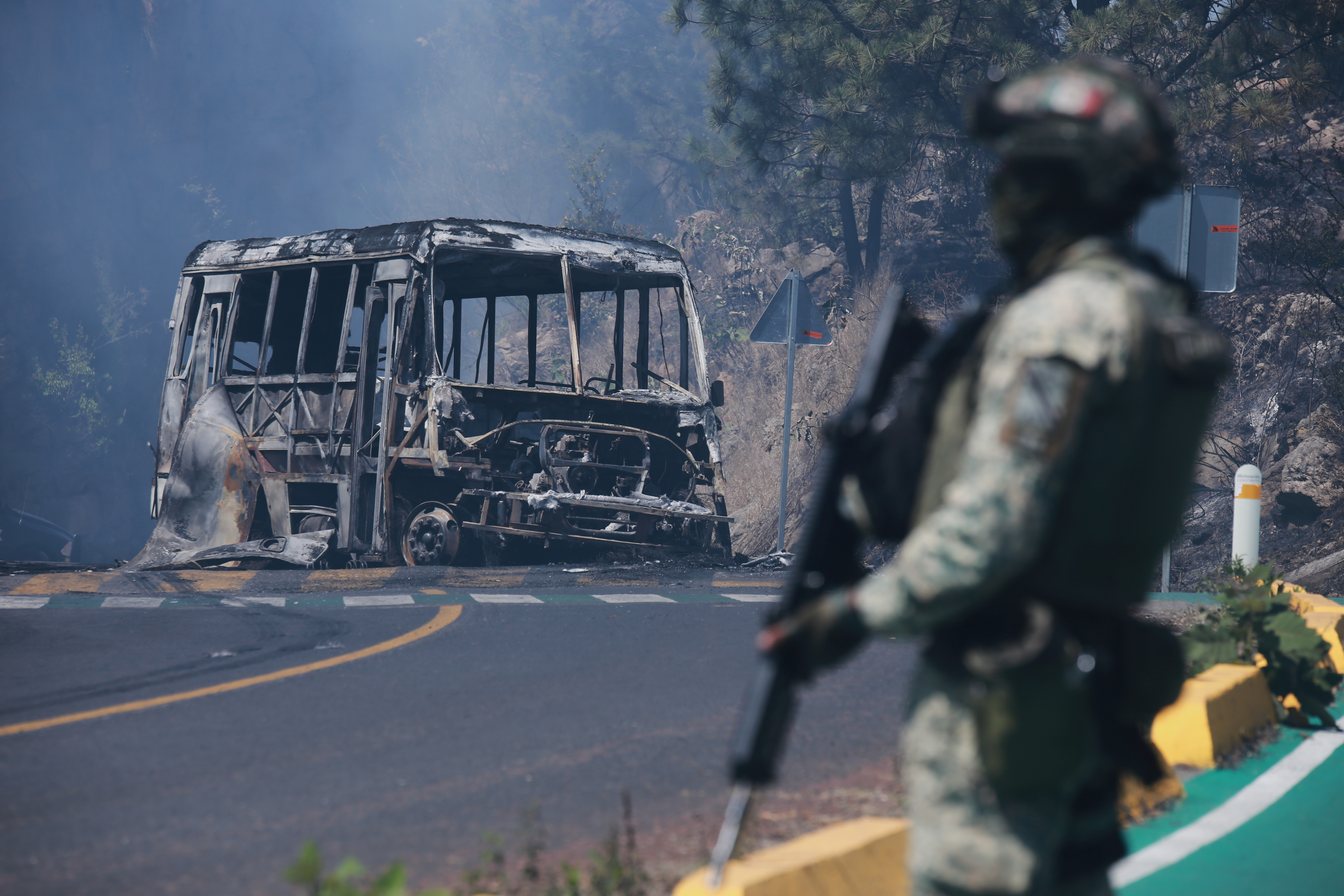
CTC: In the near future, we plan to feature an article in Sentinel that examines lessons learned from the global war on terrorism that could be applicable or are at least useful to consider in counter-cartel efforts. In your view, what strategies that have been effective against terrorist groups will also be effective against cartels?
Felbab-Brown: It’s easier to answer with what has not been effective. High-value targeting has worked in limited cases. High-value targeting was an important element of defeating the senderistas [The Shining Path] way back in the late 1980s and early 1990s. But high-value targeting, and specifically the arrest of [Shining Path leader Abimael] Guzmán and the top leadership of senderistas that was around him, including his wife and others, came after the senderistas were essentially defeated in the countryside through a policy that a) suspended eradication of drugs and b) recruited the rondas capesinas, the militias in the countryside, to fight against the senderistas. So, decapitation was the final step. The second classic decapitation success story would be the fall of the Saddam regime, except then all kinds of internal fighting and terrorism start within Iraq right after that and it becomes an extraordinarily bloody civil war and anti-U.S. insurgency. And maybe the counterterrorism campaign against al-Qa`ida could also be consider a success of high-value targeting. I say maybe because, again, lots of elements other than getting bin Ladin and certain people around him were crucial elements of the counterterrorism effort.
Now, in the crime space, decapitation alone has essentially not worked against any group of any meaningful heft and depth.6 That strategy alone has not been sufficient. I’ve written quite extensively on why that is the case, and I speculate one reason is that perhaps the skill that you need as a criminal capo [leader] puts much less of a premium on something like charisma. Perhaps logistical skills are much more important; that also means that replacement of leaders is highly feasible. The replacement might be very violent, which is a big part of the problem. It might be difficult to replace Usama bin Ladin or his successor, Ayman al-Zawahiri, but it might not be so difficult to replace someone like El Chapo, even though El Chapo might be a big logistical genius.7 Now, we have had a decapitation strategy against al-Shabaab in Somalia for years; we have had decapitation in Nigeria against Boko Haram even before U.S. involvement, and against ISWAP; we have had decapitation in Afghanistan. And the groups have not gone away. Shabaab is at least as strong as it was. Taliban is in power. Boko Haram and ISWAP are very, very strong, and insecurity in Nigeria is rampant. Then you have groups like JNIM and the rest of the Sahel space.
I have argued that what is needed with criminal groups is focusing the targeting strategy at the middle operational layer, which is not just the boss or the two bosses, but it’s really the key logisticians, the key financial operators, certainly the key political sponsors and enablers. The Trump administration here deserves a lot of credit for daring to go after corrupt or allegedly corrupt government officials, including sitting ones, such as the recent indictment of the governor of Sinaloa, Rubén Rocha Moya.8 This anti-corruption thrust is a really important direction of the anti-crime effort. Now, the Trump administration also pardoned the president of Honduras,9 who was indicted and sentenced for massive collusion with the Sinaloa Cartel and Honduran criminal groups Los Cachiros and the Valle Valle Network.10 Nonetheless, despite this decision, the expanded list of targets to include corrupt government officials is really important. So, middle-layer targeting is—in my view—a far more useful strategy, promising far greater payoffs than the high-value targeting.
Here is where the ‘but’ comes in: A lot of the militant terrorist activity presumably has some sort of end state. You hit al-Qa`ida, terrorism goes away, though perhaps another actor like ISIS may rise. But you are never going to be in a crime-free space. So, the way we need to think about crime is to, first of all, make a distinction between predatory criminality and transactional criminality. Predatory criminality is something like homicides, extortion, robberies. You want to bring predatory criminality down, and you can bring that down, and you want it to be as low as possible. You want to be living in the Western Europe system where you have one homicide per 100,000, and you have civil liberties and human rights. You don’t want to be living in a situation where homicides are 20, 30, 40 per 100,000, and criminals really determine your life in a very daily way, which they do in many parts of the world, certainly including Latin America.
But in the transactional crimes, like drug trafficking, other forms of contraband trafficking, you are very unlikely to be able to bring the illicit economy and the illicit activity to something like zero or close to zero. Sure, you want to limit the amount, but that’s an insufficient and elusive objective. What you really want is the activity to be as non-violent as possible and as distant from political structures and society as possible. So essentially, you want the drug trafficking to take place the way it does in Bethesda, Maryland, which is a very high-income neighborhood in the outskirts of Washington, D.C. Drug dealing there is very polite. There is no shooting. You don’t go to the criminal, to the purveyor of the drug, to resolve a dispute over where your fenceline sits. And you don’t want that criminal to be someone who’s corrupting local government officials and local police officers. The criminal just delivers the drugs and stays out of your life and doesn’t shoot, hands over his hands, and gets handcuffed as opposed to shooting down the police station. Which is not to say that you just want free flow of drugs; I’m not at all arguing for that. But it’s not just about limiting the flow. There is a limit how much you can push volumes down. But the way the illicit business is conducted matters very much as well, as opposed to in predatory crime, where you simply want the numbers to go down.
These, again, are significant differences where the terrorist activity is much more akin to the predatory crime. You don’t want well-behaving terrorists; you don’t want terrorists and terrorist incidents at all. And so, understanding that in this way, the two phenomena are fundamentally different, I think is important for answering what strategies are appropriate. If criminal groups provide governance, services, and have political capital with local populations, you want to take those away through strategies that sap the political capital, provide governance and services, get allegiances to switch—i.e., through the maligned or praised ‘hearts and minds’ approach. You want to deprive the violent actor of having support from local populations as much as possible by being a better administrator, by doing better at service delivery, by being less corrupt, by being far more present, by providing socioeconomic services that are meaningfully designed and are not just one-time handouts that don’t change anything. We can talk a lot about what works in the designs or not, but if you have an understanding of the criminal actors often as being providers of governance, then you need to counter them not just by shooting them down, but by addressing what gives them strength, what gives them popular support, or at least popular acceptance or tolerance.
The final element is, the more you can get at some of the financial nodes, the better. But, there is again a ‘but.’ There is a lot of self-delusion in the policy community about how much one can take away the money. And replicating the effective crackdowns on al-Qa`ida financing in the first decade of 2000 to 2010 has really not happened with any criminal group. It’s just much more challenging. Nonetheless, if nothing else, looking at the highly diversified stream of activities and income and revenues of criminal groups gives you intelligence and a better map, a better sense, of the network. Mapping out the networks and dismantling it through arrests is often a much more achievable goal than hoping that you can bring the money down by 40 percent or 60 percent, or even smaller numbers. The intelligence picture gives you the ability to act against a wider set of actors. Therefore, it is of significant value to look at how diversified the powerful criminal groups are in their lines of operations, how they operate in many commodities and activities other than drugs.
CTC: Let’s pivot to China and China’s activity in Latin America. As a starting point, could you describe the depth of cooperation that exists today between Chinese money laundering networks and Mexican cartels or Latin American cartels? And how and why did this cooperation develop?
Felbab-Brown: Essentially, Chinese money laundering groups have become the go-to money launderers for the Mexican cartels, and they have been stunningly able to displace the Black Peso Exchange Market that for 40, 50 years has been the dominant way through which Latin American groups in general, including Mexican groups, have been laundering money. And this is not just true about Latin America. We see also a dramatic rise of the Chinese criminal groups in places like Europe, Spain, France, Portugal, Italy for the Italian mafia groups. The Chinese networks are top money laundering actors.
There are several factors that give them just an incredible advantage over others. One is that they can charge very low prices for their money laundering services, because they have captive clients—i.e., people and businesses in China. China has capital controls that prevent the movement of Chinese money out of China over essentially the equivalent of $50,000 annually. Moreover, there is a lot of instability and high uncertainty in financial systems in China. In addition to personal motivations, a lot of Chinese people and businesses want to move money out of China, but they cannot do it legally. And so, we have this vast money laundering system that has served Chinese clients but that is able to impose the majority of charges onto the Chinese clients. So, the Black Peso Exchange Market would traditionally charge somewhere between 15 and 20 percent to a cartel for changing money. The Chinese networks will charge as low as one percent to a criminal group. Essentially, the bulk of the cost is shifted on Chinese clients who have no option but to use those systems. So, that’s one enormous advantage; the price mark-ups just favor Chinese money laundering networks tremendously over other money laundering systems, such as the Black Peso Exchange Market.
The second is that you can use trade-based money laundering. If you are China, you have legal business with probably every entity country in the world. If you are a Bolivian money launderer, it might be really hard to justify why you claim to have done this real estate deal or ship this amount of construction material to Mongolia. Investigators might be suspicious of that transaction. So, trade-based money laundering, even with vastly underregulated cryptocurrency burgeoning and extensively used for illicit purposes, is still one of the safest ways to launder money. Under-invoicing and over-invoicing is extraordinarily difficult for financial regulators and auditors to detect and unpack. Chinese actors are uniquely capable of doing that because of China’s global trade presence.
The third advantage is linked to the big demand in China for consumer goods—luxury goods, all kinds of goods—that allows Chinese money launderers to avoid using international banks. If you are a Mexican cartel, your biggest challenge is always dealing with liquidity, whether it’s because you need to offload and hide the vast amounts of cash collected during retail or because you need to use liquidity for, for example, warfare. It is in the retail markets, in the U.S. market or in the European markets, where you end up with vast amounts of cash. Before the rise of Chinese money laundering utilizing consumer goods value transfer, you would need to find a way into the highly regulated banking sector, with its suspicious activities reporting requirements, due diligence, et cetera, or you’d need to smuggle vast amounts of cash and then swap it for another currency. What you do now is, you go to your Chinese collector, you hand them bags of cash, and the Chinese collectors will deposit it in U.S. accounts, perhaps ‘smurf’b it around, or perhaps use a variety of students or Chinese diaspora to distribute the money, to deposit cashier checks. The Chinese launderers then just buy physical goods like cell phones and ship them to China and sell them there with a mark-up. Meanwhile, in China, the money, the value will move between two Chinese bank accounts so it’s not subject to the same level of scrutiny, just like domestic transactions in the U.S. are not subject to the same level of scrutiny as international wires. And then in Mexico, the equivalent sum of money will move between two Mexican accounts. And then the narcos will end up with having that value in Mexico and investing it in the Mexican economy or using it for other purposes. And so, this ability to bypass international banks, and use mirror transactions and value transfer among commodities, that is another really big advantage of Chinese money laundering networks.
Now, all criminals and everyone who wants to hide money are using cryptocurrencies. The Chinese are not immune to that. Chinese money laundering networks use them; Mexican cartels use them. But it’s the combination of these things—captive clientele in China, worldwide trade-based money laundering, and demand for consumer goods—combined with new transaction methods such as cryptocurrencies, and the resulting ability to avoid using international wires that gives the Chinese networks tremendous advantage all around the world.
CTC: How much does Beijing know this is going on or support this going on? Is it a bit of a turning of a blind eye because it’s advantageous in certain ways to that government?
Felbab-Brown: It’s a very tough question. It’s certainly common to allege Beijing’s complicity. I think it’s more complex. Beijing is certainly extremely unhappy about the capital flight out of China. They really don’t like that at all, and they’ve been trying to crack down on it and, for example, really muscled very strongly the governments of Southeast Asia and Australia to cooperate with catching Chinese capital flight, then repatriating it—along with people—to China. China has, however, historically not been very keen to cooperate with anti-money laundering efforts the other way, including because China’s banking system has been underregulated, and China doesn’t want to reveal the banking sector’s weaknesses and shadiness. There is fear of possible huge bubbles in China’s financial sector and other large vulnerabilities. In fact, some think China’s financial sector today might be as shaky as the U.S. financial system was in 2008 when you had the financial system crash following the burst of the housing bubble. The Chinese government fears that too much visibility into its financial system could have wide repercussion for the entire economy. Moreover, at various times, China was grey-listed under FATFc due to failures and problems in its financial due diligence. China came off the FATF’s grey list, but China still doesn’t want to really allow any eyes onto its internal financial systems.
For complex reasons, U.S.-China anti-money laundering cooperation has been mostly very limited. In general, China extends law enforcement cooperation to a country with whom it’s friendly or whom it wants to court and denies it to countries with whom it has a competitive relationship or with whom the relationship has soured. In 2024, during the last year of the Biden administration, we saw an unprecedented amount of U.S.-China anti-money laundering engagement. This is when [U.S. Treasury] Secretary [Janet] Yellen had regular meetings with her Chinese counterparts. This was the first time when the Bank of China—long accused of being a massive money laundering machine—engaged in dialogue with U.S. government officials and signed memoranda of understanding on anti-money laundering cooperation. And there were actually a few cases of investigative cooperation against money laundering between the two countries and prosecution by China, including a Chinese national who is part of the money laundering network for the Mexican cartels.11 He’s indicted by the U.S., he’s then arrested by China, China charges him. So, we went from very little to zero cooperation to some cooperation in money laundering.
China likes it when money comes into China. China does not like it when its reputation is tarnished. It’s very sensitive to issues like being put on the FATF grey list. That said, you have all kinds of domestic, political, economic constraints, including just not wanting to disclose how much of a problem there potentially is in the financial sector and how much the housing and financial sectors could unravel. And certainly, China is very opposed to capital flight out of China. So, it’s very motivated to capture money that’s leaving China. It might be less motivated to capture dirty money coming into China.
CTC: What role does China play in the drug manufacturing process and how does it fit into the larger landscape of fentanyl and synthetic opioid production in Latin America? How big of a problem is it when it comes to China and that problem set?
Felbab-Brown: China is the predominant source of precursor chemicals for synthetic drugs. This is not true just about Latin America. It’s not just true about synthetic opioids. It’s also true about methamphetamine. India is also a very important player. India is the second-largest producer of precursors for synthetic drugs. India’s pharmaceutical industry is highly under-regulated, very politically powerful, very dirty, and the Indian government is often even far more reluctant to talk about tightening regulations and acting against the vast complex of the chemical pharmaceutical sector that is a big feeder of both finished synthetic drugs and precursors for meth and synthetic opioids. But nonetheless, China is still the dominant country in the supply of precursors for synthetic drugs.
China had been under a lot of pressure since the Obama administration to reduce the flow of finished fentanyl. When China scheduled the entire class of fentanyl in 2019, fentanyl essentially stopped flowing out of China to the United States. Instead, it would be precursor chemicals going from China to Mexican cartels that then produce fentanyl in Mexico and bring it to the U.S., or precursor chemicals heading from China to Canada. Since then, the diplomatic game has essentially become ‘pressure China to schedule.’ They schedule a certain chemical, a certain precursor, and Chinese chemists adapt and start sending more basic chemicals that are called pre-precursors. Many of these very basic chemicals are of widespread use. The odds are very low that they will be scheduled because they’re just so common; you would have huge industry rebellion and pushback against their scheduling. And so, China quite likes scheduling, though it exacts a high price for scheduling. And when China schedules, the traffickers move to non-scheduled precursors.
Here is where the problem then lies: In the U.S., material support clauses would lead any actor who sent a precursor chemical to a Mexican cartel to be subject to material support statutes and, with that, massive penalties. Well, China does not have racketeering clauses, it doesn’t have material support clauses, and it doesn’t have conspiracy clauses. So, an entity in the U.S. providing a pencil, a cup of water to an FTO, including now a Mexican cartel, or even before the Mexican cartel became an FTO and it was a Specially Designated Criminal Group, can face decades in prison and just that material support is sufficient to lead to charges and punishment.
China doesn’t have any of those statutes. So, you will constantly hear from Chinese officials, ‘We cannot act against that entity because they are selling legal products.’ Meanwhile, the traffickers will advertise the non-scheduled products with notices such as ‘We know how to evade Mexican customs.’ And they will accompany the non-scheduled products with the recipes for producing fentanyl. Sometimes the traders are completely blatant. Other times, they’ll pretend that they don’t know that they are selling to a cartel. Meanwhile, Chinese traders and policy analysts insist that it is not their fault or their responsibility to know who is a cartel, who is a front for a Mexican cartel. Instead, they insist that the government of Mexico provides them with a list of companies to which they can sell. Which, of course, isn’t practical since such a list would have to be frozen and Mexican cartels could always infiltrate or coopt the listed legitimate company.
Meanwhile, China does not mandate or encourage due-diligence and know-your-customer practices in the chemical sector. This is a huge loophole. It has existed across administrations. The Trump administration has not been able to make headway with it, even with the salvo of tariffs against China in January 2025. And whether it’s through conversation, cooperation, or pressure, incentivizing the Chinese government to find a way to reliably act against the sale of chemicals to criminal actors that are not scheduled is really fundamental.
And for that matter, it’s the same issue with the Indian government. India is even behind China in scheduling, and the quality of law enforcement in India is even behind China. India’s counter-narcotics law enforcement is still very much focused on capturing heroin going across the Punjab plains or chasing actors like Dodwell Dawood Ibrahim, but not really thinking about the role of Indian pharma in the sales of industrial-potency tramadol to countries in Africa or similar drugs to countries in the Indian Ocean.
CTC: Looking toward the future, what are the two or three new developments, particularly advances in technology, such as AI drones and other emerging tools, that you think could reshape the operations of cartels and also the effectiveness of counter-cartel efforts?
Felbab-Brown: Whether it’s criminal groups or terrorist groups, the future, in my view, is much less dependent on the nexus of crime and terrorism. The hallmark of the future will be the ability of non-state armed groups to conduct a wide variety of activities at home and on their own. AI and 3D printing will allow groups to produce weapons and fake passports. There will be far less dependence on long, extensive cross-border supply chains in existence. The simplification of logistics will vastly empower non-state armed actors. Both criminal actors and terrorist actors will be able to have far longer reach with much less manpower. And this is true both in terms of violence and in terms of delivery of contraband. We are seeing criminal entities weaponizing drones. There’s been a lot of focus on Mexican cartels supposedly sending people to Ukraine, but you have had the weaponization of drones by the cartels for several years prior to that development, both to conduct targeted assassinations, and also to maintain population control and to depopulate areas.
And more and more, you will have the ability to hack and sabotage systems at home to have surveillance. So, think of your Roomba vacuum providing a perfect picture to someone who wants to rob your house. But you can also imagine all kinds of sabotage systems to kill someone. The future is much less dependent on labor for violence and for smuggling.12 It’s much more about the ability to do stuff on your own without dependence on international supply chains and international connections. This doesn’t mean that everyone will be doing everything at home, but the labor requirements have gone down. And the value of territory will be going down significantly for both sets of actors. Conducting extortion or taxation is what non-state armed actors do to raise money—be they the Taliban, Shabaab, or Mexican cartels. Often, they simply charge money on any economic activity taking place in the territory. But with that, you need to have the credibility of violently punishing someone who disobeys, who refuses to pay the tax—the zakat, the extortion fees, the cobro de piso. The ability to hack systems, impersonate people—you will have far more ability to do that, and you can be one individual and, in the end, have tremendous impact across far distances without territorial control. In the future, non-state armed actors will have the ability to bring violence, including death, to your bedroom through just hacking your systems without having to send 20 sicarios out of Colombia or Mexico to conduct the assassinations.
In the delivery space, we see the weaponization of drones; we see certainly drones for all kinds of contraband delivery. We now have surface marine drones and even very basic underwater contraband drones capable of carrying drugs across the Mediterranean,13 even as manned vessels still carry large quantities of drugs: We just had the biggest seizure of cocaine off Spain.14 The big dramatic change will be further improvements in underwater marine drones, making detection a challenge. But the existing surface marine drones are already a massive advancement that was hard to imagine 15 or 20 years ago. Whether it’s underwater or surface drones, as marine drones proliferate, then interdictions will become more challenging. Because right now, you know where drugs will head. They will head into major ports; they will head into minor ports. Islands like the Azores, islands in the Indian Ocean are natural places where drug shipments need to go through. Once marine drones carrying contraband proliferate, the entire littoral will be available for their landing. You won’t have these natural points where you know that you want to law enforcement to be monitoring.
So, much less need for labor with at-home 3D printing of weapons, passports, illicit drugs, and much less dependence on long supply chains. And at the same time, much more ability to do stuff by remote, both in contraband delivery and to conduct violence. These are all really dramatic changes empowering and transforming non-state armed actors.
Of course, security and law enforcement actors will also be taking advantage of the new technologies and be empowered by them. And so will clients of criminal groups, such as drug users. AI and 3D printing advances will enable drug users to cook drugs themselves in their home; you won’t need a criminal group to be producing illicit drugs. What if every drug user is cooking drugs at home for him or herself? Is that a safer world, a better world? Will the criminal groups put up with it, with losing the drug markets? And will drug users be producing safer drugs, or drugs that make it more challenging for public health officials to reverse lethal overdoses or counter high morbidity effects?
You can imagine all kinds of new domains of criminal activity becoming available to many more actors. Just think of the scams. The proliferation of AI images will empower extortionists: AI can generate an image that looks exactly like your grandson, a seemingly very beaten up and tortured grandson presumably being held hostage and subject to death, unless grandma pays. That image can easily become an avatar complete with the voice mimicking the voice of the actual grandson. A criminal can then create a video call with the grandmother and enhanced its credibility by describing the grandmother’s living room based on intelligence from her hacked Roomba: ‘Hey, grandma, I’m being brutalized by Nigerian human smugglers. And I know when you sit in this chair, I know exactly what the chair looks like. Please wire this money to save me.’ You will have many people falling prey to such scams. As financial security officials working in Mexico’s banking sector told me in April, right now, you have Mexican cartels capturing people’s voices. They’ll record people’s voices and then use AI to produce voice signatures and voice phrases and call Mexican banks with that, and Mexican banks then use it as sufficient authorization to access bank accounts and do bank accounts transactions. And, of course, people lose a lot of assets through such scams. It’s quite prevalent in Mexico.
One other thing I would add to the trend of non-state armed actors in the future having much less need for territory, much less need for labor, and much less dependence on transnational flows and supply chains, is also the implication that they will be able to obtain less political capital. Right now, you control territory and you give stuff to people and you employ a lot of people. If you are a terrorist group, such as the Baader-Meinhof Gang,d maybe you employ only 10 people, for example. But if you are a Mexican cartel, you’ll probably be employing thousands of people, and you get political power by giving employment to people. A combination of synthetic drugs replacing plant-based drugs, drones, and other tech reducing labor requirements means a much smaller need for labor and many fewer opportunities to employ people. The synthetic drugs revolution alone means that you have gone from millions of people working in cultivation of drug crops to thousands of people globally cooking synthetic drugs; that’s a three order of magnitude decline in labor requirements and labor opportunities.
So, you have really interesting political capital implications: i.e., a big decline in political capital for non-state armed actors. And you also have really interesting social implications, one of which is that for millennia, the criminal space was the social pressure release valve: People who were unable to work in the legal economy would find employment in the illegal one. Well, that illicit opportunity and basic livelihood survival space might now close to many because the illegal economy will be conducted by a few. And so, what’s going to happen to the people who don’t have jobs now, many more who will be laid off as a result of AI, who even might not be employable even in the traditional criminal sphere? Are they all going to be joining insurgencies? Or roam around as predatory gangs? Does the future include apocalyptic-like, anarchistic phenomena—essentially banditry for survival—since even the criminal economy will not sufficiently provide for employment and income and social identity? I don’t think that’ll be in the next five years, just to be clear.
CTC: But maybe the next 10 years?
Felbab-Brown: I would say certainly in the next 20 years. We will be very quickly exploring whether social systems and political systems have adapted to prevent that, or whether we are really heading into the grips of that kind of future. Certainly, I think that the technological changes about which we talked and their implications for non-state armed actors are well underway. Whether in five or 10 years, we are in Cormac McCarthy’s The Roade-like imagery, I don’t necessarily think so. But in the span of two decades, we’ll be really living through whether social systems have provided new safety nets, whether there is reimagined distribution of economic opportunity, whether political systems have been rearranged sufficiently, and whether there is enough value being generated and distributed to cope with the fact that many fewer people will be employable by anyone—in the legal sphere or the illegal sphere. CTC
Substantive Notes
[a] Editor’s Note: The Ogaden, located in southeastern Ethiopia, is predominantly inhabited by ethnic Somalis.
[b] Editor’s Note: “A smurf is an individual(s) who makes numerous same-day currency deposits of less than $10,000, usually at several different banks, to evade the filing of Currency Transaction Report (CTR). The act of conducting such transactions is termed ‘smurfing.’” “Part 9. Criminal Investigation, Chapter 5. Investigative Process, Section 5. Money Laundering and Currency Crimes,” Internal Revenue Service, last reviewed or updated on April 30, 2026.
[c] Editor’s Note: “Organized by the G7 in 1989, the Financial Action Task Force (FATF) is the international standard-setting body for anti-money laundering (AML), countering of the financing of terrorism (CFT), and countering proliferation financing (CPF).” “About: Financial Action Task Force (FATF),” U.S. Department of the Treasury, n.d. “When the FATF places a jurisdiction under increased monitoring, it means the country has committed to resolve swiftly the identified strategic deficiencies within agreed timeframes and is subject to increased monitoring. This list is often externally referred to as the ‘grey list.’” “‘Black and grey’ lists,” FATF, n.d.
[d] Editor’s Note: The Baader-Meinhof gang was “Germany’s most notorious far-left guerrilla group … whose members killed more than 30 people in the 1970s and 80s.” It dissolved itself in April 1998. See “Who were Germany’s Red Army Faction militants?” BBC, January 19, 2016.
[e] Editor’s Note: The setting of Cormac McCarthy’s 2006 novel The Road is a brutal, post-apocalyptic world following a cataclysmic global disaster.
Citations
[1] Editor’s Note: “US Treasury and Mexico’s UIF team up to target cross-border fuel theft by the Jalisco cartel,” Mexico News Daily, July 2, 2026; “Treasury Targets Criminal Facilitators Behind CJNG’s Cross‑Border Fuel Smuggling Schemes,” U.S. Department of the Treasury, June 30, 2026.
[2] Editor’s Note: Vanessa Buschschlüter, “Mexican band has US visas revoked for ‘glorifying drug kingpin,’” BBC, April 2, 2025.
[3] Editor’s Note: See Paul Collier and Anke Hoeffler, “Greed and Grievance in Civil Wars,” The World Bank Development Research Group, Policy Research Working Paper 2355, May 2000.
[4] Editor’s Note: See Vanda Felbab-Brown, “Human Security and Crime in Latin America: The political Capital and Political Impact of Criminal Groups and Belligerents Involved in Illicit Economies,” Applied Research Center, Florida International University, September 2011; Vanda Felbab-Brown, Shooting Up: Counterinsurgency and the War on Drugs (Washington, D.C.: Brookings Institution Press, 2019); and Vanda Felbab-Brown, Harold Trinkunas, and Shadi Hamid, Militants, Criminals, and Warlords: The Challenge of Local Governance in an Age of Disorder (Washington, D.C.: Brookings Institution Press, 2017).
[5] Editor’s Note: For more on Dawood Ibrahim, see Animesh Roul, “Dawood Ibrahim: India’s Elusive Most Wanted Man,” Militant Leadership Monitor, South Asia 1:6 (2010).
[6] Editor’s Note: For example, see Vanda Felbab-Brown, “The successes and problems of high-value targeting strategies around the world,” Brookings Institution, October 19, 2022.
[7] Editor’s Note: Vanda Felbab-Brown, “Mexico’s Out-of-Control Criminal Market,” Foreign Policy at Brookings, March 2019.
[8] Editor’s Note: “U.S. charges 10 Mexican officials, including Sinaloa governor, with drug trafficking,” CBS News, April 29, 2026.
[9] Editor’s Note: William K. Rashbaum, Maggie Haberman, Kenneth P. Vogel, and Jonah E. Bromwich, “Former President of Honduras Is Freed From Prison After Trump Pardon,” New York Times, December 2, 2025.
[10] Editor’s Note: “Juan Orlando Hernández, Former President of Honduras, Indicted on Drug-Trafficking and Firearms Charges, Extradited to the United States from Honduras,” U.S. Department of Justice, April 21, 2022; Seth Robbins and Alex Papadovassilakis, “US Indictment of Honduran Ex-President Spells Out 20 Years of Drug Ties,” Insight Crime, April 21, 2022.
[11] Editor’s Note: “Treasury Sanctions Mexico- and China-Based Money Launderers Linked to the Sinaloa Cartel,” U.S. Department of the Treasury, July 1, 2024; “Federal Indictment Alleges Alliance Between Sinaloa Cartel and Money Launderers Linked to Chinese Underground Banking,” U.S. Department of Justice, June 18, 2024; Antoni Slodkowski, “China police probe drug-related money laundering operation after US tip,” Reuters, June 19, 2024.
[12] Editor’s Note: See, for example, Vanda Felbab-Brown and Diana Paz García, “How technology is transforming crime and terrorism,” Brookings Institution, April 13, 2026.
[13] Editor’s Note: See Leo Sands, “Drug smuggling: Underwater drones seized by Spanish police,” BBC, July 4, 2022.
[14] Editor’s Note: “Spain seizes 30 tons of cocaine in record European haul, detains 23 crew,” Reuters, May 7, 2026.
