
Abstract: On June 2, 2026, two U.S.-designated foreign terrorist organizations in Iraq—Asaib Ahl al-Haq and Kataib Al-Imam Ali—announced their intention to begin the handover of their heavy weapons to the Iraqi state. Their statements came hot on the heels of the most intense military campaign fought by the Iran-backed militias (the ‘muqawama’) since the withdrawal of U.S. combat forces from the country in 2011. This campaign witnessed unprecedented military integration between Iran’s Islamic Revolution Guard Corps and hundreds of Iraqi collaborators spread across at least 36 major units in Iraq’s state-run Popular Mobilization Forces (PMF). Iraqi militia groups targeted U.S. bases, Jordan and the Gulf States, and Iraqi energy sites, sustaining an operational tempo that was an order of magnitude higher than in any previous conflict. The unprecedented military integration of the muqawama, including the capture of large swathes of Iraq’s state-funded security forces by militias and Iran’s Islamic Revolutionary Guard Corps, poses serious risks for Iraq’s stability, for U.S.-Iraq relations, and complicates the deterrence, sanctioning, and potential disarmament of Iraqi muqawama.
This study is the ninth in a series of CTC Sentinel articles since 2019 that have detailed the ongoing rise of the self-styled, Tehran-backed resistance (muqawama) factions in Iraq, and of Iran’s growing dominance within the Iraqi state. While more recent pieces since 2023 have focused on militia ‘capture’ of non-military institutions of the Iraqi state (political,1 oil,2 telecommunications3), this study will revisit the original focus on accelerating militia capture of the security sector and the acute security threat posed by Iran-backed militias in Iraq to Iraqi citizens, the Iraqi government, the United States and other international presence in Iraq, and to the broader region, notably the Gulf States.4
To recap this body of work briefly, the first was the August 2019 CTC Sentinel report5 on the growing geographic control and government funding of the Popular Mobilization Forces (PMF), Iraq’s equivalent of the Iranian Islamic Revolutionary Guard Corps (IRGC).6 This study, “Iran’s Expanding Militia Army in Iraq,” showed how a new parallel military had been created in Iraq during the opening days of the counter-Islamic State war in 2014 by Iran’s closest militia partners in the country, increasing the size of those Iran-backed militia forces 15-fold.7 The piece built on Knights’ 2017 identification of a pan-Shi`a PMF “colonization zone,” where the predominately Shiite PMF had established long-term garrison presence and economic value extraction systems in majority-Sunni areas.8 “Iran’s Expanding Militia Army in Iraq” was the first studya to fully map out PMF areas of control across Iraq. A book-length study of the PMF then followed9 (co-authored with Hamdi Malik and Aymenn al-Tamimi) that examined the dominant roles of the IRGC-founded Badr and Kataib Hezbollah in the leadership and organization of the PMF.
Four more CTC Sentinel studies followed, digging deeper into the military organization and activities of the Iraqi muqawama. In February 2020’s “Soleimani is Dead,” the key research question was why the Iraqi muqawama chose to restart kinetic operations against the U.S. diplomatic and military advisor presence in Iraq for the first time since the end of the post-2003 U.S. military mission in 2011.10 Later in November 2020, “Back Into the Shadows” discussed how Kataib Hezbollah emerged from its “incubator,” the Badr movement, and became the premier IRGC partner force in Iraq, and how KH was positioning to be the coordinator of a strata of Iran-backed militias within the PMF that was increasingly focused on projecting power via missile bases in Iraq and Syria.11
In the 2021 CTC Sentinel article “Discordance in the Iran Threat Network in Iraq,” an enlarged author team (including Crispin Smith and Hamdi Malik) described in detail how the IRGC Quds Force (IRGC-QF) under its new commander, Brigadier General Esmail Qaani, had developed a military coordination forum (the tansiqiyah)b by the end of 2020 that could deconflict proprietary single-group muqawama military efforts and also employ new IRGC-QF-directed “teaming” efforts that drew upon the most dedicated anti-U.S. militants from across the PMF personnel base.12 While December 2023’s article “Iraq’s New Regime Change” was more focused on militia state capture of non-military organs,13 it included a section on IRGC-QF’s ongoing efforts to coordinate Iraqi militia attacks against the United States and Israel after the October 7 massacres.14
Structure of the Study
This study will take forward the chronology of the military evolution of the Tehran-backed muqawama factions in Iraq by looking in depth at Iraqi militia military performance in the 2026 war between Iran and the U.S.-Israel coalition. The article draws upon the same kind of detailed interview process with U.S. and Iraqi subjects that underpinned the prior CTC Sentinel studies referenced above, including detailed attack data provided by Knights’ on-the-ground contacts in Iraq.
Such interviews are undertaken within the context of a broader investigative effort that draws upon deep, existing datasets and an author team with 40 years of consecutive, overlapping experience monitoring the Iraqi militia scene, including all of the post-2014 period in which the PMF has existed. The geolocated incident database maintained by two of the authors (Knights and Almeida) is a key source of information, including two decades of geospatial place-marking of militia attacks, militia bases, security force locations, and other contextual information. Extensive, judicious use was made of muqawama propaganda materials gathered on platforms including Telegram,15 including close analysis of muqawama attack claims through posted statements, purported launch footage, and propaganda videos.c The article also builds upon the numerous relevant entries and group profiles in the Militia Spotlight blog, which two of the authors (Knights and Smith) founded and ran.d This, plus open source image collection and verification, allowed for the creation of a dataset of weapons intelligence images related to muqawama attacks in the current war. All these layers have combined to create this article, which is a synthesized research product based on feeds from human intelligence, social media intelligence, weapons intelligence, and open-source intelligence.e
To begin with, the study provides key context and recaps the historic playbook of muqawama involvement in military conflicts involving Iran. This shows an underwhelming record of Iraqi contribution until this current war. The article then proceeds and is organized in three parts. In Part I, the article timelines five observed phases of Iraqi militia involvement in the 2026 war, a conflict that witnessed unprecedented militia mobilization of the Iraqi state’s PMF personnel, bases, and military materiel in support of Iranian regime objectives. In Part II, the article explores the four fronts in the Iraqi muqawama war effort—and the vital fifth front of information warfare (deception and psyops) and lawfare. Part III builds off of the article’s prior two parts and more thoroughly examines the support and assistance that Iraqi Popular Mobilization Forces provided to Iran’s war effort. It identifies PMF units and locations that are demonstrably linked to the Iran threat network, with a special focus on the Badr Organization, which functioned, in effect, as a part of the IRGC order of battle (from which it was born in the 1980s).16 The concluding section highlights emerging issues and outstanding questions for policymakers and intelligence analysts to pay attention to.
The overarching theme of this article and its component parts is that the current Iran/U.S.-Israel war has exposed a far broader and deeper pattern of PMF complicity in terrorist actions against Iraqis, U.S. persons, and nations in the Arab world and Europe. Thirty-six PMF units, about half the formations of the PMF, have demonstrably provided material support to U.S.-designated foreign terrorist organizations such as the IRGC, IRGC-QF, KH, Kataib Sayyid al-Shuhada (KSS), Harakat al-Nujaba, Harakat Ansar Allah al-Awfiya (HAAA), Asaib Ahl al-Haq (AAH), Kataib al-Imam Ali (KIA),f as well as the Badr Organization and many smaller undesignated groups. Major PMF forces also deployed inside Iran during the war (see Phases and Badr sections below),g without formal Iraqi government approval, effectively setting their own foreign and security policy independently of the Iraqi state—the country that financially supports the PMF and in direct violation of Iraq’s constitution and laws.h
In the view of the author team, this suggests that counter-militia reforms in Iraq sought by the United States need to reflect this broader and deeper Iranian and Iraqi muqawama penetration and instrumentalization of the PMF. Large swathes of the PMF have turned into a parallel military that undertook to fight its own war with the United States—a war that other parts of Iraq’s government did not declare and is not a formal party to (but may nevertheless bear some legal responsibility for).i This should be of strong interest to any U.S. agency charged with monitoring the implementation of security sector reform in Iraq or executing the maximum pressure effort on Iran’s regime, most recently re-energized in February 2025 by the United States via National Security Presidential Memorandum 2 (NSPM-2).17 j
Context: Recapping the Historic Playbook of Iraqi Militias in Recent Wars Involving Iran
Until the present war, the Iraqi muqawama arguably had a poor record as a military force. The start had been promising in the 1980s: The Badr Corps had been formed from Iraqi Shiite exiles and prisoners of war and had fought in the Iran-Iraq War as a light infantry division within the IRGC order of battle.18 In the 1990s, Badr had supported a low-level, cross-border insurgency against Saddam Hussein’s military from bases in western Iran.k In 2003, Badr entered Iraq as a military division via the Iranian border at the same time that U.S. forces were racing toward Baghdad.19 After Saddam’s fall, Badr saw many of its fighters folded within the U.S.-backed new Iraqi military, where they mostly fought alongside, instead of against, U.S. soldiers.20
Other Badr militants (self-styled muqawama) instead fought an insurgency against American and British forces in Iraq prior to 2011,21 but they represented such a small proportion that they were termed ‘special groups’ and were dealt with as a terrorist threat operating with the connivance of some parts of the Iraqi government and Shiite body politic, but not all or even most.22 Prior to 2011, Iraqi Shiite militants had not deployed to fight in Iran’s conflicts outside Iraq, and were not regularly attacking the Gulf States, the United States, or Israel in support of Iran’s regional policy of ‘resisting’ these states.l
The Iraqi muqawama began to take on broader regional military tasks from 2011 onward, driven by opportunities created by the Arab Spring, the start of the Syrian civil war, and the withdrawal of U.S. combat forces from Iraq.23 Iraqi muqawama bases became sanctuaries and training grounds for Gulf Shiite militants from Bahrain and Saudi Arabia in the low-level terrorist campaigns that Iran supported after the Arab Spring protests in those countries.24 The muqawama quickly refocused its most restless and aggressive IRGC-supported commanders and forces on providing a foreign legion of Iraqi Shiites to support the Assad regime and Iranian policy in Syria.25 (Iraq’s prime minister and parliament, the sole constitutional authorities allowed to command forces and declare war, did not authorize this decades-spanning military mission.26) Within Iraq, the 2014 formation of the PMF (under the leadership of U.S.-designated terrorists)27 in theory folded most of the muqawama under an Iraqi state umbrella, but this did not restrict the ability of Iraqi fighters to take part in foreign wars en mass.28
By 2017, with the Islamic State territorially defeated, the Iraqi muqawama began to turn back toward anti-U.S. militancy.m This coincided with—and perhaps was hastened by—the post-2017 U.S. policy of applying “maximum pressure” to Iran.29 In 2017-2019, shadowy, ill-defined groups of Iraqi muqawama were threatening anti-U.S. and anti-Gulf actions30 and by May 2019 were undertaking counter-pressure actions on Iran’s behalf against U.S. partners in the Gulf, demonstrating that U.S. pressure on Iran’s oil industry would be met with Iraqi explosive drone attacks on Saudi Arabia oil export infrastructure.n When major protests against Iran and its partners took place in Lebanon, Iraq, and then Iran itself in 2019, the Iraqi muqawama may have interpreted this as a deliberate U.S. and Israeli effort to overthrow the Iranian government, Lebanese Hezbollah, and the militia-backed government in Iraq.o The January 3, 2020, U.S. killing of IRGC-QF commander Qassem Soleimani and Iraq’s senior muqawama leader Abu Mahdi al-Muhandis energized years of muqawama revenge attacks, compounding the pre-existing militant effort to compel the removal of all U.S. forces from Iraq.31
Iraqi Underperformance in Iran Threat Network Conflicts
Yet, in the assessment of the author team, for all the bluster, the Iraqi muqawama’s military bark proved to be way worse than its bite in 2020-2025. In 2020-2023, as CTC Sentinel has chronicled in detail, the Iraqi muqawama were rebuilding themselves after the loss of Soleimani and al-Muhandis, but they never notably avenged their deaths32 and only tentatively attacked U.S. forces in Iraq and Syria. Even these attacks were usually undertaken from behind the cover of “façade” online brands (which the authors have previously termed “façade groups”33) used to claim attacks—an effort to derive some intra- and inter-group credit, while veiling the exact identity of the attacking group to external parties. Prior to 2023, the Iraqi muqawama did not contribute to the ‘Axis of Resistance’ struggle against Israel, even during the major military crisis in Gaza in March 2021.p They were quite easily deterred from continuing their short-lived attacks on Turkish bases in Iraq in 2022 after Turkish retaliation struck muqawama sites in northern Iraq.34
It was only after the October 7, 2023, massacres in Israel that the Iraqi muqawama sought to mount a high-tempo, sustained military campaign against the U.S. presence in Iraq and against Israel. First, the Iraqi militias focused on their near enemy: the U.S. bases in Iraq and Syria. The tempo of Iraq-launched attacks against U.S. bases in Iraq and Syria achieved a metronomic-like cadence of regularity that had never been seen before,35 but the Iraqi groups nonetheless proved fragile when threatened by painful reprisals.36 From October 2023 until February 2024, the Iraqi muqawama mounted 197 strikes (an average of 1.75 strikes per day) on U.S. bases in Iraq, Syria, and Jordan37—a very high tempo compared to the 0.2 attacks per day reported in 2020-2022.38 But this new level of effort came to a halt and the more tentative approach returned as soon as the U.S. mounted a trio of painful leadership strikes on muqawama commanders between December 2023 and February 2024.39
The Iraqi muqawama then switched its main target to Israel, launching 157 long-ranged attacks (at a rate of 0.67 per day) on Israel from February 2024 until Lebanese Hezbollah leader Hassan Nasrallah’s assassination by Israel on September 27, 2024.40 After Nasrallah’s funeral, which was attended by numerous Iraqi muqawama representatives,41 Iraqi group’s attack numbers rose to 2.69 per day against Israel for about six weeks.42 But again, the Iraqi groups curtailed their attacks almost entirely (to 0.5 attacks per day) after Israel made rhetorical threats of retaliation against the Iraqi muqawama at the United Nations in November 2024.43
Things went from bad to worse for the transnational military record of the Iraqi muqawama. In December 2024, the Iraqi groups did not cross the Syrian border to aid the Assad regime44 and only acted as a shelter for retreating Iraqi, Syrian, Afghan, and Pakistani militias supported by Iran.45 The muqawama laid very low for the whole first year of the U.S. President Donald Trump’s second term in 2025, with Iraqi groups participating only in a limited way in the Iranian military response during the Twelve Day War between Iran and the U.S.-Israel coalition in June 2025.q Finally, in August 2025, facing U.S. sanctions threats, the muqawama were unable to pressure the Iraqi body politic into passing a law that would have permanently enshrined the PMF as a government ministry.46 The United States has breezed right past every deadline for U.S. military withdrawal ever set by the Iraqi muqawama.47
By the lead-up to the current war, the Iraqi ‘resistance’ had arguably thus not been effectively resisting the United States or Israel for years.r The Iraqi muqawama demonstrated little ability or even willingness to powerfully back Iran or Lebanese Hezbollah, or to avenge the killings of Iranian, Hezbollah,s and even Iraqi militant leaders.t The Iraqi groups seemed to collectively have a ‘glass jaw’—the term for a boxer who was easy to knock-out with the right punch—in this case referring to the muqawama’s sensitivity to U.S. and Israeli threats to their leaderships. When the kinetic cells of the muqawama did strike in 2025, they seemed content to burnish their militant raison d’être purely with niche strikes on soft targets such as the Iraqi Kurds, oil investors in Iraqi Kurdistan, and defenseless Iraqi civil society—what the authors would characterize as the twisted militia equivalent of empty ‘virtue signaling.’u
By the start of 2026, this left the Iraqi muqawama firmly in the shadow of the Houthi movement, Ansar Allah.48 Despite attempting to hit Israel far less frequently than the Iraqis, the Houthis emerged from 2025 with a far better claim than Iraqi groups to be Iran’s strongest remaining military partner, with a proven track record of never bending in the face of the Saudi-led Gulf Coalition, a U.S.-U.K. joint effort, and the Israelis.49 But there was always reason to believe that many Iraqi fighters and their leaders felt embarrassment due to their growing second-class status as militants, and that they might play a more significant role in a future war.v
Part I: Phases of Iraqi Militia Involvement in the Current War
With Lebanese Hezbollah still recovering and fighting for survival,50 and with Yemen’s Houthis also either rearming or mostly showing restraint in the 2026 conflict,51 the Iraqi armed factions have had a rare opportunity to break the above pattern and function as the IRGC’s main military partner. In the author team’s assessment, the Iraqi muqawama have arguably risen to this challenge, to the best of their ability. The 2026 conflict has shown a different side of the Iraqi muqawama: a tougher, more risk-acceptant side that has seen the Iraqi groups claim to have undertaken their most intensive ever series of attacks against the United States, Kurdistan, Jordan, and the Gulf States. (As detailed by two of the authors (Smith and Knights) in a recent issue of CTC Sentinel, the Iraqi muqawama also mounted its first known attempted ‘external operations’—the series of terrorist attacks attempted by the “Harakat Ashab al-Yamin al-Islamiya” (the Islamic Movement of the Companions of the Right Hand (HAYI or IMCR)) terrorist effort in Europe and North America.52 w)
In the view of the author team, the evident expansion of Iraqi muqawama operational tempo has required both a much broader utilization of PMF armed forces inside Iraq, and unprecedented Iranian logistical and ‘advise and assist’ support to the Iraqi factions. If studied carefully, the 2026 war is probably uniquely rich as a source of insight about the changing nature of the Iraqi Shiite armed groups, their instrumentalization of the state-funded PMF, and their military relationship with Iran. The following is a preliminary effort to break the Iraqi war effort since early 2026 down into its key phases (with the nomenclature of the phases being the author teams’ characterization, not that of the militias themselves, unless explicitly stated).
Phase Zero: Preparation (January-February 2026)
Phase Zero was characterized by pre-conflict preparation and signaling. In the assessment of the author team, the Iraqi muqawama had worked in the first months of 2026 to prepare themselves for a larger role in a conflict that was widely expected to be an existential struggle for the Islamic Republic of Iran, with potentially far-reaching consequences for the Iran-backed Iraqi groups as well.53 With war looming, weapons systems were shown off by the Saraya Awliya al-Dam (SAD) façade brand (which the authors assess to be operated by Kataib Sayyid al-Shuhada or KSS).54 A large cave was the setting for the January 31, 2026, video55 x and many later SAD propaganda videos.y In the cave, SAD displayed a double-rail truck launcher carrying two ‘al-Qari’ Close-Range Ballistic Missiles (CRBMs),z plus an assortment of Iran-produced drone systems, including Shahed-101s and heavier Shahed-107s and Ababil (Qasef-2K) drones.aa
Probably in anticipation of being targeted intensively, as interviews undertaken by one author (Knights) suggest, the muqawama dispersed missile and drone systems to new hide sites by February 21, 2026, a week before the war started.56 This ‘shuffling’ was reported to be occurring at scale in Nineveh (facing targets in the Kurdistan Region of Iraq (KRI) and in western Anbar (facing Jordan and Israel), and may have happened elsewhere as well.57 Counting new arrivals and pre-existing stocks, the muqawama was then in possession of what the authors will call their “first load” of munitions.58 Other long-range weapons—possibly existing stocks of cruise missiles—were dispersed to industrial areas adjacent to Kataib Hezbollah’s Jurf as-Sakr redoubt.59
According to interview material gathered by one author (Knights),60 there was also an inflow of Iran-provided advanced conventional weapons (i.e., drones and missiles) around February 15-20. This included complete weapons systemsab but also stocks of drone components needed to facilitate local assembly.ac Other interview material also suggests a parallel effort in February and March to accelerate a pre-existing effort to ‘salvage’ Iran-provided advanced conventional weapons that had been left in Syria—unintentionally or intentionally—after the fall of the Assad regime in December 2024.61 Iranian Medium-Range Ballistic Missiles (MRBMs) with the range to strike Israel also appear to have been brought (from Iran) and located just inside Iraq’s eastern border in Wasit and Maysan provinces.62 ad Alongside drones already inside Iraq at the start of 2026, the Iraqi muqawama now possessed its ‘first load’ of munitions.63
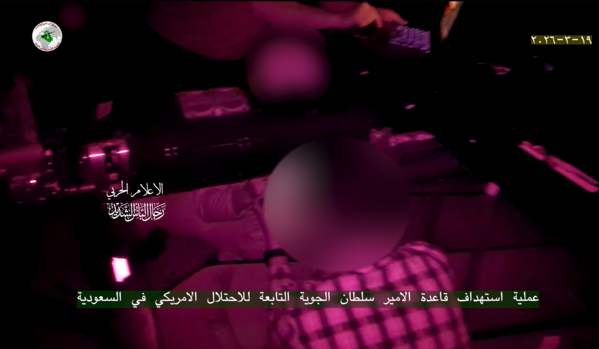
A final aspect of pre-war preparation is likely to have been target selection and allocation. Drones and cruise missiles require mission planning software packages (with target coordinates, flight route, and altitude pattern programming), and other guided missiles require aimpoint coordinates. This ‘mission profile’ is often loaded to the weapon shortly before launch, as GPS calibration is undertaken (see the image at Figure 1 as an example).ae By February 2026, the muqawama likely had a library of targeting solutions on-hand that might be thought of (in the authors’ suggested nomenclature) as the ‘starting target deck.’
Phase One: Spasm (February 28 – March 5, 2026)
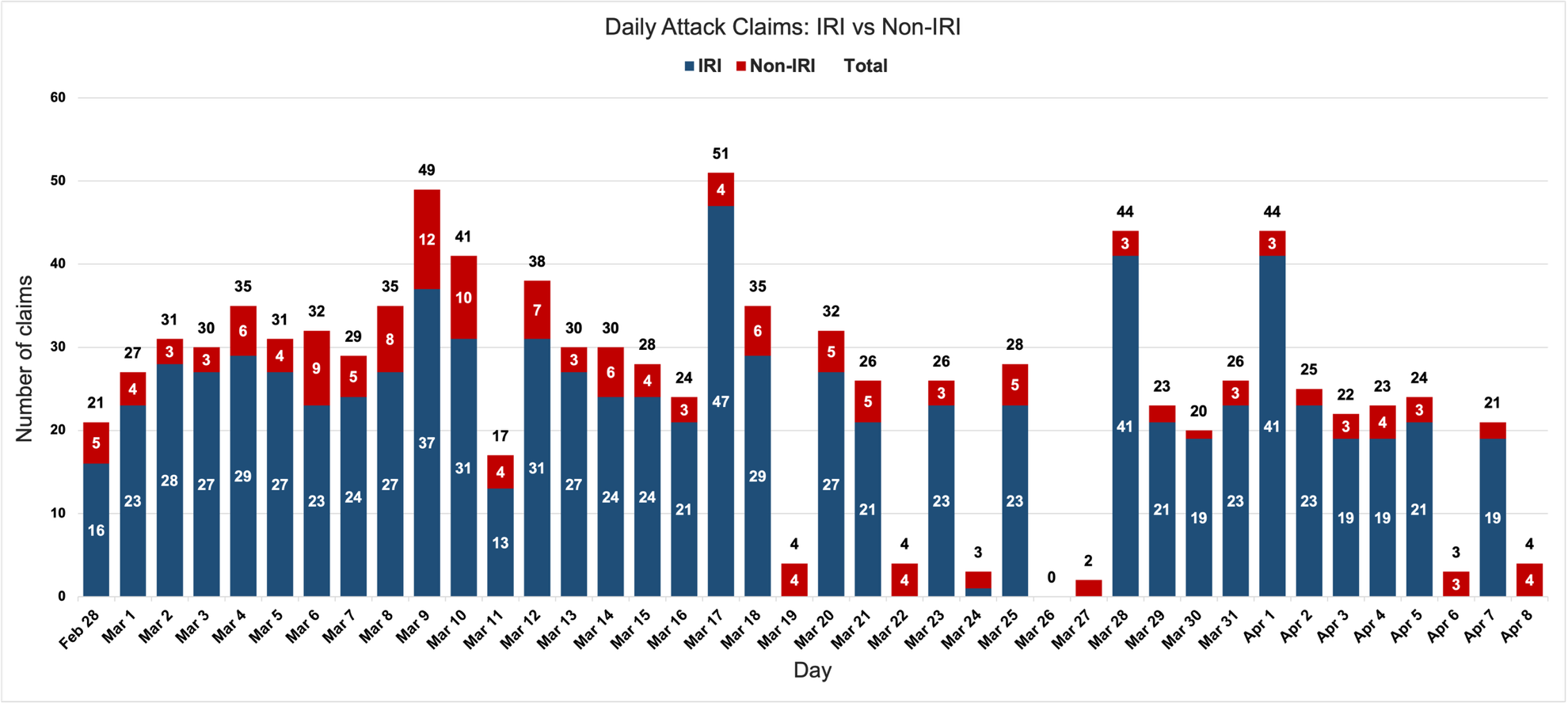
A strong surge of attacks from Iraqi groups was unsurprising, being that the war began with the United States’ killing of Iran’s Supreme Leader Ali Khamenei, the pivotal political-religious reference for Iraq’s walai militant groups.af (Of interest, the Iraqi muqawama also surged attacks on Israel following Nasrallah’s death in September 2024 and might have done so after the January 3, 2020, assassination of al-Muhandis, except for Iran’s instruction that Tehran would lead the retaliation for Soleimani and al-Muhandis with a ballistic missile strike on Al-Asad.65) In the same manner that Iran ‘went big’ from the opening moments of its response to Epic Fury,ag Phase One (assessed by the authors to span February 28 to about March 4-5) was a ‘spasm’ of strikes that saw the Iraqi muqawama operate orders of magnitude more intensely than in any previous military campaign.66 To give a metric, the most intense prior bombardment campaign mounted by the muqawama was the aforementioned May-November 2024 ‘Al Aqsa Flood’ operations room campaign against Israel, which averaged 1.57 claimed strikes per day. In the first five days of the 2026 war, Iraqi muqawama claims averaged 28.2 strikes per day.67 (Each of these claimed ‘attacks’ tended to involve one to four fixed-wing drone attacks or one to two missile launches.68)
Attack Claim Groups
The Islamic Resistance in Iraq (IRI)69 was, from the beginning, the main claim mechanism, accounting for 89 percent of attack claims in Phase One. IRI is the Iraqi muqawama collective claim mechanism intended to ensure the ‘unity of fronts’ in the post-October 7, 2023, war against Israel.70 The Militia Spotlight profile of IRI notes that “the balance of available evidence suggests that the IRGC-QF plays a role in coordinating the IRI brand.”ah Of note, in contrast to the hundreds of IRI claims from 2023-2024, IRI did not provide any breakdown of the geographic focus of its attacks, instead using the catchall phrase ‘Iraq and the region,’ referring to the broader Middle East region.71
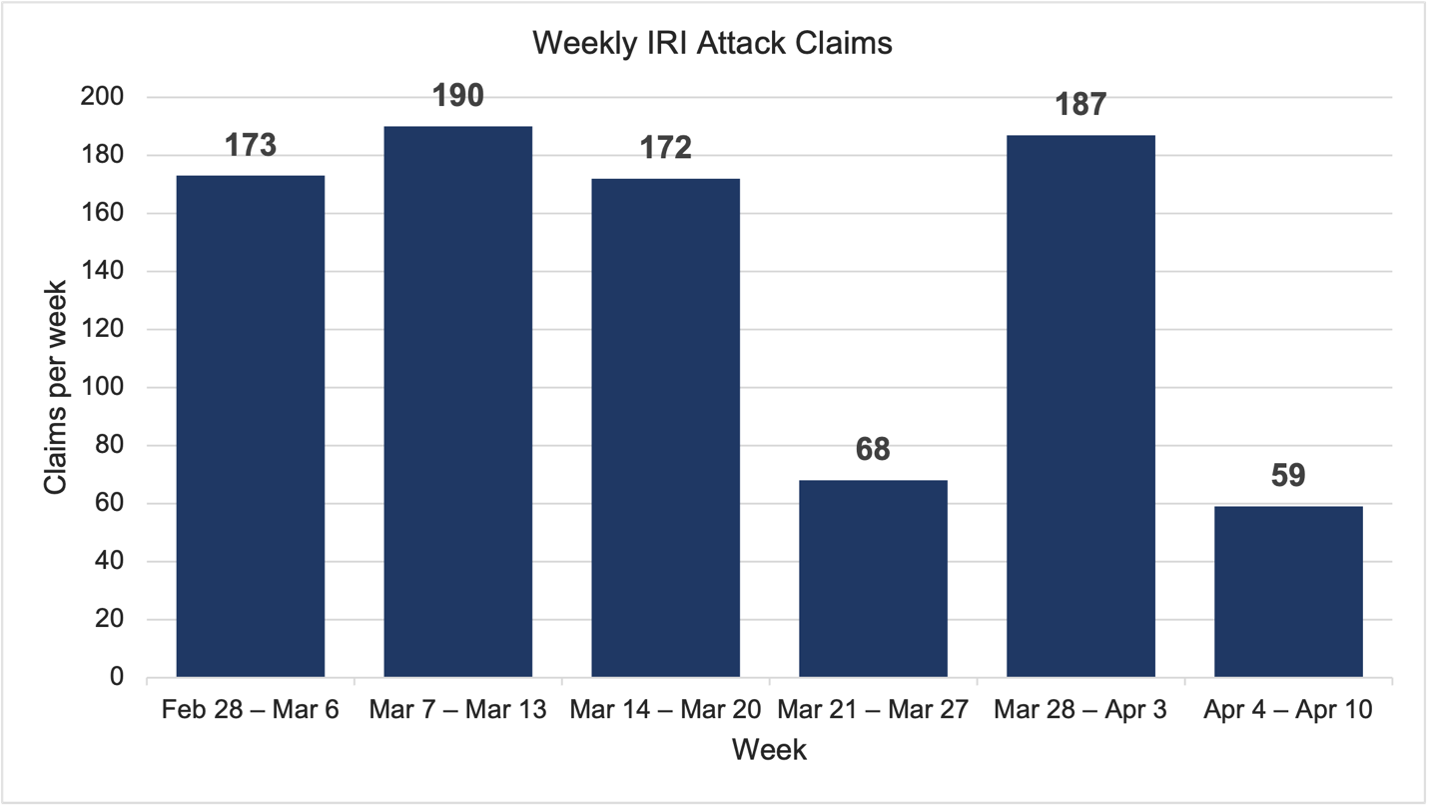
Three other Iraqi claim brands were active from the first day: One was SAD, which was the only other claimant of Iraqi muqawama strikes in the 2023-2024 campaign, aside from IRI.ai The other was an enigmatic new brand called Rijal al-Bas al-Shadeed (“RBS,” Men of Great Valor) that activated its online presence on March 4, 2026,aj retrospectively claiming its first seven attacks starting on February 28, 2026.72 Ashab al-Kahf (AK), a brand associated strongly with Harakat al-Nujaba (HAN),73 made its first claim of the war on February 28. These and other claim brands mostly did provide a geographic location for all claimed strikes in the opening weeks of the war, if not throughout.ak
Targeting During the Spasm
In Phase One, around half of all claims related to a specific location related to attacks on the KRI (i.e., 14 of 30 location-specific claims).74 SAD was the initial claimant against Iraqi Kurdistan,75 including a documented use of an Al-Qari CRBM on the U.S. military annex at Erbil International Airport (EIA) on March 1.76 News and social media reporting aggregated and geolocated during the war by the author team suggest a much larger stream of attacks on the KRI than are represented solely by the non-IRI claims.al Even after filtering out direct Iranian strikes on Iranian Kurdish oppositionist camps,am the remaining ‘unclaimed’ impacts observed in Erbil probably represent non-located IRI claims on U.S. and KRI government targets in the Kurdistan Region.an There are many reasons why KRI aimpoints may have been prevalent in the ‘first target deck’ used in the war. Logically, EIA was the main U.S. military site in Iraq as the war began, following the reported closure of bases such as Al-Asad and Harir. The muqawama also viewed Iraqi Kurdistan as a historic dumping ground for attacks, a den of spies and Iranian oppositionists, and a soft target within range of even short-range muqawama weapons that has historically lacked the military power to effectively deter such militias or Iran.ao (In Phase One, U.S. forces struck locations facing the Kurdistan Region linked to PMF brigades 14 (KSS), 30 and 50, based on launch areas west of Erbil.77)
The most enigmatic portion of the muqawama war effort would be attacks on targets outside Iraq. Some Iranian Short-Range Ballistic Missiles (SRBMs) systemsap may have been fired at the Gulf from Iraq in the first week of the war, with the Iraqi PMF providing logistical support and security for launches.aq U.S. strikes on a range of KH-linked southern Iraq locations in the first phase of the war might suggest muqawama activity against the Gulf States.ar But actual claims of attacks on the Gulf were non-existent in the first phase. The IRI might have struck targets outside Iraq during this phase, albeit without leaving any trail in the claim record, but interview material gathered by one author (Knights) suggests no major early sequence of IRI strikes on the Gulf in Phase One,78 with two known exceptions. One was an unclaimed March 3 drone strike on the U.S. Embassy in Riyadh;79 the other was the March 4 disruption in Basra of an CRBM launch against Kuwait using four Sarem or Al-Aqsa 1 CRBMs.as
From February 28, new claim brand RBS demonstrated a special focus on claiming attacks on Jordan, most frequently at Muwaffaq al-Salti Air Base (MSAB), the main regional U.S. combat aircraft basing location in the war.80 In its announcements, RBS claimed to be launching Shahed-101/107 drones during it attacks at MSAB, which suggests—based on conservative range estimates of 600-800km for these drone types—that RBS was utilizing Anbar province launch locations.81
Phase Two: Quality Operations (March 6-17, 2026)
In the author group’s opinion, from as early as March 4-5 and unfolding in the second week of the war (March 7-13) and some of the third week (March 14-17), the Iraqi muqawama started shifting toward a deliberate approach that aligned more closely with Iran’s own evolving war strategy of raising costs to the global economy and broadening the war.82 Instead of generating as many strikes as possible but causing little impact outside Iraq, the focus would shift to qualitative impact. On March 13, KSS leader Abu Alaa al-Walai (real name: Hashim Bunyan al-Siraji) publicly referenced a new phase of the war that had begun and which marked a shift to ‘qualitative objectives.’83 at (Abu Alaa has a track record of retrospectively announcing phase changes in muqawama campaigns, for instance the early 2024 targeting shifts toward Israel.au)
The new phase did not happen all at once, but instead became visible at a number of points. First, a much more intense Baghdad sub-campaign began (see the section below on this sub-campaign), part of the effort against remaining U.S. military and diplomatic points of presence. Second, claims of Iraqi attacks on the Gulf States surged by over 80 percent,84 and unclaimed attacks are also reported in Knights’ interviews to have intensified.85 Third, a sequence of unclaimed attacks began to target oil sector locations in Iraq and the Kurdistan Region with a strong known or suspected connection to the U.S. energy industry.av
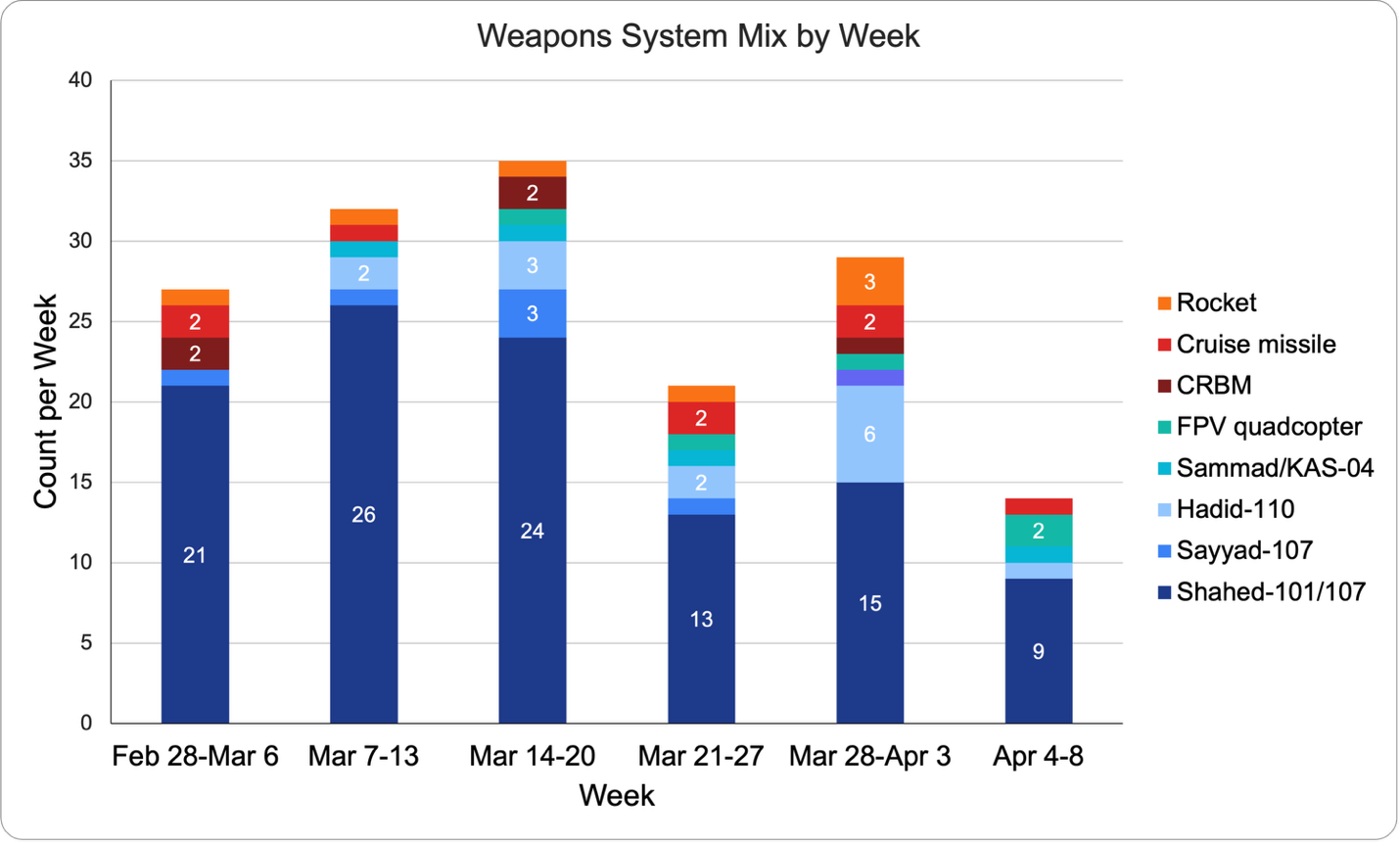
And lastly, a new ‘second load’ of Iranian munitions began to enter Iraq to enable a sustained Iraqi effort.86 This reloading mechanism is worth a whole article of its own, but in broad terms, it was undertaken mainly via the Iran-Iraq border crossings at Badra (Wasit province), Al-Sheeb (Maysan), and Mandali and Muntheriyah (Diyala).87 This reload included (for the first time) jet-powered Hadid-110 (Dalahu) delta-wing drones,aw which were detected in use for the first time on March 10.88 Greater effort was made to distribute weapons caches to new locations through ‘partnering’ or ‘teaming’ arrangements between attack cells and collaborators within a range of ground-holding PMF units.ax In the view of the author team, mid-March—and particularly the Baghdad sub-campaign—marked the point when Iraqi militias went ‘all-in’ on the war and an unprecedented number of factions began to take part in attack operations.89 According to interview material gathered by one author (Knights), from this period until the end of the war, Badr and Asaib Ahl al-Haq (AAH) operated ‘one-way attack’ drone attack cells focused on U.S. targets in Baghdad and the KRI.90 Activating an expanded set of previously unused drone cells would make sense in order to maintain the high daily tally of claimed strikes in March 5-13, an average of 33.7 per day, with each strike typically including multiple drones.91
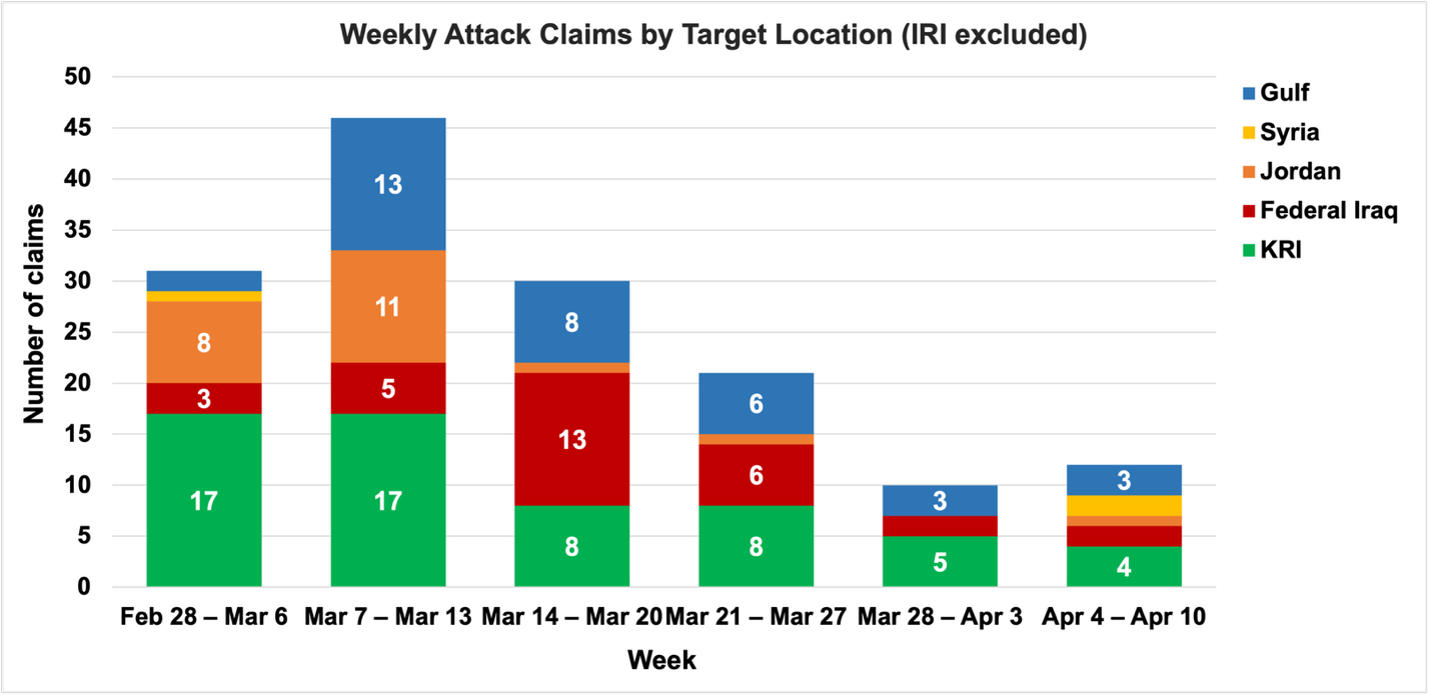
Though each of these trends will be explored in greater depth in the sections below, the author team’s assessment of the broad pattern in Phase Two is that the IRGC-QF probably ‘gripped’ the Iraqi muqawama and broadened its ambitions to include better-resourced attacks on U.S. sites in Baghdad and on the Gulf States.92 The greater the Iranian technical input into the targeting and ‘weaponeering’ process, the more control Iranian agencies might have had over the design and execution of the muqawama drone and missile campaign.ay More granular understanding of who produced muqawama ‘mission profile’ programming packages is a line of inquiry that would probably yield very valuable insights about the design of the muqawama campaign. Clearly, some of the Iraqi teams that performed final loading of mission profiles into drone guidance systems and who filmed the launches for propaganda purposes knew which target areas they were broadly striking, as evidenced by the placards (showing the date and target) held up in front of drones and missiles before many non-IRI launches.az
Phase Three: Reset and Reload (March 18-27, 2026)
From around March 18, as the Baghdad sub-campaign seemed to culminate (see the below section), the Iraqi muqawama effort powered down but never stopped. In the nine days between March 19 and March 27, the numbers of claimed attacks dropped off precipitously.93 (IRI claims were not posted for four of the nine days, and were uncommonly low on a fifth.94) SAD attacks also declined sharply in this period.ba While observed launches at greater Erbil appear to have undergone a limited decline,bb and strikes on the U.S. Embassy in Baghdad were paused, the muqawama still kept up a string of “quality” attacks on the Baghdad Diplomatic Support Center (BDSC), the U.S. diplomatic annex adjacent to Baghdad International Airport, and other targets in the Baghdad area.bc
On March 18, KH had announced a conditional five-day pause on its operations against U.S. forces, which marked the beginning of a nine-day period in which IRI claims appeared at best every two days, instead of daily. This followed an apparent success for the militias—their claims to have forced partial U.S. evacuations from Baghdad by March 20.bd But the hard-pounding of BDSC and the Embassy came at an apparent cost in terms of strikes on mid-level KH leadership. First, KH reported the death of its security official Abu Ali al-Askari by a U.S. airstrike on March 16).be Then, the most senior IRGC-QF official working exclusively on the Iraq file, Hajji Hamid, was reported as killed or seriously wounded in a March 16 U.S. airstrike on a leadership meeting house in Jadriyah).bf In the author team’s assessment, by the end of Phase Two, the muqawama showed signs of feeling the strain, probably caused by some combination of exhaustion, attrition, and thinning weapon inventories.
Phase Four: Going the Distance (March 18 – April 8, 2026)
In the fourth and final phase of the war (prior to the April 8 ceasefire), the muqawama military campaign regained some of the vigor it had shown throughout the first half of March.95 On March 28, the militias started to churn out higher numbers of attacks once more.96 Based on the interviews conducted by one author (Knights), this happened at the same time as the arrival of a new ‘third load’ of Iranian munitions.97 According to interviews conducted by one of the authors (Knights), this inflow had begun to enter Iraq during Phase Three,98 being stockpiled at major storage facilities like Camp Ashraf99 during the relatively quiet fourth week of the war (March 21-27).bg This resupply included greater numbers of cruise missilesbh and stealthy Hadid-110 jet drones, plus longer-range drone systems such as the Shahed-136, KAS-04, a new and rarely seen ‘puller-propeller’ drones patterned on the Shahed-101 series.100 From March 27-29, this ‘third load’ was distributed mainly to southern launch areas such as Jurf as-Sakr, Wasit, Diwaniyah, Maysan, and Basra.101
These longer-ranged systems were able to strike not only the northern Gulf (as had been the case throughout the conflict with Shahed-101/107 systems launched from border areas in Basra and Muthanna) but also the UAE and new Saudi Arabian targets (such as Shaybah oilfield in the Empty Quarter, the East-West pipeline, and the Red Sea oil loading terminus at Yanbu).102 In late March and early April, various militia façades and spokesmen openly threatened escalation against the Gulf States.bi In Phase Four of the war, smaller claim brands (like Jaysh al-Ghadab) for the first time claimed anti-Gulf strikes using cruise missiles.103 Within the strong IRI claim numbers for this late-war period (March 29 to April 4),104 the author team assesses there are also likely to have been a number of strikes on the Gulf.bj
Inside Iraq, Phase Four appears to have been the period when special effort was focused on the exhaustion of air defense systems in Erbil,bk both using small salvoes of three or four Shahed-101/107 drones, and using the jet-powered delta-wing drones (Hadid-110 and Shahed-238 or jet Shahed-136) now available in greater numbers.105 The former (Shaheds) soaked up anti-drone guided weapons, and the latter (jets) could only be intercepted using Counter-Rocket, Artillery, and Mortar (C-RAM) systems.bl In Baghdad, remaining suspected U.S. points of presence around Baghdad airport were struck increasingly with un-jammable fiber-optic guidance First-Person View (FPV) quadcopter dronesbm and with guided 122mm rocket systems.106 A persistent trickle of unclaimed drone attacks struck Iraqi oil sites that were viewed as linked to U.S. energy industry interests, using jet drones in at least one case.107
Deploying PMF Units into Iran
The period leading up to the April 8 U.S.-Iran ceasefire witnessed one more important trend: an apparent commitment of PMF units inside Iran itself at a time when the crisis might still have veered toward sharp escalation—including even the widely rumored prospect of U.S. ground operations inside southern Iran.108 Iraqi PMF personnel had frequently been reported inside Iran during prior protest cycles in 2019 and 2022, seemingly used to add additional capacity to Iranian regime security forces in the Arab and Kurdish areas of Iraq.109 (These were disguised as humanitarian relief missions for instance to provide flood relief in 2019.110) According to interview material gathered by one author (Knights),111 this occurred again during Phase Four of the Iran war in 2026, again sometimes disguised as humanitarian aid convoys.bn Badr ‘special forces,’ IRGC’s Iraq-based Afghan and Pakistani proxy forces,112 some Iraq-based Houthi volunteers,bo and some smaller muqawama groups (such as Saraya Khursani, PMF 18)113 reportedly crossed into Iran in at least four convoys via the unofficial Mandali crossing (between Diyala and Sumar in Iran), the Zurbatiyah crossing (between Badra and Mehran in Iran), and the Shalamcheh crossing (between Basra and Ahwaz in Iran).114 Most of these crossings happened between March 28 and April 3, when long queues of PMF vehicles became bottlenecked at Iraq-Iran border crossings and were videoed.115
According to interview material gathered by one author (Knights),116 between 18,000 and 26,000 PMF personnel crossed into Iran during this period, transported using large numbers of PMF vehicles and accompanied by large numbers of engineering vehicles belonging to the PMF and the PMF-operated (U.S.-sanctioned) Muhandis General Company.117 Other interview material gathered by the same author suggests that Iran-provided drone systems were shifted en mass from the Muthanna launch complex toward Basra in the same period on PMF trucks.bp On April 4, the United States conducted heavy strikes on one such column in Shalamcheh,118 resulting in an apparent tit-for-tat cycle of retaliation between U.S. forces and AK (i.e., Nujaba) until after the ceasefire took effect on April 8.119 Though Iraqi groups (most clearly KSS) signaled their willingness to keep striking the Gulf,bq the KRI and U.S. targets, the muqawama’s war effectively shut down on April 8, the last day that IRI issued a daily claim, and when it announced a ceasefire of two weeks ‘in Iraq and the region.’120
Part II: The Four Wars Within the War for Muqawama Networks
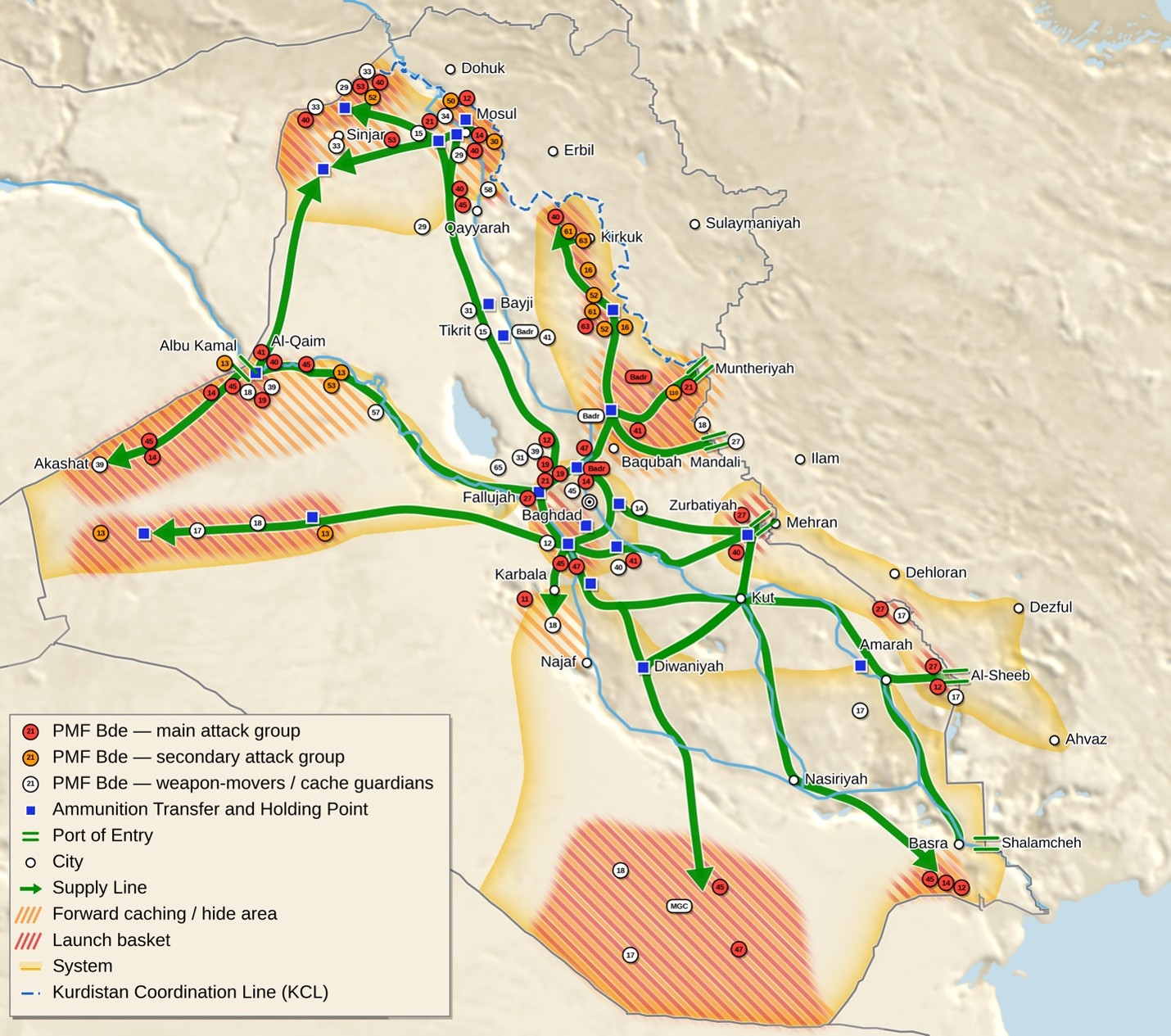
In the 2026 war, there were four sub-campaigns undertaken by the muqawama that overlapped and unfolded in parallel. They are tackled below in the order in which they emerged, but it should always be borne in mind that they occurred in an overlapping manner, not sequentially. In Part I, the authors have described the temporal phases of the war, but a geographic level of analysis is also needed. The following sections run through each of the main muqawama operating zones in the 2026 war—the north versus Kurdistan and Syria, the west versus Jordan, the Baghdad sub-campaign, and the launch campaign against Gulf targets.
The Northern War
For many years, the KRI has been the ‘punching bag’ of the Iraqi militias.br The key targets in Erbil were U.S. sites: the U.S. and coalition annex at Erbil International Airport (EIA); the U.S. consulate; KRI military and government sites, and private venues, where U.S. or other intelligence services might be operating in the Iranian axis’ view; and U.S. oil companies. Setting aside the Iranian Kurdish bases—which appear to have been almostbs entirely struck directly by Iran121 bt—this was the ‘target deck,’ and it did not change a great deal during the war. The KRI was attacked from two sides: a Nineveh launch area to the west and an ‘eastern Tigris’bu launch area to the south. Militiamen in both these areas had extensive, fresh experience in bombarding the KRI, albeit not at the high rate of fire seen in the 2026 war.122
The Nineveh Launch Area
The Nineveh Plains has long been the key launch area for attacks on Erbil from the west,123 and it is located so close to the KRI capital that even 122-mm rocket systems can threaten the city’s outskirts.bv The Nineveh Plains are controlled by Liwa al-Shabak/Quwwat Sahl Nineveh (PMF brigade 30),124 formed by Waad Qado,125 and the other is Babiliyun (PMF 50),126 formed the Rayan Kildani.127 Both leaders were sanctioned by the United States for human rights abuses under the Global Magnitsky Human Rights Accountability Act.128 The key ‘trigger-pulling’ militia operating from the Nineveh Plains is assessed by the author team to be KSS (claiming attacks as SAD),bw using the sites controlled by PMF 30 and 50.129
In the 2026 war, militias seem to have realized even before the war began that operating solely from the Nineveh Plains might be much more difficult than in the past, and they prepared to bombard the KRI at a greater remove than before (i.e., launching from beyond visual distance of Kurdistan’s border, even from scores of kilometers inside federal Iraq).130 bx Prior to the war (in Phase Zero), discussions were held between ‘the usual suspects’ (KSS (PMF 14), PMF 30 and PMF 50) and a range of PMF brigades and other muqawama players active in Mosul and the expanses of Nineveh between the Tigris and the Syrian border.131 Advanced conventional weapons began to be cached in a wider variety of locations, from the Rashidiyah area, north of the Tigris on the east Mosul side, all the way west to Syrian border locations such as Rabia, Khanasor, Sinjar, Baaj, and to the south in Hatra.132 The author team assesses that the main connective tissue between attack cells and storage sites—fulfilling the role played by the Distribution Company of a U.S. Army Brigade Support Battalion—were two PMF units: Kataib Ansar al-Hujja (PMF 29) and Kataib Al-Imam Ali (PMF 40).133 The latter seems to play a senior coordinating role in muqawama drone and missile logistics in Nineveh.by
The muqawama equivalent of the U.S. Army’s Ammunition Transfer and Holding Point134 were the PMF bases operated at the edges of Mosul city and in western Nineveh.135 The caches were run by Kataib Al-Imam Ali (PMF 40); Quwwat Waad Allah (PMF 33); Liwa al-Hussein (PMF brigade 53); Quwwat al-Shaheed al-Sadr (PMF 15); plus Kataib Ansar al-Hujja (PMF 29); KH (PMF 45, 47); and KSS (PMF 14).136 bz From the first days of March 2026, with PMF 30 and 50 locations in the Nineveh Plains being repeatedly struck by U.S. aircraft,137 most muqawama weapons seem to have been stored outside the plains until they were ready for immediate use, whereupon they would be driven from Rashidiyah or across the Tigris and used as soon as was practicable. Some of the ‘first load’ used in the war may have been recovered from Syria-located caches.138 Interviews (Knights) suggest a ‘second load’ of drones and missiles seems to have been fed into this network of ammunition transfer and holding points in western Nineveh directly from central ammunition supply points (Camp Ashraf, Diyala; Jurf as-Sakr, Babil) and areas close to the Iranian border).139
The East Tigris Area
The ‘East Tigris’ area (author team’s nomenclature) is a more spread-out set of launch areas.ca As noted above, even before the current war, the militias in the Kirkuk, Salah al-Din, and Diyala provinces were among the most practiced in bombarding the KRI. Farthest north, cells in Dibis had regularly launched drones and rockets at Erbil and U.S. or French bases in the adjacent Makhmour and Kirkuk city areas since 2018.cb In this war, Kataib Al-Imam Ali (PMF 40) sites in locations such as Qayyarah and Dibis were bombed by the United States multiple times,140 but (in the assessment of the author team) these sites were probably also basing launch cells from KH, KSS, and particularly Nujaba (PMF 12).141 (There is a publicized precedent for this kind of ‘landlord’ role for Kataib Al-Imam Ali. On December 2, 2023, five Nujaba drone operators were killed by a U.S. strike on a Kataib Al-Imam Ali base at Dibis.cc)
Farther south, a second set of experienced kinetic drone and rocket cells have long been active between Kirkuk and Tuz Khurmatu: the Badr-linked Quwwat al-Turkmen (PMF 16), Fawj Amerli (PMF 52), and new micro-units like PMF 61 and 63.142 All were struck regularly by the United States throughout the 2026 war.143 These predominantly Turkmen units are coordinated by the head of the PMF North and East Tigris Operations Command,144 Abu Hussam al-Sahlani (Hamid Ibrahim Abdal-Ridha), a veteran operator whose service under the IRGC as a senior Badr officer goes back to the 1980s, according to the CTC’s Harmony files.cd
The final set of kinetic threat actors facing the northern front is the collection of Diyala-based Badr units (PMF 20, 21, 22, 23, 24, and 27) and the Badr-formed Shia Kurdish unit Fawj Fayli (PMF 110).145 These units appear to have provided a support architecture for at least two Badr low-profile kinetic action cells undertaking drone strikes on the KRI, and perhaps striking U.S. locations in Baghdad from the eastern fringes of the city.146 These cells were operating under the control of the head of the PMF Diyala Operations Command, Badr veteran Sayyed Talib al-Musawi (Taleb Mohammed Hussein)ce and his Badr comrade Abu Jassim al-Askari.147 In this war, the author team suggests, Badr went further than just importing, moving, and hiding weapons for terrorist groups such as KH and KSS.148 Badr also undertook at least 20 drone attacks on U.S. and Iraqi targets,149 just over half of which were launched into the KRI from northern Diyala.150 In the assessment of the author team, Badr undertook its attacks within the IRI claim mechanism.cf On the last full day of the war, April 7, the United States mounted multiple strikes on Badr’s main ammunition supply point at Camp Ashraf.151
The Mini-War on Jordan
In the 2026 war, Jordan played an even more important role than it had in the prior 2023-2025 conflicts involving the Iraqi muqawama. In the post-October 7 (2023) period, Jordan acted as additional strategic depth for Israel as it defended against drone attacks from Iran and Iraqi militias.cg In 2026, Jordan’s air bases were also one of the most vital launch points for U.S. combat aircraft since most U.S. aircraft were withdrawn from the Gulf prior to hostilities.ch Only 22 attacks on Jordan were claimed by the Iraqi muqawama in the 2026 war,152 though this low figure may mask a much larger number of additional attacks obscured within the non-located IRI claims. In an intriguing conundrum, 12 of the 22 Jordan attack claims were made by the aforementioned new claim brand Rijal al-Bas al-Shadeed (RBS, Men of Great Valor).153
Effectively striking locations such as Muwafiq al-Salti Air Base (MSAB) with the workhorse muqawama weapon, the Shahed-101/107,ci required launch sites along Iraq’s western border with Syria, from as far north as Rabia (Nineveh), but more practically from western Anbar.cj This area had been a prolific drone and rocket launch area in the near past due to the U.S. bases in western Anbar and eastern Syria,154 but by February 2026, the U.S. base at Al-Asad (in Anbar) had closed, and the United States had collapsed its ongoing presence at the string of outposts they had previously maintained in eastern Syria.155 Anbar provides an excellent launch pad for attacks on Israel, but in 2026, the Iraqi muqawama mirrored Iran’s own apparent strategyck by eschewing a long-range war against Israel, and instead focusing on nearer enemies (the United States, Iraqi Kurds, and the Gulf). This left Jordan as practically the only game in town for drone cells in western Anbar. In this war, at least, every other remaining target in the region could be hit more easily from somewhere else.cl
As was the case farther north, the Anbar militias appear to have begun preparing for the war since mid-February 2026.156 One aspect of this was the acceleration of what appears to have been a salvage effort on advanced conventional weapon caches in the Syrian Euphrates Valley areas such as Al Bu Kamal and Baghuz.157 In the view of the author team, it makes sense that not all weapons could be evacuated during the rapid collapse of the Assad regime in December 2024, or immediately after while U.S. forces were present for part of 2025.158 Local smuggler networks are very strong in these areas and would probably not hesitate to squirrel away any potentially valuable materiel to later sell to the highest bidder.cm In Anbar, this recovery effort seems to center on Al-Qaim, involving Kataib Al-Imam Ali (PMF 40), KH (PMF 45), and KSS (PMF 14) as the receiving parties on the Iraq side.159
The network of muqawama ammunition transfer and holding points handrail Anbar’s loop of highway corridors clockwise from Al-Qaim to Hit, Ramadi, Rutba, the H-3 airbase, Akashat, Akkas, and back to Al-Qaim.160 Key cache guardian groups and kinetic launch operators include KH, Harakat Allah al-Awfiyah (PMF 19), Saraya al-Jihad (PMF 17), and Liwa al-Tafuf (brigade 13).161 The United States attacked these units from the start to the end of the war in recurring strikes on Al-Qaim, Akashat, the H-3 airbase, Rutba, Kilo 160, and other muqawama sites.162 The distribution company role in Anbar appears to be played by Harakat al-Abdal (PMF brigade 39), with Saraya Talia al-Khorasani (PMF 18) handling cross-province movements to the south (Jurf al-Sakr, Muthanna) and Liwa Hussein (PMF 53) running weaponry from Al-Qaim up the border to Nineveh.163
The ‘Ring of Fire’ Around Baghdad
As discussed in Part 1, Phase Two of the muqawama campaign was characterized in large part by a determined effort to drive U.S. forces out of various remaining points of presence in Baghdad. This effort had not been part of Phase One, which had hardly touched Baghdad.cn In the view of the authors, the muqawama have drawn a distinction between Baghdad diplomatic targets since at least 2021—vice military targets outside the capital.164 co This meant Baghdad sites were not attacked from day one of the war. Instead, ramping up a multi-group Baghdad attack surge appeared to take nearly two weeks to hit its stride, spanning almost the whole length of Phase Two.165
The IRI’s contribution to the campaign is hard to gauge due to the non-located nature of most of its claims, though IRI did break its own pattern (in almost the only such instancecp) to openly claim the successful March 24 FPV quadcopter drone attacks on a U.S. medevac helicopter and radar at BSDC.166 According to interview material gathered by one author (Knights),167 the IRI effort encompassed attacks on BDSC and the U.S. military advisor group at Area IV of the Baghdad airport by the Badr movement (nine attacks) and by Asaib Ahl al-Haq (five attacks).168 These included a ‘stonk’ of five heavy 240mm Falagh-1 rockets on March 15 that wounded five airport employees and security guards,cq and possibly also the March 22 107mm shot at the ISOF’s Area IV compound, which wounded five Iraqi commandos.169
Of the individual claim brands, SAD (the KSS façade group) arguably made the longest and most sustained effort of the war to evict U.S. presence out of Baghdad.170 SAD’s 15 attack claims included three FPV drone attacks171 (plus an initial quadcopter recon flight over the BEC on March 16).cr (It is interesting to note that on September 10, 2024, SAD claimed a quadcopter attack on BDSC.cs) Early in the war, the enigmatic RBS undertook a specialized mini-campaign using the rarely spotted Sayyed-107 V-tail drones to try to destroy the C-RAM system protecting BDSC.172 The assessed Nujaba claim brands—Ashab al-Kahf and Jaysh al-Ghadab—claimed eight attacks on BDSC and Area IV.173 These included Jaysh al-Ghadab’s claimed use of ‘Shaib-12’ guided 122-mm rockets on March 29,174 which appear to have been targeted on Iraqi military transport aircraft present at Baghdad airport for an unknown reason.ct
The Logistics Ring Around Baghdad
The militia support system in Baghdad has long been characterized as a ring of advanced conventional weapon storage sites, each under the control of one of the main armed groups.cu The Kataib Hezbollah effort is often viewed as being centered on Jurf as-Sakr,175 but this war showed a more dispersed system that may have tried to operate away from known sites, many of which were struck during the war: notably Jurf as-Sakr, KH locations near Palestine Street, Baghdad, and the PMF Anbar Operations Command complexes in Habbaniyah and Taqqudum.176 According to interview material gathered by one author (Knights),177 KH (PMF 47, in this case) shared Baghdad facilities in the war with KSS,cv such as the Camp Saqr (Falcon) base in western Baghdad and various water treatment plants in Nahrawan, on the southeast edge of the city. KH’s ‘arc’ of the city is southern-focused but not limited to Jurf.178
In the same manner that KH is not apparently limited to the southern arc of Baghdad, Harakat al-Nujaba may not be limited to the northern edge of Baghdad, where its better-known Tarmiyah and Taji strongholds are located.cw Nujaba also operated a large advanced conventional weapons distribution hub south of the city, near where highways 1 and 8 meet.179 Badr played a major role in securing two parts of the ‘Baghdad belts’—the western roads linking northern Baghdad and Fallujah (under Badr’s PMF 27),180 and the Jisr Diyala area to the southeast.181 Both Kataib Al-Imam Ali (PMF 40) and AAH’s PMF 41 suffered heavy U.S. strikes during the war on their logistics hubs near Suwayrah, Wasit, south of Baghdad.182
The Southern Campaign Against the Gulf
The effort by Iraqi militias to strike the Gulf States is the least understood muqawama sub-campaign of the 2026 war. Only 35 location-specific attack claims pertain to Gulf targets,183 and even the ACLED database only contains 65 attacks assessed to have struck the Gulf in the 2026 war after being launched from Iraq.184 An unknown number of anti-Gulf strikes may be concealed within the IRI’s non-located claims.
Sixteen claims concerned Kuwait,185 a major U.S. basing location that can be struck from deep within Iraq with Shahed-101/107 drones or from the border with any militia weapon, even tactical rockets, quadcopter drones and CRBMs.186 On March 4, two concealed double-CRBM systems were found unfired in Basra on the border with Kuwait,187 and from the second week of the war onward, Iraq-based attacks on Kuwait were claimed multiple times a week.188
Fifteen attacks were claimed against Bahrain,189 a much more distant target that lay at the outer range of Shahed-101/107 drones launched from the border or longer-range systems (KAS-04, Shahed-136 and cruise missiles) launched from the Iraqi interior. (Of note, in April 2024, a KAS-04 long-range drone strike on Israel was jointly claimed by IRI and Bahraini group Saraya al-Ashtar.190)
Only three claims involved Saudi Arabia,191 involving two Riyadh locations (Prince Sultan Air Base and Iskan Village) positioned in a similar ‘range band’ to Bahrain. No Iraqi militia claimed attacks on any Saudi infrastructure,192 nor the March 3 drone strike in the U.S. Embassy in Riyadh (which news interviews with an unnamed Saudi official suggested was a strike launched from Iraq by Iraqi militias).193 RBS (who claimed the two Riyadh strikes194) also claimed a very long-range strike on Al-Dhafra air base in the UAE using a Shahed-107 drone,195 which either suggests the authors’ 800km estimate for the Shahed-107 is too conservative, the drone was launched from a point outside Iraq (such as a boat), or the claim is inaccurate in some way (including the possibility a Shahed-107 was not used).cx (Whichever of these is true, including the possibility of RBS fabricating a claimed attack on the UAE, there is probably something interesting to learn from this outlying, somewhat unique claim.)
Many small indicators suggest there may be more to the story of anti-Gulf attacks than is presently known, probably including larger numbers of attacks that are unclaimed or hidden within the IRI non-located claims. First, according to interview material gathered by one author (Knights)196 and also by news reporting from Al-Monitor and Reuters,cy significant numbers of attacks were detected by Saudi Arabia to have originated in Iraq. Second, also according to interview material gathered by the same author197 and also by news reporting from the same two news outlets,198 Saudi Arabia and the UAE are reported to have mounted retaliatory air strikes in Iraq during the war, a very serious and unusual step for these Gulf States. These attacks targeted areas run by the PMF economic conglomerate, the Muhandis General Company, and seem to have been concentrated in the second and third weeks of the war (approximately March 10-20).199 Third, diplomatic tension between Iraq and the Gulf States became more intense toward the end of the war,200 a Saudi strike was reported in southern Iraq on the war’s last day, and anti-Gulf strikes extended briefly into the post-ceasefire period.cz
The Other War: Information Operations, Claims, and Façades
The muqawama continues to place great store in the importance of media war and psychological warfare.201 da Ashab al-Kahf’s March 8 public insistence of the importance of media wardb is telling, underlining a wider Iranian Axis of Resistance focus on winning strategic messaging battles (and thereby securing political and diplomatic victories).202 The U.S. FBI’s arrest and ongoing prosecution of IRGC-QF and muqawama operator Mohammad Baqer al-Saadi203 has also begun to shed some light on muqawama media strategy. As part of his role in the muqawama, al-Saadi stated to U.S. law enforcement that he was “in charge of media and psychological warfare” with his activities part of the “psychological warfare” that the muqawama is waging against the United States.204 Al-Saadi previously impressed on KH members the “need to engage in ‘psychological warfare’” while stressing in the context of attacks he orchestrated on the European homeland that “anything that distracts the enemy is useful.”205 Al-Saadi was an experienced media operator, was connected with operators of major muqawama accounts, and almost certainly had prior experience of the façade group strategy.206 His attitude toward media operations is, therefore, very likely to be representative of wider QF and muqawama media strategy.
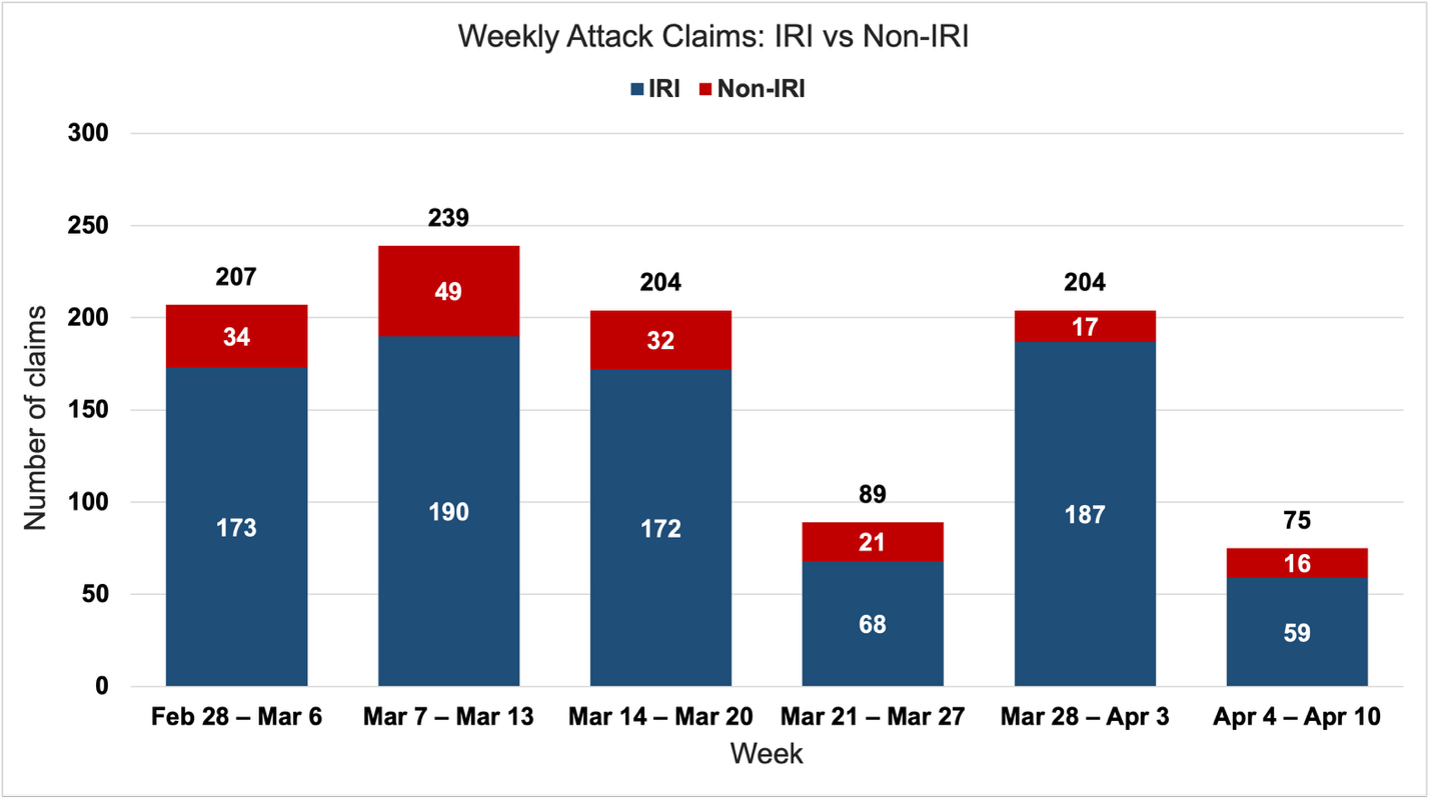
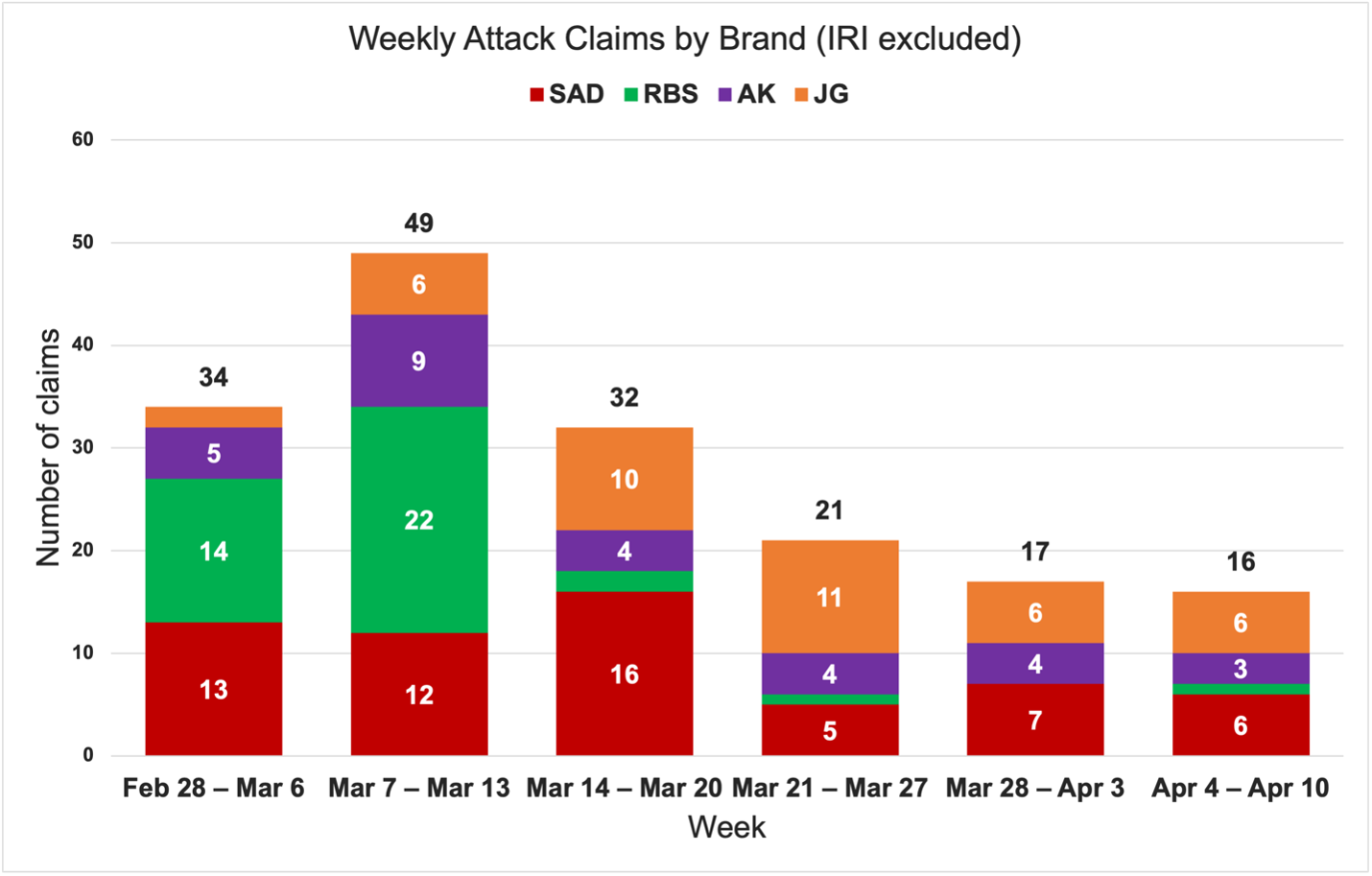
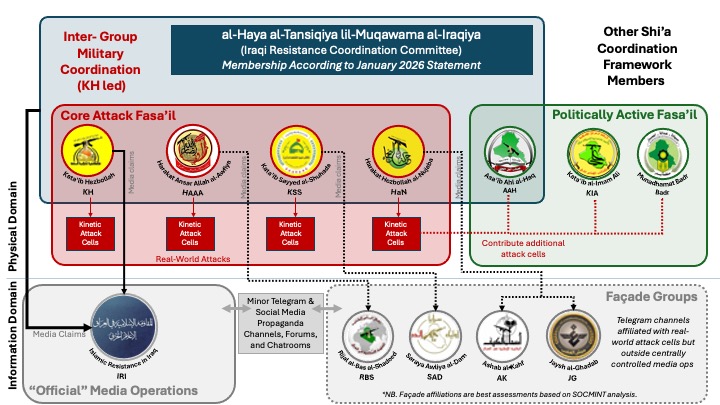
The muqawama’s love affair with the media is a double-edged sword, offering one of the best ways to look inside their minds and their organizations. As documented throughout this article, muqawama-affiliated Telegram channels posted hundreds of attack claims, using written ‘press releases,’ launch footage, high-production-value videos, and supposedly comprehensive round-up lists of alleged attacks (often broken down by the general location of target). In the authors’ view, the façade group strategy remained firmly in place.207 Over 800 launches were claimed by a range of media fronts, some pre-dating the 2026 conflict, others apparently created specifically for the war.208 These front channels are explicitly designed to obfuscate real-world groups’ involvement: consequently determining precise affiliation requires analysis of (inter alia) engagement patterns (observing trends in wider engagement with a given channel, including reposts and—equally telling—silences); analysis of language and the use of specific phrases; brand imagery and logo details; analysis of the locations of launch sites and claimed targets; imagery of weapon systems; and so on.209 This allows a rudimentary, if imperfect, assessment of likely affiliations.
Evolution of the Façade Strategy
That the muqawama continued to claim attacks through a range of façade groups was in itself a curious feature of their recent campaign,dc with five major brands, principally operating via Telegram, used to disseminate threats, propaganda, and claims of attacks on U.S. and allied targets.210 As noted above, the use of ‘façade’ brands to claim attacks reflects the balancing act facing militias: They want to derive some intra- and inter-group credit by claiming attacks, but there are many potential downsides to doing so. Their imperfect solution is to lightly conceal the exact identity of the attacking group from external parties, at least to less determined investigators for a while. In the view of the author team, the façade group strategy has enduring value for the muqawama as a form of legal warfare211 (complicating retaliation by obfuscating attribution); as an aid to recruitment and retention (by showing militia support bases that the muqawama continued to “resist” the United States and Israel); and as a form of inter- and intra-group competition, allowing groups to engage in one-upmanship.212 Even in the context of large-scale war, the façade strategy seems to have continued to perform many of these functions.
The muqawama’s use of façade groups is thus not new, but the latest round of conflict reveals some developments in the information environment. First, as noted above, centrally orchestrated media operations—a 2022-2023 developmentdd—have continued under IRI.213 In 2023-2024, IRI made 94 percent of muqawama claims—with an impressively boring and disciplined visual style that took all group personality out of claim postings.de In 2026, IRI was again a disciplined machine: It started its claims on the war’s first day, February 28, and ended them on the last day of the war, April 8.214This is still an impressive level of centralized control.
SAD (which is strongly assessed as claiming for KSS)df is the one claim brand that operated separately from IRI in both 2023-2024 and 2026. In the 2026 war, it made 59 claims (about six percent of the total, a similar proportion to its share of claims in 2023-2024).215
New claim groups also wanted to show off their flair outside of IRI in 2026, marking a partial return to proprietary brands and separate claims. The IRI quotient dropped in the 2026 war to 83 percent (849 out of 1,015 claims).216 Who was behind these groups? The below findings are provisional, and should be treated as rebuttable propositions that are worthy of further study.
On the basis of available evidence, Jaysh al-Ghadab is a new Nujaba-linked façade.217 If so, then it is Nujaba’s second such brand, in addition to Ashab al-Kahf (which returned to its original name late in the 2026 war, shedding its moniker since August 2024, Kataib Sarkhat al-Quds).dg Collectively, they represent 67 claims or about six percent, on par with SAD. If Jaysh al-Ghadab is a Nujaba front, this raises a lot of questions. What makes a group develop a second façade brand, one that does not claim attacks that differ greatly from each other? And what makes a group like Nujaba choose to stay outside IRI in the present war? These questions are fertile ground for future in-depth investigations of the muqawama information environment.
RBS is also deserving of closer investigation. There are weak indicators that RBS might have splintered internally around March 10, with its main kinetic cells folding into the IRI claim structure thereafter.dh One theory worth testing is whether RBS is an AAH or Harakat Ansar al-Awfiya façade that largely joined IRI partway through the war.di A new channel, created in October 2025 but with its first post on March 4, 2026, digital engagement patterns with RBS indicate lesser affiliation with mainstream muqawama media channels but notable levels of AAH-affiliated engagement.dj
Part III: Iraqi Popular Mobilization Forces Join Iran’s War Effort
In the 2019 CTC Sentinel article “Iran’s Expanding Militia Army in Iraq,”218 one of the authors (Knights) profiled the 60 or so PMF brigades as they ended their first five years of mobilization as government-paid Iraqi security forces.219 At that stage, the author assessed 25 PMF brigades to qualify as ‘Iran-backed’ based on their relationships with U.S.-designated terrorist groups or the IRGC.220 In the 2026 war, this author team finds (and has laid out in detail in this piece) that 36 PMF brigades either launched weapons at U.S. forces, Iraqi civilians and infrastructure, or neighboring states, or provided material support to the groups undertaking such attacks221 (i.e., U.S.-designated terrorist groups such as KH, KSS, and Nujaba).222 With around 65-70 PMF brigades in existence,223 this means that for the first time, half or more than half of the PMF units demonstrably have members providing support for terrorist groups.
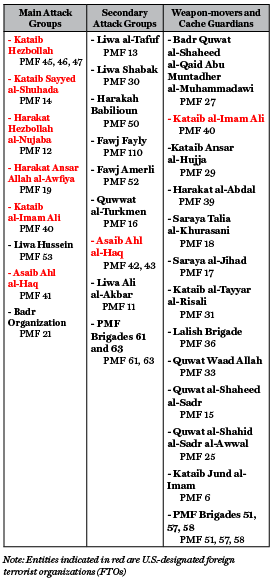
In the author team’s informed view, the evidence laid out in Part II of this study is worthy of deeper investigation by government intelligence agencies because it suggests that PMF support for foreign terrorist organizations (FTOs) has been substantial in the 2026 war.224 The information relayed in Part I of this study (especially pre-war dispersal of weapons and intra-war reloading from Iran) and Part II (geographic munitions flows to the sub-campaigns) suggests extensive muqawama use of the PMF’s vast physical laydown of cantonments, camps, and compounds across north, western, central, and southern Iraq in the war.dk
The muqawama’s 2026 drone campaign arguably also required the mobilization of significant militia manpower, including many members of the state-funded PMF. If the muqawama is assumed to have adopted significant operational security precautions (i.e., regular rotation and resting of attack cells),dl then a high-end estimate by the author team suggests the existence of as many as 135 drone cells operating during the war.dm Each drone is likely made up of around three to five militia operators,dn yielding a total of around 400-650 drone crew members if there were the high-end estimate of 135 crews working in rotation. Of these, only a very small fraction are likely to have been trained, specialized drone operators:do Instead, most of the 400-650 cell members would serve as drivers, unloaders, and security.dp A broader community of cache guardians, long-distance truckers, and security ‘wrappers’ for the drone teams (mostly drawn from the local ground-holding PMF brigades)225 might number in the very low thousands, assuming the high-end estimate of 135 cells is correct and if a normal ‘tooth-to-tail’ ratio between combat and non-combat forces is assumed.dq Even if one assumed a far leaner manpower base, the 2026 war unarguably relied upon a greater pool of muqawama operators and support services that in any previous conflict.dr
The PMF as an institution has arguably been shifting toward an Iran-allied position for many years.226 As noted in one of the authors’ book-length studies, Honored Not Contained: The Future of Iraq’s Popular Mobilization Forces (co-authored with Hamid Malik and Aymenn Al-Tamimi),227 by 2020 the civilian and military leadership of the PMF and its most powerful directorates became dominated by KH and Badr leadership figures with a tight, decades-spanning connection to the IRGC.228 In the wars since October 7, 2023, KH leaders such as the PMF’s military commander Abdal-Aziz al-Mohammadawi (aka Abu Fadak) have undermined the expectation that the PMF, as a formal Iraqi security force, answers only the constitutional commands of Iraq’s prime minister.229 For instance, the PMF leadership represented Iraq at Axis of Resistance command conferences (for instance, see the April 5, 2024, wartime conference in Tehran on counter-Israeli and counter-U.S. strategy).230 At that event, Abu Fadak stated, “The PMF is a fundamental part of the battle in Gaza and Palestine.” He admitted to taking orders primarily from a foreign official, Iran’s [then] Supreme Leader Ali Khamenei, stating: “We are waiting for the [Supreme] Leader to express his view on the next step … We came to the Islamic Republic first to express our solidarity with the vision and plan of the Leader and the Imam … and second to renew our covenant [i.e., loyalty to the Supreme Leader] and wait for the Leader’s decision.”231
In 2026, following Khamenei’s death, the Iraqi muqawama leadership atop the PMF structure took their covenant to its natural conclusion by entering the war on Iran’s side. The unauthorized steps taken by the PMF-muqawama leadership included the importation of major military arsenals from a foreign power (Iran);232 the prosecution of an unprecedented military campaign against Iraq’s international partners (the United States and European powers in the coalition military advisory group, and Arab states) from Iraqi soil involving both Iraqi and Iranian forces;233 the deployment of major Iraqi PMF units outside the country (into Iran);234 and the killing and wounding of Iraqi citizens and the destruction of Iraqi civilian infrastructure.235 The possibility of the muqawama pulling Iraq into a regional war that the country had not joined caused a degree of alarm within Iraq’s body politic. In an unprecedented statement by the Iraqi judiciary, Iraq’s Supreme Judicial Council issued a public statement on March 27 clarifying the necessary constitutional and parliamentary steps required to lawfully issue a declaration of a state of war in Iraq.236 ds
Badr: Reintegrating into Iran’s Order of Battle?
One of the most important analytical findings of this article is the new light it sheds on the kinetic and logistical roles played by Iraq’s thus-far unsanctioned Badr Organization. In the 2019 CTC Sentinel article “Iran’s Expanding Militia Army in Iraq,”237 one of the authors (Knights) dwelt on the critical role that Badr would have in shaping the PMF due to its multi-decade experience at developing conventional armed forces. Badr was the main provider of expertise and manpower in the PMF “enabler” units, such as the armor, artillery, and missiles directorates.238 Badr members—and KH and KSS members who originated in Badr—still occupy the positions of the PMF’s military commander, chief of operations, and head of the intelligence, internal security, training, and religious instruction directorates.239 In 2019, the author (Knights) wrote in CTC Sentinel: “Disentangling Badr networks from [KH] and IRGC-QF networks is thus not a simple proposition … Badr was a unit of the Islamic Revolutionary Guard Corps in the Iran-Iraq War, so its ties with Iran run very deep.”240
In those Iran-Iraq War days, Badr was literally a military division of the IRGC, and it remained so, at the very least, during its 2003 invasion of Iraq (which occurred in parallel to Operation Iraqi Freedom).241 Now, in a new post-2023 age of existential wars fought by the Islamic Republic of Iran, the author team assesses that the Badr military machine seems to be more openly playing its original intended role as an auxiliary of the IRGC when the Islamic Republic of Iran’s existence is threatened.242 Since October 2023, Badr’s leaders have become more vocal in their opposition to Israeli and U.S. actions against Hezbollah and Iran.243 In the years since apparent Israeli strikes on Badr’s Camp Ashraf,dt many anecdotal reports have reached the author team from Iraqis concerning greater logistical involvement between Badr and the IRGC regarding transshipment of Iranian advanced conventional weapons through Iraq (to Syria and Lebanon), and lately (in 2023-2024) of stronger Badr preparations to undertake kinetic attacks on Iran’s enemies.du Statements made by Badr leaders also speak to that intent. For example, on October 10, 2023, following Hamas’ attacks on Israel, Badr leader Hadi al-Ameri uncharacteristically threatened: “If the Americans intervene in the battle with Hamas, we will attack all U.S. targets.”244
In 2026, this author team concludes, Badr did cross the line from a non-kinetic supporting role to actually launching kinetic drone attacks on U.S. forces in Iraq.245 According to detailed attack data gathered by the author team,246 Badr directly undertook eight drone attacks on the U.S. BDSC site, six on the U.S. complex at Erbil airport,247 and at least one known drone strike on a Basra oilfield in which a U.S. investor was negotiating entry into.dv Badr also fired drones at Iranian Kurdish sites in the KRI,dw a throwback to Badr’s longstanding role in the 1980s-2000s as the IRGC’s main tool for attacking Saddam-backed Iranian opposition militants based in Iraq.248 Other interviews undertaken by one of the authors (Knights) identified various cross-border escorting of, and securing of, Iranian missile launchers, including Badr fighters protecting sites inside Iran or sites just inside Iraq.249 The locations mentioned are old Badr operating locations during and since the Iran-Iraq War, notably Badr’s 1990s-2000s base locations in Defful, Dehloran, Mehran, and Ahwaz.dx Badr seems to still have great ability to operate fluidly across the Iran-Iraq border, whether to bring materiel and personnel into or out of Iraq.250 (Many Badr operators have Iranian as well as Iraqi citizenship and have families and property in western Iranian areas.dy) As noted in the Phase 4 section of Part I above, Badr also appears to have moved significant PMF forces to Iran to support Iranian regime security and internal defense missions in the last week of the war.
Badr’s Role in IRGC Logistics in Iraq
Yet above and beyond all these combat roles, in the considered view of the authors, logistics was an even more important Badr contribution to the Iranian war effort in 2026.251 As noted, Badr appears to have moved weapons through Iraq for the IRGC for many years,252 but Badr’s recent role was as the logistical backbone for muqawama efforts inside Iraq.253 Throughout the conflict, Badr essentially functioned as the rear ‘third line’ logistics element for large parts of the Iraqi muqawama,254 most likely in support of groups other than KH that lack their own large-scale logistics organizations.255 In interview data, a recurring observation is the splitting of Iranian weapons cargos just inside Iraq into two main batches—one carried onward by a KH system and one by another system in which Badr was the main land transportation provider through its control of PMF trucking fleets.256 The key Badr logistics unit running this effort is Quwwat al-Shaheed al-Qaid Abu Muntadher al-Muhammadawi (PMF 27),257 named after the deceased Badr leader to whom Camp Ashraf has also been dedicated by Badr.dz
In the 2026 war, Badr appears to have served as the clearinghouse for non-KH combat logistics, supported by distribution units from Kataib al-Imam Ali (PMF 40), Saraya al-Jihad (PMF 17), Saraya al-Khurasani (PMF 18), Kataib Ansar al-Hujja (PMF 29), Harakat al-Abdal (PMF 39), and Kataib al-Tayyar al-Risali (PMF 31).258 Camp Ashraf was, and likely will be in the future, a key national stockpile and ammunition supply point for the Iraqi muqawama.259 Yet, until Badr is designated as an FTO, its units and sites may be more difficult to target than the FTOs it delivers to and those it partners with, most notably KH.
Final Questions for Analysts
This analysis has highlighted many unanswered questions in the course of its exploration of the prior history of the Iraqi muqawama at war, the phasing of their involvement in the 2026 conflict, the sub-theaters of the Iraqi war, and the role of information operations and logistics. At a higher level, there are strong indicators that the coming years will involve increased demand from policymakers in the United States and elsewhere for assessments and supporting materials on the Iraqi muqawama.
The first area of raised demand may be for assessments that identify lessons in deterrence success and failure during the war. The Iraqi muqawama were successfully ‘backed-down’ from escalating attacks by the United States in December 2023 to February 2024 and by Israel in November 2024.260 In the 2026 war, detailed analysis based on classified data will probably be necessary to uncover what worked and what did not in the U.S. (and the Gulf States’) effort to restrict Iraqi muqawama attacks. The Iraqi muqawama leadership appears from a thorough open-source review to have escaped the war with remarkably few leadership casualties,ea though the March 16 U.S. airstrike on a reported IRGC-QF and muqawama leadership meeting did seem to trigger an attempt led by KH to (unsuccessfully) arrange a rolling truce with the United States.261 Understanding whether Iraqi muqawama avoided targeting—and if so, how—is an interesting topic. A related inquiry is whether the Iraqi muqawama would have displayed its observed ‘glass jaw’ if their fielded forces had received less focus and its leaders had been threatened more effectively. Or did the context of the 2026 war—a long record of muqawama military disappointment, Khamenei’s death, and a potentially existential war for the IRGC—make Iraq’s factions much harder to deter? Is this an enduring change in their mindset?
A second demand driver for intelligence analysis may be related to sanctions and export controls. Despite a multi-decade track record of corruption, state capture, human rights abuses, and terrorist activities, Badr has consistently escaped serious regulatory or law enforcement sanction by the U.S. government and its allies.262 This could change.eb Intelligence analysts may be asked to support sanctions activities involving Badr, PMF departments and a raft of other currently unsanctioned Iraqi entities whose instrumentalization by the IRGC has been exposed by the war.
A third future focus area for analysts regarding the Iraqi muqawama may be provision of intelligence support to security sector reform (SSR) and demobilization, disarmament, and reintegration (DDR)263 initiatives involving muqawama groups and the PMF more generally. As noted in the introduction to this article, three Iraqi armed groups (including two FTOs, Asaib Ahl al-Haq (PMF brigades 41-43) and Kataib Al-Imam Ali (PMF 40)) announced their intention to enter a disarmament process,264 with the latter two FTOs clearly hoping to be granted some benefits (such as taking up cabinet roles or being given a pathway to sanctions de-listing). Other FTOs and those seeking to avoid being sanctioned may follow suit. Policymakers will request assessment as to whether these are genuine initiatives or merely efforts to blunt U.S. ‘lawfare’ and undermine the U.S. maximum pressure strategy.
On this issue, unprecedented Iraqi muqawama involvement in the 2026 war—including major external operations undertaken by these groups—underlines the important role of intelligence in placing the focus on the proven behavior of individuals and groups, not on the labels they have chosen for themselves or been given by Western governments. This article suggests that many Iraqi factions not currently designated as terrorist groups (such as Badr) nonetheless provided material support to FTOs during the war. Likewise, many groups that are formally members of Iraq’s government security forces (through the PMF) aligned themselves with a foreign power (Iran); materially supported Iranian FTOs such as IRGC and IRGC-QF; gave Iran access to Iraqi territory to launch attacks; and deployed forces outside Iraq or attacked targets outside Iraq without Iraq having declared war on the United States. Groups previously described by Western think-tanks as “parochial” armed factions265 ec due to their ascribed main focus on domestic political and economic status were actually full combatants in this war. The military actions of supposedly parochial factions were often indistinguishable from those of the so-called transnational terrorist “vanguard,”266 ed strongly suggesting that individual and group behavior (not labels) may become the key level of assessment regarding the muqawama in the future. CTC
Dr. Michael Knights is the Chief Product Officer at strategic advisory Horizon Engage. He is also an Adjunct Fellow with the Washington Institute for Near East Policy, where he co-founded the Militia Spotlight platform. X: @mikeknightsiraq
Alex Almeida is the Research Director for Security Services at Horizon Engage. He is the co-author of Back to Basics: U.S.-Iraq Security Cooperation in the Post-Combat Era, Washington Institute for Near East Policy, 2020. X: @AlexAlmeida2020
Crispin Smith is an attorney based in Washington, D.C. His research focuses on international law and the law of armed conflict, as well as operational issues related to irregular warfare, information operations, and lawfare. Previously, he co-founded the Militia Spotlight platform.
© 2026 Michael Knights, Alex Almeida, Crispin Smith
Substantive Notes
[a] Credit must always be given to the Institute for the Study of War’s (ISW’s) Order of Battle study for the Iraqi security forces and the Hashd, published in December 2017. This was the first study in open source to delve deeply into the Hashd institutional directorates and the PMF groups with assigned brigade numbers. The first detailed description of these offices came in the Institute for the Study of War report in 2017. See Jesse Rose Dury-Agri, Omer Kassim, and Patrick Martin, “Iraqi Security Forces and Popular Mobilization Forces – Order of Battle,” Institute for the Study of War, December 2017.
[b] As of January 2026, the tansiqiyah’s Telegram channel claimed that it comprised KSS, Kata’ib Karbala, HAAA, HaN, AAH, and KH. This roughly corresponds, in the view of the authors, with the core of the muqawama groups that participated in attacks against the United States during the 2026 conflict. Similarly, on June 4, 2026, an influential KH spokesman released a statement noting that “[t]he five factions of the Islamic Resistance (muqawama al-islamiyya), in addition to the Karbala Brigades, will remain cohesive and will carry out their tasks as long as there is occupation [of Iraq], violation of its airspace, and usurpation of political decision-making.” The authors assess that the “five factions” refer to KSS, HAAA, HaN, AAH, and KH.
[c] Based on the author team’s decade-spanning work in this space, the authors assess that claimed attacks and Telegram commentary from select media outlets are worth close analysis as markers of intergroup dynamics, overall strategy, and trends in military activity. It is almost certain that some Telegram material is deliberately misleading, designed to obfuscate attribution, attack origin, and group strengths and size. Nevertheless, militias have been historically reluctant to be caught in a lie: Rival groups have openly mocked those seen not pulling their weight or faking attacks. Meanwhile, there has been a historic correlation between militia attacks claimed on Telegram and proven attacks, albeit during periods where attacks were less frequent and of lower volume. The authors have documented these trends previously in Michael Knights, Crispin Smith, and Hamdi Malik, “Discordance in the Iran Threat Network in Iraq: Militia Competition and Rivalry,” CTC Sentinel 14:8 (2021). More recently, a militia spokesman framed the importance of accurate claims: “The Security Media Cell must not rush to issue statements; it should ascertain the facts before making any declaration that might aim to level accusations against the Resistance and demonize it, in line with the objectives of the enemy.” Telegram post by Abu Mahdi al-Jaafari, March 21, 2026.
[d] Militia Spotlight’s online blog and group profiles were established to track this process in detail and produce evidentiary building blocks, using legal standards of proof and certainty. The project collects militia statements in Arabic and other languages, archives evidence that risks being taken offline at a later point, and uses a data fusion process to synthesize information and analyze trends. The Militia Spotlight blog is at https://www.washingtoninstitute.org/policy-analysis/series/militia-spotlight and the Militia Spotlight profiles page is at https://www.washingtoninstitute.org/policy-analysis/series/militia-spotlight-profiles
[e] Each type of feed often makes the others more useful. For instance, ground-sourced human intelligence on a launch from a specific area at a specific time can be combined with claim video data and with target impact data to produce findings that would have been impossible to glean from any one source type alone.
[f] Broadly, the United States Treasury or State Department can designate entities as “Specially Designated Global Terrorists” (SDGTs) under the International Emergency Economic Powers Act (IEEPA), 50 U.S.C. § 1701 et seq., and Executive Order 13224 (as subsequently amended). This causes designated entities to be added to the Office of Foreign Assets Control’s list of Specially Designated Nationals and Blocked Persons (SDN List) and subject to certain economic sanctions. Entities may also be designated a “Foreign Terrorist Organization” (FTO) by the Secretary of State under the Immigration and Nationality Act (INA), also adding the entity to the SDN List while criminalizing those providing material support or resources to it (18 U.S.C. § 2339B). The core members of the muqawama are all subject to U.S. designation: KH, AAH, HaN, KSS, KIA, and HAAA are each designated as both FTOs and SDGTs. The IRGC (along with various sub-components) is also designated both as an FTO and SDGT, in addition to being subject to economic sanctions under various other programs. See generally, “Office of Foreign Assets Control’s Specially Designated Nationals and Blocked Persons List,” U.S. Department of the Treasury.
[g] The claim that significant numbers of PMF forces controlled by muqawama factions entered Iran is discussed at various points in the study and draws upon both open-source evidence (social media imagery during the war of PMF forces in traffic jams at the border crossing points between Iran and Iraq) and interview data (gathered by Knights) from a range of Iraqi contacts in a position to identify forces crossing from Iraq into Iran. The phenomenon of PMF fighters taking part in foreign wars without government approval is well-evidenced in the case of Syria already. For the earliest substantive work on this issue, see Phillip Smyth, “The Shiite Jihad in Syria and Its Regional Effects,” Washington Institute for Near East Policy, February 2, 2015. Then read the ISW report to gain detailed insight into the unauthorized transnational operations of numerous PMF units in 2014-2017: Dury-Agri, Kassim, and Martin, “Iraqi Security Forces and Popular Mobilization Forces – Order of Battle.” The phenomenon of PMF fighters entering Iran with the rationale of providing humanitarian support, while not demonstrating any prime ministerial authorization of such actions, is also documented. For instance, see references to the PMF deployment in Iran in 2019 in Golnaz Esfandiari, “Iraqis To The Rescue? Iranians Wary Of Paramilitary Forces Sent For ‘Flood Relief’ Efforts,” RFE/RL, April 16, 2019. Thus, while the deployment of large numbers of PMF forces into Iran is significant and may surprise some readers, it is not a controversial claim, and more of an underdiscussed ‘open secret’ regarding how the PMF operates as a transnational actor.
[h] Under Iraq’s constitution and laws, the prime minister is the commander in chief of the armed forces. No armed group may legally exist outside of the framework of the armed forces, and the laws governing the PMF explicitly place the formation under the prime minister’s authority—though in practice, PMF elements have frequently ignored this chain of command. See, for example, Crispin Smith, “Servants of Two Masters: the Risks Inherent in Iraq’s Hashd al-Shaabi Legislation,” NYU Journal of International Law and Politics 52:1 (2019).
[i] Iraq likely bears legal responsibility for some of the actions of the muqawama through the international law of state responsibility, either because factions have been formally adopted as official government entities integrated into the Iraqi state through PMF legislation, or due to Iraq’s failure to exercise due diligence in preventing attacks from its territory. For a discussion of Iraqi responsibility for elements of the muqawama, see Smith, “Servants of Two Masters.” See also Crispin Smith, “Iraq’s Legal Responsibility for Militia Attacks on U.S. Forces: Paths Forward,” Just Security, March 10, 2021.
[j] NSPM-2 directs U.S. officials to impose “maximum pressure” on Iran to compel it to abandon its nuclear program and support for terrorist groups while directing the imposition and enforcement of more stringent sanctions, the pursuit of Iran’s diplomatic isolation, and taking legal steps against Iranian activities inside the United States.
[k] Badr operated a network comprised of three ‘axes’ that smuggled firearms, 107mm and 122mm rockets, and other weapons, including advanced Explosively Formed Penetrator (EFP) roadside bombs into Iraq in the late 1990s and early 2000s. Many of the same border crossings, smuggling routes, and in some cases even the same cast of veteran Badr operators were reactivated ahead of the recent conflict, reprising their 1990s role as logisticians for the IRGC-QF. For a comprehensive review synthesizing material from the declassified Saddam-era Harmony documents, see Joseph Felter and Brian Fishman, Iranian Strategy in Iraq: Politics and “Other Means” (West Point, NY: Combating Terrorism Center, 2008).
[l] One small deviant case study was the Arab League Summit in Baghdad in March 2012. In 2011-2012, one of the authors (Knights) was leading threat analytic teams in Iraq and watching closely for signs that the muqawama would turn against other types of targets once the U.S. military had drawn down completely. Coming after the Arab Spring Shi`a uprisings were put down in Bahrain, the Arab League Summit, which was held in Baghdad on March 29, 2012, was opposed by some muqawama cells, resulting in the ‘not welcome’ mat being rolled out in the form of three rocket attacks on government sites in Baghdad during the summit. “Rocket explodes as Baghdad Arab summit begins: Source,” Reuters, March 29, 2012.
[m] In October 2017, the muqawama killed their first U.S. soldier since U.S. military withdrawal in 2011. One of the authors (Knights) had always assessed the October 1, 2017, roadside-bombing murder of U.S. Army Private First Class Alexander Missildine as a muqawama operation. This was confirmed by Ashab al-Kahf on May 18, 2023. See Michael Knights and Hamdi Malik, “Ashab al-Kahf Claims Six-Year-Old Unsolved Murder of U.S. Soldier,” Militia Spotlight, Washington Institute for Near East Policy, May 18, 2023.
[n] In May 2019, a video emerged claiming the establishment of the so-called Free Revolutionaries Front, which featured several individuals with blurred faces but set against the flags of the Hashd and multiple PMF factions: specifically, Liwa al-Tafuf, Asaib Ahl al-Haq, Saraya Ashura, Saraya Talia al-Khurasani, Kataib Sayyid al-Shuhada, Kataib Jund al-Imam, the Badr Organization, Kataib Hezbollah, Kataib al-Imam Ali, and Saraya al-Salam. In the video, the speaker declared the factions’ unity to confront the U.S. presence and called on Iraqis to join the front.
[o] It is an open question to what extent the muqawama and the Iranian regime truly believed that the 2019 protests were foreign-induced or purely domestic or some combination. What can be said with certainty is that the protests in Iran and Iraq in 2019 were portrayed as foreign-backed. In November 2019, a range of regime figures—from Supreme Leader Ali Khamenei to Iran’s Ministry of Intelligence of Security to President Hassan Rouhani—accused protestors of acting with the training, assistance, and direction of foreign intelligence services. For an example, see “Iran Supreme Leader calls recent mass protests a ‘conspiracy,’” Associated Press, November 27, 2019. What the Militia Spotlight team detected from close monitoring of social media inside Iraq was a visceral muqawama campaign of blaming the protests on foreign-backed ‘jokers’ (Jawkara, Ganga al-Jawkara) (the muqawama phrase) that sparked a wave of killings lasting two years. For a good description of this campaign, see Ela Khaled and Inna Rudolf, “The Iraqi Politics of Memory and Victimhood,” International Centre for the Study of Radicalisation (ICSR) and XCEPT Research, February 15, 2022.
[p] Nujaba and Kata’ib Al-Imam Ali were the main Iraqi muqawama groups trying to signal solidarity against Israel in the pre-2023 period. For their Golan Heights stunts, see “Profile: Hezbollah Harakat al-Nujaba,” Militia Spotlight, Washington Institute for Near East Policy, April 17, 2021.
[q] The militias undertook only five attacks on U.S. military and diplomatic points of presence in Iraqi Kurdistan throughout the Twelve Day War, concentrating the bulk of their attacks (around 35 in total) on Kurdish intelligence and security sites, local and internationally operated energy assets, and Iranian Kurdish opposition bases. Attack data is drawn from the authors’ geolocated SIGACT dataset, which spans the 2017-2026 period of muqawama kinetic operations in Iraq.
[r] Elements of the muqawama even took to internal dissent, calling out the ineffectiveness of the resistance strategy. In 2021, for example, AAH and KH engaged in a public war of words over muqawama strategy (which Militia Spotlight termed the “Tuna and Noodles saga”). This episode saw KH media channels criticize AAH’s rocket attacks for only damaging parked cars and AAH media channels lampoon the KH convoy strategy for “targeting convoys of tuna and noodles.” In essence, both sides criticized the seriousness of the other’s resistance effort. See, for example, Hamdi Malik, “The Tuna and Noodles Saga: Findings from a War of Words Between Militias,” Militia Spotlight, Washington Institute for Near East Policy, March 3, 2021. Later that year, Badr leader Hadi al-Ameri was publicly berated by young muqawama members during a funeral for militiamen who were killed in a U.S. airstrike on June 28, 2021. The crowd demanded serious action against U.S. troops, yelling at the leaders, “We don’t want condemnation … either take revenge or don’t come [to these funerals] anymore.” See Knights, Smith, and Malik, “Discordance in the Iran Threat Network in Iraq.” Incidents like these created a risk that militia leaders seemed to be sensitive toward: that Iraqi militias increasingly appeared to be undertaking what might be called ‘fake resistance,’ while actually getting rich off of asset-stripping the state.
[s] Claimed attack frequency against Israeli and U.S. targets did rise following Nasrallah’s killing in September 2024. See Lina Khatib, “The Degradation of Iran’s Proxy Model,” Belfer Center for Science and International Affairs, April 2026. And many militia leaders attended his funeral. See Amir al-Kaabi, Hamdi Malik, and Michael Knights, “Hassan Nasrallah’s Funeral: Iraqi Militia Response and Attendance,” Militia Spotlight, Washington Institute for Near East Policy, February 27, 2025. But overall, under pressure from U.S. retaliation, Iraqi government constraints, and the risk of wider escalation, the pace of claimed muqawama attacks declined over time, and by mid-2024, the campaign had largely faded into sporadic, low-intensity activity rather than a sustained front. By 2025, meanwhile, the combination of external pressures by the United States and Israel, the fall of the Assad regime, and the loss of capacity by Hezbollah and the Houthis drove most muqawama factions to shift their focus to domestic survival. Despite rhetorical escalation, muqawama factions diverged sharply over participation in direct conflict with Israel. During the Iran-Israel war in June 2025, the muqawama refrained from direct involvement. IRI groups did so because Iran wanted to preserve them after the military defeat of Hamas and Hezbollah. This is not only because of their political and military importance to Iran but also because they provided it with an economic lifeline to circumvent sanctions. But for most of the other factions, non-intervention reflected fear of losing political capital, manpower, and military infrastructure as well as economic clout. See Khatib, “The Degradation of Iran’s Proxy Model.”
[t] Underlining the muqawama’s sensitivity over leadership targeting, the immediate trigger for their joining in the war appears to have been the killing of Kataib Sayyid al-Shuhuda (KSS) security chief Haider al-Mousawi in a U.S.-Israeli airstrike at the al-Sheeb border crossing with Iran on June 21, 2025. Data drawn from the authors’ geolocated SIGACT dataset covering the 2026 conflict. See also Tamer Badawi, “Analysis: First Iraqi Paramilitary Casualty in Israel-Iran War Marks Escalation Risk,” Iraq Nexus, Substack, June 22, 2025.
[u] This is the turn of phrase selected by the author team to reflect the fact that militias want to be active and seemingly living up to their ideals, while often risking little and achieving little.
[v] The Militia Spotlight team has consistently felt the tension within the muqawama, often shown in the statements of junior militia members on social media and their interactions with their leaders at moments when the rank-and-file (and some commanders) seemed to want to contribute more to the transnational struggle. For one example of the discussion of these issues, see Amir al-Kaabi, Hamdi Malik, and Michael Knights, “Iraqi PMF Chief of Staff Commits to Fulfill Iranian Supreme Leader’s Plans,” Militia Spotlight, Washington Institute for Near East Policy, April 8, 2024.
[w] Notably, the Department of Justice claims that al-Saadi “planned, coordinated, and claimed responsibility for at least 18 terrorist attacks in Europe,” including eight high-profile attacks in the United Kingdom, in addition to “two additional attacks in Canada,” all conducted in the name of “Harakat Ashab al-Yamin al-Islamiya” (the Islamic Movement of the Companions of the Right Hand (HAYI or IMCR)). See “Iraqi National Arrested and Charged with Providing Material Support to Iranian-Backed Terrorist Organizations and Directing Attacks Targeting U.S. Citizens and Interests,” U.S. Department of Justice, May 15, 2026.
[x] The video shows SAD members trucking al-Qari’ CRBMs (Close-Range Ballistic Missile) into a man-made underground facility comprising large tunnels. The Arabic caption reads: “Our steps are as firm as an unshakeable mountain, and our resolve is like our swords, drawn in their sheaths; not to impress, but to be summoned at the decisive moment, a moment that knows no mercy. #Al-AwliyaFacility #Saraya_Awliya Al-Dam.”
[y] These included a February 19 video showing off SAD’s varied arsenal of drone systems and a May video showing SAD members operating forklifts and walking around inside a large underground bunker facility stacked with dozens to hundreds of Shahed-101/107 and CRBM boxes.
[z] A weapons system previously unattested in the Iraqi muqawama arsenal, the al-Qari CRBM appears to be a version of the Iranian Ababil or Arman missile, a tactical guided artillery rocket with a range of 85 km roughly comparable to the United States’ GMRLS system. For background, see Fabian Hinz, “Iranian missile deliveries to Russia: escalating military cooperation in Ukraine,” IISS, September 18, 2024.
[aa] Based on the authors’ comprehensive review of launch footage, the latter drone seems not to have featured at all in the 2026 conflict despite being displayed by SAD, and appears to have been largely phased out in favor of the ubiquitous Shahed-101/107 family of drone systems.
[ab] The primary resupplied weapons system appears, based on one author’s (Knights) interviews, to be Shahed-101/107 type fixed wing drones, which were provided in distinctive dual-use carrying and launching crates that look different from delta-wing carrying crates. Author (Knights) interviews, multiple Iraqi contacts, 2026; exact dates, names, and places withheld at request of the interviewees.
[ac] Additional engines and warheads for Shahed-101 and Shahed-107 X-tail drones were brought into Iraq in large consignments just prior to the commencement of fighting on February 28, 2026, seemingly to ensure supply for a sustained launch campaign from Iraqi soil. Author (Knights) interviews, multiple Iraqi contacts, 2026; exact dates, names, and places withheld at request of the interviewees. The idea of creating local assembly lines for drone fabrication seems to be an Iranian template, used in Lebanon and Yemen as well. A worthy line of inquiry is how IRGC and the muqawama may have cultivated drone industry technical skills and capacity using their control of Iraq’s university system via the Asaib Ahl al-Haq Minister of Higher Education and Scientific Research in 2023-2026. See Jawad Mahdi, “Injecting New Blood into Militias: The Gradual Takeover of Iraqi Higher Education by the Popular Mobilization Forces,” Fikra Forum, Washington Institute for Near East Policy, July 12, 2024.
[ad] To be able to strike Israeli targets with ballistic missiles from this area, the type of missile would need to have the range (at least) of an Iranian MRBM system such as Kheibar Sheikhan. Such mobile solid-fuel systems would seem to be the most likely to be deployed in Iraq, away from Iranian liquid fuel storage facilities in the assessment of the authors.
[ae] Launch videos frequently show drone operators uploading the mission profile to the drone’s flight control module from a laptop immediately before launch. A drone used in an attack on an energy facility in the KRI in 2023 featured a commercial, off-the-shelf Pixhawk 4 autopilot controller, but the newer Shahed-101 and 107 models use an as-yet unidentified flight controller unit, likely of Iranian make. The exact mission planning software is also unknown, but the use of regular laptops to upload the packages suggests one of several open-source mission planning and flight software. Data drawn from the authors geolocated SIGACT dataset and attack claims database. On the Shahed-101/107 flight control unit, see https://war-sanctions.gur.gov.ua/en/components/part/5009
[af] The militias that make up the muqawama in Iraq are overwhelmingly adherents to the Shi`a doctrine of velayat-e faqih (guardianship of the jurists), in practice requiring absolute loyalty to the Supreme Leader of the Islamic Republic of Iran. Badr and its offshoots (including KH, KSS, and HAAA) is a walai movement, meaning that if called upon, it will recognize Iran’s Supreme Leader as a higher authority than Iraq’s prime minister. As a young commander fighting on Iran’s side, Hadi al-Ameri is on record as stating, “We are with the Imam [Khomeini] … If our Imam says war then we say its war, if Imam says peace, then its peace … Now we know the Imam represents Islam.” See, for example, Michael Knights and Crispin Smith, “Badr Organization: Iran’s Oldest Proxy in Iraq,” Hudson Institute, June 3, 2025. See also al-Kaabi, Malik, and Knights, “Iraqi PMF Chief of Staff Commits to Fulfill Iranian Supreme Leader’s Plans,” noting that Abu Fadak, de facto operational head of the PMF and a senior KH leader, publicly and bluntly admitted to taking orders from then Supreme Leader Ali Khamenei: “We are waiting for the [Supreme] Leader to express his view on the next step … What will the response be to the aggression on the Iranian consulate and the killing of some of the [Islamic Revolutionary Guard Corps, or IRGC] commanders? … After the criminal [attack] on the consulate in Damascus, we came to the Islamic Republic to first express our solidarity with the vision and the plan of the Leader and the Imam … and second is to renew our covenant [i.e., loyalty to the Supreme Leader] and wait for the Leader’s decision.” Even as other groups and militia leaders attempt to present themselves as mainstream Iraqi nationalists, they remain deeply anchored to this ideology. For instance, Asaib Ahl al-Haq (AAH) leader Qais al-Khazali frequently uses strategic dissimulation to appear pragmatic in public, while internally reaffirming his strict belief in velayat-e faqih and his unwavering adherence to Ayatollah Khamenei’s leadership to his militant base. See, for example, Hamdi Malik, “The Dual Face of Qais al-Khazali: Extremist at Heart, Politician by Necessity,” Washington Institute for Near East Policy, March 17, 2025.
[ag] Within hours of the opening of Operation Epic Fury (in which joint U.S. and Israeli strikes killed Iran’s supreme leader, Ayatollah Ali Khamenei, along with senior commanders of the Islamic Revolutionary Guard Corps and key intelligence officials), Iran struck back by launching hundreds of ballistic missiles and drones not only at Israel but also across the Gulf. The strikes hit U.S. bases, but also killed civilians, shuttered airports, threatened shipping and oil exports, and tarnished the region’s image of stability and safety, and have been characterized as a strategy of horizontal escalation. Robert Pape, “Why Escalation Favors Iran,” Foreign Affairs, March 9, 2026. This initial burst of activity ultimately gave way to a more measured strategy based around creating economic and diplomatic pressure on the United States and allies and characterized by a reduction in rate of fire (possibly necessitated by loss of missile launchers) and a partial narrowing of target sets. Hamidreza Azizi notes that over time, “the character of [Iran’s] campaign shifted. As the war entered its second and third weeks, Iranian actions and messaging converged around a different organizing principle: attrition.” Hamidreza Azizi, “How Iran Rewrote Its War Strategy,” Iran Analytica, March 25, 2026.
[ah] Iraqi armed groups tend to jealously guard their individual identities and the credit they derive (directly or via façade groups linked to them) from attacks, so their willingness to submerge these identities and even recant an individual group attack claim suggests that a higher power is coordinating them. Hamdi Malik and Michael Knights, “Profile: The Islamic Resistance in Iraq,” Washington Institute for Near East Policy, October 21, 2023.
[ai] In 2023-2024, IRI claimed 569 (94 percent) and SAD claimed 31 (six percent). See Michael Knights, Amir al-Kaabi, and Hamdi Malik, “Tracking Anti-U.S. Strikes in Iraq and Syria During the Gaza Crisis,” Militia Spotlight, Washington Institute for Near East Policy, October 24, 2023, updated until December 3, 2024.
[aj] A Telegram post by Rijal al-Bas al-Shadeed on March 4, 2026, showed the group’s logo with the caption “in the name of the smasher of the oppressor; the Islamic Resistance in Iraq Rijal al-Bas al-Shadeed.” Note, the Telegram channel itself was created in 2025, and prior to March 4, 2026, had posted occasional generic news content relevant to Shi`a youth and Basra (possibly to build up a followership). On March 4, 2026, the channel deleted all prior posts and converted to its new façade group persona.
[ak] Both SAD and Jaysh al-Ghadab (JG), a new online brand activated shortly before the conflict, began shifting to claiming attacks on unspecified regional targets in the latter phase of the war, echoing IRI’s pattern of not identifying specific targets. Authors’ database of muqawama attack claims.
[al] The Community Peacemaker Teams – Iraqi Kurdistan (CPT-IK) non-governmental organization is a good source for ground-level reporting of strikes. They calculated that 153 strikes were suffered in the February 28 to March 9 period, a 10-day timeframe that encompassed the Phase One period and extended into the transition to Phase Two. Only 25 located claims relate to Kurdistan in the same period, with some claims pointing toward being multi-weapon or even multi-target. Even if one presumes each located claim represents three attacks, this still suggests claimed attacks represented around half of observed strikes on the KRI. (More likely, under half of all attacks were claimed by non-IRI groups.) “Escalating Attacks on the Kurdistan Region of Iraq: 196 Strikes by Iran and Affiliated Groups Kill Four and Injure 19,” CPT-IK, March 9, 2026.
[am] The authors feel fairly confident in assessing that the bulk of the strikes on Iranian Kurdish opposition sites were launched directly out of Iran. This is based on claim statements from the semi-official, IRGC-linked Tasnim news agency, attribution of those strikes directly to Iran by KRG authorities and Iranian Kurdish opposition groups, and the fact that of the strikes appear to have featured weapons systems—Shahed-136 type drones and Short-Range Ballistic Missiles (SRMBs)—that are not common in the militia weapons arsenal.
[an] Among these attacks, 43 targeted the headquarters of Iranian Kurdish opposition parties in the Kurdistan Region, and 58 were against the U.S. Consulate General in Erbil and military bases and headquarters related to the U.S. government. The other 95 attacks targeted hotels, residential areas, headquarters of the Peshmerga forces, oil fields, companies, and civilian-populated areas. CPT-IK will continue to monitor the impact of these attacks on civilians and to document potential war crimes in the Kurdistan Region of Iraq.
[ao] The muqawama have long had a fixation on the foreign intelligence (U.S., U.K., and allegedly Mossad) presence in the greater Erbil area, which they have typically associated with hotels like the Khanzad (formerly the site of the British consulate in Erbil) and Divan and various residential villas and security compounds in Erbil’s northeastern outskirts associated with the KDP political and business elite. Several of these sites, including the Khanzad and Divan hotels, were struck during the 2026 war. Data drawn from the authors’ geolocated SIGACT dataset.
[ap] To reach the Gulf from eastern Iraq, one could use a number of Iranian Short-Range Ballistic Missile types. If one assumes that solid-fuel systems might be easier to deploy outside Iran (as opposed to liquid fuel systems that require more storage and fuel cycling arrangements), then this narrows the options. If interview material (Knights) concerning the physical appearance, portability, and length of the systems appearing in Iraq is factored in, then a low-confidence assessment can be made that these systems were Zolfaqer or Fateh-110/313 SRBMs.
[aq] According to interview material gathered by one author (Knights), an unprecedented 40-missile launch came out of the Iskandariyah-Latifiyah-Yusufiya triangle immediately east of KH’s Jurf as-Sakr on March 1, 2026. Other major launches involving tens of Iran-operated missiles, secured by Badr personnel from PMF 27th brigade (PMF 27) are also reported to have originated from Wasit and Maysan during Phase One. Strikes on Israel out of the Jurf and Iran-Iraq border launch baskets would imply the forward-deployment onto Iraqi soil of large numbers of true Iranian Medium Range Ballistic Missiles (MRBMs), likely Shahab-3 (range 1,300km) class or above.
[ar] During this opening phase, U.S. counterstrikes targeted major KH and KH-partner base locations such as Jurf as-Sakr and Muthanna, both of which have been used to launch drones southwards into the Gulf before. For a description of these prior Gulf attacks, see “Profile: Awliyat Al-Waad al-Haq,” Militia Spotlight, Washington Institute for Near East Policy, April 1, 2021. On the Jurf and Muthanna strikes, this insight is derived from the authors’ database of U.S. strike reports from the 2026 war.
[as] Two container truck trailers, each housing a pair of elevating launch tubes, were found in the desert near the Kuwaiti border on March 4. The distinctive tail fin configuration identifies the missiles as either Sarem or Al-Aqsa-1 CRBMs, believed to be export variants of Iranian missiles known as the BM-45 and BM-120 (Fath-360 in Iranian service), respectively. The Sarem and Al-Aqsa 1 CRBMs were revealed by muqawama in November 2023 in an IRI-claimed strike on Al-Asad Air Base in Anbar province.
[at] The Telegram post reads: “Hardly any time had passed since the ill-conceived American venture in the Middle East when some 70,000 Americans, including military personnel, staff, and civilians, departed. It was a chaotic withdrawal akin to a rout—or what military parlance terms a ‘repositioning toward the nearest airfield.’ They left bearing heavy memories that will haunt them for a long time, much like those that plagued occupation troops after the 2003 invasion of Iraq, when many returned home to psychiatric care. While entering West Asia was once easy, exiting it today has become costly, particularly as Islamic resistance operations enter a second phase characterized by high-impact, strategic objectives. This phase marks a shift in the confrontation to a new level of pressure and deterrence, rendering the occupation’s continued presence in the region increasingly costly with each passing day.” [emphasis added by authors].
[au] Abu Alaa announced the second phase of Iraqi muqawama operations in solidarity with the Gaza war in February 2024: “[This phase] will include enforcing the blockade on Zionist maritime navigation in the Mediterranean Sea and render the [Israeli] entity’s ports out of service … This will continue until the unjust siege on Gaza is lifted and the horrific Zionist massacres against its people are stopped.” See Michael Knights, “Saraya Awliya al-Dam Finds New Mission in Israel Attacks,” Militia Spotlight, Washington Institute for Near East Policy, June 27, 2024.
[av] These included strikes on Iraqi oilfields that were being considered for U.S. inward investment (Majnoon, West Qurnah 1); U.S. oilfield services equipment warehouses in oil hubs like Basra and Erbil; a U.S.-operated oilfield in Iraqi Kurdistan (hit twice, with debilitating strikes on key infrastructure); Iraq’s largest U.K.-operated oilfield (Rumailah); and various small refineries in Iraqi Kurdistan owned by major Kurdish political families and supplied by U.S.-operated oilfields and supply chains. These attacks were very rarely claimed (i.e., just once by SAD, in the first attack on the U.S.-operated oilfield in Kurdistan). The almost negligible damage to Iraqi oilfields in Basra suggested the strikes were intended to add to the general ‘spooking’ of oil markets by the Iran threat network without actually damaging Iraq’s future revenues. Data drawn from the authors’ geolocated SIGACT dataset covering the 2026 conflict.
[aw] Unveiled by Iran in February 2025 and first attested in Iraq during the current conflict, the stealthy Hadid-110 has an estimated speed of 510 km/h and carries a 30kg warhead. With a range of 350 km, it is primarily a high-speed, short-range strike weapon, and appears to have been used exclusively against Kuwait, Erbil in the KRI, and possibly Jordan. The drone was used most heavily by IRI, though RBS also claimed an early Hadid-110 launch. Distinctive delta-shaped Hadid-110 launch boxes also turn up in a SAD ‘cave video’ after the ceasefire. TRADOC G-2, “Cyber,” Operational Environment Data Integration Network (ODIN) – Hadid 110 (Dalahu) Iranian Unmanned Aerial Vehicle (UAV), accessed June 19, 2026. See also Telegram post by Saraya Awliya al-Dam on May 21, 2026. The caption reads “A poem: We are Awliya al-Dam.” The accompanying video is essentially a music video for a SAD song (“We are Awliya al-Dam”) depicting a range of SAD activities, weapon systems, and militiamen wearing SAD uniforms. The Hadid-110 boxes can be seen at minute 1’08.”
[ax] In the geographic focus section, these trends are laid out region by region, and these relationships are shown in this article’s map and in the table of complicit PMF units on page 21. To give a quick preview of such ‘teaming’ here, drone launches in the Nineveh Plains in Mosul were undertaken by KSS and related local ground-holding PMF units (brigades 30 and 50); some of the caching of munitions for this effort was undertaken by PMF brigades 40 and 53, and the distributing link between them was the logistics support given by PMF brigade 29, among others. This is the authors’ collective conclusion, based on their synthesis of the known facts, and explored further through this text.
[ay] The author team assesses the design of mission profiles to be significant because whichever entity has the technical capability to create such profiles can influence what target is attacked and by how many projectiles, and in what sequence. Longer-ranged and more complex mission profiles, which certainly seem to the author team to be in evidence in this war, might require greater intelligence support capabilities than the muqawama possesses organically, especially when operating at unprecedented operational tempo. (For instance, every profile needs to set altitude levels for ingress to target, factoring in numerous potential obstacles like power lines, towers, tall buildings, and hills.) If the IRGC provided many or even all the mission profiles, in addition to providing the Iran-origin weapons in nearly all cases, they could, if they wished, be the main driver of targeting and the operational tempo of the muqawama campaign.
[az] In the view of the author team, having obsessively reviewed each claim video multiple times for small details, the placards (showing claim group, time and day, and target) were used by all the non-IRI claim brands—SAD, RBS, Jaish al-Ghadab, and AK. One wonders if these are being used simply to keep different videos properly ‘tagged’ (like a movie crew’s ‘clapper-board’ or ‘slate’) or if they relate to a political motive, for instance, protecting the claim brand against allegations of exaggerating attack numbers through reuse of imagery.
[ba] SAD claims had averaged average 14 per week in the first three weeks of war, but dropped to an average of just five per week on March 21-27. This insight is derived from the authors’ detailed attack claims database from the 2026 war. A spokesman for SAD posted on Telegram on March 27, 2026, noting that “we assure the Iraqi people that the decrease in the pace of Islamic Resistance operations, in all their forms, is due to the adverse weather conditions on the one hand, and the withdrawal of the occupying American forces from some of their bases in Iraq and the region on the other.”
[bb] The authors’ geolocated SIGACT dataset suggests a decline in the volume of incoming drones at Erbil during the March 19-27 window, but hard, quantified data on daily drone intercepts over Erbil is hard to come by. The authors’ data shows Erbil continued to receive daily attacks for every day during this period, except March 21. Data drawn from the authors’ geolocated SIGACT dataset covering the 2026 conflict.
[bc] These included a 107mm rocket shot from a launcher concealed inside the trunk of a civilian sedan at the ISOF’s Area IV compound adjacent to the BDSC, as well as effective quadcopter strikes on a radar site and U.S. medevac helicopter at the BDSC (the first of the war), plus another lethal quadcopter attack on the INIS headquarters in Baghdad’s Mansour district (an Iraqi Kurdish INIS officer was killed in the attack). In the KRI, a drone attack was undertaken against a Peshmerga outpost in the Makhmour area—the only such attack on a Peshmerga frontline outpost position during the war. Attack data is drawn from the authors’ geolocated SIGACT dataset covering the 2017-2026 period of muqawama kinetic operations.
[bd] Militia channels celebrated an apparent drawdown of U.S. positions around this time. In the early hours of March 22, 2026, Ashab al-Kahf posted on Telegram to note that “the cowardly enemy, under the protection of the counter-terrorism apparatus, is fleeing from some of its bases towards Jordan. We have sufficient and detailed information about their current location and which base they will use as a hideout.” The following day, a spokesman for AK posted a lengthy statement on Telegram, noting that “we are following with interest and caution the humiliating withdrawal of the occupation forces from beloved Baghdad as a result of the resistance’s strikes—a victory granted to us by God. We are also monitoring the small number remaining, ostensibly for guard duty, in addition to the withdrawal of NATO forces. We promise you that we will follow you wherever you go until you leave the entire region.” Also on March 22, 2026, a spokesman for SAD posted a statement on Telegram noting “the Americans and NATO requested from the Iraqi government a 24-hour truce with the Iraqi muqawama factions to facilitate the withdrawal of their forces from Victoria Air Base in Baghdad to Turkey … NATO’s aircraft failed to land at Victoria Air Base yesterday due to the heavy fire from muqawama factions targeting the base … The Americans are now only present in the Kurdistan Region after the muqawama factions, in all their blessed forms, expelled them from all their positions.”
[be] KH official media channel Kaf announced Abu Ali al-Askari’s death in a March 16, 2026, statement, signed by KH Secretary General Abu Hussein al-Hamidawi and posted on Telegram. No mention of the cause of death was made, though his death was referred to as a “martyrdom.” Abu Ali al-Askari’s last public statement was posted on March 6, 2026. The Kaf statement noted that Abu Ali’s role would be taken up by a new official, Haj Abu Mujahid al-Assaf. On March 17, 2026, a new Telegram channel was created under that name, which then picked up posting statements on behalf of KH’s military wing in the same manner and style as Abu Ali al-Askari.
[bf] On March 16, 2026, at least four persons were reported killed in a U.S. airstrike on a villa in Jadriyah, Baghdad. The strike followed drone attacks on the U.S. embassy. See “Four killed in Iraq’s Baghdad as US forces, Iran-backed groups trade fire,” Al Jazeera, March 16, 2026. Some local reports claimed that the strike targeted two officials linked to Iran’s activities in Iraq, with the primary target a figure known as “Nasiri,” who manages Iran’s economic file in Iraq, along with another official responsible for the Islamic Revolutionary Guard Corps (IRGC) file inside the country. See “Source: Baghdad strike aimed at Iran-linked operatives,” Shafaq News-Baghdad, March 17, 2026. “Nasiri” likely refers to Hajji Hamid Nasseri, a known IRGC official. (Brigadier General Hajji Hamid Nasseri is the IRGC-QF Jihad Assistant for Iraq.)Author (Knights) interviews, multiple Iraqi contacts, multiple sessions with significant detail, 2021, exact dates, name, and places withheld at request of the interviewees.) Two of the authors (Knights, Smith) have encountered lively anecdotal discussion within their Iraqi contact networks regarding theories of who was present from the muqawama and the IRGC at the Jadriya villa at the time of the explosion.
[bg] In a March 24 video showing the launch of several drones from a hidden bunker complex, SAD announced the activation of a second underground storage facility, likely hinting at the arrival of a fresh ‘reload’ from Iran. SAD Telegram post, March 24, 2026.
[bh] Cruise missile attack claims generally referenced Arqab cruise missiles, the Iraqi muqawama designation for the Iranian Paveh/358 series of land attack cruise missiles, first attested in the militia arsenal in January 2024. An early-war IRI claim showing the launch of a ‘Jamal-10’ cruise missile suggests the muqawama may have additional Paveh-variant cruise missiles during the conflict. See Alex Almeida and Michael Knights, “Iranian Made Quds-2 Missile Photographed in Iraq,” Washington Institute for Near East Policy, January 5, 2024, and IRI Telegram post, March 8, 2026.
[bi] On March 30, 2026, Abu Alaa al-Walai posted a Telegram statement noting the role of the Axis of Resistance in targeting locations in the Gulf. On April 2, 2026, KH official Telegram channel “Kaf” posted direct threats against regional countries, stating that “The bias of the rulers of Jordan, Saudi Arabia, and the UAE towards the crimes of the Zionist-American enemy against the Islamic Republic, and their treachery against the honorable free people of Iraq; This represents the height of depravity and treachery, necessitating a firm response from the Iraqi government. This response should begin with punishing Jordan specifically, as it is one of the launching points for enemy aircraft targeting the Popular Mobilization Forces and Iraqi security forces. This punishment should include the complete closure of the land border crossing and the cessation of Iraqi oil shipments, which they rely on for sustenance. This should serve as a lesson and a warning to all who betray the causes of their nation. While we affirm that the Iraqi resistance targeted American forces in Kuwait in the early days, it avoided harming their economic interests and infrastructure. While we urge that the interests of the State of Qatar—excluding American bases—be spared, in appreciation of its responsible stances on the Palestinian cause and the axis of resistance, we warn countries allied with the enemy of the repercussions of allowing their territories to be used to attack the Islamic Republic.” On April 4, 2026, AK posted on Telegram: “The targeting of border crossings between Iraq and the Islamic Republic of Iran—which disrupts people’s lives and leads to a rising cost of living in Iraq regarding food and household necessities, effectively imposing an economic blockade through Zionist-American raids aided by Gulf states—compels us to respond in kind. Our targets will be the interests of the peoples of the Gulf, a consequence of the reckless, Zionist-aligned policies of their monarchs. While we strive—by all religiously sanctioned means—to spare these peoples from this war, their rulers refuse to allow it. The peoples of the Gulf must know and fully grasp what their rulers are doing to them; because of these rulers, upcoming strikes will target their very economic and vital existence. We also affirm that the targeting of oil fields in Iraq is being carried out from the normalizing statelet of Kuwait and from the governorates of northern Iraq. Therefore, we say to them: If forced to do so, we will strike your oil fields as well.” Meanwhile, the façade group AWH made its second and final statement of the conflict on Telegram on April 1, 2026, noting that “our mujahideen from the sons of the Arabian Peninsula continue their jihad by targeting the Barakah [UAE] nuclear reactor until its destruction, making its facilities a testament to the downfall of the rule and subservience of the sheikhs of the Emirates. Our eyes will not close, nor will the fires of our anger be extinguished, until these people cease providing services to the Zionist-American enemy by using the Emirates as a launching pad for aggression against the Islamic Republic of Iran.”
[bj] Gulf governments began to call in Iraqi ambassadors to receive their protests about the increased attacks from Iraq in April 2026, with these occurring on April 9 (Kuwait), April 12 (Bahrain, Saudi Arabia), and April 14 (UAE). See “Iraqi Diplomats Face Wave of Summons as Regional Neighbors Protest Militia Attacks,” Kurdistan 24, April 14, 2026. The Kuwaiti demarche also referred to the overrun and burning of Kuwait’s consulate in Basra on April 7, 2026. David Cloud, “Pro-Iranian Protesters Attack Kuwait Consulate in Southern Iraq,” Wall Street Journal, April 7, 2026.
[bk] In the view of the authors, the effort may have served a number of purposes: First, cost-imposition by using cheaper attack systems than the defending expendable munition; and second, capability development and operational lessons learned about penetration of air defenses.
[bl] The authors’ day-to-day monitoring of attacks on the greater Erbil area showed marked increase in close-in C-RAM intercepts during this period.
[bm] FPV quadcopters proved to be one of the more effective weapons used by the muqawama during the war, scoring direct hits on two C-RAM radar sites, a U.S. medevac Black Hawk, as well as fuel tanks, a hangar, and communications mast and at the Baghdad airport. The three-drone ambush of a U.S. diplomatic convoy at the BDSC on April 8 may also have employed quadcopter drones. Authors’ geolocated SIGACT dataset and claims database. See also David S. Cloud, Robbie Gramer, and Stephen Kalin, “An Iraqi Drone Attack Barely Missed a Security Convoy for a Freed U.S. Hostage,” Wall Street Journal, April 12, 2026.
[bn] In early April 2026, numerous videos and still pictures began to appear on Iraqi social media of large traffic jams of PMF vehicles at the border ports of entry to Iran, headed into Iran. Phillip Smyth paid close attention to these convoys and reposted a number of images of them. He noted they were often emblazoned with Red Crescent markings, although no Iraqi Red Crescent missions were formally announced at the time and no new humanitarian crises were identified in Iran either. For an example of Smyth’s work, see Phillip Smyth, “The ‘Hashd (Iraqi PMFs) aid convoy’ for Iran. Note a few issues …,” X, April 3, 2026.
[bo] For instance, on April 1, 2026, 200 Houthi personnel were reported to have crossed via Mandali into Iran. Author (Knights) interviews, multiple Iraqi contacts, 2026; exact dates, names, and places withheld at request of the interviewees.
[bp] It is interesting to note that the Basra area is probably not optimal (due to range restrictions) for the launching of Shahed-107 drones into the Hormuz and southern Gulf area, which was the apparent emerging locus of the war in late March. In contrast, Ahwaz province, just inside Iran, provides launch areas that allow the muqawama’s most main drone systems to reach the southern Gulf.
[bq] On April 8, 2026, Abu Alaa Al-Walai posted a statement on his official Telegram channel noting that “we emphasize the necessity of keeping the battle open with the rapacious entity [Israel], which does not respect international law, and against normalizing with states that harbor the interests of the Zionist entity, such as the UAE, Bahrain, and other countries in the region.” On April 20, 2026, SAD posted on its Telegram channel that “we in the Islamic Resistance in Iraq – Saraya Awliya al-Dam – are fully prepared to resume our military operations, which have exceeded 200, against the occupying presence in Iraq and the region, with greater intensity and impact, in a manner that will gladden the hearts of the believers and enrage the infidel aggressors.”
[br] When Iraqi muqawama have felt the need to flex their muscles but have needed to be cautious around major powers such as the United States and Israel, they have often attacked Iraqi Kurdistan. They are partly following their own prejudices, as many Arab, Turkmen, and micro-minority militiamen have their own communal and territorial grudges against Iraq’s Kurds. Anti-KRI attacks rarely draw Iraqi public backlash onto the militias, due to the troubled relationship the Kurdistan Region has with federal Iraq’s body politics and media, and Iraqi Kurdistan has no real retaliatory capability to factor. Iran seems to have no reservations about striking the KRI either: The IRGC regularly strikes Iranian Kurdish oppositionists in Iraqi Kurdistan and shares the view of the muqawama that the KRI is too close to the Americans, the Turks, and maybe even the Israelis. In the 2026 war, IRGC paranoia about an Iranian Kurdish uprising supplied via the KRI reached its zenith. Little surprise then that the KRI was the single most heavily targeted location in the muqawama’s war effort. This is the authors’ collective conclusion, based on their synthesis of the known facts, having monitored muqawama anti-Kurdistan attacks across the 2017-2026 period.
[bs] As the authors describe in footnoteDX, a number of anti-Iranian Kurdish strikes may have been launched from Iraq by Iraqi militias, including Badr and SAD.
[bt] There were some notable exceptions to this pattern, including a twin-drone attack on Kurdish opposition bases in Sulaymaniyah claimed by SAD on March 24 (SAD’s only such claim during the war) and an April 3 drone attack on a Komala villa in an urban Sulaymaniyah residential neighborhood, which authors assess was also launched out of Iraq. SAD Telegram post, March 24, 2026, and authors’ geolocated SIGACT dataset.
[bu] This is the author team’s formulation, but it does echo many uses of the geographic divider (east of the Tigris) by Iraqi security forces over the years, including the current PMF East Tigris Operations Command. Michael Knights and Alex Almeida, “Militia Schisms: The Dissolution of the PMF Northern Axis,” Militia Spotlight, Washington Institute for Near East Policy, August 5, 2024.
[bv] Most notably, in September 2020, a 122mm rocket was launched at Erbil from a concealed truck launcher in eastern Nineveh Plains. The rockets were launched at an extreme range of 40km, from a site in the ‘no man’s land’ between the Kurdish and Iraqi internal border checkpoints. On March 5, 2026, a similar truck-launched 122mm shoot at Erbil out of the same launch basket was successfully foiled by U.S. or Kurdish Peshmerga forces. Data drawn from the authors’ geolocated SIGACT dataset covering the 2017-2026 period of muqawama kinetic operations.
[bw] In February 2021, a botched 107mm shot from a truck infiltrated into the KRI, spraying rockets across Erbil airport and the city’s northwestern quadrant, where most of the major international hotels and business towers in the city are concentrated. The attack was subsequently linked to a KSS cell that had recruited a local Turkmen with a Kurdistan residency permit to assist in the purchase and emplacement of the truck launcher inside the KRI. Data drawn from the authors’ geolocated SIGACT dataset covering the 2017-2026 period of muqawama kinetic operations. See also Michael Knights, “The Erbil Rocket Cell: Insights from Haidar Hamza al-Bayati’s Confession,” Washington Institute for Near East Policy, March 7, 2021.
[bx] A launch point closer to the target is usually preferred because it minimizes the distance the drone’s inertial navigation system will accumulate drift error and cuts down on flight plan complexity, including the number of programmed waypoints required to maneuver around major terrain obstacles. Launch baskets during drone campaigns against Kurdistan, including the brief June-July 2025 attack series and the long-running micro-campaign against the Khor Mor gas plant were generally located within 20-25km of the Kurdish internal border. Data drawn from the authors’ geolocated SIGACT dataset. Data drawn from the authors’ geolocated SIGACT dataset covering the 2017-2026 period of muqawama kinetic operations.
[by] PMF units in Nineveh are nominally supposed to answer to the PMF Nineveh Operations Command, which is dominated by al-Muhandis appointee Ali Kadhim al-Musawi and his powerful deputy, Kataib Al-Imam Ali operative Hajj Ali Kerwei. Michael Knights, “Iran’s Expanding Militia Army in Iraq: The New Special Groups,” CTC Sentinel 12:7 (2019). See also Michael Knights, Hamdi Malik, and Aymenn Al-Tamimi, “Honored, Not Contained: The Future of Iraq’s Popular Mobilization Forces,” Policy Focus 163, Washington Institute for Near East Policy, 2020.
[bz] To preview the method used, these linkages and role divisions were identified using different overlapping sources and types of data. For instance, two human sources suggest that PMF 29 is supporting KSS attacks in the Nineveh Plains by transporting drones to and from arms caches extending west into the Rabia area, and another source suggests PMF 53 is caching weapons in three parts of the Rabia area. The authors’ historic datasets include numerous references to PMF 29 and PMF 53 activities in these areas, aiding assessment of their sourcing and sometimes resulting in exact matches of geolocated arms storage points from different sources, whose reporting is separated by months or years. Old datasets of geolocated property use (i.e., a water and sanitation motor pool) allows enrichment of and validation of certain details from reports. The authors’ incident database makes sure that reported deliveries of weapons match up with launch reports, and they may match with prior launches from previous years. The authors’ dataset of U.S. strikes might then also note a U.S. strike nearby to the locations mentioned, suggesting the United States also view the hamlet as an active enemy point of presence. These ‘man-draulic’ non-AI calculations, report by report, combine to become a mesmerizing synthesis effort spanning multiple maps and whiteboards that may include some mistakes, but which also undoubtedly contain some interesting intelligence findings.
[ca] Some of the most experienced ‘trigger-puller’ units in this area were PMF brigades 16 and 63, two local Turkmen militia units stationed along the Turkmen corridor from Tuz Khurmatu in Salah ad-Din to Dibis, northwest of Kirkuk. Both units have been intimately involved in the long-running micro-campaign against the Khor Mor gas plan since 2023, and were big providers of launch crews during last year’s June-July attack series. The authors suspected that during the current campaign, these units likely graduated from providing the grunt labor, security ‘wrappers,’ and last-mile logistics to operating their own drone cells. Data drawn from the authors’ geolocated SIGACT dataset covering the 2017-2026 period of muqawama kinetic operations.
[cb] PMF brigades 61 and 62—two brigades developed from bodyguard units loyal to Abdul-Ridha Yilmaz al-Najjar, al-Sahlani’s predecessor as commander of the Northern Axis—are among the suspected ‘trigger puller’ units in this area alongside Brigade 40. Since the Twelve Day War last year, the link between these local ground-holding units and the specialized drone operators appears to be Bassim Ghazi al-Amerli, the Altun Kupri-based head of KSS’ political wing (and failed parliamentary candidate), and former head of intelligence in the PMF Northern Axis. Data drawn from the authors’ geolocated SIGACT dataset covering the 2017-2026 period of muqawama kinetic operations.
[cc] The apparent Nujaba cell leader killed at Dibis, Hussein Hadi al-Aqabi, apparently had close ties to Abu Taqwa, the high-level Nujaba leader killed on January 4. See Michael Knights, “Who Are Nujaba and Why Did the U.S. Just Strike Them?” Washington Institute for Near East Policy, January 4, 2024. On December 3, a U.S. airstrike in Kirkuk killed five members of the Iran-backed militia Harakat Hezbollah al-Nujaba (HaN) as they were preparing to launch a one-way attack drone. See Michael Knights, Hamdi Malik, Ameer al-Kaabi, and Crispin Smith, “Profile: Harakat Hezbollah al-Nujaba,” Washington Institute for Near East Policy, April 27, 2021. Social media affiliated with HaN immediately mourned the dead fighters. Shortly after the U.S. strike, Sabereen News and other platforms close to HaN identified the slain operators as part of the Islamic Resistance in Iraq (IRI) brand and claimed that they were killed while conducting their duty. See Hamdi Malik, Crispin Smith, and Michael Knights, “Profile: Sabereen News,” Washington Institute for Near East Policy, April 9, 2021, and Malik and Knights, “Profile: The Islamic Resistance in Iraq.” On December 4, the five fighters were buried in Najaf after a funeral service in Baghdad. Their coffins were covered with HaN’s flag, not the Iraqi or PMF flag. Ameer al-Kaabi, “Overlap Between the Islamic Resistance in Iraq and the Popular Mobilization Forces,” Washington Institute for Near East Policy, December 12, 2023.
[cd] During the 1980s, al-Sahlani lived in a Badr compound in Khorramshar with now-deceased PMF chief Abu Mahdi al-Muhandis, emerging as one of al-Muhandis’ top proteges. In the 1990s and early 2000s, he headed Badr’s Southern Axis in Maysan, Dhi Qar and Muthanna, smuggling EFPs and other Iranian munitions into Iraq. In addition to heading the ETOC, he currently also serves as Badr chief Hadi al-Ameri’s executive deputy and ‘jihad assistant.’ Harmony Document ISGQ-2005-00038283, https://alghadeertv.iq/archives/375633. The former is an interview from Khamenei’s official Arabic-language website featuring an interview with al-Sahlani where he describes his relationship with Muhandis and Soleimani. The latter is from the official Badr news agency’s recent report on their Shura meetings with al-Sahlani and Abu Jassim al-Askari seated on either side of Hadi al-Ameri.
[ce] Abu Jassim headed Badr’s Investigation and Inspection Directorate in the late 1990s and early 2000s and currently serves as Hadi al-Ameri’s political deputy, the ‘civilian’ counterpart to al-Sahlani’s role as jihad assistant. Harmony Document ISGQ-2005-00038283, “Iraqi Intelligence Study about the Badr Corps,” https://alghadeertv.iq/archives/375633
[cf] An earlier footnote discussed the labyrinthine synthesis effort involving historic and new geolocated attack data: A very similar effort was undertaken using all available claim data, videos, imagery, prior patterns set by the claim brands, location targeting trends linked to the brand, and human intelligence gathered by Knights. This allowed multi-source synthesis involving how detailed interview data regarding the targeting and point of origin of Badr drone attacks in the 2026 war interacted with claim data from the appropriate days. Interview-identified Badr strikes (for instance against BDSC in Baghdad, or an Iranian Kurdish opposition base, or an oil company location) frequently coincided with no RBS, JG or KSS/SAD or Nujaba/AK located claims that day or shortly thereafter. Though there could be factors unknown to the authors, and it is conceivable that Badr attacks might be claimed by no one in some or all cases, it seems more likely to the authors that Badr kinetic actions were enfolded within the non-detailed, non-located IRI attack claim totals. This is the authors’ collective conclusion, based on their synthesis of the known facts, and explored further through this text.
[cg] On October 1, 2024, Iran attacked Israel with ballistic missiles, and Jordan’s air defense intercepted some of the incoming projectiles. See “Jordan: Background and U.S. Relations,” Congressional Research Service. In June 2025, during the Twelve Day War, Israel and Iran launched barrages of missiles and drones against each other. Many of these crossed Jordanian airspace, and with U.S. assistance, Jordanian forces shot down Iranian missiles crossing over Jordan, leading to widespread domestic anger and charges that Jordan was, in effect, helping to protect a State of Israel that was at that same moment killing large numbers of Palestinian civilians. Curtis R. Ryan, “With Friends Like These: Jordanian Security Amidst the US-Israel War on Iran,” Project on Middle East Political Science, June 2026.
[ch] Riley Mellen, Christoph Koettl, and Eric Schmitt in “Dozens of U.S. Planes Are at Jordan Base, Satellite Images and Flight Data Show,” New York Times, February 20, 2026, indicated a tripling over usual levels in the number of American warplanes stationed at Muwaffaq al-Salti Air Base in central Jordan. According to Ghaith al-Omari and David Schenker, because U.S. bases in the Gulf states are closer to Iran and more vulnerable to missile and drone attacks, the kingdom has emerged as a critical node in the “Western Basing Strategy,” enabling the safer positioning of American assets. See Ghaith al-Omari and David Schenker, “Jordan’s Wartime Balancing Act,” Washington Institute for Near East Policy, April 15, 2026.
[ci] The authors estimate the Shahed-101/107 accounted for some 75 percent of all identifiable projectile launches during the war. It was the only weapons system in continuous use from the opening burst of attacks to the April 8 ceasefire. Data drawn from the authors’ attack claims database and geolocated SIGACT dataset. Always an apparent easy job to assemble, the Shahed-101/107 has been made even more simple to transport, set up, and launch by being supplied inside a reusable carrying case that doubles as a pop-up launcher stand.
[cj] Assuming a range of around 800km. For a brief discussion of the difficulties of estimating the range of the Shahed-107 drone system, see footnote CX.
[ck] Israel accounted for only a tiny fraction of the claimed targets in the authors’ detailed attack claims database from the 2026 war (two claims by RBS), though a larger number of attacks on Israel may have been rolled into the IRI’s daily digests.
[cl] Western Anbar’s value as a launch area is likely to increase in future conflicts however, since it can range targets such as Ovda airbase in the Israeli Negev, where the United States based F-22 fighters during the current conflict, the British Sovereign Base Areas on Cyprus, and, using long-range drone systems, Chania airbase in Crete, as well as U.S. operating locations in the Western Basing Network such as Camp Yanbu and the Saudi airbases at Tabuk and Taif, not to mention NEOM and other civilian Vision 2030 development projects at the head of the Red Sea. Authors’ range calculations. See also John Gambrell, “US exploring new bases in Saudi Arabia amid Iran tensions,” Military Times, January 26, 2021, and Michael R. Gordon and Lara Seligman, “In a First, U.S. Deploys Combat Jets to Israel for Potential Wartime Mission in Iran,” Wall Street Journal, February 26, 2026.
[cm] This stretch of the Syrian border was always a major problem for modern states. In the authors’ collective 40 years of covering Anbar and Nineveh, no government (Baathist Syria or Iraq, the successor regimes, or the military forces of the U.S.-led coalition and the Syrian Defense Forces) have ever really outmatched cross-border smuggling networks along this border. Likewise, whenever chaos has struck, locals in Iraq (and Syria and Yemen) have (in the lived experience of one author, Knights) typically been very quick to identify abandoned or unguarded military materiel, relocate it, and sell it later.
[cn] The BDSC at Baghdad airport appears to have suffered only three or four drone attacks prior to March 5, one of which was claimed by SAD. An unfired bank of 107mm rocket tubes was also found in Abu Ghraib, west of the airport, on March 3 (possibly left to be found, as a signal). On March 6, SAD claimed a 122mm rocket shoot at the BDSC; an elevating dump truck-type launcher was near the airport on the previous night. The immediate trigger for the shift to a more kinetic in the Baghdad area on March 5 may have been a raid by ISOF commandos (based at Area IV, adjacent to the BDSC) on a suspected PMF ammunition storage site on East Baghdad’s Palestine Street (central Baghdad urban turf with a strong level of KH ground presence and control) on the previous day. Authors’ geolocated SIGACT database from the 2026 war and muqawama attack claim database.
[co] Militia leaders in statements will often draw a distinction between military targets outside of Baghdad, targets viewed as ‘military’ (such as the Baghdad Diplomatic Support Center) on the outskirts of Baghdad, and diplomatic sites in central Baghdad. Targeting of these categories represents progressive steps up a kind of escalatory ladder. This is the authors’ collective conclusion, based on their synthesis of the known facts, and based on monitoring of all muqawama operations against Baghdad diplomatic targets since 2019.
[cp] The former U.S. special operations at Harir Airfield near Erbil is the other exception, with two location-specific claimed attacks by IRI. The only other exception was a FPV drone attack on BDSC claimed by IRI. These insights derived from the authors’ detailed attack claims database from the 2026 war.
[cq] A truck with three banks of two 240mm rocket tubes was found near Radwaniyah outside the airport perimeter on the night of March 15. Analysis by the authors shows the same launch truck featured in IRI video claiming an attack on an undisclosed ‘occupation base.’ 240mm rockets are only rarely employed by the muqawama in Iraq. The last recorded 240mm attack was another, two-rocket shoot at the BDSC in January 2022. That attack was claimed by Saraya Ababil, assessed by the authors to be an AAH-run brand. Authors’ geolocated SIGACT database, IRI Telegram post, March 16, 2026, and Crispin Smith and Hamdi Malik, “Saraya Ababeel Claims Baghdad Drone and Rocket Attacks,” Militia Spotlight, Washington Institute for Near East Policy, January 7, 2022.
[cr] No targets were struck in the SAD video of the March 16 overflight, but the overflight was likely post-operation reconnaissance for an (unclaimed) attack that took out Saab 1X Giraffe C-RAM tracking radar at the BEC on March 14. SAD’s coyness about openly claiming the March 14 attack hints at the muqawama’s demarcation between sensitive diplomatic targets in the Baghdad IZ and the outlying military sites. Authors’ geolocated SIGACT database from the 2026 war, SAD Telegram post, March 17, 2026.
[cs] Kataib Hezbollah denied involvement. Kataib Sayyid al-Shuhada (KSS) reported faster than any other Shi`a platform. See Michael Knights, Amir al-Kaabi, and Hamdi Malik, “Tracking Anti-U.S. and Anti-Israel Strikes From Iraq and Syria During the Gaza Crisis,” Militia Spotlight, entry dated September 10, 2024.
[ct] Possibly misidentified as an U.S. military transport, though the targeted aircraft—an An-32 turboprop—is also used by the Iraqi military to fly ISOF commandos around the country. Use of the Arash guided long-range 122mm rockets is rare in Iraq. The last such attack, in July 2025, also targeted an Iraqi special operations location, the ISOF’s Kirkuk commando battalion base at Kirkuk airport. Beyond their vendetta against Iraq’s U.S.-partnered special operations forces, the muqawama also seem to have developed a fixation on Iraq air defense radar sites, with least two successful and four near-misses or intercepted drone attacks on Imam Ali (Tallil) airbase, al-Asad, Balad, Taji, Basra, and Umm Qasr during the current conflict. Air defense radars at Kirkuk, Taji, al-Asad, and Tallil (the headquarters of Iraq’s southern, central, western, and northern air defense regions) as well as Balad, were also targeted during the Twelve Day War last year. This insight is derived from the authors’ detailed attack claims database from the 2026 war.
[cu] In the authors’ collective experience, it has long been discussed by human sources and contacts that the main ‘issue points’ for Iran-provided drones are a ring of drone caches in the Baghdad outskirts.
[cv] One intriguing recurring feature of interview data gathered by Knights is the repeated mention in multiple provinces (Baghdad, Diyala, Nineveh) of drone and missile caching and distribution using Ministry of Water Resources and municipality locations and vehicles over which muqawama forces have attained access. This fits with some historical observed trends: the caching of weapons at so-called ‘no-strike locations’ protected from air attack by international humanitarian law and longstanding anecdotal evidence (from Iraq and Yemen) and some video (from Houthi Yemen) received by one author (Knights) showing water tanker ‘disguises’ applied to transporter-erector launchers being used to transport missiles. Author (Knights) interviews, multiple Iraqi contacts, 2023-2026; exact dates, names, and places withheld at request of the interviewees. See also author (Knights) interviews, multiple Yemeni, UAE and Saudi contacts, 2018-2026; exact dates, names, and places withheld at request of the interviewees.
[cw] It is worth recalling that the senior Nujaba commander Mushtaq Talib Al-Saeedi (Abu Taqwa) was identified as the deputy head of the PMF Baghdad Belt Operations. Militia Spotlight noted at the time of his death that he “was known to distribute advanced Iranian conventional weapons (drones and missiles) warehoused in the Baghdad Belts area.” Knights, “Who Are Nujaba and Why Did the U.S. Just Strike Them?”
[cx] Iran claims a range of 1,500 kilometers for the Shahed-107. Based on Ukrainian analysis of recovered Shahed-107 drones exported to Russia by Iran, the authors opt for a more conservative 800 km. Gun-cam footage and kill markings on Al-Dhafra-based French Tiger helicopters show some Shahed-101/107 drones were intercepted over the UAE, but it remains unclear if those drones came out of Iraq or southern Iran. See Harold Altman and Taylor Rogoway, “Russia Now Using Iranian Shahed-107 Drones To Strike Beyond The Front Lines,” War Zone, November 18, 2026, and Armée de Terre, “Embarquez avec nos experts aérocombat, engagés au Proche et au Moyen-Orient avec …,” X, May 30, 2026.
[cy] Mid-April news reporting from Al-Monitor and Reuters has suggested that Saudi officials view the number of probable attacks originating from Iraq as a significant portion of all attacks. “Saudi Warplanes Struck Militias in Iraq, Sources Say,” Reuters, May 13, 2026; Amberin Zaman, “Majority of attacks on Saudi Arabia carried out by pro-Iran militias in Iraq,” Al-Monitor, May 18, 2026.
[cz] AK, for example, claimed one last attack on April 8, 2026, via a statement on its Telegram channel reading: “We adopt responsibility for targeting the interests of the Zionist-American enemy in the region (oil facilities, industrial areas, infrastructure) on April 8, 2026, using appropriate weapons.” See footnote BQ.
[da] While kinetic rocket, drone, and IED attacks against U.S. forces receive the most Western attention, the use and misuse of law and the courts is a core militia strategy, decisive in state capture efforts over the last half-decade, with soft war often more successful than kinetic efforts.
[db] Ashab al-Kahf posted a statement on March 8, 2026, indicating the importance to the muqawama of media warfare noting: “We call upon all resistance and jihadist media outlets, at this critical juncture in our nation’s history, to unite and stand shoulder to shoulder within the axis of resistance alongside the Islamic Republic of Iran in confronting American and Zionist tyranny. It is incumbent upon all resistance media platforms to join forces and cooperate in conveying news and facts to the entire world. The battle today is not merely military; it is also a media war that demands a conscious presence and a unified voice to reveal the truth and expose the aggression of the arrogant powers. Telegram post on March 8, 2026, by Ashab al-Kahf.
[dc] In 2021, two of the authors (Smith and Knights) examined the rise of fake media brands (which they called “façade groups”) used by real-world fasail to propagandize their attacks and activities while obfuscating the true identities of any given perpetrator—delaying or confounding retaliation (whether kinetic or legal). Over years and through the Militia Spotlight project, a team of experts observed and documented the rise and fall of different media accounts, continuously assessing the likely affiliations of specific media channels to better attribute (very real) attacks to specific militias and cells. See Militia Spotlight at https://www.washingtoninstitute.org/policy-analysis/series/militia-spotlight and Knights, Smith, and Malik, “Discordance in the Iran Threat Network in Iraq.”
[dd] A critical moment in enforcing this centralized media discipline occurred when Sabereen News was subjected to a forced suspension between March 28 and April 8, 2022. The shutdown was likely ordered by higher muqawama leadership or Iranian sponsors. See Hamdi Malik, Crispin Smith, and Michael Knights, “Sabereen’s Suspension (Part 1): Signs of Dissent and Noncompliance,” Militia Spotlight, April 11, 2022. The ultimate centralization of the muqawama media strategy then came following the outbreak of the Gaza conflict in October 2023. Rather than competing for credit under their individual militia names or various façade groups, the militias consolidated their kinetic attack claims under a single, generic umbrella brand: the Islamic Resistance in Iraq (IRI). See Amir al-Kaabi, Michael Knights, and Hamdi Malik, “Facade Group Linked to Iran Claims Five Attacks on Americans in Iraq and Syria,” Militia Spotlight, October 20, 2023.
[de] The IRI primarily posts dry text-based statements in a laconic format: The statement will state the time period it covers (often “the last 24 hours”), a statement as to the number of IRI operations launched in the timeframe, a general indication of the general type and quantity of weapons used (e.g., “dozens of drones and rockets”), and a very general indication of the target location (often simply “enemy bases in Iraq and the region”).
[df] First profiled by Militia Spotlight in 2021, SAD has maintained its own online identity independent from (for example) IRI for most of its documented history, and claimed to have launched attacks on Israel from Syria and Lebanon between 2023 and 2024. From 2021 onward, the group appeared to be a front for KSS (claiming attacks against U.S. locations in Erbil from as early as February 2021). The brand’s current online channel was created in 2023 and its second post congratulated KSS commander Abu Alaa al-Walai for his inclusion on a U.S. sanction list.
[dg] First profiled by Militia Spotlight in 2021 (and dating to at least 2019), AK is one of the oldest façade groups and has gone through multiple iterations. In August 19, 2024, the group changed its name from Ashab al-Kahf to Kataib Sarkhat al-Quds (KSQ) (Cry of Quds Brigade) as part of ongoing operations against Israel, indicating an effort to expand beyond Iraq (AK was also one of the only Iraqi groups to have claimed to have attacked Israel prior to 2023).In March 2026, the group appears to have retired the KSQ name, and reverted to AK, likely in order to show a return to an Iraq focus. The group AK is likely affiliated with Harakat al-Nujaba.
[dh] As noted earlier when discussing how the fusion of claims data and human intelligence can give low-confidence insights into how real-world groups interact with new façade brands, this kind of synthesis and claim-watching can help to notice potential organizational changes in the muqawama. One is the near-cessation of claims by RBS after March 10, 2026, as the second phase of the muqawama’s war began to take effect. A tiny fraction of RBS claim activity continued, while RBS’ main unique feature (exclusive use of the obscure Sayyed-107 drone) ended, and from March 10 all Sayyed-107 use now exclusively occurred under the IRI claim brand (where there had been no Sayyed-107 use before by IRI or any other group). This is the authors’ collective conclusion, based on their synthesis of the known facts, and explored further through this text.
[di] Again, this might be thought of as an interesting low-confidence theory derived from claim-spotting using some advanced techniques that should not be discussed in case exposure prejudices future use of the techniques. RBS’ online existence has a notably stronger connection to AAH-related online entities than any other online community. Alternately, RBS could be a HAAA façade, based upon its early-war focus on Jordanian targets attacked from HAAA’s Anbar operating areas and the group’s sudden downward change of activity immediately after receiving heavy U.S. strikes on March 10-12, 2026. (Based on the authors’ database of U.S. strikes in the 2026 war.) Either are interesting theories to dig into. This is the authors’ collective conclusion, based on their synthesis of the known facts, and explored further through this text.
[dj] RBS is a new channel, created in October 2025, with its first post on March 4, 2026. Of all the channels that posted significant numbers of attack claims in the 2026 war, engagement patterns with RBS indicate lesser affiliation with mainstream muqawama media channels—although the channel had notable levels of AAH-affiliated engagement. In the past, apparent AAH alignment has been recognized later as broader Sadrist heritage (which can point to present or former members of Nujaba, Kataib al-Imam Ali, Fadhila, or even Saraya al-Salam).
[dk] The number of sites struck by the United States during war—over 60 identified target locations belonging to a range of PMF brigades —likely represents only a fraction of the extensive PMF physical infrastructure that was commandeered by the muqawama war effort, ranging from large cantonments and logistics bases with hardened ammunition storage bunkers to small compounds and rural farm properties.
[dl] This cautious operational security model would require that any given drone crew will disperse and go to ground for a period of three to four days after conducting a launch to evade overhead ISR tracking, dispose of any electronic ‘emitters’ (i.e., mobile phones), and break any “pattern of life” signatures.
[dm] To generate this estimate, the authors used the median number of daily claimed attacks (34) as the baseline operational tempo. The authors then applied the cautious operational security assumption. Multiplying the median daily tempo by the estimated length of the drone cell operational cycle (one attack day, plus two to three ‘off’ days) yields a pool of around 135 drone teams operating in continuous rotation across federal Iraq.
[dn] This figure is based on a review of attack claim videos showing militia crews assembling and launching the drones. Authors’ database of attack claims and associated video archive of the 2026 war. Also, the authors are drawing on their broader analysis of 2023-2026 muqawama drone operations, which have included scores of videos showing the same kinds of launch procedures. The heavier Shahed-107 type drone will typically require at least two men to manhandle the fuselage tube into position, plus another operator to load the drone’s mission plan.
[do] The Shahed-101/107 and Hadid-110 type drones are preloaded in special ‘ready to launch’ boxes that include pop-up erector stands. Setting up the launch stand and attaching the wings, tail fins, and rocket booster is likely not a technically demanding process, though a specialized drone operator is probably still needed to upload the flight plan to the drone’s autopilot module.
[dp] Trained or relatively unskilled, the high-end estimate of 400-650 drone crew personnel are likely to have been drawn from a vetted sub-set of KH, KSS, and other core ‘tier one’ muqawama groups.
[dq] Beyond the attack cells, the ‘outer layer’ of logistics and support personnel provide cache guardians and security ‘wrappers’ for the drone teams (mostly drawn from the local ground-holding PMF brigades). Thus, those handling the transportation and distribution of drone systems in total must necessarily number in the very low thousands, if a normal tooth-to-tail ratio is assumed—usually around one to three in modern military ground force operations. See John J. McGrath, The Other End of the Spear: The Tooth-to-Tail Ratio (T3R) in Modern Military Operations (Fort Leavenworth, KS: Combat Studies Institute Press, 2007).
[dr] A number larger than the manpower roster of KH during the group’s early covert phase in 2010 (around 400 personnel). See Michael Knights, “The Evolution of Iran’s Special Groups in Iraq,” CTC Sentinel 3:11 (2010).
[ds] It notes that “unilateral declaration of a state of war by [muqawama] factions in practice—through engaging in activities of a military nature—constitutes a clear violation of the [Iraqi] Constitution. [The authority to declare war] is exclusively reserved for legitimate constitutional institutions that represent the will of the people and operate within an organized legal framework. When some [muqawama] factions [unilaterally declare war], they undermine the authority of the state and erode the principle of the rule of law.” Though the court’s statement addressed the issue of who has authority to formally declare war on behalf of the Iraqi state, it failed to address legal issues arising from the international law of state responsibility; in many cases, Iraq likely bears legal responsibility for the actions of the muqawama, either because the factions have been formally adopted as official government entities integrated into the Iraqi state through legislation, or due to Iraq’s failure to exercise due diligence in preventing attacks from its territory. For a discussion of Iraqi responsibility for elements of the muqawama, see Smith, “Servants of Two Masters.” See also Smith, “Iraq’s Legal Responsibility for Militia Attacks on U.S. Forces: Paths Forward.”
[dt] Israel struck Camp Ashraf in July 2019 as it tried to interdict the flow of precision weaponry and advanced conventional munitions to Syria and Lebanon via the “land bridge of Iraq.” See Michael Knights and Alex Almeida, “Militias Are Threatening Public Safety in Iraq,” Washington Institute for Near East Policy, August 14, 2019.
[du] This has been a recurring theme in human reporting gathered by Knights and Smith. Since at least 2019, more and more scattered human reporting has discussed a growing Badr logistical role, and (since 2023) also a low-profile kinetic role for Badr. This is two authors’ (Knights and Smith) collective conclusion, based on their synthesis of the known facts, and explored further through this text.
[dv] A jet Shahed-136 drone crashed in Majnoon oilfield in Iraq on September 28, 2025. The incident coincided with the lead-up to the October 8, 2025, signing of a contract for a U.S. oil company to operate the field. Data drawn from the authors’ geolocated SIGACT dataset covering 2025.
[dw] On March 16, a Badr kinetic cell in northern Diyala led by Fayli (Shiite) Kurd commander Baqir al-Kinani struck one Iranian oppositionist camp in Qara Dagh, Sulaymaniyah, and another was struck in Qaladize, Sulaymaniyah, on May 29 by a Badr cell by another Fayli commander Jah Sadiq al-Fayli. Badr is the dominant militia among the Fayli community, which extends all the way down the Iran-Iraq border from Khanaqin to Badra. Data drawn from the authors’ geolocated SIGACT dataset covering the 2026 conflict.
[dx] It makes sense that Badr personnel who lived in these areas of Iran for parts of three decades would maintain ties and familiarity there, and from time to time, the authors have heard indications of this from Badr members and informed persons. This is the authors’ collective conclusion, based on their synthesis of the known history of Badr. Knights and Smith, “Badr Organization.”
[dy] This has been a consistent theme in Knights’ interview materials and discussions with Badr members spanning back to 2003. Many senior Badr members do not dispute (in private) that they hold Iranian citizenship and have property and dual-national family members there. This is Knights’ conclusion, based on his synthesis of the known data across 23 years of Iraqi interviews.
[dz] The official Iraqi government name for Camp Ashraf is Abu Muntadher al-Muhammadawi.
[ea] No top-level muqawama leaders—such as KH head Abu Hussein, KSS head Abu Alaa, or Nujaba head Akram Kaabi—were killed. The most high-profile militia fatalities included Jaafar al-Husseini, the face behind KH’s Abu Ali al-Askari social media spokesman, and KH’s security chief for its Jurf al-Sakhr cantonment (and key drone operator), Ali Hussein al-Furaiji, plus a bevy of mid-level missile and rocket specialists killed in Baghdad. Data drawn from the authors’ geolocated SIGACT dataset.
[eb] Two of the authors (Knights and Smith) have noted in a previous report Badr’s activities and affiliations could make it eligible for sanctioning under at least three extant sanctions programs. Knights and Smith, “Badr Organization.”
[ec] This study loosely broke PMF militias into two broad categories, which the study terms “vanguard networks” (with tight-knit leaderships but weak ties to society and closer ties to Iran) and “parochial networks” (which the study characterizes as having less coherent leadership but strong social bases in Iraq). The study classes Saraya al-Salam, AAH, and Badr as parochial networks.
[ed] The study principally categorizes KH as a “vanguard” group, claiming that “KH has weak vertical ties to its base and the communities where it operates” and arguing that with fewer domestic stakes, KH and other vanguard groups are more willing to push the transnational confrontation forward.
Citations
[1] Unpacking this chronology in detail is the focus of Michael Knights, Hamdi Malik, and Crispin Smith, “Iraq’s New Regime Change: How Tehran-Backed Terrorist Organizations and Militias Captured the Iraqi State,” CTC Sentinel 16:11 (2023).
[2] Michael Knights, “Iraqi Oil and the Iran Threat Network,” CTC Sentinel 18:4 (2025).
[3] Michael Knights, “Rise of the E-Militias: Designated Terrorist Groups Infest Iraq’s Digital Economy,” CTC Sentinel 18:11 (2025).
[4] Michael Knights, “Iran’s Expanding Militia Army in Iraq: The New Special Groups,” CTC Sentinel 12:7 (2019); Michael Knights, “Soleimani Is Dead: The Road Ahead for Iranian-Backed Militias in Iraq,” CTC Sentinel 13:1 (2020); Michael Knights, “Back into the Shadows? The Future of Kataib Hezbollah and Iran’s Other Proxies in Iraq,” CTC Sentinel 13:10 (2020); Michael Knights, Crispin Smith, and Hamdi Malik, “Discordance in the Iran Threat Network in Iraq: Militia Competition and Rivalry,” CTC Sentinel 14:8 (2021); and Knights, Malik, and Smith, “Iraq’s New Regime Change.”
[5] Knights, “Iran’s Expanding Militia Army in Iraq.”
[6] Ibid.
[7] Ibid.
[8] Michael Knights, “Predicting the Shape of Iraq’s Next Sunni Insurgencies,” CTC Sentinel 10:07 (2017).
[9] The best deep-dive on the PMF is Michael Knights, Hamdi Malik, and Aymenn Jawad Al-Tamimi, “Honored, Not Contained: The Future of Iraq’s Popular Mobilization Forces,” Washington Institute for Near East Policy, March 23, 2020.
[10] Knights, “Soleimani Is Dead.”
[11] Knights, “Back into the Shadows?”
[12] Knights, Smith, and Malik, “Discordance in the Iran Threat Network in Iraq.”
[13] Knights, Malik, and Smith, “Iraq’s New Regime Change.” This study was augmented by a further study in 2025, which argued that the militias’ most decisive successes in the 2020s stemmed from lawfare and institutional capture, specifically by co-opting the judiciary and legislative branches to overturn democratic outcomes. Crispin Smith and Michael Knights, “How Iran aligned militias seized Iraq: irregular warfare, lawfare and regime change,” Small Wars & Insurgencies Journal, 2025.
[14] Knights, Malik, and Smith, “Iraq’s New Regime Change.”
[15] The authors maintain a detailed attack claims database from the 2026 war, which includes tabulated date, claim group, narrative details, branding, achieved offline Telegram posts, and related videos and imagery.
[16] Michael Knights and Crispin Smith, “Badr Organization: Iran’s Oldest Proxy in Iraq,” Hudson Institute, June 3, 2025.
[17] National Security Presidential Memorandum-2/NSPM-2, The White House, February 4, 2025.
[18] Knights and Smith, “Badr Organization.” See also Michael Knights, Crispin Smith, and Hamdi Malik, “Profile: Badr Organization,” Militia Spotlight, Washington Institute for Near East Policy, September 2, 2021.
[19] Knights and Smith, “Badr Organization.”
[20] This process—known as demaj (amalgamation)—is described in depth in Knights, Malik, and Al-Tamimi, “Honored, Not Contained.”
[21] See the in-depth discussion of Badr-KH ties in the Badr sections of Knights, “Back into the Shadows?”
[22] See Michael Knights, “The Evolution of Iran’s Special Groups in Iraq,” CTC Sentinel 3:11 (2010).
[23] This is a broad historical observation by the author team, and probably not a very controversial one.
[24] The role of Iraqi muqawama training and support to Gulf militants is explored in depth in Michael Knights and Matthew Levitt, “The Evolution of Shi`a Insurgency in Bahrain,” CTC Sentinel 11:1 (2018). See also the section on the training of Gulf militants in Knights, “Back into the Shadows?”
[25] Phillip Smyth, “The Shiite Jihad in Syria and Its Regional Effects,” Washington Institute for Near East Policy, February 2, 2015.
[26] See an examination of this command-and-control issue and the Syrian case in Knights, Malik, and Al-Tamimi, “Honored, Not Contained.”
[27] See Ibid.
[28] Smyth, “The Shiite Jihad in Syria and Its Regional Effects.”
[29] Michael Eisenstadt, “Deterring Iran in the Gray Zone: Insights from Four Decades of Conflict,” SMA/STRATCOM Academic Alliance Speaker Series, September 30, 2021; Michael Knights, “Iran’s Counter-Pressure Campaign: Strategy, Tactics, and the Quest for Regional Dominance,” Washington Institute for Near East Policy, June 11, 2026.
[30] Knights, “Back into the Shadows?”
[31] This is essentially the history that was captured as it unfolded by the Militia Spotlight blog from 2022-2025, and within the parallel series of CTC Sentinel articles from the same years that functioned as the long-form synthesis outputs from the blog.
[32] Knights, “Soleimani Is Dead.”
[33] Knights, Smith, and Malik, “Discordance in the Iran Threat Network in Iraq.”
[34] See the profile of this group at Militia Spotlight: Michael Knights, “Profile: Liwa Ahrar al-Iraq,” Militia Spotlight, Washington Institute for Near East Policy, July 19, 2022. See also Alex Almeida and Michael Knights, “The Muqawama’s Duel with Turkey,” Washington Institute for Near East Policy, May 17, 2022.
[35] See Michael Knights, Amir al-Kaabi, and Hamdi Malik, “Tracking Anti-U.S. Strikes in Iraq and Syria During the Gaza Crisis,” Militia Spotlight, Washington Institute for Near East Policy, October 24, 2023, updated until December 3, 2024.
[36] See Knights, al-Kaabi, and Malik, “Tracking Anti-U.S. Strikes in Iraq and Syria During the Gaza Crisis.”
[37] Ibid.
[38] Ibid.
[39] A good listing of the deceased commanders can be found here: Michael Knights and Ameer al-Kaabi, “Militia List of U.S. ‘Greatest Hits’ Gives Insight Into Attack Cell Structure,” Militia Spotlight, Washington Institute for Near East Policy, November 26, 2024.
[40] See Knights, al-Kaabi, and Malik, “Tracking Anti-U.S. Strikes in Iraq and Syria During the Gaza Crisis.”
[41] Ameer al-Kaabi, Hamdi Malik, and Michael Knights, “Hassan Nasrallah’s Funeral: Iraqi Militia Response and Attendance,” Militia Spotlight, Washington Institute for Near East Policy, February 27, 2025.
[42] See Knights, al-Kaabi, and Malik, “Tracking Anti-U.S. Strikes in Iraq and Syria During the Gaza Crisis.”
[43] Ameer al-Kaabi, Michael Knights, and Hamdi Malik, “Iraqi Militias Downscaling Their Anti-Israel Actions,” Militia Spotlight, Washington Institute for Near East Policy, November 26, 2024.
[44] Hamdi Malik, “PMF Non-Deployment to Save Assad: Sudani’s View Contradicted by Iran,” Militia Spotlight, Washington Institute for Near East Policy, January 21, 2025.
[45] Hassan al-Araji, Michael Knights, Hamdi Malik, and Sary Mumayiz, “The Fatemiyoun/Zainabiyoun Influx: Iraq’s Intensified Hosting of Two U.S.-Designated Terrorist Groups,” Militia Spotlight, Washington Institute for Near East Policy, February 11, 2025.
[46] Michael Knights, “The Danger of Letting Iraq’s PMF Authority Law Pass,” Militia Spotlight, Washington Institute for Near East Policy, April 8, 2025.
[47] This history has been covered in detail as it unfolded, through the Militia Spotlight blog (until 2025) and the CTC Sentinel article series by the authors since 2020.
[48] For military analysis of the Houthis, see Michael Knights, “An Heir and a Spare? How Yemen’s ‘Southern Hezbollah’ Could Change Iran’s Deterrent Calculus,” Washington Institute for Near East Policy, December 2023.
[49] See the two CTC Sentinel studies published in 2024 and 2025: Michael Knights, “Assessing the Houthi War Effort Since October 2023,” CTC Sentinel 17:4 (2024) and Michael Knights, “A Draw Is a Win: The Houthis After One Year of War,” CTC Sentinel 17:10 (2024). For a detailed analysis of Iran-Houthi relations, see Michael Knights, Adnan al-Gabarni, and Casey Coombs, “The Houthi Jihad Council: Command and Control in ‘the Other Hezbollah,’” CTC Sentinel 15:10 (2022).
[50] Orna Mizrahi, “‘The Roaring Lion’—Hezbollah’s War for Survival,” INSS Insight No. 2118, March 24, 2026.
[51] “Houthi Escalation Calculus Following Cautious Entry into the Iran War,” Institute for the Study of War, April 3, 2026.
[52] Crispin Smith and Michael Knights, “Mohammad Baqer al-Saadi: Profiling an IRGC and Iraqi Militia Operative,” CTC Sentinel 19:5 (2026).
[53] To give one example of the kind of analysis that foresaw an existential war for the Iranian regime, see Bilal Saab, “What Trump wants from Iran talks – and what Tehran is prepared to give,” Chatham House, February 6, 2026.
[54] Michael Knights, “Profile: Kataib Sayyid al-Shuhada,” Militia Spotlight, May 3, 2021 (updated November 17, 2023).
[55] Saraya Awliya al-Dam post on Telegram, January 31, 2026.
[56] Author (Knights) interviews, multiple Iraqi contacts, 2026; exact dates, names, and places withheld at request of the interviewees.
[57] Author (Knights) interviews, multiple Iraqi contacts, 2026; exact dates, names, and places withheld at request of the interviewees.
[58] Author (Knights) interviews, multiple Iraqi contacts, 2026; exact dates, names, and places withheld at request of the interviewees.
[59] Author (Knights) interviews, multiple Iraqi contacts, 2026; exact dates, names, and places withheld at request of the interviewees.
[60] Author (Knights) interviews, multiple Iraqi contacts, 2026; exact dates, names, and places withheld at request of the interviewees.
[61] Author (Knights) interviews, multiple Iraqi contacts, 2026; exact dates, names, and places withheld at request of the interviewees.
[62] Author (Knights) interviews, multiple Iraqi contacts, 2026; exact dates, names, and places withheld at request of the interviewees.
[63] Author (Knights) interviews, multiple Iraqi contacts, 2026; exact dates, names, and places withheld at request of the interviewees.
[64] This is the authors’ collective conclusion, based on their synthesis of the known facts, and explored further through this text.
[65] Knights, “Soleimani Is Dead;” Knights, al-Kaabi, and Malik, “Tracking Anti-U.S. Strikes in Iraq and Syria During the Gaza Crisis.”
[66] This is the authors’ collective conclusion, based on their synthesis of the known facts, and explored further through this text.
[67] Authors’ database of muqawama attack claims.
[68] Authors’ database of muqawama attack claims.
[69] Hamdi Malik and Michael Knights, “Profile: The Islamic Resistance in Iraq,” Washington Institute for Near East Policy, October 21, 2023.
[70] Ibid.
[71] Authors’ database of muqawama attack claims.
[72] Authors’ database of muqawama attack claims.
[73] Crispin Smith, Hamdi Malik, Michael Knights, and Sary Mumayiz, “Profile: Kataib Sarkhat al-Quds (formerly known as Ashab al-Kahf),” Militia Spotlight, Washington Institute for Near East Policy, April 1, 2021, updated October 18, 2024.
[74] Authors’ database of muqawama attack claims.
[75] Authors’ database of muqawama attack claims.
[76] Six of 14 but it was also joined in targeting by RBS and AK on March 4-5.
[77] This insight is derived from the authors’ database of U.S. strike reports from the 2026 war.
[78] Author (Knights) interviews, multiple Iraqi contacts, 2026; exact dates, names, and places withheld at request of the interviewees.
[79] “Saudi Warplanes Struck Militias in Iraq, Sources Say,” Reuters, May 13, 2026; Amberin Zaman, “Majority of attacks on Saudi Arabia carried out by pro-Iran militias in Iraq,” Al-Monitor, May 18, 2026.
[80] Riley Mellen, Christoph Koettl, and Eric Schmitt, “Dozens of U.S. Planes Are at Jordan Base, Satellite Images and Flight Data Show,” New York Times, February 20, 2026.
[81] This insight is derived from the authors’ detailed attack claims database from the 2026 war, which includes tabulated date, claim group, narrative details, branding, achieved offline Telegram posts, and related videos and imagery.
[82] This is the author group’s assessment based on all available information gathered during the course of this research project.
[83] Telegram post from “Abu Alaa al-Walai – Official Channel,” March 13, 2026.
[84] This insight is derived from the authors’ detailed attack claims database from the 2026 war.
[85] Author (Knights) interviews, multiple Iraqi contacts, 2026; exact dates, names, and places withheld at request of the interviewees.
[86] Knights gathered over a dozen individual detailed reports of inbound drone and missile shipments in this period. Author (Knights) interviews, multiple Iraqi contacts, 2026; exact dates, names, and places withheld at request of the interviewees.
[87] Author (Knights) interviews, multiple Iraqi contacts, 2026; exact dates, names, and places withheld at request of the interviewees.
[88] This insight is derived from the authors’ detailed attack claims database from the 2026 war.
[89] This is the author group’s assessment based on all available information gathered during the course of this research project.
[90] This insight is derived from the authors’ detailed attack claims database from the 2026 war.
[91] This insight is derived from the authors’ detailed attack claims database from the 2026 war.
[92] This is the authors’ collective conclusion, based on their synthesis of the known facts, and explored further through this text.
[93] This insight is derived from the authors’ detailed attack claims database from the 2026 war.
[94] This insight is derived from the authors’ detailed attack claims database from the 2026 war.
[95] This is the authors’ collective conclusion, based on their synthesis of the known facts, and explored further through this text.
[96] This insight is derived from the authors’ detailed attack claims database from the 2026 war.
[97] Author (Knights) interviews, multiple Iraqi contacts, 2026; exact dates, names, and places withheld at request of the interviewees.
[98] Author (Knights) interviews, multiple Iraqi contacts, 2026; exact dates, names, and places withheld at request of the interviewees.
[99] Author (Knights) interviews, multiple Iraqi contacts, 2026; exact dates, names, and places withheld at request of the interviewees.
[100] Interview data is corroborated by the authors’ detailed attack claims database and geolocated SIGACT dataset, which shows a marked increase in the use of these new ‘exotic’ drone models beginning in the war’s third week (see Figure 5).
[101] Author (Knights) interviews, multiple Iraqi contacts, 2026; exact dates, names, and places withheld at request of the interviewees.
[102] Stephen Kalin, “Saudi Arabia and Iraq Are Caught in a Hidden War Within the War,” Wall Street Journal, April 20, 2026.
[103] This insight is derived from the authors’ detailed attack claims database from the 2026 war.
[104] Author (Knights) interviews, multiple Iraqi contacts, 2026; exact dates, names, and places withheld at request of the interviewees.
[105] This is the authors’ collective conclusion, based on their synthesis of the known facts, and explored further through this text.
[106] Authors’ database of muqawama attack claims.
[107] April 1 Shahed 238. This insight is derived from the authors’ detailed attack claims database from the 2026 war.
[108] For an example of this kind of expectation, see Priyanka Shankar, “Is the US ready to invade Iran? What Trump’s moves tell us so far,” Al Jazeera, March 30, 2026.
[109] Knights and Smith, “Badr Organization.”
[110] Ibid.
[111] Author (Knights) interviews, multiple Iraqi contacts, 2026; exact dates, names, and places withheld at request of the interviewees.
[112] Al-Araji, Knights, Malik, and Mumayiz, “The Fatemiyoun/Zainabiyoun Influx.”
[113] Michael Knights, “Punishing Iran’s Triggermen in Iraq: Opening Moves in a Long Campaign,” Washington Institute for Near East Policy, December 6, 2019.
[114] Author (Knights) interviews, multiple Iraqi contacts, 2026; exact dates, names, and places withheld at request of the interviewees.
[115] See Phillip Smyth, “The ‘Hashd (Iraqi PMFs) aid convoy’ for Iran. Note a few issues …,” X, April 3, 2026.
[116] Author (Knights) interviews, multiple Iraqi contacts, 2026; exact dates, names, and places withheld at request of the interviewees.
[117] Author (Knights) interviews, multiple Iraqi contacts, 2026; exact dates, names, and places withheld at request of the interviewees.
[118] Fadhel al-Nashmi, “Air Strike Cuts Southern Iraq Off from Iran,” Asharq Al Awsat, April 5, 2026.
[119] This insight is derived from the authors’ database of U.S. strike reports from the 2026 war.
[120] This insight is derived from the authors’ detailed attack claims database from the 2026 war.
[121] See footnote AM.
[122] This is the authors’ collective conclusion, based on their synthesis of the known facts, and explored further through this text.
[123] Data drawn from the authors’ geolocated SIGACT dataset covering the 2017-2026 period of muqawama kinetic operations.
[124] Hamdi Malik, Michael Knights, and Yaqoub Beth-Addai, “Profile: Hashd al-Shabak (30th PMF Brigade),” Militia Spotlight, Washington Institute for Near East Policy, June 22, 2022, updated June 3, 2024.
[125] Ibid.
[126] Michael Knights and Yaqoub Beth-Addai, “Profile: Kataib Babiliyoun (50th PMF Brigade),” Militia Spotlight, Washington Institute for Near East Policy, March 16, 2023, updated November 27, 2023.
[127] Ibid.
[128] “Treasury Sanctions Persons Associated with Serious Human Rights Abuse and Corrupt Actors in Iraq,” U.S. Department of the Treasury, July 18, 2019.
[129] Author (Knights) interviews, multiple Iraqi contacts, 2026; exact dates, names, and places withheld at request of the interviewees.
[130] This is the authors’ collective conclusion based on a synthesis of geolocated interview material and the authors’ geolocated SIGACT dataset.
[131] Author (Knights) interviews, multiple Iraqi contacts, 2026; exact dates, names, and places withheld at request of the interviewees.
[132] Author (Knights) interviews, multiple Iraqi contacts, 2026; exact dates, names, and places withheld at request of the interviewees.
[133] This is the authors’ collective conclusion, based on their synthesis of the known facts, and explored further through this text.
[134] See “ATP 4-35: Munitions Operations and Distribution Techniques,” U.S. Army, September 2014.
[135] This is the authors’ collective conclusion, based on their synthesis of the known facts, and explored further through this text.
[136] This is the authors’ collective conclusion, based on their synthesis of the known facts, and explored further through this text.
[137] This insight is derived from the authors’ database of U.S. strike reports from the 2026 war.
[138] Author (Knights) interviews, multiple Iraqi contacts, 2026; exact dates, names, and places withheld at request of the interviewees.
[139] Author (Knights) interviews, multiple Iraqi contacts, 2026; exact dates, names, and places withheld at request of the interviewees.
[140] This insight is derived from the authors’ database of U.S. strike reports from the 2026 war.
[141] This is the authors’ collective conclusion, based on their synthesis of the known facts, and explored further through this text.
[142] Data drawn from the authors’ geolocated SIGACT dataset covering the 2017-2026 period of muqawama kinetic operations.
[143] This insight is derived from the authors’ database of U.S. strike reports from the 2026 war.
[144] Michael Knights and Alex Almeida, “Militia Schisms: The Dissolution of the PMF Northern Axis,” Militia Spotlight, Washington Institute for Near East Policy, August 5, 2024.
[145] See Knights, Malik, and Al-Tamimi, “Honored, Not Contained.”
[146] Author (Knights) interviews, multiple Iraqi contacts, 2026; exact dates, names, and places withheld at request of the interviewees.
[147] Both Sayyed Talib al-Musawi (Taleb Mohammed Hussein) and his Badr comrade Abu Jassim al-Askari are mentioned repeatedly in interview material. Author (Knights) interviews, multiple Iraqi contacts, 2026; exact dates, names, and places withheld at request of the interviewees.
[148] This is the authors’ collective conclusion, based on their synthesis of the known facts, and explored further through this text.
[149] Author (Knights) interviews, multiple Iraqi contacts, 2026; exact dates, names, and places withheld at request of the interviewees.
[150] Author (Knights) interviews, multiple Iraqi contacts, 2026; exact dates, names, and places withheld at request of the interviewees.
[151] This insight is derived from the authors’ detailed attack claims database from the 2026 war.
[152] This insight is derived from the authors’ detailed attack claims database from the 2026 war.
[153] This insight is derived from the authors’ detailed attack claims database from the 2026 war.
[154] Insight gathered from the authors’ geolocated SIGACT dataset covering the 2017-2026 period of muqawama kinetic operations.
[155] The contraction of the coalition footprint in federal Iraq can be traced in successive OIG quarterly reports on Operation Inherent Resolve, available at https://www.dodig.mil/Reports/Lead-Inspector-General-Reports/Tag/47804/operation-inherent-resolve/
[156] Author (Knights) interviews, multiple Iraqi contacts, 2026; exact dates, names, and places withheld at request of the interviewees.
[157] Author (Knights) interviews, multiple Iraqi contacts, 2026; exact dates, names, and places withheld at request of the interviewees.
[158] This is the authors’ collective conclusion, based on their synthesis of the known facts, and explored further through this text.
[159] Author (Knights) interviews, multiple Iraqi contacts, 2026; exact dates, names, and places withheld at request of the interviewees.
[160] Author (Knights) interviews, multiple Iraqi contacts, 2026; exact dates, names, and places withheld at request of the interviewees.
[161] Author (Knights) interviews, multiple Iraqi contacts, 2026; exact dates, names, and places withheld at request of the interviewees.
[162] This insight is derived from the authors’ database of U.S. strike reports from the 2026 war.
[163] Author (Knights) interviews, multiple Iraqi contacts, 2026; exact dates, names, and places withheld at request of the interviewees.
[164] This is the authors’ collective conclusion, based on their synthesis of the known facts, and explored further through this text.
[165] This is the authors’ collective conclusion, based on their synthesis of the known facts, and explored further through this text.
[166] This insight is derived from the authors’ detailed attack claims database from the 2026 war.
[167] Author (Knights) interviews, multiple Iraqi contacts, 2026; exact dates, names, and places withheld at request of the interviewees.
[168] Author (Knights) interviews, multiple Iraqi contacts, 2026; exact dates, names, and places withheld at request of the interviewees.
[169] Data drawn from the authors’ geolocated SIGACT dataset covering the 2026 war.
[170] This insight is derived from the authors’ detailed attack claims database from the 2026 war.
[171] This insight is derived from the authors’ detailed attack claims database from the 2026 war.
[172] This insight is derived from the authors’ detailed attack claims database from the 2026 war.
[173] This insight is derived from the authors’ detailed attack claims database from the 2026 war.
[174] This insight is derived from the authors’ detailed attack claims database from the 2026 war.
[175] See the in-depth section on Jurf as-Sakr in Knights, “Back into the Shadows?”
[176] This insight is derived from the authors’ database of U.S. strike reports from the 2026 war.
[177] Author (Knights) interviews, multiple Iraqi contacts, 2026; exact dates, names, and places withheld at request of the interviewees.
[178] Author (Knights) interviews, multiple Iraqi contacts, 2026; exact dates, names, and places withheld at request of the interviewees.
[179] Author (Knights) interviews, multiple Iraqi contacts, 2026; exact dates, names, and places withheld at request of the interviewees.
[180] Author (Knights) interviews, multiple Iraqi contacts, 2026; exact dates, names, and places withheld at request of the interviewees.
[181] Author (Knights) interviews, multiple Iraqi contacts, 2026; exact dates, names, and places withheld at request of the interviewees.
[182] This insight is derived from the authors’ database of U.S. strike reports from the 2026 war.
[183] This insight is derived from the authors’ detailed attack claims database from the 2026 war.
[184] Sherwan Hindreen Ali, “Are Iran-backed Iraqi militias escalating attacks against the Gulf?” ACLED, May 21, 2026.
[185] This insight is derived from the authors’ detailed attack claims database from the 2026 war.
[186] This is the authors’ understanding based on years of research on range limitations of muqawama weapons.
[187] Data drawn from the authors’ geolocated SIGACT dataset covering the 2026 war.
[188] This insight is derived from the authors’ detailed attack claims database from the 2026 war.
[189] This insight is derived from the authors’ detailed attack claims database from the 2026 war.
[190] Michael Knights, Amir al-Kaabi, and Hamdi Malik, “Is Kataib Hezbollah Behind Saraya al-Ashtar’s Claimed Attack on Israel?” Militia Spotlight, Washington Institute for Near East Policy, May 4, 2024.
[191] This insight is derived from the authors’ detailed attack claims database from the 2026 war.
[192] This insight is derived from the authors’ detailed attack claims database from the 2026 war.
[193] “Saudi Warplanes Struck Militias in Iraq, Sources Say;” Zaman, “Majority of attacks on Saudi Arabia carried out by pro-Iran militias in Iraq.”
[194] This insight is derived from the authors’ detailed attack claims database from the 2026 war.
[195] This insight is derived from the authors’ detailed attack claims database from the 2026 war.
[196] Author (Knights) interviews, multiple Iraqi contacts, 2026; exact dates, names, and places withheld at request of the interviewees.
[197] Author (Knights) interviews, multiple Iraqi contacts, 2026; exact dates, names, and places withheld at request of the interviewees.
[198] See footnote CY.
[199] Author (Knights) interviews, multiple Iraqi contacts, 2026; exact dates, names, and places withheld at request of the interviewees.
[200] See the demarches mentioned earlier in footnote BJ. See also “Iran’s Revolutionary Guards set up covert Iraqi cells to attack Gulf neighbors, sources say,” Reuters, June 19, 2026.
[201] See, for example, Crispin Smith and Michael Knights, “Remaking Iraq: How Iranian-Backed Militias Captured the Country,” Just Security, March 20, 2023, noting the militias’ obsession with al-harb an-nā’ima (soft war) and al-harb al-qānūniyya (legal warfare).
[202] This is the authors’ collective conclusion, based on their synthesis of the known facts, and explored further through this text.
[203] Smith and Knights, “Mohammad Baqer al-Saadi.”
[204] “Dual Iranian-Iraqi National Indicted for Providing Material Support to Terrorist Organizations,” U.S. Department of Justice, May 29, 2026.
[205] Ibid.
[206] Smith and Knights, “Mohammad Baqer al-Saadi.”
[207] This is the authors’ collective conclusion, based on their synthesis of the known facts, and explored further through this text.
[208] This insight is derived from the authors’ detailed attack claims database from the 2026 war.
[209] Developing and exercising these skills has been the primary focus of the Militia Spotlight team since 2021.
[210] This insight is derived from the authors’ detailed attack claims database from the 2026 war.
[211] For a discussion of muqawama use of lawfare, see Smith and Knights, “Remaking Iraq.” See also Crispin Smith, Hamdi Malik, and Michael Knights, “Team of Legal Gladiators? Iraqi Militias’ Tortured Relationship with Law,” Just Security, April 12, 2021.
[212] This is the authors’ collective conclusion, based on their synthesis of the known facts, and explored further through this text.
[213] This insight is derived from the authors’ detailed attack claims database from the 2026 war.
[214] This insight is derived from the authors’ detailed attack claims database from the 2026 war.
[215] This insight is derived from the authors’ detailed attack claims database from the 2026 war.
[216] This insight is derived from the authors’ detailed attack claims database from the 2026 war.
[217] Jaish al-Ghabab was created on February 23, 2026, days before the start of the conflict in February 2026, and it posted its first post on February 25, 2026. Given its limited history, assessing the group’s affiliation is difficult. Preliminary analysis suggests it is likely an HaN affiliate, based on patterns of reposting and amplification.
[218] Knights, “Iran’s Expanding Militia Army in Iraq.”
[219] See Knights, Malik, and Al-Tamimi, “Honored, Not Contained.”
[220] Knights, “Iran’s Expanding Militia Army in Iraq.”
[221] This is the authors’ collective conclusion, based on their synthesis of the known facts, and explored further through this text.
[222] This is the authors’ collective conclusion, based on their synthesis of the known facts, and explored further through this text.
[223] This is the authors’ collective conclusion, based on their synthesis of the known facts, and explored further through this text. The authors maintain a roster of all known active brigades. At any time, a smattering of PMF units display a very low level of activity or are partway through amalgamation, and new small units pop up regularly, so the range of 65-70 is defensible and appropriately inexact.
[224] This is the authors’ collective conclusion, based on their synthesis of the known facts, and explored further through this text.
[225] Author (Knights) interviews, multiple Iraqi contacts, 2026; exact dates, names, and places withheld at request of the interviewees.
[226] See Knights, Malik, and Al-Tamimi, “Honored, Not Contained.” Also peruse the Militia Spotlight profiles page to see over 30 PMF brigades characterized in terms of their close relationships with the muqawama.
[227] Knights, Malik, and Al-Tamimi, “Honored, Not Contained.”
[228] Ibid.
[229] Amir al-Kaabi, Hamdi Malik, and Michael Knights, “Iraqi PMF Chief of Staff Commits to Fulfill Iranian Supreme Leader’s Plans,” Militia Spotlight, Washington Institute for Near East Policy, April 8, 2024.
[230] Hamdi Malik and Michael Knights, “The PMF Represents Iraq at the Axis of Resistance Conference in Tehran,” Militia Spotlight, Washington Institute for Near East Policy, May 24, 2024.
[231] Al-Kaabi, Malik, and Knights, “Iraqi PMF Chief of Staff Commits to Fulfill Iranian Supreme Leader’s Plans.”
[232] This is the authors’ collective conclusion, based on their synthesis of the known facts, and explored further through this text.
[233] This is the authors’ collective conclusion, based on their synthesis of the known facts, and explored further through this text.
[234] This is the authors’ collective conclusion, based on their synthesis of the known facts, and explored further through this text.
[235] This is the authors’ collective conclusion, based on their synthesis of the known facts, and explored further through this text.
[236] See “Constitutional Declaration of a State of War,” Republic of Iraq Supreme Juridical Council, March 27, 2026, available at https://www.sjc.iq/view-en.79344/.
[237] Knights, “Iran’s Expanding Militia Army in Iraq.”
[238] Knights, Malik, and Al-Tamimi, “Honored, Not Contained.”
[239] Ibid.
[240] Knights, “Iran’s Expanding Militia Army in Iraq.”
[241] Knights and Smith, “Badr Organization.”
[242] This is the authors’ collective conclusion, based on their synthesis of the known facts, and explored further through this text.
[243] Knights, Malik, and Smith, “Iraq’s New Regime Change.”
[244] Amir al-Kaabi and Michael Knights, “Iran-Backed Militias Applaud Hamas, Threaten Americans by Amir al-Kaabi,” Militia Spotlight, Washington Institute for Near East Policy, October 13, 2023.
[245] This is the authors’ collective conclusion, based on their synthesis of the known facts, and explored further through this text.
[246] This is the authors’ collective conclusion, based on their synthesis of the known facts, and explored further through this text.
[247] Author (Knights) interviews, multiple Iraqi contacts, 2026; exact dates, names, and places withheld at request of the interviewees.
[248] This has been a consistent theme in Knights’ interview materials and discussions with Badr members spanning back to 2003.
[249] Note the earlier footnote regarding Zolfaqer and Fateh-110/313 SRBMs inside Iraq.
[250] This is the authors’ collective conclusion, based on their synthesis of the known facts, and explored further through this text.
[251] This is the authors’ collective conclusion, based on their synthesis of the known facts, and explored further through this text.
[252] This is the authors’ collective conclusion, based on their synthesis of the known facts, and explored further through this text.
[253] This is the authors’ collective conclusion, based on their synthesis of the known facts, and explored further through this text.
[254] This is the authors’ collective conclusion, based on their synthesis of the known facts, and explored further through this text.
[255] This is the authors’ collective conclusion, based on their synthesis of the known facts, and explored further through this text.
[256] Author (Knights) interviews, multiple Iraqi contacts, 2026; exact dates, names, and places withheld at request of the interviewees.
[257] Knights, Malik, and Al-Tamimi, “Honored, Not Contained.”
[258] Author (Knights) interviews, multiple Iraqi contacts, 2026; exact dates, names, and places withheld at request of the interviewees.
[259] This is the authors’ collective conclusion, based on their synthesis of the known facts, and explored further through this text.
[260] This is the authors’ collective conclusion, based on their synthesis of the known facts, and explored further through this text.
[261] See footnote BD.
[262] Knights and Smith, “Badr Organization.”
[263] Knights, Malik, and Al-Tamimi, “Honored, Not Contained.”
[264] Seth Frantzman, “Several Iranian-backed militias in Iraq say they accept state control of weapons,” FDD’s Long War Journal, June 3, 2026.
[265] Renad Mansour, “Networks of power: The Popular Mobilization Forces and the state in Iraq,” Chatham House, February 2021.
[266] Ibid.
