
From the Editors
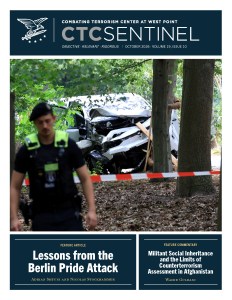
On July 25, a 21-year-old German man conducted a vehicle-ramming and machete attack at the Christopher Street Day Pride celebration in Berlin, killing one and injuring 31 others. The perpetrator was later killed in a confrontation with police. In our cover article this month, Adrian Shtuni and Nicolas Stockhammer examine the details that have subsequently emerged about the attacker, including several interactions with the German judicial system, and what they reveal about gaps between warning and response. “The warning indicators,” they find, “were unusually dense—foreign intelligence, prior convictions, jihadi travel attempts, extremist family and network ties, and a formal high-risk assessment. The threat was recognized, but the institutional response did not match the known level of risk.”
In our feature commentary, Wahid Gulrani considers what happens to the “militant social inheritance”—relational, infrastructural, and symbolic assets—left behind when militant organizations in Afghanistan are degraded or eliminated. These assets “are transferred, lie dormant, or are repurposed on a slower clock than the one by which counterterrorism measures success.” This longer horizon, Gulrani argues, means militant groups’ remaining “social estate” is often “invisible … [to] the instruments pointed at it,” which he contends has implications for counterterrorism assessment.
Amira Jadoon, David Reas, and Natalie Tarby provide a close examination of the doctrine of the Balochistan Liberation Army’s suicide wing, highlighting that it “justifies its violence not through religion but through secular rationalism.” Furthermore, they write, “its martyrdom doctrine, which is not linked to any religious doctrine, represents a stark deviation in the broader Afghanistan-Pakistan militant landscape.”
Utilizing 10 years of data on African park ranger deaths, Christian Jokinen examines what attack patterns against these rangers can reveal about “shifts in territorial contestation, insurgent penetration, and the evolving security dynamics in protected areas,” which “often mirror broader trends in armed conflict, banditry, and weak state control.” “Rangers,” Jokinen writes, “occupy a particularly exposed position at the intersection of conservation, state authority, territorial control, and access to natural resources. Their casualties are therefore not peripheral to the conflict environment; they are, in important cases, an expression of how that conflict operates within protected areas.”
Don Rassler and Kristina Hummel, Editors-in-Chief
