
Abstract: This article traces how the Islamic State has come to view China over the years. Over the past decade, within the Islamic State’s broader propaganda and operations ecosystem, Beijing has evolved from a peripheral grievance into a routinized enemy, with serious implications. It argues that this evolution unfolded in four phases: early, episodic references to Uyghur suffering prior to 2014 and, after 2014 and the caliphate’s proclamation, a gradual consolidation under Islamic State central media, which embedded Xinjiang and “East Turkestan” into the group’s global narrative; a period of experimentation with Chinese‑language content and symbolic threats, including Mandarin-language nasheeds and Uyghur‑focused videos; the emergence of Islamic State Khorasan Province (ISKP) as the movement’s anti‑China vanguard; and finally, normalization of China alongside the usual arch-enemies of jihadis—America, Russia, and local regimes—and expansion of the anti-China campaign to Africa. The article concludes that China’s ascent to great‑power status and deepening involvement in fragile Muslim‑majority regions will sustain, and likely increase, its prominence in Islamic State discourse, posing a persistent, if uneven, security challenge for Beijing and its partners.
Over the past decade, the Islamic State has moved China from the periphery of its worldview to a routinized enemy whose interests are legitimate targets for both propaganda and attack.1 This shift has not been linear, and it cannot be understood simply as a reaction to Beijing’s repression of Uyghur Muslims in Xinjiang. Rather, it emerges from the interplay of three major developments: the evolution of Islamic State central media after the proclamation of the caliphate in 2014; experimentation with Chinese‑language and Uyghur‑focused content; and, more recently, the rise of Islamic State Khorasan Province as the movement’s anti‑China vanguard.2
This article traces that trajectory in four phases primarily through the lens of Islamic State propaganda content and output. It begins by briefly situating the Islamic State’s hostility toward China in pre‑2014 jihadi discourse, then shows how the group’s central media after 2014 converted sporadic grievances into a recurring campaign theme. It then examines the Islamic State’s experimentation with Chinese‑language material and symbolic threats during the mid‑2010s, before turning to ISKP’s post‑2019 efforts to weaponize China’s regional posture and Taliban-China relations.3 The final section argues that by the mid‑2020s, violence and propaganda against Chinese targets had become normalized components of the Islamic State repertoire, lowering the threshold for future attacks on Chinese interests. The aim of this article is to accurately describe how the Islamic State views China in its media releases, how the views expressed through media content have changed over time, and why this matters for the terrorist threat landscape facing China. This includes a look ahead to regions such as sub-Saharan Africa where Beijing is likely to face increased resistance and outright hostility toward its expanding presence. This more aggressive pushback against Chinese interests is reflected in the proliferation of Islamic State media accounts, both official and unofficial, placing Beijing in their collective crosshairs.
Phase 1: From Early Uyghur Grievances to Caliphate Rhetoric (2009-2014)
The Islamic State’s hostility toward China predates the formal caliphate but was initially episodic and derivative of broader jihadi concerns. In the late 2000s, when the Islamic State was still the Islamic State in Iraq (ISI) and part of al‑Qa`ida’s transnational network, references to Uyghur suffering only appeared sporadically in its messaging. Shortly after the 2009 Urumqi riots and ensuing crackdown, ISI released a lengthy martyrdom video4 that advocated for the protection of the Uyghurs, threatened Beijing, and folded Xinjiang into a global narrative of Muslim oppression at the hands of “crusaders,” “Jews,” and local “apostates.” This material foreshadowed later themes but did not yet place China at the center of Islamic State strategy. Geopolitical developments have impacted this shift to a more China-focused Islamic State propaganda campaign, with operational implications expected to follow.
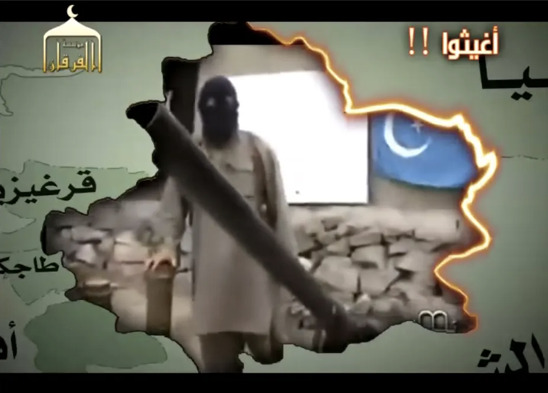
The proclamation of the caliphate in 2014 marked a turning point. In June of that year, Islamic State spokesman Abu Muhammad al‑Adnani announced the establishment of the caliphate, and within days, Islamic State leader Abu Bakr al‑Baghdadi’s audio message “A Message to the Mujahidin and the Muslim Ummah in the Month of Ramadan” highlighted “the extreme torture and degradation of Muslims in East Turkestan.”5 Al-Baghdadi condemned China for preventing Muslims from exercising their basic rights and signaled that Beijing’s policies in Xinjiang would occupy a significant place in the caliphate’s worldview.
Subsequent Islamic State leadership statements reinforced this framing. In a July 2014 sermon, al-Baghdadi claimed that Muslims’ rights were being seized in China and boasted of foreign fighters from a range of countries, including China, thereby asserting both the caliphate’s global reach and its connection to Muslims in Xinjiang.6 In 2015, he questioned Saudi Arabia’s credibility by asking why its rulers did nothing for Muslims in China, an attempt to use Uyghur suffering as a wedge issue to delegitimize regional regimes.7
In his role as official Islamic State spokesman, the individual who was long believed to be al-Baghdadi’s deputy, al‑Adnani, echoed and amplified these themes through his own speeches.8 In a September 2014 address, for example, he lamented “hundreds of thousands of dead, wounded, and imprisoned Muslims, and the millions displaced … all over the world at the hands of the Jews, crusaders, Rafidah, Nusayriyyah, Hindus, atheists, and apostates, in … China, the Caucasus, and elsewhere,” explicitly grouping China with an array of religious and ideological enemies.9 In 2016, al-Adnani again singled out Chinese “atheists” for committing “massacres, crimes and atrocities against the Muslims in … Turkestan,” thus placing Beijing alongside other taghut (tyrant) powers like Russia and the United States in the Islamic State’s cosmology of enemies.
In this first phase, China was not yet a distinct nor coherent propaganda campaign, but the rhetorical building blocks were laid: Xinjiang as “East Turkestan,” Uyghur repression as emblematic of anti‑Muslim tyranny, and China as one of several great powers oppressing Muslims worldwide.10 The ground was prepared for a more sustained focus once the Islamic State’s central media consolidated after 2014.11 Given its prominent role on the world stage, China has always been on the Islamic State’s radar, especially in terms of propaganda and strategic communications. But over time, as China’s physical presence has expanded to different regions, and as its treatment of Uyghur Muslims became more widely discussed, Beijing has also found itself rising on the list of priorities in terms of Islamic State operational focus. Over time, the salience of China as an enemy prioritization has shifted, growing in response to geopolitical developments and the behaviors and perceived behaviors of the Islamic State’s adversaries.
Phase 2: Experimentation and Linguistic Targeting (2014-2017)
Between 2014 and 2017, Islamic State central media moved from occasional references to China toward a more deliberate, experimental campaign that tested Chinese‑language and Uyghur‑focused products.12 This can be seen by the gradual and slow increase of Mandarin- and Uyghur-language media content as well as a relative focus on Chinese themes, despite being considerably inferior in quantity and quality than other topics. The consolidation of Islamic State media under the Diwan of Media during this period provided the organizational capacity to pursue such experiments in a coordinated way.
The group’s flagship English‑language magazines—Dabiq and its successor, Rumiyah—played a key role in embedding China into the group’s global narrative.13 They more often referenced Xinjiang as “East Turkestan,” reproduced segments of al-Baghdadi and al-Adnani speeches mentioning Uyghur repression, and presented the reconquest of East Turkestan as part of the caliphate’s long‑term territorial ambitions.14 As part of the group’s stated intention of expanding the Islamic State “until they reach Indonesia, China, Spain, and Rome,” propaganda maps were circulated online depicting future Islamic State provinces stretching from the Levant through Khorasan into Xinjiang, visually inscribing Chinese territory into the group’s imagined state.15
At the same time, the Islamic State invested in linguistic outreach to Chinese language audiences. An October 2014 video, released by the group’s media apparatus, featured Chinese subtitles and celebrated a “Chinese brother” who had conducted a suicide operation in Iraq.16 This production signaled both technical capability and a willingness to present Chinese‑speaking militants as exemplars and martyrs.
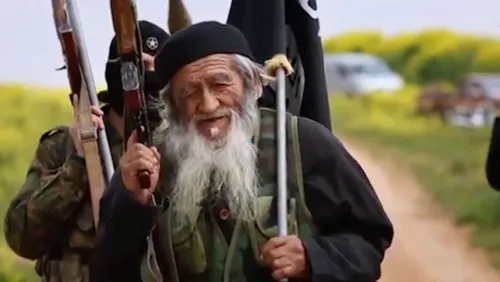
In July 2015, another video featured an elderly cleric from Xinjiang calling for the killing of “Chinese infidels,” interspersed with scenes of Uyghur children pledging violence. This was a theme cultivated by the Islamic State across multiple conflict zones and theaters, including in Iraq and Syria, where the ‘Cubs of the Caliphate’ concept was born and featured in the group’s propaganda. The carefully staged imagery in the case of China, as it did in the Middle East, suggested an intergenerational, socially embedded jihad against Beijing rather than a marginal cause.17 In other words, while the approach was not unique to China, it demonstrated that China was on equal footing with other countries and regions prioritized in Islamic State propaganda.
In November 2015, the first killing of a Chinese citizen by the Islamic State was featured in its propaganda by highlighting Fan Jinghui in Dabiq magazine as a hostage “for sale,” then later claiming that he and a Norwegian captive had been “executed” after being abandoned by “kafir” nations and organizations.18 However, perhaps the most notable experiment was the release of a Mandarin‑language nasheed (Islamic chant) in December 2015.19 Although there was no sizable, discernible increase in recruitment among Chinese militants in favor of the Islamic State, nor an increase in the Mandarin language media content production supporting the Islamic State, the nasheed carried disproportionate symbolic weight. It demonstrated that the Islamic State was prepared to address Chinese‑speaking audiences in their own language, to graft its ideology onto local grievances, and to test whether such content could resonate within Uyghur and broader Sinophone Muslim environments. It also directly challenged jihadi organizations—both global and local—that were traditionally considered the only platforms available for Mandarin-speaking and Uyghur militants until the inception of the Islamic State. Furthermore, the Islamic State’s al-Hayat Media Center produced numerous Uyghur-language nasheeds around this time.20
The influence of these efforts extended into the digital sphere among supporters. In early 2016, a Tsinghua University website was briefly defaced with jihadi slogans calling for “holy war,” illustrating how pro‑Islamic State sympathizers could contest Chinese symbolic spaces even without physical access.21 In February 2017, an Islamic State video released by al‑Furat Media showed a Uyghur fighter threatening China and promising revenge.22 The video was part of the Islamic State’s attempt to reach out to militants affiliated with rival organizations and to potential supporters in China—a tactic applied also to other theaters where the Islamic State lacked physical presence—thus signaling to Chinese and Uyghur militants that the Islamic State was a viable platform for armed struggle. Shortly thereafter, the Islamic State claimed responsibility for the kidnapping and killing of two Chinese nationals in Pakistan’s Balochistan, as a retaliation for Pakistan’s security forces’ counterterrorism operation in the area, translating years of symbolic hostility into concrete violence.23
Taken together, this phase was characterized by experimentation. Islamic State central media tested Chinese‑language outreach, elevated Uyghur grievances, and began to depict Chinese citizens and infrastructure as legitimate targets. These experiments would prove important once regional conditions changed and a more proximate Islamic State affiliate took up the anti‑China banner.24 Furthermore, the propaganda manifested into Islamic State killings and plots targeting Chinese nationals and interests for the first time, signaling a shift in the targeting imperative.25 Still, it should be noted that this was not the first instance of a jihadi group killing a Chinese national. In June 2009, an attack launched by al-Qa`ida in the Islamic Maghreb (AQIM) against an Algerian paramilitary police convoy escorting Chinese construction workers led to 19 paramilitary police and one Chinese worker killed.26
Phase 3: Economic Imperialism, COVID‑19, and the Emergence of ISKP as Vanguard (2020-Present)
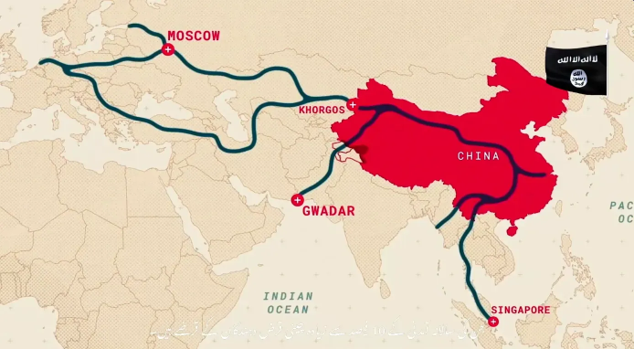
As China’s overseas footprint expanded and the Belt and Road Initiative (BRI) accelerated, Islamic State narratives opportunistically shifted from a Xinjiang‑centric grievance frame to a broader critique of Chinese economic imperialism.27 This evolution coincided with the rise of ISKP, headquartered in Afghanistan, as the movement’s spearhead on propaganda and attacks targeting China.
With China’s growing political, diplomatic, and economic footprint, it is inevitable that Beijing will encounter friction in certain parts of the world. South Asia is one of the regions where a more visible Chinese presence has resulted in an aggressive push-back from a range of violent non-state actors, including separatists and jihadis.
Economic Imperialism and Belt and Road Narratives
During this period, the Islamic State’s Arabic‑language weekly newsletter Al Naba began portraying BRI not as a neutral development project but as a scheme for political capture and exploitation.28 Articles described China’s “method of investment” as a way of binding tyrannical governments in Muslim‑majority countries through debt and infrastructure, forecasting that Beijing would eventually intervene directly with military forces to defend its interests. In this narrative, Chinese nationals, diplomatic facilities, and commercial projects became legitimate targets for preemptive violence, justified as defensive measures against an encroaching imperial power. For the Islamic State, this has become a self-fulfilling prophecy, since Beijing’s expansionist ambitions show no signs of ebbing, and thus, are portrayed as proof of China’s creeping imperialism.
This framing was particularly salient in regions where Chinese investments were highly visible, but local grievances were acute. China-Pakistan Economic Corridor (CPEC) infrastructure,29 energy pipelines in Central Asia, and mining ventures in Afghanistan and Pakistan were cast as the soft underbelly of a rising superpower.30 In 2017, pro‑Islamic State outlet Al‑Battar Media Foundation proclaimed that it was entering into a state of war with China and would target Beijing’s “New Silk Road” initiative in the name of defending Uyghur Muslims. Jihadi and separatist groups beyond the Islamic State,31 including Pakistani Taliban (or Tehrik-i-Taliban Pakistan, TTP) factions and Baloch insurgents, converged on similar themes, sometimes targeting Chinese nationals as symbols of unwanted foreign intrusion.32
COVID-19 as “Soldier of Allah”
The COVID-19 pandemic added another layer to the Islamic State’s anti‑China discourse. Beginning in early 2020, pro‑Islamic State channels on encrypted platforms framed the virus as a “soldier of Allah” sent to punish China and other enemies of Islam. Posters and unofficial media depicted figures in protective suits alongside slogans linking the outbreak in Wuhan to divine retribution for Uyghur repression and other alleged crimes against Muslims.33 Official outlets amplified this message. Al Naba editorials described COVID‑19 as a torment from God for the “Crusader” countries and infidels, with China frequently included in that category.34 The pandemic thus became a symbolic bridge connecting theological ideas of punishment and cosmic justice to geopolitical criticism of Beijing.
Rather than focusing solely on public health consequences, the Islamic State interpreted the outbreak through a theological lens, presenting COVID-19 as a manifestation of divine retribution against states accused of oppressing Muslims, including China, because of its policies in Xinjiang. The Islamic State sought to link contemporary geopolitical events to religious concepts of justice and punishment.35
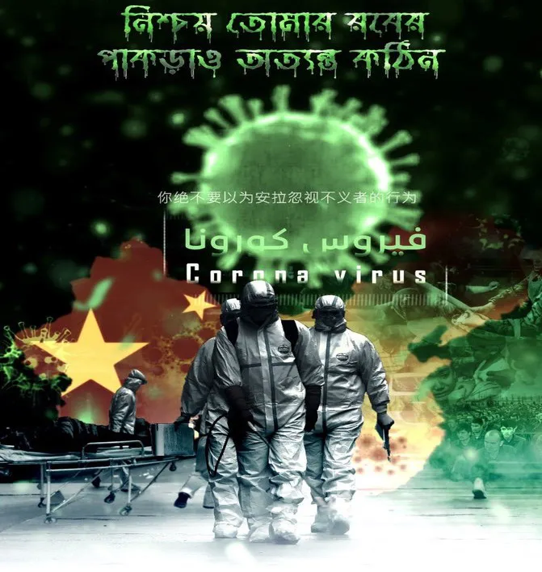
in 2020
Pro-Islamic State media networks quickly incorporated the pandemic into their anti-China messaging.36 In several cases, COVID-19 was described as an opportunity created by God to weaken hostile powers and expose the vulnerability of states that jihadi propagandists routinely portrayed as enemies of Islam.37 Quraysh Media, for example, circulated propaganda posters (not pictured) depicting a hazmat-suited individual accompanied by the slogan, “China: coronavirus … A promise is a debt we must not forget.” Posts celebrated the pandemic with messages such as “May God punish China with death, as they had brought death to Muslims,” “as China beats Uyghur Muslims, coronavirus is now beating China,” and “the virus is God’s army that destroys the kafir (infidels).”
Significantly, the COVID-19 narrative did not exist or emerge in isolation. Instead, it was absorbed into an already established anti-China propaganda framework centered on the plight of Uyghur Muslims. This framing enabled propagandists to reinforce anti-China sentiment, legitimize hostility toward Chinese interests abroad, and integrate contemporary geopolitical developments into a broader worldview grounded in religious conflict and cosmic justice.
ISKP’s Rise and the Taliban-China-Uyghur Triangle
Islamic State central media gradually reduced explicit references to Uyghurs after 2016, possibly due to the lack of actual support from Uyghur militants, difficult access to the population, and the strategic choice of concentrating its media focus on other theaters. However, ISKP began to emerge as the entity in the movement that spearheaded the release of anti-China content with an unprecedented volume, in-depth content, and a string of attacks against Chinese citizens and interests. It seems that initially, ISKP’s media apparatus remained tightly controlled by Islamic State central, and that it was abiding by the rules and procedures of the Islamic State media apparatus for official releases.a As a consequence, anti‑China content was limited despite the presence of figures such as Abu Zar al‑Burmi, a Burmese preacher known for his fiery anti‑China rhetoric.38 Only after ISKP lost its territorial strongholds in eastern Afghanistan around 2019-2020, and its media production became more decentralized through the emergence of various unofficial outlets, did anti‑China themes crystallize.39 Moreover, in January 2020, a plot was foiled in Brest, northwest France, where seven suspects were arrested for allegedly planning attacks on a French military site and local Chinese New Year celebrations, with the cell reportedly having recorded pledges of allegiance to the Islamic State.40
ISKP’s strategy was to frame China’s engagement with the Afghan Taliban as evidence of Taliban ‘apostasy’ and ‘betrayal.’ As the Taliban advanced militarily and retook Kabul in August 2021, pro‑ISKP outlets ramped up anti‑Taliban and anti‑China messaging. The newly designated official media branch, Al‑Azaim Foundation, began producing a steady stream of content castigating the Taliban for normalizing relations with Beijing, accepting Chinese aid and investment, and endorsing the “One China” policy.41 Media content produced by the group systematically criticized Afghan Taliban and Chinese officials, accusing the Taliban of selling out oppressed Muslims in exchange for economic aid and international recognition.42 b Editorials and booklets in Pashto, Dari, and English attacked Taliban statements that framed Xinjiang as an internal Chinese issue and criticized Kabul’s assurances that it would not allow Uyghur militants to operate from Afghan soil.43 In this telling, China was not just another external enemy; it was the power that had successfully co-opted the Taliban, thereby justifying ISKP’s war on both.
ISKP’s operational activity further reinforced this narrative. The October 2021 suicide attack on a Shi`a mosque in Kunduz—carried out by a bomber identified as “Muhammad al-Uyghuri”—was used by ISKP and affiliated pro-Islamic State media to merge themes of Uyghur identity,44 hostility toward the Taliban, and anti-China messaging into a single symbolic event.45 The Islamic State’s Amaq News Agency named the attacker “Muhammad al-Uyghuri” and claimed that “the Taliban has pledged to expel and oust [Uyghurs] at the request of … China.”
By early 2022, ISKP had fused earlier Islamic State themes—Taliban criticism, Uyghur solidarity, opposition to economic imperialism, and defiant great‑power rhetoric—into a more sustained campaign. As a result, follow-on ISKP attacks and alleged plots against Chinese nationals in Afghanistan and the broader region were framed as strikes against a taghut regime that ISKP cast as a primary enemy. China was no longer just another distant oppressor; it was a proximate, active player in ISKP’s operating environment and a symbolically rich target around which to organize its challenge to the Taliban. ISKP effectively merged anti-Taliban narratives with global anti-China Islamic State narratives. Numerous publications depicted the Taliban as de facto security guarantors to Shanghai Cooperation Organization (SCO) member states against ISKP in the region, whereas in other narratives, the group placed China alongside the United States and Russia as “modern Pharaohs.”46 ISKP sought to elevate Beijing to top‑tier enemy status in the minds of supporters, consistent with its widening focus beyond merely local Afghan or Pakistani issues to a broader global agenda. In this context, ISKP sought to expand its regional vision by launching the now-defunct Arabic-language magazine Sadoy Khorasan.47 Issue 5 chiefly featured one of the most detailed articles against China regarding the Arabic-speaking Muslim world’s relations with China, including international organizations such as the World Council of Muslim Communities, as well as the organization’s visit to Xinjiang.48
Operationally, the most significant attack carried out by ISKP that purposely targeted Chinese civilians—“diplomats and businessmen,” as the group claimed—was the assault on the Kabul Longan Hotel on December 12, 2022, which housed Chinese nationals and Taliban officials.49 The attack was carried out by two Tajik nationals and resulted in the death of three individuals—none of them Chinese nationals—several injuries, including Chinese nationals, and the death of one of the attackers. The attack remains the most significant one carried out by ISKP targeting Chinese nationals due to the motivation of the attack, which was explicitly targeting Chinese foreigners; the preparation, as the two attackers stayed inside the hotel for days; and the impact of the attack, which could have resulted in more Chinese casualties if they had succeeded.50 ISKP and pro‑Islamic State outlets exploited the Kabul hotel attack to amplify Al Naba’s themes, with Al‑Azaim quickly issuing a Pashto‑ and Persian‑language image of the attackers amid hotel smoke, later translated into Tajik by Al‑Azaim Tajiki.51 The Kabul hotel assault did not occur in isolation. Earlier that same year, in January 2022, ISKP conducted a suicide bombing outside the Taliban’s Foreign Ministry building in Kabul, timed around the expected arrival of a Chinese delegation. The attack signaled the group’s intent to target Chinese diplomacy, as well as to challenge the Afghan Taliban’s reassurances of guaranteeing security and the Taliban’s broader relationship with China.52
In 2023, ISKP carried out a suicide attack in June in Badakhshan Province that resulted in the killing of several Taliban officials.53 According to ISKP, the goal of the attack was to disrupt Islamic Emirate of Afghanistan (IEA)-China security efforts and to terrorize China’s economic plans in the region.54 In January 2025, ISKP claimed its second direct attack against a Chinese national in Afghanistan. The operation occurred in a village in the northern province of Takhar. During the attack, a group of ISKP militants stopped the vehicle in which a Chinese mining worker and his translator were traveling, and executed the miner.55 A year later, in January 2026, ISKP conducted a suicide bombing at the Chinese noodle restaurant in Kabul, which killed six local Afghans and one Uyghur Muslim. This attack helped to amplify ISKP’s China-focused narratives, spotlight its anti-China activity to an international audience, and likely gain more credibility with other jihadis and extremists who hold anti-China grievances. Consequently, ISKP immediately capitalized on the attack. On February 4, 2026, after a six-month hiatus, ISKP published issue 38 of Khorasan Ghag magazine, which carried an article seeking to exploit the international backlash over the attack for its own purposes. In the article, the ISKP directly addressed the Uyghur population, presenting itself as the only jihadi group that is attacking China on their behalf, accusing Kabul and Islamabad of ignoring the Uyghur issue.56 The April 2026 issue of Voice of Khurasan continued to capitalize on the attack by translating the Khorasan Ghag issue into English and boasting about how the attack bypassed the Taliban’s security.57
Simultaneously, since 2023, ISKP has been attempting to expand its recruitment of Uyghur militants allegedly based in Afghanistan. In February 2023, ISKP released its first publication exclusively dedicated to China, the Uyghurs, and the Taliban.58 In the text, ISKP directly addresses East Turkistan Islamic Party (ETIP) militants in Afghanistan, arguing that while the Taliban are preventing them from attacking Chinese interests in the country, ISKP is eager to provide them with a platform for carrying out terrorist operations. The message was reiterated in September 2023 when ISKP discussed at length the status and fate of the ETIP in Afghanistan, arguing that ISKP is the only jihadi platform for targeting Chinese interests in the region, while stating that the Taliban have reduced the Uyghur issue to a solely internal matter of the Chinese government.59
As part of the group’s strategy to exploit the growing ties between the Afghan Taliban and China to boost recruitment among jihadi organizations, ISKP also expanded its criticism of Afghan Taliban-China relations to other jihadi rivals in the region. Among jihadi groups in the region, the Pakistani Taliban and its factions are the main recruitment targets for ISKP. In the recent past, Pakistani Taliban militants have been accused of carrying out attacks in Pakistan that led to the death of Chinese nationals, such as the April 22, 2021, suicide bombing at a hotel in Quetta, where the Chinese ambassador was present; the July 14, 2021, bomb attack targeting a bus carrying Chinese engineers in Dasu; and the March 26, 2024, suicide bombing in Shangla, also targeting a bus carrying Chinese engineers.60 In this context, ISKP seeks to instrumentalize the issue to compete with other jihadi organizations. For instance, issue 13 of Urdu language ISKP magazine Nida-e-Khorasan, published in January 2026, accused the TTP of following the Afghan Taliban path in appeasing the international community, including assuring China that it does not harbor any hostility against it.61 Even religious political parties in Pakistan were not spared criticism, as in Issue 3 of Nida-e-Khorasan, the leader of the Pakistani religious-political party Jamaat Ulema-e-Islam-Fazl (JUI-F), Mawlana Fazlur Rehman, was criticized for having cordial relations with China, in addition to his support for the Afghan Taliban’s government.62
Phase 4: Normalization, Multipolarity, Outlet Diversification, and African Expansion (Late 2022/Early 2023-Present)
By the mid‑2020s, hostility toward China had become somewhat routine within the Islamic State’s broader ecosystem. What had begun as less frequent linguistic outreach and sporadic rhetorical denunciations had matured into routine, almost bureaucratic messaging and opportunistic violence. Similar evolutions against other Islamic State targets have resulted in real-world, physical attacks. For instance, in September 2022, ISKP attempted to conduct a suicide bombing outside of the Russian Embassy in Kabul, following a media campaign threatening foreign nationals in Afghanistan.63 Subsequently, following a stream of new threats against Russia, the Islamic State conducted the Crocus City Hall attack in Moscow in March 2024.64
This normalization is visible in the way attacks on Chinese‑associated venues and personnel were presented by Islamic State central and ISKP alike. Claims issued via Amaq News Agency and Al Naba followed standardized templates, using conventional jihadi terminology and embedding China alongside the usual roster of enemies—America, Russia, regional ‘apostate’ regimes—rather than treating Chinese targets as exceptional.65 Mandarin‑language flourishes and explicit references to Xinjiang became less central in these communiqués. Instead, the focus shifted to signaling that the Islamic State remained capable of hitting a major external power despite territorial collapse and sustained counterterrorism pressure.
The evolution from ‘special’ to ‘routine’ is important. It is possible that once China’s inclusion in the enemy hierarchy no longer required elaborate justification, the threshold for targeting Chinese interests was lowered. This seems to be similar to attacks against U.S. and Western targets and against the so-called near enemy (local governments), which do not require continuous justification by the Islamic State for them to be targeted by cells and inspired individuals. These dynamics made it easier for local cells and sympathizers to justify opportunistic attacks against Chinese workers, businesses, or diplomatic facilities as self‑evident acts of jihad, without needing explicit central guidance and also acts that were focused on an Islamic State priority. The January 2026 suicide bombing at a Chinese‑favored restaurant in Kabul’s Shahr‑e‑Naw district discussed in the previous section, for example, was framed as both retaliation for Uyghur repression and a demonstration that Chinese nationals remained vulnerable even in supposedly secure areas under Taliban protection.
At the same time, pro‑Islamic State media in South Asia further diffused anti‑China narratives. The Voice of Hind magazine, associated with the Islamic State’s ‘Hind Province’ (ISHP),66 integrated criticism of Chinese atheism, Uyghur oppression, and China’s partnership with India into a broader portrayal of great power competition as a struggle between ‘evils’ hostile to Islam. Other outlets, such as Voice of Khurasan and various online magazines, echoed ISKP’s portrayal of China and India as joint colonial actors in the Indian Ocean and South Asia, repurposing even modest attacks on Chinese tourists or workers as proof of a global anti‑China campaign.67 This could lead to further incidents of anti-Chinese political violence in the region in the years to come.
ISHP and ISKP publications inspired new South Asian outlets to emerge and amplify their messages. In January 2024, Voice of Khurasan 32 carried a piece on the Maldives that framed the country as a site of “power struggle for regional domination of the two growing Evils, India and China, both of whom are the staunch enemies of Islam and Muslims.”68 ISKP boasted that “in Feb 2020, three kuffar — one Australian and two Chinese nationals — were stabbed by our Inghimasi brothers in Hulhumale, an Island near the capital Malé” and warned that “the soldiers of Khilafah are ever ready to slit their throats and slaughter them along with their kuffar allies (Chinese and Indians).”69
By incorporating the Maldives stabbing of Chinese nationals into its broader narrative, ISKP demonstrated that even relatively small attacks on tourists or workers can be repurposed as evidence of a global anti‑China campaign. By broadening the narrative, it is likely that ISKP hopes to appear ubiquitous and amplify the psychological component of its propaganda campaign.
Multipolarity and China as a Rising Great Power
ISKP’s anti-China messaging has become one of the clearest examples of how the group turns geopolitics, grievance, and sectarian outrage into a single propaganda line. The movement does not treat Beijing as just another distant enemy; it places China within a broader map of great power competition, portraying it as both an imperial actor and a persecutor of Muslims.70 That framing allows ISKP to present China as a target for revenge, a symbol of global disorder, and a major player in multipolar competition with the United States and its regional Asian allies.
A major step in that evolution came with the September 2022 publication of “China’s Daydream of Imperialism,” which marked one of ISKP’s most detailed anti-China ideological attacks. The text portrayed China as an ascending hegemon seeking to build its own regional sphere while competing with American power. It argued that Beijing’s “booming economy has become a global concern for many international players” and that this shift is “a real challenge for the U.S. hegemony in the world economy.” ISKP also claimed that China is “pushing to turn the unipolar world into a bipolar one” and pursuing “their future ambition of conquering the world and establishing their own power sphere.” In ISKP’s logic, China is not merely a rival state but an imperial project in motion, destined to collide with the Islamic world.
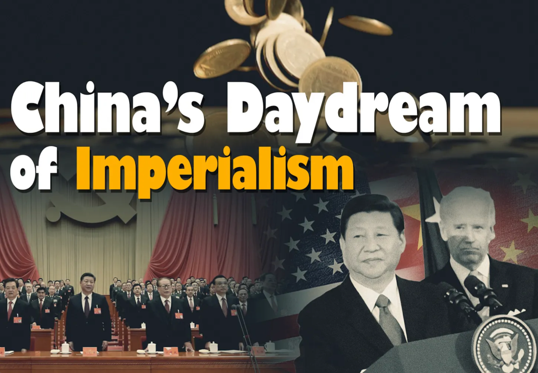
That article also tied China directly to a larger collapse of the world order. ISKP predicted that escalating tensions around Taiwan and other geopolitical flashpoints would lead the “enemies of Islam” into a wider war, which it characterized as an approaching “Third World War.” The text warned that Beijing would eventually face the “sharp blades of the Khilafah mujahidin,” making clear that ISKP intended to exploit great-power disorder to threaten Chinese assets directly. China was thus integrated into a strategic narrative about global instability, creating room for jihadi advance.
That same logic becomes even more concrete in ISKP’s multimedia output, especially its April 2023 video “The Unrestrained Metastasis Within the Body of the Ummah.” The film largely focuses on criticizing and threatening the Pakistani government, but China and CPEC sit at the center of its broader message.71 ISKP refers to the Pakistani state as “cancerous” and beholden to hostile outside powers, including communist China and the capitalist West. It presents Pakistan as a country being hollowed out by debt, corruption, foreign influence, and moral decay, while the narrator attacks the state for economic crisis, unemployment, inflation, and insecurity. The propaganda tries to make Pakistan look like a broken proxy of foreign interests rather than a sovereign Muslim state, overlapping with al-Qa`ida and Pakistani Taliban narratives. However, while Pakistani Taliban and al-Qa`ida gradually marginalized anti-China narratives, at best focusing on economic, socio/political issues while toning down Uyghur-specific content, ISKP dedicated a large portion of its narratives against Pakistan by connecting Islamabad with the Uyghur issue.
In the video and in ISKP propaganda generally, China is portrayed as a power that does not merely influence states but absorbs them through debt, infrastructure, and political dependency. For example, in the video ISKP portrays the China-Pakistan Economic Corridor as part of a wider Belt and Road strategy that allows Beijing to entrench itself inside Muslim lands. The narrator argues that Pakistan’s “ever-increasing ties with China” amount to subjugation, and that CPEC functions as a vehicle for the “Chinese Atheists” to enslave local Muslim populations, “under the pretext of development projects,” especially around the Pakistani port of Gwadar.
ISKP also accuses China of ‘debt-trap diplomacy’ and of using economic leverage to expand its control over governments around the world. To make the point, the video compares Pakistan’s trajectory to Sri Lanka’s debt crisis, implying that CPEC could produce the same result: dependence, loss of sovereignty, and eventual territorial control by Beijing if Islamabad cannot repay its obligations. In the group’s telling, the language of development conceals a project of domination, whereby Muslim countries are being sold out from within.
That threat matters because it shifts ISKP’s anti-China propaganda from abstract grievance to a concrete geopolitical warning where propaganda is paired with an operational threat. For example, the video concludes with direct warnings to the Pakistani government with ISKP pledging to attack CPEC development sites. That follows a pattern already visible in ISKP’s past violence against Chinese targets, including the killing of two Chinese nationals in Pakistan in 2017, the attack on Chinese guests at a Kabul hotel, and the suicide bombing at the Taliban foreign ministry on a day when Chinese representatives were reportedly due to be present.72
The broader strategic logic behind these efforts is that ISKP treats geopolitical rivalry as an opportunity. This is why “China’s Daydream of Imperialism” and “The Unrestrained Metastasis Within the Body of the Ummah” work together so effectively as propaganda texts. The first provides the grand ideological frame: China as an imperial power heading toward a civilizational clash. The second gives that frame a practical set of targets: CPEC, Gwadar, Pakistani institutions, and the wider Chinese footprint in South Asia. Between them, ISKP turns geopolitical rivalry into a recruiting narrative, a threat narrative, and a justification for violence.73
The Broadening Diversity of Islamic State Outlets Criticizing China
This diffusion of anti-China narratives beyond official online Islamic State channels became increasingly evident following ISKP’s December 2022 attack on Chinese nationals in Kabul,74 which triggered a wave of anti-China propaganda from a diverse range of official and pro-Islamic State media outlets. The online Islamic State sphere does this with a select few high-profile attacks, with the Bondi Beach mass shooting, for instance, but following ISKP attacks on Chinese and other foreign targets in Afghanistan, there is a notable response by Al-Azaim Media Foundation and various pro-Islamic State propaganda outlets online.75 The propaganda surge that followed the attack demonstrated that anti-China messaging was no longer confined to Islamic State Central or ISKP alone. Instead, a significantly broader and more diverse ecosystem of pro-Islamic State media outlets rapidly mobilized to amplify anti-Chinese narratives across multiple languages and platforms. Beyond official coverage in Al Naba and statements from ISKP’s al-Azaim Foundation for Media Production, the campaign drew participation from al-Azaim Tajiki, the English-language translation outlet Halummu, the pro-Islamic State media group al-Battar, Hadm Alaswar, and the Bengali-language outlet At-Tamkeen Media. These organizations translated, repackaged, and redistributed anti-China content, ensuring that narratives linking the Kabul attack to the treatment of Uyghur Muslims reached audiences across South Asia, Central Asia, the Middle East, and the broader online supporter network.
The breadth of participation extended even further, with additional Islamic State-aligned and pro-Islamic State channels such as Aladiyat, at-Taqwa, and Vanguards of the Ansar (Supporters) producing original propaganda celebrating the attack and threatening future violence against Chinese interests. Their messaging portrayed China as an enemy of Islam, framed the Kabul operation as retaliation for Beijing’s policies in Xinjiang, and sought to position the Islamic State as the only jihadi movement willing to translate anti-China rhetoric into action. The involvement of such a wide range of online outlets—spanning official provincial media, translation networks, ideological amplifiers, and supporter-run propaganda channels—illustrates a notable expansion of anti-China narratives across the broader pro-Islamic State media sphere. This has also been observed with the attacks on Pakistani and Russian diplomatic facilities; however, the China attacks have been most frequent in terms of targeting foreign nationals and interests and have evoked the greatest reactions. This suggests that hostility toward China was increasingly becoming a shared theme embraced by a diverse array of Islamic State supporters and affiliated propagandists, rather than remaining solely the focus of Islamic State Central and ISKP.
This trend continued into 2026 with in-house branch media networks and a new pro-Islamic State propaganda outlet explicitly prioritizing anti-China messaging. In late April 2026, ISKP’s Voice of Khurasan magazine published an article titled “Who Will Take Revenge for the Uyghur Muslims”—a translation from the Pashto-language original published in February shortly after the attack—using the January attack on a Chinese restaurant in Kabul as both a justification for anti-Chinese violence and a forward-looking declaration of intent. The article framed the operation as religious retribution on behalf of persecuted Uyghur Muslims, constructed China as a structurally defined enemy of Islam, and attacked the Taliban’s legitimacy for its engagement with Beijing. Positioning itself as the sole defender of Uyghur Muslims, ISKP signaled that the Kabul attack was not an isolated incident but the opening move in a sustained campaign against Chinese nationals and interests across the region.76
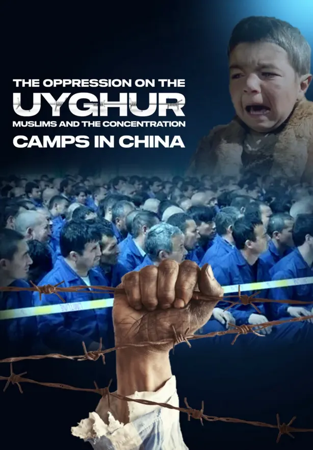
Then, on June 1, 2026, the newly established Al-Iman Media Center released an article titled “The Alienation of Muslims in China” in its inaugural magazine issue, which devoted extensive attention to the plight of Uyghur Muslims and portrayed Beijing as a principal enemy of Islam.77 The outlet’s rhetoric and thematic focus closely resembled those of ISKP’s Voice of Khorasan magazine, which for years had been among the most prolific Islamic State publications targeting China and highlighting Xinjiang-related grievances. Al-Iman’s article framed Xinjiang as an occupied Muslim land, accused Chinese authorities of systematic religious and cultural eradication, and integrated the issue into a broader Islamic State narrative of global conflict between Islam and its perceived enemies. The appearance of a new pro-Islamic State media platform adopting themes long championed by ISKP underscores how anti-China propaganda has continued to diffuse across the wider Islamic State support ecosystem, further broadening the range of unofficial outlets dedicating significant attention to China and the Uyghur issue.
The Islamic State’s Anti-China Campaign Expands to Africa
Expanding beyond South and Central Asia to include Africa, Islamic State’s anti-China campaigning in the mid-2020s began to fuse the same ideological framing developed for Afghanistan and Pakistan with local grievances over resources and governance in conflict zones such as the Democratic Republic of the Congo (DRC) and Mozambique.78 In Mozambique, this broader pattern had earlier parallels in al-Shabaab’sc August 2020 attack on and subsequent destruction of a Chinese sawmill called Mr. Forest in Mocímboa da Praia,79 an attack that underscored how Chinese commercial presence could be folded into insurgent narratives of foreign exploitation.
The March 2026 ISCAP raid on Chinese-run gold sites in eastern DRC was framed in the same terms used by ISKP: Chinese projects were depicted as instruments of exploitation and foreign domination, and attacks on them were presented as legitimate strikes against an oppressive global order.80 That framing was echoed explicitly in an earlier Al Naba editorial: The newsletter warned that “Crusader oil companies who have invested billions of dollars” were at risk and argued that foreign powers were using Mozambique’s resources for “plunder,” claiming that “there is nothing in the country that interests the Crusaders besides its huge reserves of different natural resources and in which American, French and South African companies jointly invest. And Russian and Chinese companies are ambitious to find for themselves a foothold in them as well.”81 Al Naba went further, threatening that South African involvement in the Cabo Delgado conflict “will place it in a great financial, security and military predicament, and may result in prompting the soldiers of the Islamic State to open a fighting front inside its borders,” and asserting that if ‘Crusader’ states intervened to protect investments and “guarantee the continuation of their plunder of the resources of the region,” they were “delusional,”82 because such intervention would only strengthen the insurgents’ cause.
Those statements matter because they show how Islamic State central media explicitly links resource extraction to ideological grievance, turning economic actors into symbolic enemies and widening the list of legitimate targets. By casting Western, South African, Russian, and Chinese companies as partners in the “plunder” of Muslim lands, Al Naba supplies local Islamic State affiliates with a directive to attack extractive projects, foreign personnel, and states perceived to defend them. This rhetoric aligns targets with strategic narratives: Operations that might once have been framed as purely criminal or opportunistic can be presented as part of a more coherent global campaign against foreign exploitation. Seen alongside the DRC mine assault, the editorial underscores how anti-China narratives—once cultivated in Afghanistan and Pakistan—are being repurposed to give ideological cover to attacks across Africa, helping to normalize such targeting within the wider Islamic State ecosystem.83
As China fills out a more robust presence throughout sub-Saharan Africa, it seems likely that future Islamic State propaganda campaigns will include a more detailed focus on Chinese infrastructure projects, the presence of Chinese nationals, and what the movement views as the exploitation of Muslims’ resources in areas where China operates. From the Sahel to the southeastern Swahili coast, the Islamic State remains entrenched, positioning itself as a vanguard against great power meddling and interference in local affairs.d Whether through the exploration of critical minerals in the DRC or the development of natural gas deposits in Mozambique, the presence of nation-states and multinational corporations is not going to cease—in fact, as great power competition intensifies, there may very well be a greater and more visible presence of countries such as the United States, China, Russia, France, and others scrambling for access to resources. In turn, the Islamic State will seek to take advantage of more frequent and substantive involvement of great powers on the African continent. As it has with other geopolitical developments, the Islamic State has mastered the art of portraying itself as the perpetual underdog, a David versus Goliath framing that resonates with large swaths of the group’s supporters.
Strategic Implications for China
The evolution of the Islamic State’s anti-China campaign carries several important strategic implications that extend beyond propaganda into operational and geopolitical domains.84 First, China now occupies a structurally embedded position within the Islamic State’s global enemy hierarchy. No longer framed solely as a persecutor of Uyghurs, Beijing is increasingly portrayed as a systemic adversary, an ascendant power whose political, economic, and security activities in Muslim-majority regions are interpreted as forms of imperial expansion. This shift reflects a broader recalibration in jihadi discourse, where China is treated alongside the United States, Russia, Iran, and regional governments as part of an interconnected constellation of hostile forces.
Second, the rise of ISKP as the vanguard of anti-China propaganda and operations ensures that Chinese interests across Afghanistan, Pakistan, Central Asia,85 and beyond will remain exposed to threats.86 ISKP’s ability to integrate local grievances with global ideological narratives allows it to position attacks on Chinese nationals and projects as both strategically meaningful and religiously justified. While other militant actors, such as Baloch separatists or Tehrik-i-Taliban Pakistan, may inflict higher casualties on Chinese nationals and interests in specific contexts, ISKP plays a distinct role in amplifying these incidents through the Islamic State’s transnational media ecosystem.87 This amplification effect magnifies the psychological and strategic impact of attacks, transforming localized violence into components of a broader global campaign.
Third, the normalization of anti-China targeting across official and pro-Islamic State media ecosystems arguably makes more anti-China violence likely. As a result, attacks against Chinese nationals, infrastructure, and commercial interests can now be framed as self-evident acts of jihad. This dynamic increases the likelihood of opportunistic violence by decentralized cells and unaffiliated sympathizers, particularly in fragile environments where Chinese economic engagement is visible, but security provision is uneven.88
Fourth, the geographic diffusion of anti-China narratives, most notably into African theaters such as the DRC and Mozambique,89 signals an important expansion of the threat landscape. In these contexts, Islamic State affiliates have adopted and adapted the anti-China framing utilized by the Islamic State and popularized by ISKP in multiple languages and consistently throughout time, exploiting them to challenge rival jihadi organizations. Often, they merged it with local grievances over resource extraction, governance failures, and foreign economic presence. By embedding China within a broader narrative of plunder and external domination, Islamic State propagandists provide ideological cover for attacks on extractive industries and foreign personnel with links to China. This convergence of global narrative and local conflict dynamics suggests that Chinese interests are more vulnerable in regions far removed from the original Xinjiang-centric framing.90
Finally, China’s continued ascent as a global power and its deepening engagement in politically unstable regions will likely sustain, and in some cases intensify, its prominence in Islamic State discourse.91 Diplomatic outreach, infrastructure investments, and security partnerships are consistently reframed within jihadi narratives as evidence of complicity with apostate regimes and as justification for violent resistance. As this pattern continues, Beijing faces a dual challenge: protecting its overseas personnel and assets while navigating the reputational and perceptual dimensions of its foreign policy in environments where militant groups actively exploit external involvement for recruitment and mobilization. This has implications for Chinese counterterrorism strategy and may affect how China views its security policy, particularly regarding the potential for greater involvement through private security companies, proxies, or local security partners in unstable regions.
Taken together, these dynamics indicate that the Islamic State’s anti-China campaign has matured into a durable and adaptable component of its global strategy. Even as the group’s operational capabilities fluctuate across regions, the ideological infrastructure underpinning hostility toward China is now firmly established. This makes it very likely that China will remain a recurring target within Islamic State propaganda and operations, with the scale and intensity of the threat shaped by local conditions but sustained by a coherent transnational narrative.92 CTC
Lucas Webber is a Senior Threat Intelligence Analyst at Tech Against Terrorism, a Senior Research Fellow at The Soufan Center, and the Co-Founder and Editor-in-Chief of MilitantWire.com.X: @LucasADWebber
Riccardo Valle is a research analyst, security consultant, and founder of Militancy Chowk. He conducts research on armed groups and international jihadi non-state actors. He is currently the Director of Research at The Khorasan Diary. X: @Valle_Riccardo_
Colin P. Clarke is the Executive Director of The Soufan Center. He also serves on the editorial board of Studies in Conflict and Terrorism, as well as Terrorism & Political Violence. X: @ColinPClarke
Daniele Garofalo is an analyst and researcher specializing in jihadi terrorism, armed and insurgent groups. He also monitors terrorist propaganda and serves as a security consultant. He is the founder and director of the intelligence platform Daniele Garofalo Monitoring. X: @G88Daniele
© 2026 Webber, Valle, Clarke, Garofalo
Substantive Notes
[a] Media content produced by the Islamic State’s regional branches and affiliated publishing houses have to be submitted to and reviewed by the Media Monitoring Committee. Prior to 2020, ISKP media content was exclusively published by Islamic State’s central media. However, gradually after 2020, ISKP started publishing its own content bypassing Islamic State’s central media. See Islamic State rulings on media content in Daniel Milton, Pulling Back the Curtain: An Inside Look at the Islamic State’s Media Organization (West Point, NY: Combating Terrorism Center, 2018), documents 1, 2, 5.
[b] For instance, this includes criticism of Deputy Foreign Minister Muhammad Naeem Wardak’s statements on the Uyghur issue being an internal issue of China; Afghan Taliban Prime Minister Abdul Sala Hanafi’s remarks that Afghanistan adheres to the “One China Policy;” Afghan Taliban ambassador to China Bilal Karimi’s statements saying that the Taliban are assisting China in countering ISKP; senior Taliban leader Maulvi Abdul Kabir’s statements on ISKP as a common enemy of China and Afghanistan; and Taliban officials meeting Chinese Foreign Minister Wang Yi. See Khorasan Ghag, Issue 37, pp. 10-11; Khorasan Ghag, Issue 33, p. 41; Khorasan Ghag, Issue 28, p. 45; Khorasan Ghag, Issue 30, p. 50; Khorasan Ghag, Issue 31, p. 26; “TKD MONITORING: New ISKP Video Describes the History of East Turkestan,” Khorasan Diary, December 1, 2023; “TKD MONITORING: New Video from ISKP Criticizes Taliban over Palestine and Xinjiang,” Khorasan Diary, November 19, 2023.
[c] Note that this al-Shabaab refers to Ahl al-Sunnah wa al Jamma’ah (ASWJ), not the al-Shabaab based in Somalia.
[d] For instance, ISKP Tajik wing published anti-Russian content due to the latter’s participation in the Syrian civil war. See “TKD MONITORING: ISKP Magazine (Sadoi Khuroson) Issue 2,” Khorasan Diary, June 27, 2024.
Citations
[1] Lucas Webber, “ISKP Escalates Its War Against Beijing in Latest Attack Targeting Chinese Nationals, Promises More to Come,” Militant Wire, January 20, 2026.
[2] Lucas Webber, “A History of the Islamic State’s Media Warfare Against China,” Militant Wire, September 27, 2021.
[3] Lucas Webber, “Islamic State in Afghanistan Publishes New Anti-China Book Detailing Beijing’s ‘Crimes Against Muslims,’” Militant Wire, June 14, 2024.
[4] Ibid.
[5] Al-Hayat Media Center, 2014, available at Jihadology, July 1, 2014.
[6] Bernard Haykel, “The ISIS Primer,” Wilson Center, January 21, 2016.
[7] Abu Bakr al-Baghdadi, “March Forth Whether Light or Heavy,” Al-Furqan Media Foundation, May 14, 2015, transcript published by Inside the Jihad.
[8] Abu Muhammad al-Adnani, “Indeed Your Lord Is Ever Watchful,” Al-Furqan Media Foundation, September 21, 2014, translated and archived by Aaron Y. Zelin, Jihadology.
[9] Haroro J. Ingram, “Psychology, Not Theology: Overcoming ISIS’ Secret Appeal,” E-International Relations, October 28, 2014.
[10] Abdul Basit, “China, Xinjiang and the Uyghurs in Global Jihadist Propaganda,” Small Wars Journal, January 17, 2021.
[11] Lucas Webber, “Jihadist Perceptions of a Rising Superpower: Troubles Along China’s Belt and Road,” Small Wars Journal, February 21, 2021.
[12] Te-Ping Chen, “Islamic State Video Threatens China With Homegrown Fighters,” Wall Street Journal, March 1, 2017.
[13] Eitan Azani and Francesco Dotti, “The Islamic State’s Web Jihadi Magazine Dabiq and Rumiyah: More than Just Propaganda,” International Institute for Counter-Terrorism, July 2021.
[14] Dabiq, Issue 4, 2014, p. 4.
[15] Dabiq, Issue 5, 2014, p. 33; Lucas Webber, “The Islamic State’s South Asian Branches are Spearheading an Anti-China Campaign,” Global Network on Extremism and Technology (GNET), January 8, 2024.
[16] Michael Clarke, “The Islamic State’s Chinese Fighters and the Threat to China,” China Brief 15:17 (2015).
[17] Avi Issacharoff, “Bloody Islamic State Video Puts China in Cross Hairs,” Times of Israel, March 1, 2017.
[18] Shannon Tiezzi, “ISIS: Chinese Hostage ‘Executed,’” Diplomat, November 19, 2015.
[19] Rynn Song Ningyu, “Why Did ISIS Release a Chinese-Language Jihad Song and Who Sings It?” Asia Times, December 22, 2015.
[20] Aymenn Jawad al-Tamimi, “New Islamic State Nasheed in Uyghur Language,” Jihad Intel, July 7, 2015.
[21] David Matthews, “Islamic State Hackers ‘Target Top Chinese University,’” Times Higher Education, January 20, 2016.
[22] Joseph Hincks, “Uighur Militants Reportedly Threaten China in ISIS Video,” Time, March 1, 2017.
[23] Farangis Najibullah, “Islamic State Claims It Executed Two Chinese Citizens Kidnapped in Pakistan,” Radio Free Europe/Radio Liberty, June 9, 2017; “Army releases details of 3-day Mastung operation that targeted ‘IS facilitators,’” Dawn, June 8, 2017.
[24] Colin P. Clarke and Lucas Webber, “ISIS-K Goes Global,” Foreign Affairs, August 1, 2024.
[25] Lucas Webber, “History of ISKP’s War Against China: Killing of Mine Worker Marks Latest Act,” Militant Wire, March 17, 2025.
[26] Chris Zambelis, “Uighur Dissent and Militancy in China’s Xinjiang Province,” CTC Sentinel 3:1 (2010).
[27] Lucas Webber, “Islamic State Khurasan Threatens China in New Propaganda Poster Following Killing of Chinese Engineer in Pakistan,” Militant Wire, April 2, 2024.
[28] Elliot Stewart, “The Islamic State Stopped Talking About China,” War on the Rocks, January 19, 2021.
[29] Webber, “History of ISKP’s War Against China.”
[30] Lucas Webber, “Uzbek Pro-ISKP Media Threatens China and Celebrates Pakistan Attack on Chinese Nationals,” Militant Wire, April 16, 2024.
[31] Webber, “A History of the Islamic State’s Media Warfare Against China.”
[32] Lucas Webber, “Baloch Militants Intensify Guerrilla Campaign Against China as Beijing’s Footprint Expands in Pakistan,” Militant Wire, August 28, 2024.
[33] Daniele Garofalo, “The Propaganda of Jihadist Groups in the Era of Covid-19,” Jihadica, November 1, 2021.
[34] Paul Cruickshank and Don Rassler, “A View from the CT Foxhole: A Virtual Roundtable on COVID-19 and Counterterrorism with Audrey Kurth Cronin, Lieutenant General (Ret) Michael Nagata, Magnus Ranstorp, Ali Soufan, and Juan Zarate,” CTC Sentinel 13:6 (2020).
[35] Ibid.
[36] Webber, “History of ISKP’s War Against China.”
[37] Garofalo, “The Propaganda of Jihadist Groups in the Era of Covid-19.”
[38] Lucas Webber, “Abu Zar al-Burmi: Jihadi Cleric and Anti-China Firebrand,” Small Wars Journal, April 6, 2021.
[39] Amira Jadoon, Abdul Sayed, Lucas Webber, and Riccardo Valle, “From Tajikistan to Moscow and Iran: Mapping the Local and Transnational Threat of Islamic State Khorasan,” CTC Sentinel 17:5 (2024).
[40] Robin Simcox, “Europe and the Fall of the Caliphate,” Counter Extremism Group, September 2020.
[41] Voice of Khurasan, Issue 1.
[42] Khorasan Ghag, Issue 37, pp. 10-11; Khorasan Ghag, Issue 33, p. 41; Khorasan Ghag, Issue 28, p. 45; Khorasan Ghag, Issue 30, p. 50; Khorasan Ghag, Issue 31, p. 26; “TKD MONITORING: New ISKP Video Describes the History of East Turkestan,” Khorasan Diary, December 1, 2023; “TKD MONITORING: New Video from ISKP Criticizes Taliban over Palestine and Xinjiang,” Khorasan Diary, November 19, 2023.
[43] Khorasan Ghag, Issue 28, p. 45; Khorasan Ghag, Issue 37, pp. 10-11; Yalghar, Issue 6.
[44] Lucas Webber, “Perspectives | Islamic State Using China to Vilify Taliban,” Eurasianet, November 4, 2021.
[45] Ibid.
[46] Khorasan Ghag, Issue 34, p. 34; Voice of Khorasan, Issue 37, p. 35; Voice of Khorasan, Issue 38, p. 22.
[47] Khorasan Diary, “TKD MONITORING: Islamic State Khorasan (ISKP) mouthpiece al-Azaim published the first issue …,” X, January 4, 2023.
[48] Sadoy Khorasan, Issue 5, p. 34.
[49] Al Naba, 369, December 15, 2022.
[50] “ISKP claims attack on Chinese-owned Kabul Longan Hotel – one of the attackers escapes,” Afghan Witness, January 2, 2023.
[51] Lucas Webber, “ISKP Attack on Chinese Nationals in Kabul Unleashes Wave of Anti-Chinese Jihadist Propaganda,” Terrorism Monitor 21:1 (2023).
[52] Lucas Webber, “Islamic State Khurasan’s International Target Strategy: Suicide Bombing Aimed at Taliban Foreign Ministry and Chinese Diplomats,” Militant Wire, January 13, 2023.
[53] “At least 11 killed in Afghanistan mosque explosion,” Al Jazeera, June 8, 2023.
[54] Khorasan Ghag, Issue 25, p. 69.
[55] Al Naba, Issue 479.
[56] Khorasan Ghag, Issue 38, p. 91.
[57] Voice of Khurasan, Issue 48, p. 38.
[58] “God Grant Victory to the Muslims in East Turkestan,” Al-Azaim Foundation, February 19, 2023.
[59] “TKD MONITORING: ISKP Book on Diplomatic Ties Between AIG and China,” Khorasan Diary, October 2023.
[60] “Deadly car bombing in Pakistan targets hotel hosting Chinese ambassador,” France24, April 22, 2021; Abid Hussein, “Two get death in Pakistan for attack targeting Chinese engineers,” Al Jazeera, November 15, 2022; Ayaz Gul, “Suicide Bombing Kills 5 Chinese Citizens in Pakistan,” Voice of America, March 26, 2024.
[61]]Nida-e-Khorasan, Issue 13, p. 80.
[62] Nida-e-Khorasan, Issue 3, p. 25.
[63] Lucas Webber and Riccardo Valle, “Islamic State Khurasan’s History of Targeting Diplomatic Missions,” Militant Wire, September 23, 2022.
[64] Lucas Webber, Riccardo Valle, and Colin P. Clarke, “The Islamic State Has a New Target: Russia,” Foreign Policy, May 9, 2023.
[65] Ibid.
[66] Lucas Webber, “Voice of Khorasan Magazine and the Internationalization of Islamic State’s Anti-Taliban Propaganda,” Terrorism Monitor 20:9 (2022).
[67] Voice of Khurasan, Issue 32, 3.
[68] Ibid.
[69] Ibid.
[70] Lucas Webber, “Islamic State Khorasan: Global Jihad in a Multipolar World,” Diplomat, February 1, 2023.
[71] Webber, “Islamic State Khurasan Threatens China in New Propaganda Poster Following Killing of Chinese Engineer in Pakistan.”
[72] Webber, “History of ISKP’s War Against China;” “Islamic State says it killed two Chinese teachers kidnapped in Pakistan,” Reuters, June 9, 2017.
[73] Lucas Webber, “IS-S Seeks to Exploit Geopolitical Tensions in New Anti-China Propaganda Campaign,” Militant Wire, February 27, 2024.
[74] Webber, “ISKP Attack on Chinese Nationals in Kabul Unleashes Wave of Anti-Chinese Jihadist Propaganda.”
[75] Lucas Webber, “Deep Analysis: The Islamic State is Using the Bondi Attack to Inspire Violence in the West,” Militant Wire, June 9, 2026; Lucas Webber, “The Islamic State vs. Russia in Afghanistan,” Diplomat, September 9, 2022.
[76] Khorasan Ghag, Issue 38, p. 91; Voice of Khurasan, Issue 48, p. 40; Lucas Webber, “ISKP Boasts January Bombing of Chinese Nationals; Threatens, Alongside Pro-IS Groups, to Increase Attacks Avenging Uyghur Persecution,” Militant Wire, June 8, 2026.
[77] Lucas Webber, “Al-Iman Media Center: New Pro-Islamic State Outlet Takes Aim at China,” Militant Wire, June 2, 2026.
[78] Daniele Garofalo, “ISCAP’s Insurgency in Eastern DR Congo: Patterns of Violence and Territorial Control,” Daniele Garofalo Monitoring, April 29, 2026.
[79] Harry Verhoeven and Sérgio Chichava, “Al-Shabaab and Chinese Trade Practices in Mozambique,” War on the Rocks, September 23, 2021.
[80] Daniele Garofalo, “Islamic State Global Trends: Monthly Analysis | April 2026,” Daniele Garofalo Monitoring, May 3, 2026; Lucas Webber, “Islamic State Expands China-Targeted Campaign from Asia Into Africa Following ISCAP Attack on Chinese Gold Mines in DR Congo,” Militant Wire, March 19, 2026.
[81] “ISIS Threatens South Africa, See Why,” Naija News, July 8, 2020.
[82] Ibid.
[83] Webber, “ISKP Escalates Its War Against Beijing in Latest Attack Targeting Chinese Nationals, Promises More to Come.”
[84] Bradley Jardine and Edward Lemon, “Terrorist Organisations and Conservative Islamic Influencers are Capitalising on Sinophobia in Central Asia,” RUSI, November 4, 2025.
[85] Webber, “The Islamic State’s South Asian Branches Are Spearheading an Anti-China Campaign.”
[86] Colin Clarke, “Islamic State-Khorasan Province Is a Growing Threat in Afghanistan and Beyond,” Diplomat, April 18, 2023.
[87] Lucas Webber, “Islamic State Khurasan Promises to Escalate War Against China,” Militant Wire, December 3, 2023.
[88] Abdul Basit, “ISKP’s Evolving Propaganda Against Chinese Imperialism,” Terrorism Monitor 20:22 (2022).
[89] Garofalo, “ISCAP’s Insurgency in Eastern DR Congo.”
[90] Jason Warner, “Understanding China’s New Counterterrorism Ambitions in Africa,” CTC Sentinel 18:8 (2025).
[91] Mollie Saltskog and Colin P. Clarke, “It’s China’s Turn to Face Transnational Terrorism Threats,” Defense One, April 21, 2025.
[92] Lucas Webber, Colin Clarke, and Peter Smith, “ISKP’s Latest Campaign: Expanded Propaganda and External Operations,” Global Network on Extremism and Technology (GNET), June 27, 2024.
