
Abstract: This article profiles Mohammad Baqer al-Saadi, an alleged senior operative linked to Kata’ib Hezbollah, Iran’s Islamic Revolutionary Guard Corps Quds Force (IRGC-QF), and wider Iraqi proxy militia networks. Drawing on U.S. Department of Justice filings, open-source intelligence, archived Arabic-language social media content, and interviews with Iraqi sources, the study demonstrates al-Saadi’s unusually trusted position within Iran-backed militant structures. The authors trace a career rubbing shoulders with elite commanders of the Quds Force as well as a ‘who’s who’ of Iraq’s militia commanders, growing from a young fighter and staff officer to a businessman alleged to have engaged in weapons procurement while running assassination cells. His career may now have come to a grinding halt, after he played one of the key roles in coordinating attacks on the European homeland and in Canada (and having attempted the same on U.S. soil), acts which contributed to his arrest and extradition to the United States in mid-May 2026. Now at the heart of criminal and counterterrorism proceedings in the Southern District of New York, al-Saadi’s case nevertheless exposes the potential for further IRGC-backed efforts to develop external terrorist capabilities—even as it creates new legal and strategic vulnerabilities for Iran and its proxy militias should others attempt to launch attacks beyond the Middle East.
This article takes a close first look at Mohammad Baqer Saad Dawood al-Saadi,1 an Iraqi man who was detained in Turkey in early May 20262 and extradited to the United States on May 15, 2026, where the U.S. Department of Justice charged him with six counts of terrorism-related offenses for his activities as an operative of Kata’ib Hezbollah (KH) and Iran’s Islamic Revolutionary Guard Corps (IRGC).3 He was subsequently indicted by a New York grand jury on May 28, 2026, on each of the six counts along with two additional terrorism-related charges.4 In its press release and accompanying complaint, the U.S. government alleged that al-Saadi is “a high-level member of Kata’ib Hizballah, who also has close ties to the IRGC and Hizballah,” including close ties to very senior IRGC-Quds Force (QF) and muqawama (Iran-backed resistance) commanders.5 Of particular timely importance, the Department of Justice claims that al-Saadi “planned, coordinated, and claimed responsibility for at least 18 terrorist attacks in Europe,” including eight high-profile attacks in the United Kingdom, in addition to “two additional attacks in Canada,” all conducted in the name of “Harakat Ashab al-Yamin al-Islamiya” (the Islamic Movement of the Companions of the Right Hand (HAYI or IMCR)) which the FBI characterizes as a front of Kata’ib Hezbollah6 and which, in the assessment of the authors, bears all the hallmarks of a muqawama ‘façade group’ operation, in which an online brand is used to partially conceal the real-world identity of an Iranian-aligned attacker.a This early assessment now appears to be partially confirmed by al-Saadi himself: According to the Department of Justice, al-Saadi waived his Miranda rights while in custody and voluntarily admitted to being a leader within the “muqawama” (resistance) encompassing all of the IRGC, KH, (Lebanese) Hezbollah, and the Houthis while his statements and materials found by the United States on his phone demonstrate a role actively directing what al-Saadi describes as “psychological warfare” against the United States and Europe designed to “install fear and terror in civilians.”7
This article will examine publicly available evidence regarding al-Saadi. It will draw upon the Department of Justice press release8 and accompanying complaint,9 and supplement this information with a number of additional information streams. The first is a dense collection of Arabic-language social media images that existed online for numerous years and that have been archived by the Militia Spotlight team in order to support evidentiary analyses such as this one.b As well as validatingc and reviewing the images themselves and the strong terrorist associations they appear to prove, this study will analyze what is known about the online platforms carrying the images and accompanying text.d The article also builds upon the numerous relevant entries and group profiles in the Militia Spotlight blog, which the authors founded and edited.e Finally, this piece draws upon the same kind of detailed interview process with Iraqi subjects that underpinned prior CTC Sentinel studies undertaken by this author team, which have periodically detected Mohammad Baqer al-Saadi’s operational activity in the years since 2020.10 All these layers have combined to create this article, which is a synthesized report based on feeds from social media intelligence, other open-source intelligence, and human intelligence gathered from non-government individuals with direct experience of Mohammad Baqer al-Saadi.
The overarching theme of this analysis is that al-Saadi has had a glittering career serving the IRGC-QF and Kata’ib Hezbollah, and has almost certainly enjoyed rarified trust and access in support of their operations. To make this case, the piece will first recap the key U.S. allegations that led to al-Saadi’s arrest. Then, the online evidence linking al-Saadi to known terrorist actors will be reviewed in detail. Thereafter, the article will consider what al-Saadi’s case may signal with regard to IRGC-muqawama relations and the potential deterrent effect if al-Saadi is successfully prosecuted.
Al-Saadi: Arrest, Link to HAYI, and Exposure as a Senior KH Affiliate
The arrest of Mohammad Baqer al-Saadi is potentially important because, in the assessment of the authors, it is the clearest indication yet that the muqawama al-islamiyya fil-Iraq (“the Islamic Resistance in Iraq”) and its component Iran-backed militias are trying to ‘raise their game’ as a military and terrorist partner to their key supporter: the IRGC and specifically its Quds Force. Iraq’s Iranian-aligned militia groups played a major kinetic role during the latest phase of the U.S.-Israel-Iran conflict, which began on February 28, 2026, and ended with the uneasy ceasefire of April 8. During earlier rounds of confrontation, the muqawama had appeared comparatively sidelined.11 Analysts noted that previously groups such as Kata’ib Hezbollah (KH), Harakat Hezbollah al-Nujaba (HaN), and Kataib Sayyed al-Shuhada (KSS) played a far less visible role in Iran’s running interstate conflicts with Israel and the United States than Hezbollah in Lebanon or Yemen’s Houthis.12 That changed dramatically in March 2026, when Iraqi militias launched hundreds of advanced drones, rockets, and missiles against targets across Iraq and the wider Middle East.13 (This military performance upgrade of the Iraqi muqawama is the subject of a forthcoming CTC Sentinel article.) In the assessment of the authors, this intensification of kinetic operations seemed designed to fill a gap left by Hezbollah, the Houthis, and Hamas, and to say to both Iran and Iran’s adversaries: Iraq’s muqawama is back, operating at unprecedented scale and tempo, and apparently acting in direct support of Iran’s broader wartime strategy.
But 10 days into the conflict, the Iraqi muqawama appeared to take a significant step toward an even more novel and significant capability: that of long-range external operations in the form of terrorist attacks on geographically distant countries. On March 9, the Telegram channel “Alfaqaar” posted a statement by a new muqawama group, calling itself Harakat Ashab al-Yamin al-Islamiyya (the Islamic Movement of the Companions of the Right Hand (HAYI or IMCR)).14 (The FBI complaint unsealed in May would subsequently show that Mohammad Baqer al-Saadi had himself sent the same statement and associated iconography via his SnapChat account more than four hours before it first circulated in public—demonstrating his advanced and insider knowledge of HAYI’s operations.15 And U.S. analysis of al-Saadi’s phone—made public upon his indictment—demonstrates that he tactically directed at least some of the HAYI attackers in real-time via video call and coordinated directly with KH propagandists to maximize the media impact of HAYI’s videos and photos.16) That first public HAYI statement itself revealed little. But Alfaqaar added its own commentary: “A resistance group calling itself the ‘Islamic Movement of the Companions of the Right Hand’ announced in an official statement the start of its military operations against American and Israeli interests worldwide.”17 f At least in the eyes of the propagandists behind the Alfaqaar channel, then, HAYI existed to take the fight to the United States and Israel—which in turn would have been understood by muqawama readers as being a part of the then still raging regional conflict between those countries and the Islamic Republic.
The assessment of the author team is that Alfaqaar has long functioned as part of Iraq’s militia propaganda ecosystem.g The channel was originally established in 2020,18 likely by supporters or affiliates of Asa’ib Ahl al-Haq (AAH), a core member of Iraq’s muqawama.h The channel had changed affiliation at least once by 2023, with its affiliations increasingly closely tied to KH by 2025.19 Many features of HAYI and its statements, including its language, iconography, and the pattern of affiliated channel reposts, further affiliated the group with KH and wider muqawama online infrastructure.i
Following its initial statement, HAYI claimed at least 18 attacks on targets around Europe, beginning with a claimed bombing in front of a synagogue in Liege, Belgium,20 and including arson attacks, rudimentary bombings,21 and one possible stabbing at locations in the United Kingdom,22 Belgium,23 France,24 the Netherlands,25 Greece,26 and North Macedonia.27 The last claim, the stabbing attack in London, came on April 29.28
On Friday, May 15, 2026, the U.S. Department of Justice announced the arrest of an Iraqi man named Mohammad Baqer Saad Dawood al-Saadi,29 charging him with six counts of terrorism-related offenses for his activities as an operative of Kata’ib Hezbollah and Iran’s IRGC. In its press release and accompanying complaint, the U.S. government alleged that al-Saadi is “a high-level member of Kata’ib Hizballah, who also has close ties to the IRGC and Hizballah” including close ties to very senior IRGC and muqawama commanders.30
The complaint and associated press releases further claim that al-Saadi and his associates “planned, coordinated, and claimed responsibility for at least 18 terrorist attacks in Europe” in addition to “two additional attacks in Canada, in the name of Harakat Ashab al-Yamin al-Islamiya,” which the FBI characterizes as a front of Kata’ib Hezbollah.31 Based on additional details supplied in the documents, al-Saadi had consistent access to information and videos of HAYI’s attacks before all other public media channels and on several occasions may have been the initial source for other muqawama-affiliated channels.32 Further, information contained in the FBI complaint indicates that al-Saadi coordinated at least some of HAYI’s attacks on Europe,33 paid local criminals to conduct HAYI attacks,34 and provided planning and targeting information to individuals carrying out attacks.35 On May 28, 2026, a New York grand jury indicted al-Saadi on each of the six counts raised by the FBI complaint along with two additional terrorism-related charges. The accompanying DOJ press release revealed even more details into the case against al-Saadi. Notably, al-Saadi himself appears to have waived his right to remain silent, apparently confirming various details alleged in the earlier complaint. Notably, he described himself as a leader within the muqawama (resistance), which he uses to refer to all of the IRGC and its regional proxies. His statements and analysis of his phone also appear to confirm him as having played an important role directing and coordinating the HAYI attacks, liaising between Iraqi militias, running military intelligence operations rooms, and leading “media and psychological warfare” against the U.S. and European allies.36
Al-Saadi: A Life in Pictures
Although the allegations against al-Saadi remain unproven in a court of law, substantial open-source material exists that supports the broader characterization of al-Saadi outlined by the FBI and DOJ. Additional information obtained by the authors through interviews conducted between 2022 and 2026 with Iraqi specialists and Iraqi government sources (exact names, dates, and locations withheld at the request of interviewees) further reinforces the assessment that al-Saadi operated as a significant muqawama figure as well as a trusted QF asset.37
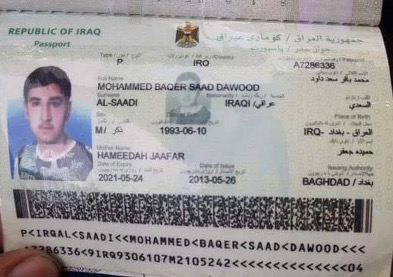
Born in 1993,38 probably in Iran39 j to Iraqi parents,k al-Saadi appears to be the child of exiled Shi`a Iraqis who left Iraq for Iran, possibly during the Iran-Iraq War.l Al-Saadi’s given name (Mohammad Baqer) is a ‘compound name,’ which is somewhat unusual and often used to honor a descendent or hero, in this case potentially Muhammad Baqir al-Sadr, the Daawa Party leader executed in 1980 by Saddam Hussein’s regime. (Interestingly, Muhammad Baqir’s older sister, Amina, has the same name as Muhammad Baqir al-Sadr’s sister, Amina Sadr bint al-Huda, who was executed alongside him in 1980.40)
In the assessment of the authors, Mohammad Baqer appears to have grown up in a devout Shi`a Iraqi family that took part in the Iran-backed anti-Saddam resistance in the 1990s-2000s. This may be why one interviewee41 referred to Mohammad Baqer’s family as ‘mosafereen,’ a generation of joiners to the Badr movement, which was formed and controlled by the Iranian Revolutionary Guard Corps (IRGC).42 The mosafereen were Iraqis deported from Iraq or otherwise driven out by the Saddam government.43 It is assessed by the authors as likely that al-Saadi’s father was a fighter in the Badr formation or an adjacent IRGC-backed Islamic resistance group of Iraqis.44 This generation produced many of the founders and senior leaders of today’s Iraqi muqawama, with decades-spanning ties to Iranian senior commanders in IRGC-QF.m
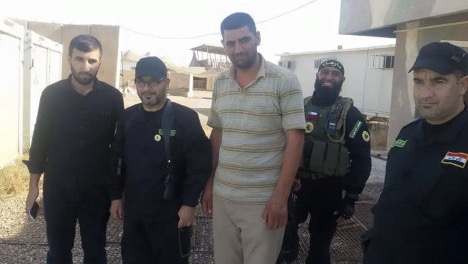
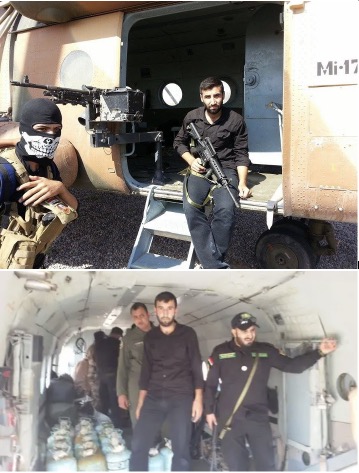
Mohammad Baqer al-Saadi appears to have returned to Iraq after the fall of the Baathist regime in 2003. Ten years later, aged around 20, al-Saadi reportedly traveled to Syria as a fighter in support of Bashar al-Assad’s regime, before returning to Iraq in 2014 to participate in operations against the Islamic State in Diyala Governorate.45 Images available online show that al-Saadi was operating alongside Iraqi Shi`a Popular Mobilization Forces (PMF) and the wider Iraqi military (i.e., unspecified Iraqi helicopter forces) from at least 2015.46 These images show him in a range of contexts, particularly during the 2015 Samarra campaigns against the Islamic State.n Unusually for such pictures, however, al-Saadi almost never wears a military uniform, and the authors are not aware of any images existing of him wearing formal unit markings—this, despite frequently being pictured alongside Iraqi military and militia members, while often appearing with a range of American-pattern weapons. Unusually, he is not openly connected to any specific PMF brigade or any armed group (fasail in Arabic) in this period.47
Photographic Links to Senior Commanders
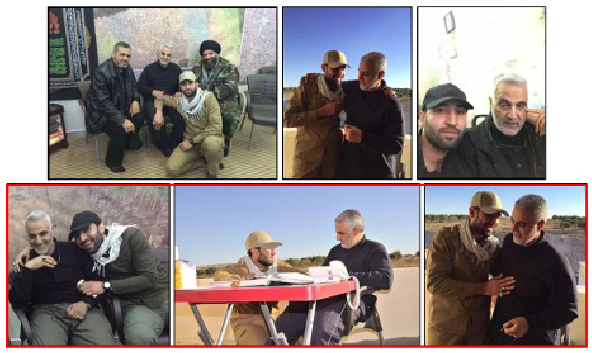
In addition to these irregularities in the military images of al-Saadi, it was apparent from as early as 2015 that he was not a standard PMF volunteer or even a low-level faisal foot soldier. Instead, he was photographed since 2015 with a ‘who’s who’ of senior IRGC and militia commanders that is unique in the experience of the authors.o Multiple photographs exist showing al-Saadi with IRGC-QF commander Qassem Soleimani on at least two separate occasions. According to individuals with direct experience of al-Saadi, around this time al-Saadi was noticed by Soleimani and KH founder Abu Mahdi al-Muhandis and was given positions of trust within their retinues.48 During the conflict with the Islamic State in Iraq (between 2014 and 2017), al-Saadi is described by multiple interviewees as having played a role in distributing weapons (i.e., light and medium weapons) to different militia groups and PMF units,49 possibly explaining the extraordinary influence and access such a young fighter was able to command. A worthy topic for further study is discovering the origin of these weapons donations and which benefactors stood behind them.
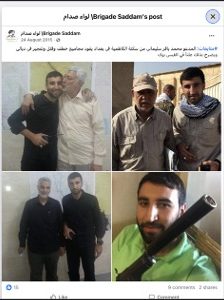
Al-Saadi’s first appearance in the public record (at least as identified by the authorsp) was in a social media postq from August 24, 2015. The post included four photos of al-Saadi (Figure 2), showing him standing with Soleimani, al-Muhandis, Badr’s leader Hadi al-Ameri, and another picture of al-Saadi alone while holding a silenced pistol. The original Arabic caption reads “a man named Muhammad Baqir Soleimani, a resident of Kadhimiya in Baghdad, is leading groups involved in kidnapping, killing, and bombings in Diyala, and he openly declares this on Facebook.”50 These images show a man visually identical to the same al-Saadi who has been detained in the United States over 10 years later: On May 6, 2020, an X account associated to Mohammad Baqer al-Saadi and actively named in the 2026 FBI complaint51 posted both identical and visually similar images.52
2016 Activity in Syria, Pseudonym, and Inaccurate Death Reports
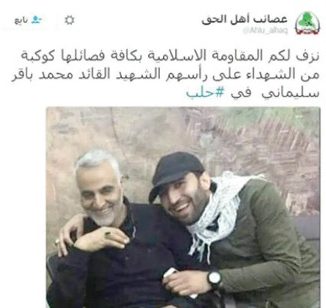
Around 2016, al-Saadi appears to have traveled back to Syria to support fighting in and around Aleppo. At about that time, more online sources refer to al-Saadi as “Mohammad Baqir Soleimani” [emphasis added] in connection with photographs of al-Saadi;53 in many cases, these photographs can also be matched to subsequent images posted after 2020 by al-Saadi himself,r confirming that the two identities refer to the same individual. Several of these news articles from 2016 alleged—inaccurately—that Mohammad Baqir Soleimani (i.e., al-Saadi) had been killed in Syria, while noting his close connection with Qassem Soleimani.54 The reports of the death seem to have begun after muqawama group Asa’ib Ahl al-Haq (AAH) announced his death,55 then tweeted another photo of him with Soleimani to mourn his loss, stating “all of the factions of the Islamic Resistance mourn a group of martyrs, headed by their martyred commander Muhammad Baqir Soleimani in Aleppo.” (See Figure 3.) Al-Saadi later posted a message on one of his social media accounts confirming that he had not been killed after all.56
al-Saadi’s apparent death in 2016.
At the time of his alleged death in Aleppo, a blog post titled “the killing of ‘Hajj Mohammad Baqir Soleimani’, the beloved guardian of the criminal Qassem Soleimani in Iraq and Syria and the commander of Asaib Ahl al-Haq + 42 photos” (posted on the website MessagefromIran) shared a carousel of 42 images depicting al-Saadi, including several images that would later be reshared by al-Saadi on social media.s These images appear to show al-Saadi operating in the Samarra, Iraq, area alongside elements of the Iraqi military.t There are also seven photos (Figure 4) of al-Saadi with Soleimani (some subsequently posted by al-Saadi himself) as well as the same photo with Hadi al-Amiri as was previously available on social media; a photo including Kata’ib al-Imam Ali (KIA)57 commander Ayoub Falih Hasan Al-Rubayie (aka Abu Azrael; Figure 5) as well as several images depicting al-Saadi in Tehran. (At the time (2016), KIA was not a U.S.-designated terrorist entity, but its founder, Shibl al-Zaydi, was.u)
Participation in Suppressing the 2019 Tishreeni Protests
According to interviews with individuals possessing direct knowledge of al-Saadi’s activities, al-Saadi participated in violence unleashed in Baghdad on the Tishreeni movement protestors in late 2019. These interviewees allege that al-Saadi personally participated in clashes around protester-occupied Sinek Bridge in November 2019.58 Al-Saadi is also purported to have headed a cell charged with conducting assassinations in Baghdad.59 One group of interviewees have identified al-Saadi as playing “a major role in assassinations through his own group, which is called Ali Imad al-Baqir.”60 This group “specialized in carrying out assassination operations against activists who had a negative stance on Iran.”61
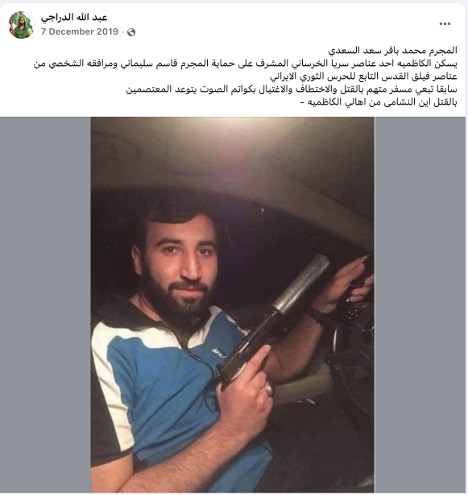
On December 7, 2019, a picture of al-Saadi holding a silenced pistol (Figure 7) was posted on a pro-Tishreeni Facebook account with the caption:
The criminal Muhammad Baqir Sa’d al-Saadi: A resident of Kadhimiya, he is a member of the Khorasani Brigades [NB. PMF Brigade 18]—specifically the unit tasked with protecting the criminal Qasem Soleimani—and serves as his personal bodyguard. He is an operative of the Quds Force, a branch of the Iranian Revolutionary Guard Corps (IRGC). Formerly a taba’iya mosafirv individual, he stands accused of murder, kidnapping, and carrying out silenced assassinations. He has issued death threats against the protesters. Where are the honorable men of Kadhimiya?
The image itself seems to originate from around 2018, posted by al-Saadi on his (likely now deleted) Facebook account. The post was captured by an anti-government Facebook account, which noted:
Soleimani’s aide—that “brat” [za’tout]w known as Mohammad Baqir Soleimani—posted a veiled threat involving a silenced weapon just an hour ago. This comes right after the General [Qasem Soleimani] returned to Tehran this afternoon empty-handed, having failed to announce the formation of the “largest bloc” and, notably, having failed to even secure a meeting with Al-Abadi!”62 x
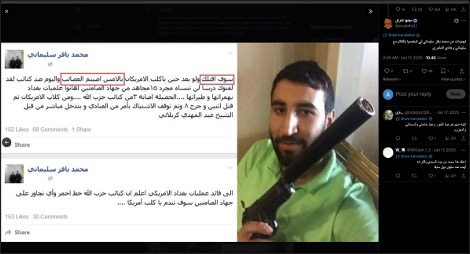
At some point previously, al-Saadi himself posted another similar image of himself (likely from circa 2015) brandishing a silenced pistol, an assassination (not battlefield) weapon, accompanied by the following threats (Figure 8):
I will kill you, even if it takes time, you American dog! Yesterday you attacked Asa’ib Ahl al-Haq, and today you are attacking Kata’ib Hezbollah. They taught you a lesson you will never forget. Just 15 mujahideen from the Silent Jihad humiliated the Baghdad Operations Command with its Humvees and aircraft… The result: 3 Kata’ib Hezbollah fighters were wounded… and 2 of the American dogs were killed and 8 wounded. The clash was stopped by the order of al-Abadi and with the direct intervention of Sheikh Abdul-Mahdi Karbalaiy
And
To the American commander of Baghdad Operations: Know that Kata’ib Hezbollah is a red line, and any transgression against the Silent Jihad will be regretted, you American dog…
From at least 2019 onward, al-Saadi also became prolific in issuing death threats to opponents of Kata’ib Hezbollah, including against journalists,63 members of Iraq’s intelligence services, and then Prime Minister Mustafa Kadhimi and members of his administration.64 These posts provide some support for claims that al-Saadi engaged in (or at least cultivated an impression of engaging in) assassinations and other sensitive criminal activities.
Later Relationships
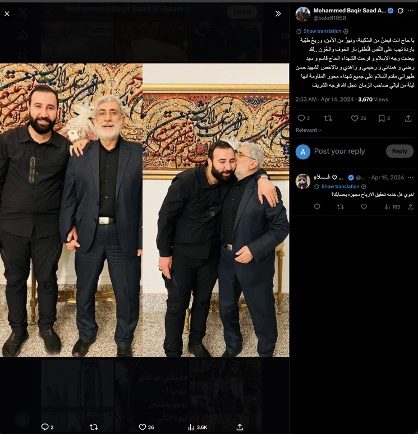
Images available online show al-Saadi traveled to Lebanon shortly after the October 7, 2023, attacks against Israel, although the authors do not currently understand the extent of his activities there—though one interviewee claimed to the authors that al-Saadi developed closer ties with members of Lebanese Hezbollah after the deaths of his patrons Soleimani and al-Muhandis in January 2020.65 Pictures were also released of al-Saadi with IRGC-QF commander Esmail Qaani (Figure 9). Al-Saadi appears to have enjoyed significant access at the funeral events of Hezbollah leader Hassan Nasrallah on February 23, 2025, with at least one image showing him standing in an area with Abu Fadak al-Mohammedawi (Chief of Staff of the PMF and a former KH secretary general).66 It seems clear that despite Soleimani’s death, al-Saadi continued to enjoy significant access to and trust with senior Quds Force and KH leaders around this time. For example, in mid-April 2024, an X user posted a photo that appeared to show two photos of al-Saadi with Qaani.67 As the photos do not appear to have been seen online prior to April 2024,z they may show al-Saadi and Qaani during this crisis period, or at the very least are intended to show that al-Saadi had wartime access to Qaani at a time when such audiences would have been carefully limited and arranged, and when considerable risk would attach to both parties by meeting (Figure 9).aa
Al-Saadi’s Life in the Shadows
Al-Saadi was not so public about all aspects of his operational activities. In the following section, the authors will explore some carefully curated insights that have been drawn primarily from interviews with Iraqi persons with knowledge of al-Saadi’s operational career.
Travel to Support Drone Procurement and Terrorist Activity
At some point in the early 2020s, al-Saadi became involved in drone procurement efforts by Iraqi militias.68 It is assessed by the authors as likely that he leveraged his impressive personal networks with senior Iranian and militia commanders, and his prior experiences distributing Iranian weapons for militias and PMF units.69 According to individuals with direct experience of al-Saadi, as part of this work, al-Saadi developed close ties with Lebanese Hezbollah.70 He also began to travel more broadly, including to Europe, to secure component supply chains and arms.71 One group of interviewees have identified al-Saadi as a “drone mover” involved in securing attack drones for KSS in advance of the current 2026 U.S.-Israel-Iran war (the interviewees believe these drones were subsequently used to attack U.S. and coalition bases in the Kurdistan Region of Iraq).72
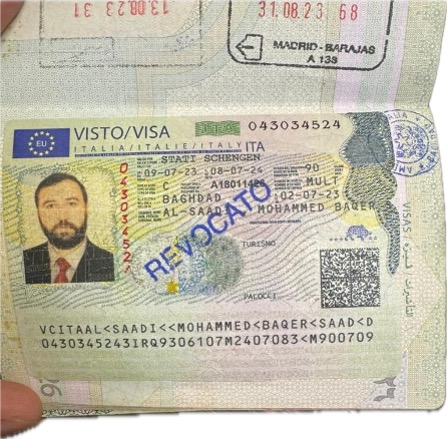
It is assessed by the authors as likely that at this time, al-Saadi began to develop contacts in both the Iranian and Iraqi diasporas in Europe, as well as in regional criminal organizations; these contacts likely formed the basis for subsequent networks through which he could find proxies to conduct attacks under the HAYI brand in 2026.73 A passport image (Figure 10) provided by a contact of one of the authors (Knights) shows a Schengen area multiple-entry visa for passport number A18011426 that became active on September 7, 2023. This visa was revoked for an unknown reason between August 31, 2023, and August 7, 2024, apparently during a visit to Italy.
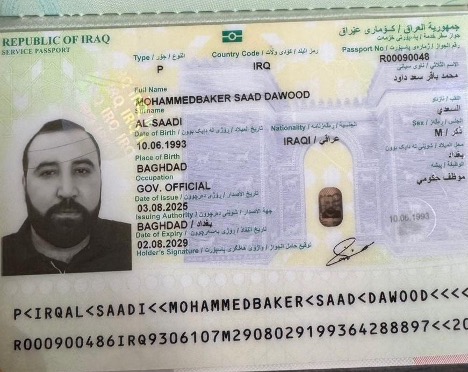
Concerningly, al-Saadi’s freedom of movement appears to have been significantly enabled by the issue of a Government of Iraq special ‘service passport’ (passport number R00090048, Figure 11), further indicating al-Saadi’s continued access and influence while raising questions about his links into the echelons of government as well as international legal questions related to Iraq’s state responsibility for al-Saadi’s actions.74 The service passport identifies him as an Iraqi government official.ab
Penetration of Iraqi Intelligence Agencies
Another area of reported covert activities by Mohammad Baqer al-Saadi is the recruitment of Iraqi security officials to illegally provide Iraqi government classified information to the Iranian government and to Iraqi fasail.75 How did this work? According to one reporting network in Iraq, considered credible by the authors,76 al-Saadi’s work is supported by the combined efforts of an IRGC-QF officer in Baghdad, KSS head Abu Alaa al-Walai, and the head of Iraq’s National Security Service, Abu Ali al-Basri (real name Abdal-Karim Abd-Fadil Hussein).ac
These players combine their influence to bring Iraqi intelligence officers to meeting houses, singly and in groups, in order to offer support to their careers in return for information that will be of value to IRGC officers based in the Iranian embassy in Baghdad and its outstations in Iraq.77
To give a concrete example, in late 2025, a deputy of al-Saadi called Karrar al-Asadi (also known as Sheikh Haydar)78 and Karrar’s wife (who is a director general in NSS)79 are alleged to have gathered a group of compromised intelligence officers at the house of a Daawa Party MP in Jadriya, Baghdad.80 In addition to two director generals of NSS field operations, the meeting was reportedly attended by the director general of counter-espionage at the Iraqi National Intelligence Service (somewhat ironically) and the deputy interior minister responsible for intelligence.81 Abu Ali al-Basri and Mohammad Baqer al-Saadi also reportedly attended the meeting, as did a deputy speaker of the Iraqi parliament and an IRGC-QF officer.82 The Iranian officer instructed all assembled to finance and support al-Saadi’s work in confronting terrorism and ‘the Israeli project’ in Iraq.83
Known-Unknowns Concerning Mohammad Baqer al-Saadi
One fascinating aspect of al-Saadi’s career is the scope of his possible militia affiliations, which appear to include KSS, KH, Saraya Talia al-Khorasani (PMF 18th brigade), and Asa’ib Ahl al-Haq. Yet, he never wore the unit insignia of any one of them, raising the possibility of a closer affinity with the IRGC-QF itself or with so-called QF-operated Iraqi ‘special groups’84 rather than with an individual fasail or formal PMF unit. This is partially borne out by the importance of his roles, first in distributing much-needed weapons and later in building weapons procurement networks.
The clear rapport al-Saadi appears to have had with Soleimani, Abu Mahdi al-Muhandis, and more recently with Esmail Qaani, combined with the trust that the IRGC-QF appear to have placed in him is particularly remarkable for a relatively young Iraqi militiaman. Given the apparent strength of those relationships, it is likely al-Saadi had and retains closer ties with the IRGC itself than with current Iraqi militia leaders, raising the probability that he acts at the direction—or at least with the knowledge—of the IRGC and its leadership.
This might fit him into the typology explored in previous CTC Sentinel articles by this author team85 of the newer generation of QF-operated Iraqi muqawama fighters—the so-called Al-Warithuun (inheritors, heirs). The authors have observed a growing trend of cross-fasail Iraqi cells directly operated by the IRGC-QF (notably illuminated by information gleaned from the arrest of the killers of U.S. missionary Stephen Troell in 2023).86 Notably, QF operators appear to have sought new, younger Iraqi militants who had not already been biometrically identified by Iraqi and Western intelligence agencies, and with primary loyalties to the IRGC-QF (rather than to Iraqi fasail).87 An interesting issue for further inquiry would be drawing comparisons between al-Saadi’s decade-long record and the careers of older muqawama leaders who also made their name as weapons movers with tight, direct relations to IRGC-QF: Abu Mustafa al-Sheibani, Shibl Muhsin Ubayd al-Zaydi, Abu Sajjad al-Gharawi and the aforementioned Abu Ali al-Basri.88 In the assessment of the authors, both are senior muqawama intelligence operators with more direct connection to the IRGC than to other Iraqi leaders.
The case of al-Sheibani (who also uses the names Hamid Thajeel Wareij Al-Attabi or Mustafa Abd’al Hamid Hussein al-Otabi) may be particularly useful as a template through which to understand the path of up-and-coming terrorist leaders like al-Saadi. Al-Sheibani broke away from Badr and KH to form KSS, he worked directly with IRGC in Syria for many years, and he undertook arms smuggling, assassination, and intelligence missions, more so than conventional kinetic attacks. This may be a model to watch for among the next generations of Iran-backed terrorists in Iraq—men who do not fit into the conventional pattern of a fasail rocketeer or roadside bomber or a PMF commander.
The Balance Sheet on External Operations: An Interim Assessment
It is much too early to come to a detailed judgement on HAYI’s external operations and whether they will be viewed as ‘worth it’ for the Iraqi muqawama and the IRGC. However, as a placeholder interim assessment, the balance sheet does not appear to be positive for the forces behind Mohammad Baqer al-Saadi and the HAYI effort.
The Promise of External Operations
The effort was certainly bold and potentially attention-grabbing, which is what Iran and the Iraqi muqawama desired in the midst of their cost-raising, headline-grabbing retaliatory response to the U.S.-Israeli assault on Iran. The 18 attacks that al-Saadi and colleagues allegedly orchestrated across Europe were novel and, had he not been detained, the United States would argue that they could well have been developed into a more significant terrorist campaign. The attacks carried out throughout March and April appear (in the interim assessment of the authors) to have principally been designed to sow fear and confusion in Europe and North America, signaling Iran’s ability to cause consequences in foreign homelands for the U.S.-Israeli war while terrorizing foreign Jewish communities.89 In al-Saadi’s own words, the purpose of the attacks was to “[distract] the enemy” and wage “psychological warfare” to “instill fear and terror in civilians.”90 Most targets had a link to Jewish communities (synagogues, Jewish community centers, Jewish charities) or Israel (the Israeli embassy in London), while some may have been tied to U.S. economic targets (Bank of America office in Paris).91 No casualties are associated with the arson attacks or explosions, though the attacks could easily have caused injury or death, given the targeting of ordinary civilian locations.
Al-Saadi and his associates appear (in the interim assessment of the authors) to have adopted a tried and tested Iranian methodology discussed by Matthew Levitt in prior CTC Sentinel works.92 The IRGC-QF and the Ministry of Intelligence and Security (MOIS) have long been known to recruit local criminal groups, teens, and other local actors to conduct sabotage, intimidation, and assassination of opponents on foreign shores.93 Within this conspiracy—the FBI complaint suggests al-Saadi was supported by other associates94—al-Saadi appears to have worked to recruit local proxies to carry out attacks,ad run at least some of those proxies95 while providing them with funds, targets, and direction,96 directly received proof of the attacks, and then propagandized the deed by passing footage and associated HAYI claims to popular media channels.97 Al-Saadi’s professional background, as pieced together in this study, shows an individual well placed to develop and run these operations. Having worked to support IRGC-QF objectives for his entire adult life, and with the personal and professional networks in place that gave him access to strategic planners and resources in QF and the Iraqi muqawama, it is the authors’ assessment that al-Saadi is almost certain to have at least enjoyed the support of his Iranian patrons and, more likely than not, was operating with their blessing or under their direction. His experience running assassination operations in Baghdad likely taught him how to run criminal networks, while his more recent penchant for foreign travel (on a government-issued passport) gave him opportunities to develop his own proxies.
What al-Saadi and his associates achieved in Europe could be written off as relatively insignificant. Very few casualties were sustained, and the attacks were sufficiently small scale that but for the HAYI claims some (though not all) might have been written off as petty crime. But with the concept proved, crude IED and arson attacks carried out by local criminals could have given way to more complex tactics and weapons.ae Alternatively, had an Iraqi militia been seen to have successfully developed a new attack vector in support of Iranian objectives, other groups might have felt compelled to develop their own similar capabilities (either out of a desire to collaborate or a need to compete—or both).af
North America was clearly on HAYI’s radar, starting in Canada, but the U.S. homeland would have been the ultimate prestige target for the movement and its backer, Kata’ib Hezbollah. For the Iraqi fasail, this war was a chance to get out from the shadow of Iran’s more successful terrorist partners such as Lebanese Hezbollah and the Houthis in Yemen. If al-Saadi is viewed primarily as a fasail external operations specialist, his efforts in this war may have been aimed at vaulting an Iraqi-led effort into the front row of Iraq’s terrorist partners by avenging the death of Supreme Leader Ali Khamenei with the first-ever terrorist attacks launched on the U.S. homeland by an Iraqi Shi`a muqawama group. If al-Saadi is viewed primarily as a QF-operated asset, this may be an example of Iran’s use of non-Iranians in external operations.98
Either way, the payoff did not materialize yet. The HAYI effort failed—so far—to successfully penetrate the continental United States and only achieved limited results in Europe. In fact, IRGC-QF and muqawama associates of al-Saadi might well now be asking themselves whether low-level arson and crude-IED attacks have been worth the international scrutiny. The IRGC-QF and Iraqi militias (few of which are sanctioned in Europe) are now exposed as affiliated with (and likely directing) attacks on Western homelands. And should al-Saadi be shown to have been operating at the Quds Forces’ direction, European policymakers will almost certainly be forced to adopt even tougher stances toward Iranian-inspired or -directed operations on the continent. In sum, the HAYI effort might also now appear to have been a counterproductive or inefficient use of militia or IRGC resources.
Can Iraqi Muqawama External Operations Be Deterred?
In addition to not generating very valuable results, the HAYI saga may also inflict significant costs on the Iraqi muqawama and their IRGC backers. To start with, al-Saadi, an influential militia figure, is in custody in the United States, having been arrested in Turkey before being turned over to the FBI and transported to the United States. He may know a lot about other aspects of Iraqi muqawama and Iranian operations, including information about leaders, sites, operational security measures, targeting, financing, procurement, and communications channels.
As important, al-Saadi’s capture may have personal impact within the pantheon of Iranian and Iraqi muqawama leaders, and result in a loss of prestige. He appeared in the assessment of the authors to have been an important cog in the IRGC’s machine in Iraq. Images show him meeting with Abu Alaa al-Wilai of KSS, the NSS director Abu Ali al-Basri, Abu Fadak al-Mohamadawi of KH, Hadi al-Ameri of Badr, Akram Kaabi of HaN, among other Iraqi leaders.ag Iraqi government efforts to have al-Saadi instead extradited back to Iraq were unsuccessful, one of the first times that the Iraqi fasail have ever failed to return one of their lost commanders back into their hands and a soft form of house arrest or full release.ah This is because they are no longer simply manipulating the Iraqi legal system into rendering the captive back to the PMF parallel judicial system or some other kind of release. In the international sphere, they have proven much more vulnerable. This alone may deter further overseas movements by Iraqi external operations cells. This deterrent effect would be particularly strong if al-Saadi and others are successfully prosecuted in high-profile cases.
Groups like KH and KSS potentially have a lot to lose inside and outside Iraq. In addition to raising the risk of senior leadership strikes by the United States or other aggrieved foreign powers, there is also the chance that such external operations could weaken the position of KH, KSS, and other factions in Iraq, where it operates at the highest levels of the PMF command structure,99 draws on thousands of government salaries,100 and even has MPs in parliament.101 At present, unless specifically sanctioned, most of these Iraqi factions are relatively free to travel in the Gulf, Turkey, the Arab world, Europe, and Asia.
For relatively little strategic or tactical value, al-Saadi—and by extension, KH and KSS—are now even more exposed at a moment when they are already in the spotlight: for likely involvement in high volumes of drone and missile attacks within and outside Iraq;ai for kidnapping U.S. citizen Shelley Kittleson (in KH’s case);aj and potentially for launching drone attacks on the UAE and Saudi Arabia after al-Saadi’s detention.ak Al-Saadi may be in a position to shed light on all these issues, bringing the Iraqi fasail and their political offshoots under greater scrutiny from Iraq’s judiciary, the United States, and the Gulf States.
The United States and some Gulf States may be on the edge of kinetic action against KH and other Iraqi fasail following these provocations. European states, meanwhile, may now come under increased public scrutiny to proscribe Kata’ib Hezbollah (or even the IRGC) as terrorist organizations—something they have been reluctant to consider in the past. All this is arguably a bad omen for the Iraqi muqawama as a new prime minister, Ali al-Zaidi, settles into his role. Al-Saadi’s case shows that even less publicly exposed militia leaders will be subject to ever more severe scrutiny and legal or custodial risks outside of Iraq or Iran should they attempt to develop attacks on continental Europe, the United Kingdom, or the U.S. homeland. CTC
Crispin Smith is an attorney based in Washington, D.C. His research focuses on international law and the law of armed conflict, as well as operational issues related to irregular warfare, information operations, and lawfare. Previously, he co-founded the Militia Spotlight platform.
Dr. Michael Knights is the Chief Product Officer at strategic advisory Horizon Engage. He is also an Adjunct Fellow with the Washington Institute for Near East Policy, where he co-founded the Militia Spotlight platform. X: @mikeknightsiraq
© 2026 Crispin Smith, Michael Knights
Substantive Notes
[a] ‘Façade’ groups, in the terminology of the authors, are online brands used to claim kinetic attacks and make threats. The authors built the Militia Spotlight platform partially around the exploration of such façades and their linkage to real-world armed groups and individuals, in order to foster accountability. See Crispin Smith, Michael Knights, and Hamdi Malik, “Attributing the Erbil Attack: The Role of Open-Source Monitoring,” Washington Institute for Near East Policy, February 24, 2021.
[b] Al-Saadi was first identified to one of the authors (Smith) during interviews conducted in 2021, at which time the Militia Spotlight team collected and stored limited information about his activities. Subsequent analysis of that material, material included in the DOJ complaint, and social media imagery and posts has included advanced reverse image searches, advanced imagery analysis, and interviews with sources familiar with al-Saadi’s career and background.
[c] In the current media landscape (and given the significant and sudden media attention that this case is now subject to), it is reasonable to consider the possibility of falsified testimonies and AI-generated or -edited imagery. The base of this analysis has been substantially conducted drawing on information obtained prior to 2026 (with a significant portion predating 2023, reducing the likelihood of AI manipulation in the imagery). Moreover, images used in this study have been closely analyzed for signs of falsification. Similarly, material derived from interviews substantially draws on information provided and archived prior to the al-Saadi case unsealing, particularly from an interview series conducted around 2021 and 2022. Where more recent interviews have been conducted, information has been cross-referenced against prior statements and earlier non-public Militia Spotlight archival materials.
[d] For discussions of militia use of branded anonymous Telegram channels, see, for example, Michael Knights, Crispin Smith, and Hamdi Malik, “Discordance in the Iran Threat Network in Iraq: Militia Competition and Rivalry,” CTC Sentinel 14:8 (2021), noting that “façade groups [use] Telegram and other social media to claim rocket and convoy attacks in the hours following an attack event. Often the façade’s Telegram and social media platforms are created in the hours before the group’s first claim, but pre-made unique iconography of each group and the rapid growth of their media following suggests pre-preparation of façade brands for later use. Some groups have been used to claim strings of attacks, while other groups appeared for one or two attacks only before the brand name and associated media accounts fall into disuse.”
[e] Militia Spotlight’s online blog and group profiles were established to track this process in detail and produce evidentiary building blocks, using legal standards of proof and certainty. The project collects militia statements in Arabic and other languages, archives evidence that risks being taken offline at a later point, and uses a data fusion process to synthesize information and analyze trends. The Militia Spotlight blog is at https://www.washingtoninstitute.org/policy-analysis/series/militia-spotlight and the Militia Spotlight profiles page is at https://www.washingtoninstitute.org/policy-analysis/series/militia-spotlight-profiles
[f] The statement shared by Alfaqaar includes an English translation; the version displayed in the FBI Complaint and shared by al-Saadi is only in Arabic. HAYI initially had its own Telegram channel, but this was shut down by Telegram in late March.
[g] First mentioned in the CTC Sentinel in 2021, the authors assessed at that time that the channel had ties to Asa’ib Ahl al-Haq, but it subsequently appears to have adopted a closer affinity with other groups while going through at least one change of username. The original channel, also named “Alfaqaar” was replaced by a new Telegram handle on April 11, 2023, with a post stating “The New Al-Faqaar Channel on Telegram—Established Following the Deletion of the Previous Channel: Our enemy’s weakness has caused them to fear us even in the virtual realm; thus, they have resorted to deleting our accounts and channels in an attempt to undermine our resolve. Yet, how futile are their efforts! For the spirit of the truthful never wavers, and our struggle continues unabated in the arena of ‘soft warfare’—God willing.” Knights, Smith, and Malik, “Discordance in the Iran Threat Network in Iraq.”
[h] Media pattern analysis conducted by the Militia Spotlight team in 2021, and corroborated by interviews with individuals with detailed insight into muqawama operations, strongly indicate that Alfaqaar was originally created by a team of individuals affiliated with AAH. The channel also is affiliated with a militia façade group known as quwwat dhul-fiqaar (the Zulfiqar Forces).
[i] Notable channels that frequently reposted IMCR content include Sabereen News, Qeyam.Post, Rasad al-Muqawama, Shabab al-Islam, Jehad Brothers, Unit 10000, all of which have ties to Kata’ib Hezbollah, and some of which have ties to Harakat al-Nujaba. See also “Harakat Ashab al-Yamin al-Islamia: A New Group or Part of a Broader Iranian-Aligned Network?” Dark Owl, April 16, 2026.
[j] Note that his passport lists Baghdad as a place of birth—this is not necessarily incompatible with a real place of birth in Iran: In many cases, passports issued to those born in Iran will still show the place of birth as a town or province within Iraq. See, for example, “Iraq: Knowledge Base profile,” HM Passport Office, updated April 10, 2026.
[k] His father Saad Dawood and mother (named on his passport) is Hamida Jaafar Jawad (born 1967). Al-Saadi was not identified with an Iraqi birthplace in any interview or document consulted for this study. Multiple independent interviewees have identified Mohammad Baqer as having at least one Iraqi parent, backed up by the fact that he holds Iraqi citizenship. Author (Knights) interviews, individuals with knowledge of al-Saadi’s career; exact dates, names, and places withheld at request of the interviewees.
[l] Al-Saadi was not identified with an Iraqi birthplace in any interview or document consulted for this study. Multiple independent interviewees (by both authors) place him living in Iran during his youth. His father Saad Dawood and mother (named on his passport) is Hamida Jaafar Jawad (born 1967). Multiple independent interviewees state with moderate confidence that they were Iraqi exiles living in Iran where they had their three children: a daughter Amina (born 1991), a son Mohammad Baqer (born 1993), and another daughter Fatima (born 1997).
[m] These individuals—such as Abu Mustafa al-Sheibani and Abu Mahdi al-Muhandis—are discussed in detail in Michael Knights, “Back into the Shadows? The Future of Kata’ib Hezbollah and Iran’s Other Proxies in Iraq,” CTC Sentinel 13:10 (2020).
[n] Several images show al-Saadi in operational contexts in locations in and around Samarra, or with maps clearly showing geography in the Samarra and Diyala area.
[o] In the authors’ collective experience, it is highly unusual for so young a fighter to have such access to so many commanders from multiple different militias, nor is such a clearly intimate and close relationship with senior leaders such as Qassem Soleimani, Esmail Qaani, and Abu Mahdi al-Muhandis either ordinary or commonplace.
[p] The authors have conducted a comprehensive review of open-source material relating to al-Saadi prior to 2026. In several cases, it is clear that certain images or statements still available in public are derived from now defunct, deleted, or hidden accounts. Moreover, at the time of publication, new photographs and screenshots of past messages continue to resurface. Except where noted, more recently resurfaced materials have been omitted from this study to minimize the risk of using misinformation generated following al-Saadi’s public arrest. In several cases, however, this study makes use of online posts apparently made by Sunni activists and members of the Tishrini protest movement; particularly around 2019, al-Saadi attracted significant negative attention from members of these groups for his alleged role in suppressing protests and orchestrating assassinations.
[q] The Brigade Saddam, Facebook is a pro-Saddam/Baathist blogger, so it is very likely an anti-Shi`a and/or anti-Iran commentator. Nevertheless, as the information being drawn from this source is an image, the basic data is still considered valuable and able to be judged on its own merits, regardless of the source’s motivations.
[r] This is the same Telegram account named in the 2026 FBI complaint.
[s] Posts from the 2016 article were likely originally shared by al-Saadi himself on social media or privately. Photos that were subsequently reshared by accounts confirmed as belonging to Muhammad Baqer al-Saadi are as follows: (1) On May 6, 2020, @bakr81950 posted a tweet depicting al-Saadi stood in an embrace with Iraqi paramilitary leader and former chief of staff of the Popular Mobilization Forces (PMF) Abu Mahdi al-Muhandis; (2) On August 1, 2020, @bakr81950 posted a tweet depicting al-Saadi kneeling next to a table, conversing with Soleimani. This is the same photo as identified on MessagefromIran in 2016; (3) On November 17, 2020, @bakr81950 posted a tweet depicting al-Saadi kneeling next to a table, conversing with Soleimani.
[t] On April 21, 2021, @bakr81950 posted a tweet depicting al-Saadi sitting in front of a map of Samarra, Iraq, speaking to Soleimani.
[u] Shibli al-Zaidi was sanctioned by the United States on November 13, 2018, for acting on behalf of the IRGC-QF and assisting in, sponsoring, or providing financial, material, or technological support for, or financial or other services to or in support of, Hezbollah. See “Treasury Sanctions Key Hizballah, IRGC-QF Networks in Iraq,” U.S. Department of the Treasury, November 18, 2018.
[v] As noted earlier, this refers to individuals who fled or were exiled from Iraq to Iran in the 1980s and 1990s (i.e., mosafereen). As noted in the authors’ earlier assessment, this likely refers to his father’s background. This is the assessment of the author team, based on their collective 34 years of close monitoring of the Iraqi militia scene.
[w] It may be worth noting that al-Saadi is periodically referred to by human sources in some variation of this manner—‘the spoiled child of Soleimani’ or ‘the spoiled son of Soleimani.’ This seems to suggest a person not under the authority of Iraqi muqawama leaders, with some kind of unique ‘top cover,’ somewhat annoyingly from their perspective. Authors interviews, individuals with knowledge of al-Saadi’s career; exact dates, names, and places withheld at request of the interviewees.
[x] This refers to then incumbent Iraqi Prime Minister Haider al-Abadi.
[y] The official representative of Grand Ayatollah Sayed Ali Al-Sistani, the latter being the senior cleric in Iraq.
[z] A detailed reverse image search—and the authors’ own ongoing collection effort as part of the Militia Spotlight program—suggests to the authors that this piece was probably not available online prior to April 2024. This does not mean it was taken in April 2024, but it does suggest it was either taken in April 2024 or was released in April 2024 for a purpose.
[aa] During wartime, with IRGC leaders being assassinated on a regular basis by Israel, access to leaders like Qaani would logically be very constrained and limited to essential or important visits only. In the authors’ collective assessment, by being photographed apparently standing next to Qaani at this dangerous time—or giving the impression of doing so—al-Saadi demonstrates access and dedication. This is all assessment of the author team.
[ab] While it is commonplace for powerful Iraqis to buy such a passport even if they are not, in fact, a government official, it is still incumbent on the Iraqi government to ensure that such passports are not granted to ineligible users. Author (Knights) interviews, individuals with knowledge of Iraqi passport and visa procedures exact dates, names, and places withheld at request of the interviewees.
[ac] Abu Ali al-Basri (not to be confused with the deputy operations chief for the PMF, who has the same kunya or nom de guerre) is the legendary former head of the Falcons counterterrorism unit, and a Daawa member since the 1970s, with decades-spanning connections to the IRGC-QF and Iran’s intelligence services. Abu Ali al-Basri is a long-term Daawa party clandestine resistance fighter who served alongside Abu Mahdi al-Muhandis on the side of Iran during the Iran-Iraq war, and who worked against the Saddam regime with IRGC-QF and other Iranian security agencies. For an entertaining, if very positive, account of Abu Ali al-Basri’s life and times, see Margaret Coker, The Spymaster of Baghdad: A True Story of Bravery, Family, and Patriotism in the Battle against ISIS (New York: Dey Street Books, 2021). See also Michael Knights, Crispin Smith, and Hamdi Malik, “Discordance in the Iran Threat Network in Iraq: Militia Competition and Rivalry,” CTC Sentinel 14:8 (2021).
[ad] As of April 29, authorities had made at least 44 arrests in connection with HAYI incidents: 28 in the United Kingdom, 10 in the Netherlands, four in France, and two in Belgium. The majority of them were young men, including 11 boys aged 14 to 17; three women aged 47 to 59 have been arrested as well. At least 16 individuals have been formally charged: eight in the United Kingdom, four in the Netherlands, and four in France. All those charged are males—seven of them minors, the youngest aged 16. Adrian Shtuni, “Deniable, Disposable, Disruptive: Iran’s Hybrid Warfare in Europe Demands a Proactive Response,” Washington Institute, May 4, 2026.
[ae] Indeed, one of al-Saadi’s last messages to a KH contact before his arrest read, “If God grants us success tonight, there will be a shooting at a restaurant”—an apparent escalation from earlier attacks. See “Dual Iranian-Iraqi National Indicted for Providing Material Support to Terrorist Organizations,” U.S. Department of Justice, May 29, 2026.
[af] In the authors’ experience, individual fasail within the muqawama are at once competitive and collaborative. One group demonstrating new capabilities or tactics often may subsequently lead to a proliferation of the capability as other groups either learn from or outdo the innovators. At least three possible examples of this activity can be observed over recent years: (1) the development and proliferation of one-way attack UAVs, (2) competitive propagandizing of claimed attacks against the United States in the early 2020s, and (3) UAV attacks against Saudi Arabia and the UAE (rare and specialist prior to 2026, but commonplace during the recent U.S.-Iran war).
[ag] A reply (posted after al-Saadi’s arrest was publicized) to one of al-Saadi’s X posts from 2024 depicts al-Saadi traveling alongside Kataib Sayyid al-Shuhada leader Abu Alaa al-Walaei. @sa199_kk, post on X, dated May 15, 2024, accessed May 18, 2026.
[ah] This is the authors’ assessment based on their collective 34 years of monitoring Iraqi muqawama groups use of the judicial system to mitigate negative outcomes on their captured members. To give some concrete examples, one might look at cases such as the 2020 detentions of KH rocketeers and later militia leader Qassem Muslih, and the later Iranian-Iraqi efforts to get an Iraqi-held IRGC-QF assassin released back to Iran. See Amir al-Kaabi and Michael Knights, “Kataib Hezbollah’s Escalating Feud with the Iraqi Security Forces,” Militia Spotlight, Washington Institute for Near East Policy, May 19, 2023; “Muslih’s release likely part of deal compelling militias to stop anti-U.S. strikes in Iraq,” Arab Weekly, October 6, 2021; and Michael Knights and Crispin Smith, “Direct-Operated IRGC-QF Attack Cells in Iraq: Data Related to the Troell Case,” Militia Spotlight, Washington Institute for Near East Policy, February 19, 2025.
[ai] This drone and missile campaign will be chronicled in depth in a forthcoming CTC Sentinel article by the authors and additional collaborators.
[aj] The U.S. State Department claimed that Kittleson was “kidnapped by members of the foreign terrorist organization Kata’ib Hizballah near Baghdad, Iraq.” See “Release of American Journalist Shelly Kittleson,” U.S. State Department, April 7, 2026.
[ak] On May 14-15, 2026, al-Saadi was transferred to U.S. agents and flown to the United States, with his arrest being publicly announced in the afternoon of May 15, Iraq time. On May 17, the UAE’s Barakah nuclear plant was attacked by three drones launched from Iraq, according to the UAE government. Three other drones entered Saudi Arabia from Iraq on May 17, according to the Saudi Arabian Ministry of Defense. See “UAE Strongly Condemns Terrorist Drone Attacks Targeting Barakah Plant Launched from Iraqi Territory,” UAE Ministry of Foreign Affairs, May 20, 2026, and Seth Frantzman, “Saudi Arabia targeted by drones ‘from Iraq,’ condemns strike on UAE nuclear plant,” Jerusalem Post, May 18, 2026.
Citations
[1] “Iraqi National Arrested and Charged with Providing Material Support to Iranian-Backed Terrorist Organizations and Directing Attacks Targeting U.S. Citizens and Interests, U.S. Department of Justice, May 15, 2026.
[2] Rebecca Schneid, “The Iran-Backed Militia Behind a Terror Plot Against American Jews,” Time, May 16, 2026.
[3] United States of America v. Mohammad Baqer Saad Dawood al-Saadi Complaint 26 MAG 1622.
[4] “Dual Iranian-Iraqi National Indicted for Providing Material Support to Terrorist Organizations,” U.S. Department of Justice, May 29, 2026.
[5] United States of America v. Mohammad Baqer Saad Dawood al-Saadi Complaint 26 MAG 1622.
[6] Ibid., notes 1 and 2.
[7] “Dual Iranian-Iraqi National Indicted for Providing Material Support to Terrorist Organizations.”
[8] United States of America v. Mohammad Baqer Saad Dawood al-Saadi Complaint 26 MAG 1622.
[9] Ibid.
[10] Authors interviews in 2020-2026, individuals with knowledge of al-Saadi’s career; exact dates, names, and places withheld at request of the interviewees.
[11] See, for example, Burcu Ozcelik and Tamer Badawi, “Why Did Iraq’s Militias Sit Out the Iran–Israel War and Why it Matters,” RUSI, August 15, 2025. See also Louisa Loveluck and Mustafa Salim, “Why powerful pro-Tehran militias in Iraq stayed quiet amid Iran conflict,” Washington Post, June 25, 2025.
[12] See Bridget Toomey, “The Houthis join Iran’s attacks on Israel,” FDD’s Long War Journal, June 18, 2025, noting that “[t]he Houthis [were] the only Iranian proxy to openly attack Israel in solidarity with Iran during the latter two countries’ most recent [2025] conflict” whereas “Iraqi militias [were] relying primarily on rhetoric and limited but unclaimed actions to avoid American reprisals.”
[13] David Schenker, “Iraq Is at Another Crossroads with Iran-Backed Militias—and Washington,” Washington Institute for Near East Policy, PolicyWatch 4197, April 8, 2026; Timour Azhari, Ahmed Rasheed, and Humeyra Pamuk, “Exclusive: Saudi warplanes struck militias in Iraq during war, sources say,” Reuters, May 13, 2026.
[14] Alfaqaar, post on Telegram, March 9, 2026.
[15] United States of America v. Mohammad Baqer Saad Dawood al-Saadi Complaint 26 MAG 1622, paragraph 15(a). Al-Saadi posted the identical statement at 11:13 AM US Eastern Time on March 9. Image at paragraph 15(a) of United States of America v. Mohammad Baqer Saad Dawood al-Saadi Complaint 26 MAG 1622.
[16] “Dual Iranian-Iraqi National Indicted for Providing Material Support to Terrorist Organizations.”
[17] Alfaqaar, post on Telegram, March 9, 2026.
[18] Based on authors’ research conducted using commercial Telegram analytics tools; the original Alfaqaar channel was created on April 13, 2020.
[19] Media pattern analysis conducted by the Militia Spotlight team.
[20] A video was initially propagated by prominent muqawama Telegram channel Sabereen before receiving near simultaneous reposts from KH’s Unit 10000 and Qeyam.Post accounts.
[21] Joe Truzman, “Ashab al Yamin: Terrorism With (Semi) Plausible Deniability,” Foundation for Defense of Democracies, April 1, 2016.
[22] See, for example, Alfaqaar reposting HAYI video claiming an arson attack on a London synagogue, posted March 23, 2026.
[23] See, for example, Sabereen News reposting HAYI video claiming the March 9 attack on a synagogue in Liege, Belgium, posted March 11, 2026.
[24] See, for example, Alfaqaar reposting HAYI video threatening a Bank of America location in Paris, France, posted March 28, 2026. Note that an attempted bombing of the building was foiled that day. Jérémie Pham-Lê, “The strange foiled attack on Bank of America in Paris: ‘He said if the kids pulled off the job, there’d be many more,’” Monde, April 7, 2026.
[25] See, for example, Alfaqaar reposting HAYI video claiming an attack on The Atrium office building in Amsterdam on March 16, 2026.
[26] See, for example, Alfaqaar reposting HAYI video claiming an attack on a synagogue in Greece on March 11, 2026.
[27] See, for example, Alfaqaar reposting HAYI video claiming an attack on a Jewish center in Skopje, North Macedonia, on April 12, 2026.
[28] See, for example, Sabereen News reposting HAYI video claiming the March 9 attack on a synagogue in Liege, Belgium, posted March 11, 2026. Note that this final attack may have been claimed in error. “Press Release: Tech Against Terrorism warns Golders Green attack marks national emergency, calls for urgent government action,” Tech Against Terrorism, April 30, 2026.
[29] “Iraqi National Arrested and Charged with Providing Material Support to Iranian-Backed Terrorist Organizations and Directing Attacks Targeting U.S. Citizens and Interests.”
[30] Ibid.
[31] United States of America v. Mohammad Baqer Saad Dawood al-Saadi Complaint 26 MAG 1622, paragraph 12.
[32] Ibid., paragraphs 12, 15, and 16.
[33] Ibid.
[34] Ibid., paragraph 16(e).
[35] Ibid., paragraph 16(b)-(c).
[36] “Dual Iranian-Iraqi National Indicted for Providing Material Support to Terrorist Organizations.”
[37] Authors interviews, individuals with knowledge of al-Saadi’s career; exact dates, names, and places withheld at request of the interviewees.
[38] Date of birth confirmed by, inter alia, authors interviews, al-Saadi’s own Telegram handle (@MOHAMMED_BAQER1993), and images of his passport seen by the authors. Al-Saadi’s passports (see Figures 1 and 11) show his birthdate as October 6, 1993.
[39] Authors interviews, individuals with knowledge of al-Saadi’s career; exact dates, names, and places withheld at request of the interviewees.
[40] Author (Knights) interviews, individuals with knowledge of al-Saadi’s career; exact dates, names, and places withheld at request of the interviewees.
[41] Author (Knights) interview, individual with knowledge of al-Saadi’s career; exact dates, names, and places withheld at request of the interviewee.
[42] Michael Knights and Crispin Smith, “Badr Organization: Iran’s Oldest Proxy in Iraq,” Current Trends in Islamist Ideology, June 2025. See also Michael Knights, Crispin Smith, and Hamdi Malik, “Profile: Badr Organization,” Militia Spotlight, Washington Institute for Near East Policy, September 2, 2021.
[43] Knights and Smith, “Badr Organization.” See also Knights, Smith, and Malik, “Profile: Badr Organization.”
[44] This is the assessment of the author team, based on their collective 35 years of close monitoring of the Iraqi militia scene.
[45] Author (Smith) interviews, individuals with knowledge of al-Saadi’s career; exact dates, names, and places withheld at request of the interviewees.
[46] See, for example, https://messagefromiran.com. Many of these images can be directly associated with posts shared by al-Saadi himself.
[47] This is the assessment of the author team, based on their collective 34 years of close monitoring of the Iraqi militia scene.
[48] Author (Smith) interviews, individuals with knowledge of al-Saadi’s career; exact dates, names, and places withheld at request of the interviewees.
[49] Author (Smith) interviews, individuals with knowledge of al-Saadi’s career; exact dates, names, and places withheld at request of the interviewees.
[50] Post by Brigade Saddam, Facebook, dated August 24, 2015, accessed May 18, 2026.
[51] Federal criminal complaint number 26 MAG 1622 states that al-Saadi is a user of X (formerly Twitter) account @bakr81590. This account has reportedly shared multiple photos depicting al-Saadi.
[52] Post by @bakr81950, X, dated May 6, 2020, accessed May 18, 2026; reverse image search, Yandex, dated May 18, 2026, accessed May 18, 2026.
[53] “[A military commander close to Qassem Soleimani was killed in the battles of Aleppo],” sabr.cc, September 24, 2016. See also “[The killing of ‘Hajj Mohammad Baqir Soleimani’, the beloved guardian of the criminal Qassem Soleimani in Iraq and Syria and the commander of Asaib Ahl al-Haq],” messagefromiran.com, September 22, 2016; “[Iraqi militia commander and 4 Iranian soldiers killed in Aleppo],” Al-Arabiya, September 24, 2016; and “[The Iraqi ‘Tiger Brigade’: Their weapons come from Syria, and their salaries from Baghdad],” Asharq Al-Awsat, September 27, 2016.
[54] Amir Toumaj, “Iraqi Shiite militia commander close to Qassem Soleimani killed in Aleppo,” Threat Matrix, FDD’s Long War Journal, September 27, 2016.
[55] “[Hajj Qassem’s friend was martyred in Aleppo],” Atrak News, September 23, 2016.
[56] See https://messagefromiran.com, September 22, 2016.
[57] MessagefromIran, dated September 22, 2015, accessed May 18, 2026.
[58] Author (Smith) interviews, individuals with knowledge of al-Saadi’s career; exact dates, names, and places withheld at request of the interviewees.
[59] Author (Smith) interviews, individuals with knowledge of al-Saadi’s career; exact dates, names, and places withheld at request of the interviewees.
[60] Author (Knights) interviews, individuals with knowledge of al-Saadi’s career; exact dates, names, and places withheld at request of the interviewees.
[61] Author (Knights) interviews, individuals with knowledge of al-Saadi’s career; exact dates, names, and places withheld at request of the interviewees.
[62] Facebook post, May 16, 2018.
[63] @bakr81950, post on X, March 28, 2022. See also a video posted on Mwaatana House’s YouTube channel on July 8, 2020, in which journalist Ghaith al-Tamimi shows the threats he is receiving from “Mohammad Baqir Soleimani, the personal bodyguard of General Qassem Soleimani.”
[64] Steve Nabil, “2/ He openly alluded to and claimed involvement in the 2021 attack on the Royal Saudi Compound …,” X, May 15, 2026; Unit 10000, post on Telegram, December 25, 2025; @bakr81950, post on X, March 28, 2022.
[65] Author (Smith) interviews, individuals with knowledge of al-Saadi’s career; exact dates, names, and places withheld at request of the interviewees.
[66] Steven Nabil, “A photo of Mohammad Baqer at the funeral of Lebanese Hezbollah leader …,” X, May 15, 2026.
[67] @bakr81950, post on X, dated April 4, 2024, accessed May 18, 2026.
[68] Author (Smith) interviews, multiple unconnected individuals with knowledge of al-Saadi’s career; exact dates, names, and places withheld at request of the interviewees.
[69] Author (Smith) interviews, individuals with knowledge of al-Saadi’s career; exact dates, names, and places withheld at request of the interviewees.
[70] Author (Smith) interviews, individuals with knowledge of al-Saadi’s career; exact dates, names, and places withheld at request of the interviewees.
[71] Authors interviews, individuals with knowledge of al-Saadi’s career; exact dates, names, and places withheld at request of the interviewees.
[72] Author (Knights) interviews, individuals with knowledge of al-Saadi’s career; exact dates, names, and places withheld at request of the interviewees.
[73] Author (Smith) interviews, individuals with knowledge of al-Saadi’s career; exact dates, names, and places withheld at request of the interviewees.
[74] “Dual Iranian-Iraqi National Indicted for Providing Material Support to Terrorist Organizations.”
[75] Author (Knights) interview, members of one reporting network with knowledge of the meeting; exact dates, names, and places withheld at request of the interviewees.
[76] Author (Knights) interview, members of one reporting network with knowledge of the meeting; exact dates, names, and places withheld at request of the interviewees.
[77] Author (Knights) interview, members of one reporting network with knowledge of the meeting; exact dates, names, and places withheld at request of the interviewees.
[78] Author (Knights) interview, members of one reporting network with knowledge of the meeting; exact dates, names, and places withheld at request of the interviewees.
[79] Author (Knights) interview, members of one reporting network with knowledge of the meeting; exact dates, names, and places withheld at request of the interviewees.
[80] Author (Knights) interview, members of one reporting network with knowledge of the meeting; exact dates, names, and places withheld at request of the interviewees.
[81] Author (Knights) interview, members of one reporting network with knowledge of the meeting; exact dates, names, and places withheld at request of the interviewees.
[82] Author (Knights) interview, members of one reporting network with knowledge of the meeting; exact dates, names, and places withheld at request of the interviewees.
[83] Author (Knights) interview, with members of one reporting network with knowledge of the meeting; exact dates, names, and places withheld at request of the interviewees.
[84] For a discussion of the Special Groups, see Michael Knights, “Back into the Shadows? The Future of Kata’ib Hezbollah and Iran’s Other Proxies in Iraq,” CTC Sentinel 13:10 (2020).
[85] The idea of the IRGC Quds Force beginning to direct-operate cells was introduced in Michael Knights, “Soleimani Is Dead: The Road Ahead for Iranian-Backed Militias in Iraq,” CTC Sentinel 13:1 (2020). It was then developed further in Michael Knights, “Back into the Shadows? The Future of Kata’ib Hezbollah and Iran’s Other Proxies in Iraq,” CTC Sentinel 13:10 (2020) and Michael Knights, Crispin Smith, and Hamdi Malik, “Discordance in the Iran Threat Network in Iraq: Militia Competition and Rivalry,” CTC Sentinel 14:8 (2021).
[86] Michael Knights and Crispin Smith, “Direct-Operated IRGC-QF Attack Cells in Iraq: Data Related to the Troell Case,” Militia Spotlight, Washington Institute for Near East Policy, February 19, 2025.
[87] Ibid.
[88] For Sheibani, see Michael Knights, “Back into the Shadows? The Future of Kata’ib Hezbollah and Iran’s Other Proxies in Iraq,” CTC Sentinel 13:10 (2020). Foir Zaydi, see “Treasury Sanctions Key Hizballah, IRGC-QF Networks in Iraq,” U.S. Department of the Treasury, November 13, 2018. For Gharawi, see “Tactical Interrogation Report: Qais al-Khazali,” Declassified by: MG Terry Ferrell USCENTCOM Chief of Staff, Declassified on: 6 April 2018, released, April 15, 2007, pp. 3-4. For Abu Ali, see footnote AC.
[89] See “Iraqi National Arrested and Charged with Providing Material Support to Iranian-Backed Terrorist Organizations and Directing Attacks Targeting U.S. Citizens and Interests” and Schneid.
[90] “Dual Iranian-Iraqi National Indicted for Providing Material Support to Terrorist Organizations.”
[91] “Iraqi National Arrested and Charged with Providing Material Support to Iranian-Backed Terrorist Organizations and Directing Attacks Targeting U.S. Citizens and Interests.”
[92] For an excellent overview of this, see Matthew Levitt, “Trends in Iranian External Assassination, Surveillance, and Abduction Plots,” CTC Sentinel 15:2 (2022) and Matthew Levitt, “Tehran’s Homeland Option: Terror Pathways for Iran to Strike in the United States,” CTC Sentinel 18:8 (2025).
[93] Adrian Shtuni, “Deniable, Disposable, Disruptive: Iran’s Hybrid Warfare in Europe Demands a Proactive Response,” Washington Institute, May 4, 2026.
[94] Complaint at paragraphs 9 and 12.
[95] Ibid., paragraph 16(b).
[96] Ibid., paragraph 17.
[97] Ibid., paragraph 15.
[98] For an excellent overview of this, see Matthew Levitt, “Trends in Iranian External Assassination, Surveillance, and Abduction Plots,” CTC Sentinel 15:2 (2022) and Matthew Levitt, “Tehran’s Homeland Option: Terror Pathways for Iran to Strike in the United States,” CTC Sentinel 18:8 (2025).
[99] See Michael Knights, Hamdi Malik, and Aymenn Al-Tamimi, “Honored, Not Contained: The Future of Iraq’s Popular Mobilization Forces,” Policy Focus 163, Washington Institute for Near East Policy, 2020. This study maps out the exact fasail leadership threaded throughout the PMF command structure, and it remains largely current at the time of writing.
[100] See Michael Knights, “Iran’s Expanding Militia Army in Iraq: The New Special Groups,” CTC Sentinel 12:7 (2019) and Amir al-Kaabi and Michael Knights, “Extraordinary Popular Mobilization Force Expansion, by the Numbers,” Militia Spotlight, Washington Institute for Near East Policy, June 3, 2023.
[101] See Michael Knights, “The Hoquq Candidates: Kataib Hezbollah’s Aspiring Parliamentarians,” Militia Spotlight, Washington Institute for Near East Policy, September 30, 2021, and Michael Knights, Hamdi Malik, and Ameer al-Kaabi, “Profile: The Hoquq Movement,” Militia Spotlight, Washington Institute for Near East Policy, March 15, 2024.
