
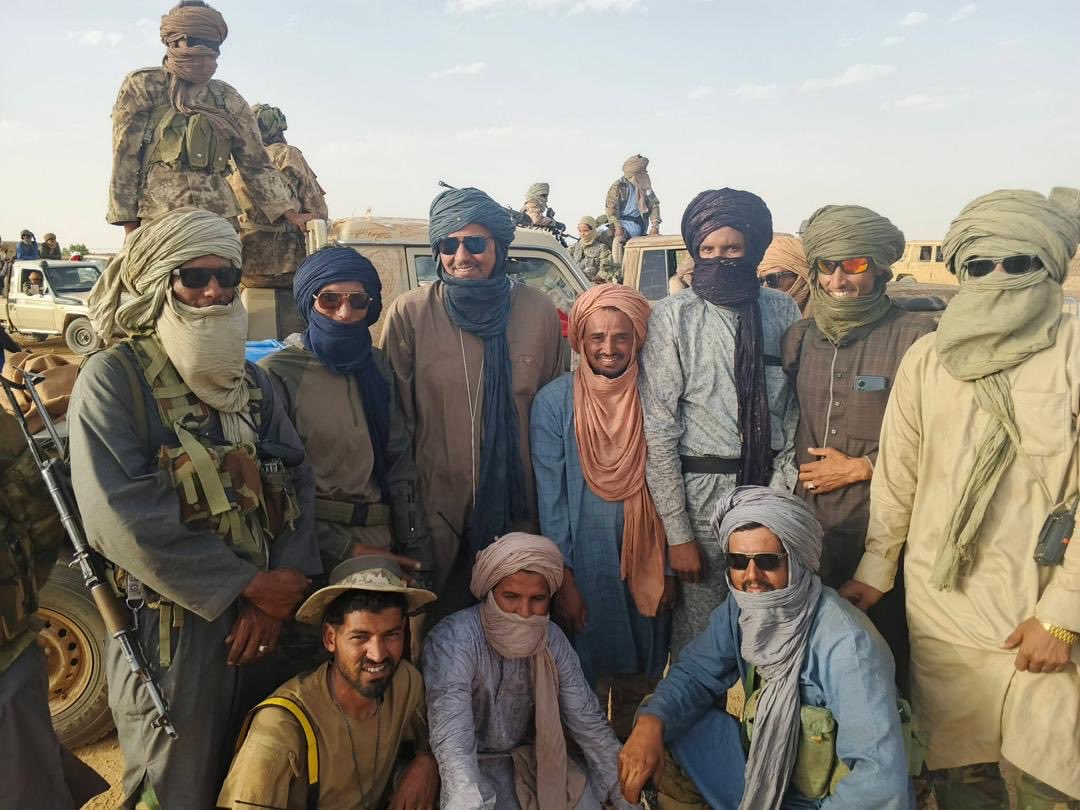
Wassim Nasr is a French journalist who has been monitoring jihadi groups for more than a decade for the French news outlet France24 in French, English, and Arabic. He has conducted multiple investigations and interviews in this regard. Nasr is a senior research fellow at the Soufan Center and is the author of État islamique, le fait accompli (2016). He has also been a contributor to CTC Sentinel. X: @SimNasr
CTC: This past weekend, on Saturday, April 25, JNIM (Jama’at Nusrat al-Islam wal-Muslimin) partnered with Tuareg rebels from the FLA (Azawad Liberation Front), and they conducted a coordinated, joint offensive against multiple cities in Mali. This included the recapturing of the town of Kidal, and it also resulted in the death of the Malian defense minister in a vehicle-borne suicide bombing. It would be a bit of an understatement to say that the offensive was transformative. Then on April 28, JNIM said that it was going to impose a total siege on the capital of Bamako and warned that civilians caught between its forces and the Malian armed forces will be targeted. Can you tell us about the offensive, about what JNIM and FLA achieved, and the significance of the operation?
Nasr: The most important change in behavior that we had is this open alliance between the FLA and JNIM. But that was expected. Because I broke the story of this deal between JNIM and the FLA a year ago, in March 2025, which makes me think that the deal was set in February. I confirmed this information by sources on both sides at the time, and I broke the story with France24, saying that they had agreed on many crucial things and that the man in charge of this ‘rapprochement’ is none other than al-Ghabass Ag Intalla, an FLA Tuareg figure and longtime companion of Bilal Ag al-Charif—a Tuareg figure himself and the actual head of the FLA. His mission was to reach out to his long-time acquaintance, Iyad Ag Ghali, the other Tuareg figure heading JNIM.
The most important things are the following: the MNLA, a major component of the FLA, which has a history as a secular rebellion for the independence of Azawad, and therefore the FLA, agreed to apply sharia law, which made it possible for JNIM to ally with them. If they did not accept this, JNIM wouldn’t have allied with them. But what sharia law are we talking about? It is like a ‘customary’ sharia law, as has already been implemented by JNIM since its creation in 2017. There’s no more cutting heads off and cutting hands off and the public executions, as AQIM [al-Qa`ida in the Islamic Maghreb] did, for example, in 2012. But it is stated and admitted that sharia law would be respected and local judges would judge in respect to it, whether they are part of JNIM or not. Which, in a way, suits JNIM because they already maintain sharia in the areas they control, but they didn’t have enough manpower to implement it themselves. So, they relied on local traditional judges, which is in accordance with what is already implemented in those rural areas, even during the period of French direct military presence. This came after a period where the directive from the leadership was to avoid interfering in people’s daily life, but the absence and inefficiency of Malian courts naturally drove people towards Islamic local judges and the only force capable of enforcing the judgments was JNIM. So, unless you go the full-blown AQ [al-Qa`ida] way like in 2012 or full-blown Islamic State Sahel Province (ISSP) way as is the case today in the areas they control in Mali, Niger, and Burkina Faso, you are still in something very common and very acceptable for the locals. Moreover, until the takeover of Kidal, neither JNIM nor ISSP controlled urban, populated areas. Just to give you one example, a few months back, they caught ‘roadcutters,’ as they say—thieves that are on the roads—in the area of Timbuktu. Instead of killing them, JNIM gave them the choice to leave town for six months. As for the same crime, ISSP is cutting hands and feet in public places. It’s all in the implementation.
So, why did the FLA accept it? While it wants the independence of the “Azawad” in northern Mali, JNIM came to them and told them, ‘We have different programs and objectives. We had our wars and dogmatic differences.’ They tolerated and fought each other periodically up to April 2024. Tens of dead on both sides on the Mauritanian border. ‘We don’t have the same objectives, but we have the same enemy.’ The same enemy is the junta in Bamako, knowing that Bamako denounced the Algiers agreements (2015-2024) and labeled the rebels as ‘terrorists,’ JNIM said to the FLA, ‘No country in the region and no international actor will accept to create a new country in Mali. But the countries in the region and the international community could accept the implementation of sharia law through Islamic governance.’ A soft version. We had the Taliban—not soft—but still tolerated, as they distanced themselves from global jihad and kept AQ checked. We had Syria, recognized, delisted, sanctions lifted, and in the Coalition against the Islamic State. So, there were two prior examples [of the acceptance of the implementation of sharia law by former jihadi actors]. So why did they have to convince them of this? Because to put pressure on the capital and on central Mali, Fulani fighters are needed. And the Fulani fighters in the ranks of JNIM, like all fighters, won’t fight for the ‘independence of Azawad,’ but they would fight for sharia law. So JNIM told the FLA, ‘If you want some autonomy, instead of unattainable independence, if you want to break the Malian junta and to kick the Russians out, you need to accept sharia law for us to fight with you in the north and to put pressure on the military in the southern part of the country.’ This was agreed to more than a year ago.
Another issue that was agreed upon, which is very important and we’ll see if it’s going to be applied properly or not, is that administration of urban areas will be by a joint venture between JNIM and FLA where the FLA will have the upper hand, and they even put in place de-confliction sharia courts. If they have problems with each other, instead of shooting at each other, they have recognized judges from both sides for peaceful conflict resolution. Another thing that is also in the agreement, which is quite important and was also established more than a year ago, is the exchange of assets and of capabilities. We saw it, for example, when the FLA used IEDs [improvised explosive devices] against the Russians—knowing that they don’t have bomb manufacturers, so they took them from JNIM.
What happened lately, to go back to the heart of your question, is actually the application of the 2025 agreement on the scale of the whole country through a military plan. They fought together—not next to each other, but together—in Gao and Kidal. And the fact that they attacked on the scale of the country at the same time permitted them to take back Kidal and other towns and military facilities in the north. The Russian Africa Corps put up a fight in Kidal and they fought at the Bamako airport, but they have limited assets. In order to protect Kati Bamako, and sustain the ruling junta, they had to drop parts of the north. This is why they retreated. This FLA-JNIM coalition worked up to now, because the terms of the coalition are much clearer than what they were in 2012 [between AQIM and MNLA] and because the inner structure of both actors have changed since.
But the big test, in my view, will come if they are able to keep Kidal and how they will govern Kidal and under what terms. If it is governed with respect to the agreement that was signed in 2025, it could work. The frictions between a number of prominent Tuareg leaders were put aside; they came together in this. Some of those local leaders have been sworn enemies for 30 years. They came together. And why did all those people come together and why did the FLA come with the JNIM? And why is even part of the Malian opposition leaning toward JNIM, as the only force capable of ousting the junta, leaning back to the imam Mahmoud Dicko who is in exile in Algiers? It’s because Bamako took all the bad decisions that it could take by labeling everybody as terrorists, silencing the press, the NGOs, putting opponents in prison, pushing political opponents to exile in Algiers, the Ivory Coast, by making of all the countries around them enemies—Mauritania, Algeria, Ivory Coast, always accusing France, always accusing neighboring countries for their own failures. So actually, they created the conditions of this outcome. A week ago, I talked to a Malian politician, Oumar Mariko. He’s a Marxist, an early opponent of the junta, a three-time presidential candidate, a former representative. The 67-year-old man went all the way to Mali and crossed illegally to the territory of JNIM to negotiate the release of detained Malian military, which were abandoned by their own government. You cannot accuse him of Islamism or jihadism. And he succeeded in freeing four of them. In the coalition with Imam Dicko, known as CFR, one of the prominent faces of this coalition, is Etienne Fakaba Sissoko. Sissoko is Christian. Though, at this point, and despite the latest events, no new, clear political offer, either by the opposition or the ruling junta, is on the table.
Many people have been comparing the situation with Syria. It’s not really comparable to Syria. Though the way JNIM is acting can be compared to HTS in a way, but also with the Taliban regarding diplomatic relations with the international community and former foes. Meaning in the first communiqué JNIM issued about the coordinated attacks, they called on Russia to drop its support for the regime in order to have “future good relations.” Keep in mind that a week before, they released two Russian hostages, and actually, after this communication, the Russian Africa Corps was able to retreat from Kidal, Tessit, Tessalit, and Aguelhoka without being shot at. In the second communiqué about the attacks, they called on Mali’s military to drop arms in order to go back home, as they released some of the captured military, so they are moderating their position. In the third very political communiqué, they renewed the call for ‘a united front (with other political forces) to avoid chaos in Mali.’ Though the comparison with Syria stops here. Al-Nusra Front had to break with AQ and create HTS, etc. It took them almost eight years. But I think that in Mali, it could go the other way around. JNIM is in a position where they can break with AQ de facto through governing. They allied with a secular group, they are calling for opponents of the Malian junta who are not at all in the jihadi sphere, so de facto, they are taking this path. They also have a chance to do it because they never plotted for AQ international, like the Nusra Front, but, if the break is chaotic and not justified religiously, it could empty their ranks, and fighters could defect to the Islamic state. Since 2019, the existential priority for them is the fight with the Islamic State.
CTC: Do you think that JNIM is on a path to break with al-Qa`ida then? On one level, that seems to make sense given what you’ve described, but on the other level, the association with al-Qa`ida, how is that potentially harming them at this time? There are cases to be made that it is, but it also seems that maybe it hasn’t put the additional pressure on them that you would imagine it would. You could also make the case that maybe they’ll do that over the longer term. But in this short term, what’s the cost of the al-Qa`ida relationship?
Nasr: Coming from Iyad Ag Ghali himself, “breaking with al-Qa`ida isn’t the priority of the day.” But breaking with al-Qa`ida is on the table. When would it happen? I don’t know. How would it happen? I don’t know either, because their situation is much more complicated than the Nusra Front, meaning when the latter broke with al-Qa`ida, the mother ship had a representative in Syria next to the Nusra Front leaders. If they want to break, who are they going to address? Zawahiri is dead; his death is yet to be acknowledged and a successor is yet to be declared. That’s a very practical issue, on one hand. On the other hand, as I told you, if they break with al-Qa`ida without any ‘legal shariatic’ justification, a big part of the fighters, especially Fulanis, might defect to the Islamic State. This is why I am saying that the comparison with Syria stops here. If we make it a prerequisite of JNIM to break from al-Qa`ida before some kind of governing or getting into alliances which are acceptable to Mali—I’m not speaking to welcoming them to Washington or putting out the red carpet for them to go to Paris—but about tolerating negotiations in Mali between Malians and afterwards in the Sahel as a whole. A prerequisite will be much more damaging for them, and they won’t be able to do it at this point in time. If they conceive it as weakening for them in the fight with the Islamic State, they won’t do it. If we make another comparison with the Syrian example, al-Sharaa himself told me that when he broke with ISIS, he had to address AQ in order to keep the fighters he still had as most left for ISIS. The dilemma is apparent today as we speak; it’s JNIM that is stopping the Islamic State from growing bigger and farther south. It’s not local armies, it’s not militias, it’s not the Russians, it’s JNIM.
CTC: Given recent events of this past weekend, in terms of JNIM’s ability to have more influence and control of certain areas within Mali, will that speed up their efforts to compete more effectively against the Islamic State, or do you think it will slow them down?
Nasr: They challenged the Islamic State in Ménaka, Mali, and they lost, though they succeeded in other parts of Mali and Burkina Faso. So today, Ménaka, except the town itself, is being controlled by ISSP, because JNIM was the last to try to challenge the Islamic State there. The Malian authorities tried; they failed. The Russians tried; they failed. The Tuareg factions that are loyal to Bamako failed. The last to try was JNIM, and I can tell you, they put a real effort in it—human effort and assets. Still, they failed. So, the area is controlled by the Islamic State. The town is still controlled by Tuareg factions loyal to Bamako and by Africa Corps. But the area is controlled by the Islamic State, and they even attacked the town, profiting from the turmoil caused by FLA-JNIM attacks all over the country. And it is in Ménaka that three Western hostages are being held, all three were taken hostage in bordering Niger: an Austrian national, a Swiss national, both abducted in Agadez, and of course the American missionary pilot, who was taken in Niamey.1 This being said, the areas of activity of JNIM are still the same. But what delayed the phase that you are seeing now is actually the war with the Islamic State. Once JNIM admitted they lost in Ménaka and they accepted the loss, they rebuilt their power against the Malian government, and they made alliance with the FLA. This is the time span between 2023 and 2025.
In the fight against the Islamic State, the highest number of fighters killed on either side are Fulanis. So, this is also a dynamic to challenge and to tackle and to be taken into consideration. Because even if we look at what’s happening now—and this is why I think there will be a phase two of these most recent attacks—the coordinated attacks happened country-wide. In the north, we had coordination of JNIM, FLA, Tuareg, and Arab fighters, but in the center and around Bamako, it’s mostly Fulani fighters. And as we speak, the only perceivable political gain is for the Tuaregs in the north. So, if they want it to work, the Fulanis of the center should have something in return for fighting. So, if they have this ‘something’ through political bargaining and national negotiations, it could stop. If they don’t, we will go into phase two. If JNIM gets a deal that is acceptable according to sharia, or at least if they get enough to answer some of the historic grievances of the Fulani populations, they will become more attractive than the Islamic State for these populations, and this will help achieve stabilization.
In Syria, al-Sharaa won the battle politically, ideologically, and militarily. So, he’s more attractive. And this is why, under current conditions, the Islamic State will have a hard time resurging in Syria—though it might happen in Iraq, where Sunni populations don’t have a political and economic horizon. In Syria, they have something else, a political system that they accept, and this is why, for example, most of the Arab fighters of the Syrian Democratic Forces left and Damascus took back the north almost without a fight. If JNIM has something to give for those Fulani-majority fighters, they will stick to them, and it will continue to be an obstacle to the Islamic State. If they don’t, the Islamic State might have the upper hand. And of course, it’s a dilemma for the countries of the region, for the U.S., for France—what is acceptable, what is not acceptable? What is tolerable, what is not tolerable? What are the real objectives? Is it a good idea, for example, to keep supporting the juntas, which are fueling the problem now? Many talk about avoiding state collapse in the Sahel, but isn’t it already collapsed when you barely control your capitals and your territory? If you look at the last report of Human Rights Watch on Burkina Faso,2 you see that the death toll of civilians by the hands of the military and of the militias is almost three times higher than of the death toll by jihadis. Out of 1,837 civilians killed from January 2023 to August 2025, 1,255 were killed by government forces and loyalist militias.
CTC: To go back to the offensive specifically, what do we know about the tactics and the weapons that were used?
Nasr: Nothing groundbreaking. Small arms, RPGs, technicals, machine guns mounted on motorcycles, monitoring the battlefield with FPV [First Person View] drones, nothing new. They are just getting better and better at command and control. Many people ask, ‘How did they get the arms? Where did they get the arms?’ They got the arms from military barracks, and sometimes from the black market, and they are getting better at command and control and fire support, etcetera. This is experience. The FLA is using explosive FPV drones in a better way than before. They are not masters in the art: The son of al-Ghabass Ag Intalla mentioned earlier was killed while manipulating an explosive FPV during an attack against an Africa Corps convoy in February.3 But they are managing to use what they have at hand in a better way. But the most important thing to me, as with the attack on the airport in Niamey by the Islamic State and as with the attack in Kati, they are monitoring the battlefield in a skillful way. With the assets they have, they are getting better at using the equipment they have. For example, to send the suicide bomber in Kati, they mapped the area using Google Earth. They didn’t send him in blind; they mapped it. They knew exactly where to send him, what are the weak spots, how to occupy the army on this spot in order to let him go through. And they learned from previous failures in Kati. This is human skill. We don’t even see ATGMs [anti-tank guided missiles]. There’s nothing groundbreaking with the weapons they are using.
CTC: There was a video yesterday that France24 highlighted that showed an FLA fighter using a Starlink terminal, which could be helping with command and control.
Nasr: Of course. I was specific on weapons, but of course, Starlinks. I published years ago a picture of the first Starlink I saw.4 It was JNIM taking over an Islamic State position and commander, and in the pictures they issued, there was a Starlink. But yes, Starlink is very important. They have it on their pickups. This is how they send out almost live footage. They are connected; the battlefield becomes connected. This is, of course, very important, but it’s not new.
CTC: The offensive is reported to have impacted Russian-supported Africa Corp units and personnel operating in Mali. What do we know about this?
Nasr: I wouldn’t overblow the impact on Russia-junta relations. Because as I told you, the Russians had to make a choice. They didn’t have enough assets to protect all the military facilities stretched all over the country at the same time. They made the choice to focus, with helicopters, drones, etcetera, on protecting the regime, on protecting Kati and Bamako’s airport. They partially failed because the minister of defense was killed, their main man Sadio Camara, but they protected the airport of Bamako. And they tried to put up a fight in Kidal, which ended in a deal because JNIM and the FLA opened the way for a deal and because they knew that they won’t have military support in time to avoid another Tinzaouaten massacre.b Remember, it was after that failure that Wagner Group was labeled Africa Corps and connected more strongly with the Russian Ministry of Defence. They could not afford something like that again, so they had to cut a deal, to leave Kidal. If you noticed, the first public appearance of [Mali’s leader Assimi] Goïta since the offensive was with the Russian delegation and Africa Corps representatives. So, I don’t think at all that it will damage the relationship.
On the contrary, I think it will consolidate the relationship because the objective of the relationship is to preserve the junta. The number one objective and priority was never to fight the jihadis. Otherwise, they wouldn’t have sent Wagner and then Africa Corps up to the north against the rebels. They would have sent them around Bamako and farther south to prevent jihadis from growing on the borders of Cote d’Ivoire, Senegal, etcetera. At the end of the day, even if they lost Kidal—which was the jewel of the crown, the only success they had in Mali—I don’t think that the junta will drop them because they don’t have many other choices. France and the U.S. had major differences with the three juntas because they did not have the same priorities anymore. When you don’t have the same priorities, you look for other partners. And that’s what they did. But the strategy of focusing on consolidating their grip on power backfired and not only in Mali, because in Burkina Faso, more than 60 percent of the country is under jihadi control and in Niger the capital is being attacked and because a ‘corridor’ is open between ISWAP and ISSP on their soil.
But still, their priority is to preserve power, and in this regard, Russia is a partner. The Russian investment in Western Africa and Mali is still so low cost and acceptable for Moscow, even with a relatively high death toll. That is why they won’t leave. Because the strategic impact is still huge, with a very low-cost investment, added to the fact that they are being paid to be there. So, this should be really kept in mind, because even in the coverage today, the people are solely focusing on ‘the Russians failed, they are not the good partner to fight jihadis.’ But the main objective is not to fight jihadis; it’s to keep the juntas in power and use the Sahel countries as an ‘aircraft carrier’ for Moscow’s influence in West Africa.
CTC: What should we expect over the next several weeks in Mali? What impact might the recent offensive have on terrorism in neighboring countries and their stability?
Nasr: What I can say is that the sooner Malian political opponents, insurgents, and JNIM jihadists accept, and are allowed, to talk, the quicker we will have a viable answer for Mali and the region. The answer should not be, ‘Let’s try the juntas again.’ Because many have been trying for years; it didn’t work. So, if they are helped, again, to stay in power, it does not mean that they will be fighting jihadists. It will mean they will keep fighting to stay in power. This is why they ejected the most relevant partners, the most relevant international organizations, the most relevant NGOs, not to even talk about the press.
At the same time, the longer this process takes, the less JNIM has to make concessions. They are the most powerful military actor on the ground. So, if today they do not succeed in getting along with the political opponents and keep getting along with the Tuareg rebels, they can wait. They will not try to take Bamako with black flags and pickups. The only way for them to reach power is to get into coalition. If they go into a coalition, as I said earlier, it would mean that they will moderate their positions on many things. It won’t be perfect. It won’t be liberal; it won’t be Switzerland. But it’d be something that will lower the death toll and bring some stabilization.
This should be tackled smartly. Power brokers, the international community should go back to counterinsurgency ways. Counterterrorism, as it was conducted for 20 years—meaning ‘kill them all’—did not work. In my humble opinion, working on this issue for 15 years, decision makers should go back to counterinsurgency, where negotiation is part of the act, military is part of the act, intelligence is part of the act, in a combined way. Making something stable, even if it’s an Islamic-inspired rule, in Mali could be part of the answer. If you look at countries like Mauritania, it’s an Islamic republic. They were the first to be hit by AQIM in 2009. And then, not a single attack on their soil since 2011. If the international community encourages, for example, Mauritania to be the landscape for some negotiations, things could be put on track. Mauritanians don’t have means; they don’t have assets. But they have an experience. I think decision makers should think a little bit outside of the box. When I got [senior JNIM leader Amadou] Koufa’s answers to my questions in October 2024, he was talking about conflict resolution.5 So why should the West keep on going in a war with no perceivable end, while hardcore jihadis are moderating their positions and saying, ‘We can go into conflict resolution. We accept negotiations,’ having in mind the other examples that have occurred already in the world. When I went to Idlib in 2023 to meet Ahmed al-Sharaa, I had this in mind. I was like, ‘This is a new blueprint. This is something that never happened before.’ You had a listed jihadi group, HTS, controlling a territory and saying, ‘We want to be out of global jihad. That was a mistake. This is why.’ And we saw it working with the fall of Assad. I’m not saying it’s going to work the same way in Mali—different country, different environment, different challenges, etcetera. And if you ask me what other countries should do, I would say that international power brokers should help create the right conditions for talks on local and regional levels. It should not be, as we say in football, ‘You get a red card. You talk to the terrorists, you’re disqualified.’ No. Talk to them. If it works, good; if it doesn’t, go back to the military option.
If we enlarge the scope of our reading, you know that other terrorist organizations, historically speaking, not Islamists or jihadists, like the IRA, like the ETA, like the PLO or others, at one point in time, they were hijacking planes, they were planting bombs. At another point in time, they accepted to negotiate, and they entered political processes with more or less success for each of these groups. The hardcore part of it vanished, was killed, or was eliminated. This should be part of the equation, because we should acknowledge that ‘kill them all’ doesn’t work and that terrorism is political and is not an end per se as a long-term strategy.
CTC: When you think about this blueprint and to embrace counterinsurgency and different approaches to the region and the role of countries like Mauritania, do you think about figures like, the name that comes to mind is somebody like Abu Hafs al-Mauritani,6 who in certain circles is a credible person, used to be in al-Qa`ida but could play some type of role if we’re thinking creatively about these things?
Nasr: Abu Hafs is a potential known figure in the region with appropriate ‘credentials,’ but other religious scholars accepted by all parties could play a similar role. The Malian imam Dicko that I mentioned earlier could play a role in this regard that goes beyond Mali to Burkina Faso. I met both of them twice over the years and the last time was in Nouackcott in February. Abu Hafs plays a role in Mauritania, and he could play a role in the Sahel crisis, but the Mauritanians need to be empowered to allow this. They should be given a clear mandate; they cannot do this themselves. They are poor, they are not politically powerful enough, and being such a platform is a huge weight to handle. Look at the Qataris, for example. They are paying a very high price for playing this role again and again and again, despite the fact that each and every time it comes as a request from warring parties or the international community. So, it’s a decision to be taken on the international level, to say, ‘Okay, we accept to talk. Let’s talk, let’s partner with this country, with this NGO, or with this figure, and then let’s see what the outcome will be.’ This could work only if Western capitals decide about their priorities. Is the priority to see whiskey bars in Timbuktu? Or to see the pacification of decades-old war zones?
As I told you, JNIM can wait. They are fighting with the Islamic State; that’s their priority. If you don’t put anything on the table, they will keep growing. There’s nothing to entice them to stop growing. And when I say growing, it’s from the top and from the bottom. If at the top the decision is to stop the growing, they don’t completely control what’s happening on the ground in the outskirts of Burkina Faso or Benin. This is also part of the dilemma. If you let them get more centralized, they’ll get more powerful politically, but you will have an identified counterpart capable of implementing agreements. But politically, they will grow more efficient and challenging. At the same time, you have an actor who doesn’t want to negotiate, who’s growing, and with real potential, which is the Islamic State.
CTC: We’d like to talk a little bit about Islamic State Sahel and its recent trajectory. In late January, as you know well, the Islamic State Sahel claimed responsibility for a coordinated surprise attack on the Niamey International Airport in Niger. What was the significance of that attack, and what does it tell us about the trajectory of the Islamic State’s affiliate in the Sahel and West African regions?
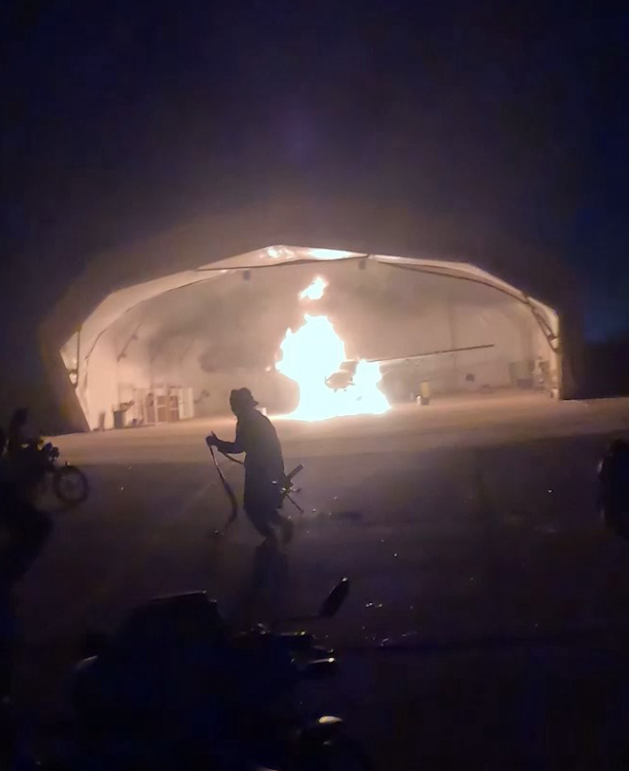
Nasr: That was the last indication that actually the link between ISWAP and the Islamic State Sahel affiliate is consolidated. I wouldn’t say it was created, I say consolidated, because it was already happening since 2022 and the battles of Ménaka that I talked about. And the most important part of this, in my sense, is not the weapons; it’s again the human assets and the use of those weapons. It was a night attack monitored by drones with fighters going in with fire support from the outside, without fire support mistakenly killing their own fighters. They proved to be skillful. We cannot say, militarily speaking, it’s within reach of just anybody to plan and conduct such an operation. This is very important regarding the capabilities, and this is very important regarding the strategy they have, because it is the first time they attacked this way. Comparatively, the Bamako attack by JNIM in 2024 was conducted in a ‘classical’ way, meaning you put people in, they die fighting. Niamey’s airport attack is something else. And the fact that the Islamic State succeeded in retreating is also very important.
Added, of course, the capacity to abduct people in Agadez, the U.S. missionary pilot in Niamey, enhancing the attacks in the area of Dosso in the race between them and JNIM to this new tri-border region between Niger, Nigeria, and Benin. This is vital for them because this is where they can reach for the south or not, remembering that the first occurrence of the Islamic State attack in the area was in Benin in 2022, and it was countered by JNIM. So they have potential there. And we saw also the defection of one commander—not a very important commander—in Burkina Faso, from the ranks of JNIM to the ranks of the Islamic State. They tried to make a fuss about it, meaning ‘a leader with hundreds of fighters.’ It’s not true. It was one leader with his bodyguard. But still, it was a first.
JNIM is still dominant, but if you take out some figures like Ag Ghali, like Koufa, or Jaafar Dicko in Burkina Faso, and their seconds in command, middle-ranking commanders and fighters could see a better opportunity for them in the ranks of the Islamic State. So it’s a growing force. They also have potential because of the enhanced link with ISWAP, because as you know, ISWAP is the most territorialized, most administrated ‘province’ of the Islamic state in the world. And they have manpower and human skills. I always emphasize, it’s always more about the men than about weapons. It’s about the men. Since the fall of [former Niger President Mohamed] Bazoum, and ousting of French and U.S. forces from Niger, after Mali and Burkina Faso, there is almost a no-fly zone above those three countries and jihadi groups are free to roam in an unprecedented way. JNIM and ISSP recently had their first fight on the border between Niger and Burkina Faso, and another one in northwest Nigeria on the border with Benin. For me, those are the indications to follow to have a glimpse about what’s going to happen next.
CTC: In that vein, what has the Islamic State Sahel been up to since that attack in January? What are you paying attention to? What concerns you?
Nasr: I’m following closely the attacks in Dosso and in this tri-border region with Nigeria and Burkina Faso. We are witnessing more and more attacks. They are trying to control the roads. I don’t know if they are seeking to control the pipeline or not, because sometimes people tend to give them objectives they don’t actually have. For example, after the Niamey airport attack, the talk of the media was about the yellowcake [uranium oxide concentrate] stocked there.7 They were not even aware that there was yellowcake in the air base. They knew it after the attack because everybody was talking about it. And they even put it in their magazine, Al Naba, to say, ‘Okay, now you’re talking about yellowcake. Next time, we’ll take it.’
What I’m also following very closely is the situation in northwest Nigeria between the Islamic State, JNIM, and the bandits. This is very important because I think that if some bandits decide to openly take one side or the other, it would be a game changer. Because this is how it happened in Niger. CTC
Substantive Notes
[a] Editor’s Note: Shortly after publication of this interview, it became clear that Russian forces who retreated from Tessalit to Aguelhok did not eventually leave the town.
[b] Editor’s Note: In July 2024, the Wagner Group and Malian forces sustained a significant defeat in a battle against separatists and Islamist militants (including JNIM fighters) in Tinzaouaten, Mali. In November 2024, The New York Times reported that it had “confirmed the deaths of at least 46 Wagner fighters and 24 allied Malian soldiers.” Christiaan Triebert, Elian Peltier, Riley Mellen, and Sanjana Varghese, “How Wagner’s Ruthless Image Crumbled in Mali,” New York Times, November 1, 2024.
Citations
[1] Editor’s Note: See “Austrian woman kidnapped in Niger, say sources,” Reuters, January 12, 2025; Baba Ahmed, “A Swiss woman has been kidnapped in Niger’s Agadez, authorities say,” Associated Press, April 14, 2025; and Sarah Carter, “American missionary kidnapped from home in Niger’s capital by armed men, sources tell CBS News,” CBS News, October 22, 2025.
[2] Editor’s Note: “‘None Can Run Away’: War Crimes and Crimes Against Humanity in Burkina Faso by All Sides,” Human Rights Watch, April 2, 2026.
[3] Editor’s Note: “Drone Attack Attempt Foiled Near Aguelhok as Two FLA-JNIM Fighters Killed in Explosion,” West Africa Weekly, February 23, 2026.
[4] Editor’s Note: See Wassim Nasr, “#Mali #JNIM #AQMI revendique l’opération contre Abdel Aziz Maza …,” X, June 7, 2024.
[5] Editor’s Note: For more on this, see Paul Cruickshank, “Answers from the Sahel: Wassim Nasr, Journalist, France24, on His Interview with Deputy JNIM Leader Mohamed (Amadou) Koufa,” CTC Sentinel 18:1 (2025).
[6] Editor’s Note: For background on Abu Hafs al-Mauritani, see “Al Qaeda leader Abu Hafs al-Mauritani freed in Mauritania,” CBS News, July 9, 2012, and “Former al-Qaeda mufti: I condemn ISIL attacks,” Al Jazeera, November 21, 2015.
[7] Editor’s Note: Adal Rhoubeid and Maureen Farrell, “How a crisis over a stockpile of uranium created an opening for US reengagement in Niger,” Atlantic Council, March 3, 2026; Basillioh Rukanga, “Heavy gunfire and blasts heard near airport in Niger’s capital,” BBC, January 29, 2026; “Attack on Niamey airbase sounds alarms on uranium security,” Africa Confidential, February 4, 2026.
