
Abstract: In early 2026, almost seven years after it began, the indefinite detention of tens of thousands of Islamic State affiliates and their families in northeast Syria ended in chaos after a massive break out from Al-Hol detention camp and the transfer of thousands of the group’s fighters to Iraq. Observers now ask: How did we get here, what happened, and what does this mean for countering the Islamic State? To answer these questions, it is vital to consider the heterogeneous group held in northeast Syria, how they got there, as well as the policy decisions that shaped their detention. As the situation has recently drastically changed, this article considers the security implications seven years later for Syria and beyond.
The detention system holding Islamic State affiliates and their families in northeast Syria began to crumble in early 2026. Weeks after an estimated 200 male detainees fled from an Islamic State detention facility near the town of Shadadi, Al-Hol detention camp—known for holding Islamic State-affiliated families—was empty after more than 20,000 escaped the once-secure site.1 Fearing more breakouts, by mid-February, U.S. Central Command confirmed the completed transfer of 5,700 male detainees from Syria to Iraq.2 The once expansive detention system holding Islamic State affiliates and their families had fallen to pieces. For those that have studied this issue, the collapse of indefinite detention in northeast Syria was both foreseeable and avoidable.
For the last seven years, tens of thousands of men, women, and—primarily—children captured after the fall of the Islamic State’s so-called caliphate in 2019 were held in detention sites (including detention facilities and detention camps) in northeast Syria.a Run by the Syrian Democratic Forces (SDF), and its civilian arm the Democratic Autonomous Administration of North and East Syria (DAANES), these detention sites held Syrians, Iraqis, and Third Country Nationals (TCNs)b and were supported by the Global Coalition to Defeat the Islamic State (the Coalition).3
While meant to be only a temporary solution, for the last seven years little changed. Despite the Islamic State’s history of exploiting breakout events to rebuild and expand its networks4 and much international debate over the questionable security and humanitarian standing of these detention sites, Syria remained divided and international actors were slow to act, turning the situation into a protracted, indefinite crisis.
Yet, the fall of the Assad regime in December 2024 and the rise of the new interim president, Ahmed al-Sharaa, created an opening for change in Syria, but also left detention facilities and detention camps in the northeast vulnerable.5 This came to a head when despite best intentions and years of policy emphasizing the systematic reduction of these detained populations through repatriation, reintegration, and, where appropriate, accountability, the collapse of indefinite detention occurred rapidly, chaotically, and with little transparency at the start of 2026. As questions emerge about how this unfolded—and what it means for ongoing efforts to counter the Islamic State—it is vital to examine how the world arrived at this point and what comes next.
The purpose of this article is to examine how the indefinite detention of thousands of Islamic State-affiliated individuals and their families shaped the international community’s current ability—and desire—to counter the group. The article progresses by initially addressing how individuals ended up in detention, before discussing the detention process as well as security and humanitarian concerns that impacted the detention sites. It also examines international reluctance toward repatriation and recent chaos that rewrote the map, before concluding by addressing future threats posed by—and to—those previously detained in northeast Syria. This article argues that despite the desire to move on from this chapter, a cooperative international effort is still needed to counter a resilient and now more disperse Islamic State threat, one that has—and will continue—to use its supporters to resurge.
The Collapse of the Caliphate and the Start of Indefinite Detention
The scope and scale of the Islamic State’s mobilization, coupled with the group’s active recruitment of men, women, and children to its state-building project, made it unique among jihadi actors.6 Many in the region willingly joined the Islamic State, while others were forced under its occupation as it grabbed territory across Syria and Iraq.7 Still others left their home countries to join the group, with more than 50,000 men, women, and children from approximately 80 countries joining jihadi groups in Syria and Iraq between 2011 and 2018, including the Islamic State.8
The Islamic State’s gendered recruitment, coupled with its theological-legislative gendered system of control,9 created both security and policy implications for those seeking to counter the group. Its system of control forced domesticity and excluded women and girls from much of public life as a way of prioritizing female modesty, often leading to a gross misunderstanding of women’s roles in the group.10 Its policies also affected men and boys, focusing on militarization with the group’s gender essentialism specifically affecting boys, with violence ingrained in every part of their upbringing.11 This meant that for those seeking to counter the Islamic State, teenage boys were viewed as a security threat due to the indoctrination and training they may have received from the group. Moreover, the Islamic State’s binarized gender roles emphasizing men as fighters had implications, as many of the group’s male supporters were killed fighting for the group, leaving behind thousands of women and children family members.12
This phenomenon became evident when between late 2018 and early 2019, the SDF—with support from the U.S.-led Coalition—began to take control of territory formerly held by the Islamic State in northeast Syria. In the process, men, women, and—primarily—children affiliated with or perceived as affiliated with the group were detained and transferred to detention sites in northeast Syria, including ‘pop-up’ detention facilities and detention camps—many of which were originally designed as temporary shelters for internally displaced persons (IDPs).
Dealing with tens of thousands of people taken into custody during this time, the SDF developed emergency detention measures to divide the populations. These measures reflected the Islamic State’s own binarized gender roles that were implemented throughout its caliphate, and gendered assumptions concerning ideological commitment and risk.13 Women and children were separated from men and teenage boys—some as young as 14—perceived as Islamic State fighters.14 Approximately 10,000 men and teenage boys were moved into detention facilities, while the majority of those captured—around 60,000 mostly children and women—were moved into detention camps.15 This process was never supposed to be permanent. Yet, international reluctance to repatriate their citizens, and faced with no real consequences, the indefinite detention crisis began.
It is imperative to make two important caveats. First, not every foreign fighter or foreign traveler that joined jihadi groups in Syria and Iraq ended up in indefinite detention. Some returned home, some moved to other conflict theaters, and some aligned with other groups, including the now-defunct Hayat Tahrir al-Sham (HTS), and moved to other parts of Syria.16 Second, not everyone held in detention sites in northeast Syria was affiliated with the Islamic State. For example, many of the detention camps that Islamic State-affiliated women and their children were sent to were already IDP camps holding displaced populations.17
The following sections will explore the detention sites, including detention facilities primarily holding men and teenage boys and detention camps primarily holding women and children.
Detention Facilities Holding Men and Teenage Boys
At its peak, the SDF was estimated to hold more than 10,000 Islamic State-affiliated men and teenage boys at detention facilities, including 5,000 Syrians, 3,000 Iraqis, and 2,000 TCNs,18 which the U.S. State Department once called “the largest concentration of detained terrorists in the world.”19 Holding such a large number of individuals led to many security and humanitarian concerns over the years. Some of these issues arose because many of these facilities were not purposely built to hold detainees, suffered from outdated infrastructure, lacked aid entering the facilities, had no legal status for existing, and exhibited shortcomings among those running the facilities, like insufficient medical infrastructure and limited guard force training on the humane treatment of detainees.20 This in turn also affected the security situation. For example, in 2021 the United Nations noted that “the improvised and converted facilities in which they are held are often unsuitable from humanitarian and security perspectives.”21 Yet, between 2021 and the end of 2025 little changed.22
Moreover, for the Islamic State, the freeing of these individuals would both militarily aid the group’s depleted ranks as well as serve as a propaganda tool, showcasing its continued power. In September 2019, then-Islamic State caliph Abu Bakr al-Baghdadi called on the group’s fighters to free detainees.23 Since then, security forces dealt with at least two security incidents a year, with January 2022 seeing the largest attack claimed by the group.24 The 10-day operation at Panorama detention facility in northeast Syria involved more than 200 fighters and a car bomb alongside simultaneous riots inside the facility, and led to some escapes (though many were recaptured or killed).c For years after the attack, the SDF, the DAANES, and international partners pointed to these security issues and glossed over humanitarian concerns.25 d
It is important to acknowledge that over the last seven years, gathering concrete information on individuals in detention facilities has remained extremely difficult—and sometimes unreliable—for numerous reasons, including security reasons, as well as the fact that they were run by non-state actors, the SDF and the DAANES. As such, NGOs or international organizations did not operate in the detention facilities, and even international bodies like the United Nations and the Coalition struggled to gain access.e For many countries that have been reluctant to take accountability for their citizens, not having access to this concrete information allowed them to deny responsibility.
One of the last times that comprehensive information was publicly available was mid-2024, with Amnesty International noting that despite public perception that these facilities were run by the SDF, in reality detention facilities were run by both the SDF (15 facilities) and its civilian arm the DAANES (10 facilities).26 By the end of 2025, detention facilities in northeast Syria were said to still hold nearly 9,000, including 8,000 adult men and 1,000 teenage boys and young men initially detained as minors, as well as 100 women.f Many women detained in detention facilities were accused of committing crimes in DAANES territory, including in detention camps.27
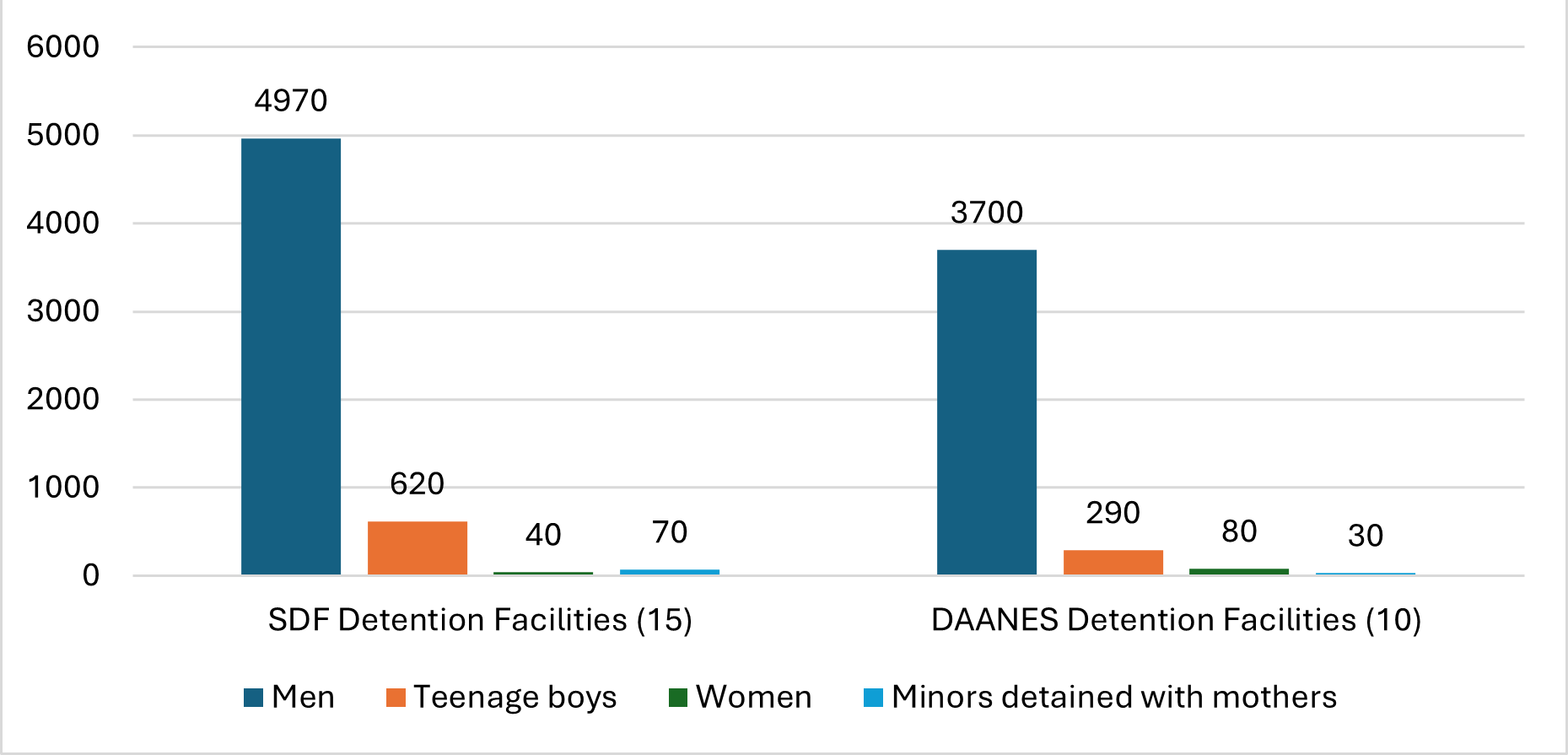
According to Amnesty International, in 2024 the 15 SDF-run facilities held roughly half of those in detention facilities, including some 2,000 TCNs from at least 55 countries.28 When addressing TCNs held in detention facilities, these are the populations referred to. In fact, the Coalition has acknowledged that just two SDF-run detention facilities, Sini detention facility (near Shadadi) and Panorama/“Al-Sina’a” detention facility (near Hasakah),g held 85 percent of the individuals in SDF detention.29 h At the end of 2025, many of those who remained in SDF-run detention facilities in northeast Syria (including approximately 2,000 TCNs) never faced trial despite being held since 2019.30
The remaining 10 detention facilities—those not run by the SDF—were run by its civilian arm, the DAANES. DAANES-run facilities could be divided into two categories: a) eight detention facilities, and b) two youth “rehabilitation” centers (which will be discussed below).
The vast majority of the detainees held in DAANES-run detention facilities were Syrians with perceived Islamic State affiliation who had been tried and sentenced by the DAANES’ “People’s Defence Courts,” which charged individuals with ‘terrorism’ and other crimes related to national security in northeast Syria.i Because of the DAANES’ non-state status, they could only charge and put on trial Syrians.
Over the years, many questions have arisen about the number of individuals in detention facilities. For example, even after years of repatriation of Iraqi men from these facilities, the SDF still claimed at the end of 2025 that there were still 9,000 Islamic State-affiliated individuals in detention facilities.j This has raised concerns that political prisoners may have been mixed in with Islamic State-affiliated populations. For example, in 2024 Amnesty International flagged that the DAANES and SDF have been accused of using allegations of affiliation with the Islamic State to intimidate and silence people, as well as exact revenge in personal or clan disputes.31 The lack of international oversight of the SDF’s handling of detention facilities, coupled with international reluctance toward repatriation—particularly men—led to a situation in which even today there is still little knowledge about the size and scope of the issue, including names, gender, age, and nationality of those who were held in detention facilities.k
Minors in Detention Facilities and Youth “Rehabilitation Centers”
Seven years later, one of the most contentious issues remains the holding of minors in detention facilities. This includes teenage boys held alongside adult men, minors held with their mothers, and those held in youth “rehabilitation” centers after being forcibly separated from their families. The indefinite detention of minors has been criticized for not meeting the United Nations Standard Minimum Rules for the Administration of Juvenile Justice.32
As early as 2019, it was clear that there were hundreds of teenage boys held in detention facilities in northeast Syria alongside adult men.33 As of 2024, around 800 teenage boys were still being held in adult detention facilities, the majority at the adult Panorama detention facility.34 In 2022, the Coalition acknowledged that there were at least 539 detainees in Panorama detention facility that were younger than 18 years old when they were initially detained in 2019.35 Despite being detained as minors, many of these teenage boys are now young men, turning 18 while still in detention.
In addition to youths held alongside adults in detention facilities, at the end of 2025 there were two main youth “rehabilitation” centers run by the DAANES: Houri (established in 2016) and Orkesh (established in 2022), which as of August 2023 together held around 200 boys, of which approximately 190 boys were TCNs, while the remaining boys were Syrians.l By mid-2024, most of the boys held at Houri and Orkesh “rehabilitation” centers had been moved from Al-Hol camp.36 While this was an improvement from the SDF’s previous policy of moving boys from Al-Hol camp into prisons with adult men, this was not without controversy, as these boys were still forcibly removed from their families.m The SDF has claimed they removed these boys for several reasons, including their involvement with violent and criminal activities, their indoctrination into extremist ideologies, as well as being at risk of sexual violence.37
Compared to conditions of minors held alongside adult detainees, or even minors held in detention camps, the conditions of the youth “rehabilitation” centers were considered slightly better, with boys and young men receiving some physical and psychological support, humanitarian assistance, as well as some education.38 Yet, while called “rehabilitation” centers, without a long-term solution, these camps have remained just a holding point. Only Syrian boys in Houri were ever charged, tried, or released.39 Some foreign nationals were repatriated. For the rest, researchers have called this the “conveyor belt of incarceration,” as this offer of “rehabilitation” is only a passing phase until inevitable transfer to prison at age 18.40 Rather than proactively addressing youths who were victims of the Islamic State, the system of indefinite detention further victimized these young boys.
Detention Camps Holding Women and Children
At the fall of the caliphate, the majority of the captured individuals were minors and women, who were then sent to closed detention camps, meaning camp residents were not free to leave.41 In early 2019, when the populations of Islamic State-affiliated individuals in these camps peaked, there were several detention camps.n However, by July 2022, the United Nations acknowledged that only two detention camps still held Islamic State-affiliated families.42 They included first, the larger Al-Hol camp, and second, the smaller Roj camp.43 Security of both camps was run by the SDF, with funding coming from the U.S. State Department and USAID for camp management (including food, water, and internal security).44
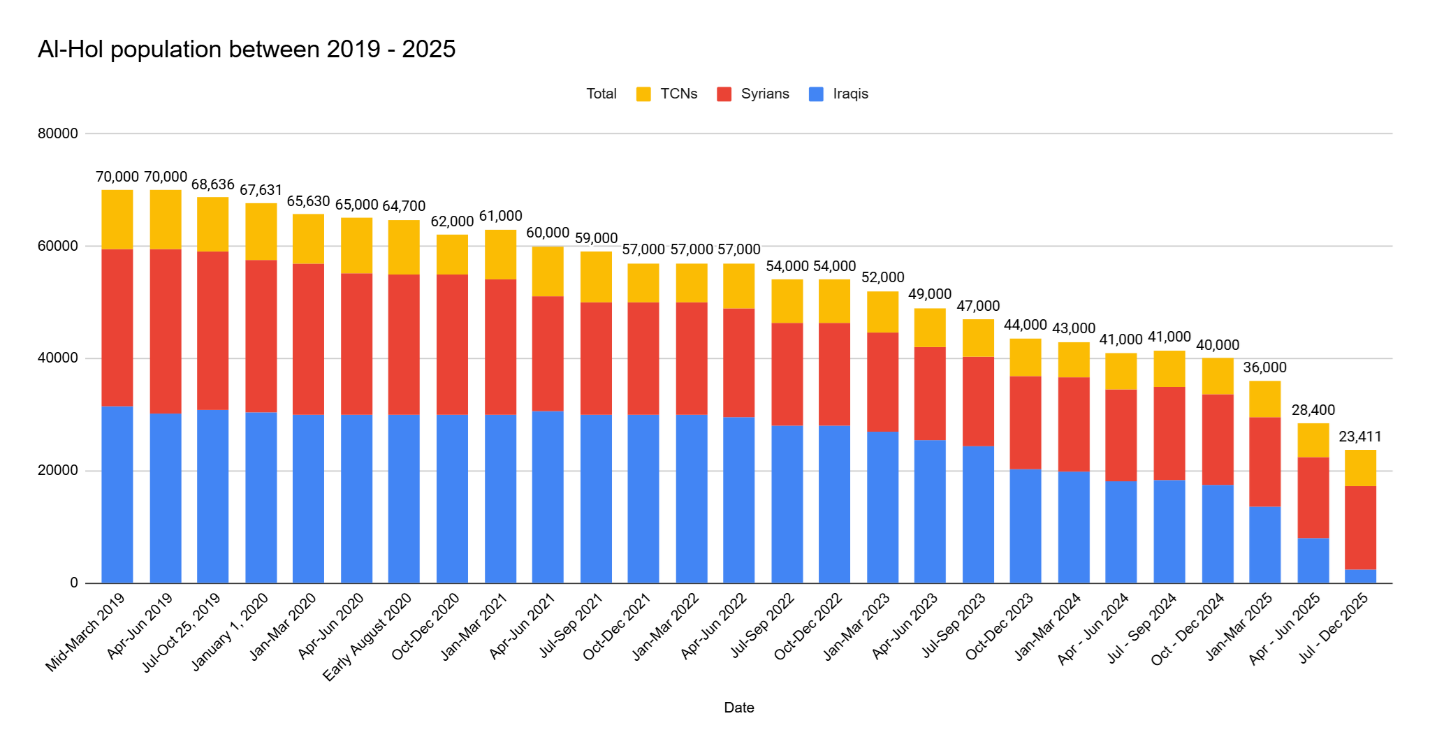
Al-Hol was originally opened in 1991 by the United Nations High Commissioner for Refugees as an IDP camp, but was reopened in 2016 by the SDF as an IDP camp, and by 2018 around 10,000 mostly Iraqi nationals lived in the camp.45 However, between December 2018 and April 2019, more than 60,000 individuals—most of whom were minors—entered Al-Hol camp, creating an urgent need to process these individuals, with logistical, humanitarian, and even security challenges.46 At that time, 65 percent of the population in Al-Hol was under the age of 12.47 Due to its size, the camp was divided into several annexes, including one just for TCNs.
By the end of 2025, Al-Hol held still around 24,000 people, with more than 60 percent of the population under the age of 18, 29 percent of the population being women, and the remaining 11 percent being men.48 The majority of families in Al-Hol were female-headed households.49 The largest of the detention camps, Al-Hol represented the intractability of indefinite detention. A complex environment, the camp held both Syrian and Iraqi IDPs who were in the camp before 2019, as well as an influx of Islamic State-affiliated families captured by the SDF. In October 2025, UN Women released a report that contended one quarter of those detained in Al-Hol had no connection to the Islamic State.50
Due to the size and population in Al-Hol, the camp faced both hostile internal dynamics and served as a target for Islamic State attacks. For example, in September 2022 the Islamic State claimed responsibility for an attempted multi-pronged vehicular attack on Al-Hol, which aimed to break free the group’s supporters and act as “revenge for imprisoned women.”51 Moreover, the camp was plagued by adult women who were still ardent supporters of the group as well as minor children at risk of radicalization and recruitment by the Islamic State, with Save the Children noting in 2022 that with two murders in the camp a week, Al-Hol was “per capita, one of the most dangerous places in the world to be a child.”52
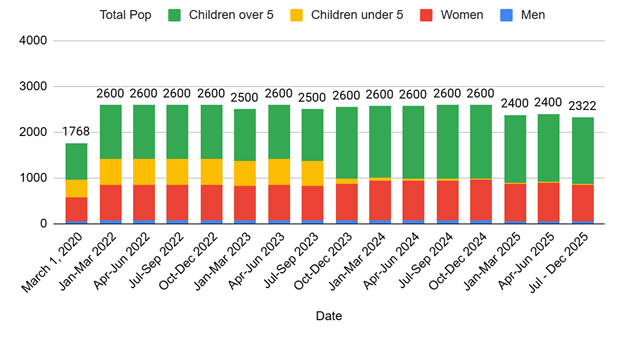
While most Islamic State-affiliated women and minors ended up in Al-Hol camp, it soon became clear that the size of the camp, as well as the humanitarian and security situation in the camp required some sort of solution. By March 2020, the SDF, with support of the Coalition, was working on a plan to relocate TCN families from the foreign annex of Al-Hol to other camps, particularly Roj.53 While Roj camp was originally established in 2016 as an IDP camp for those from Syria fleeing the Islamic State, it was expanded in 2020.54 Beginning in July 2020, approximately 400 TCN families were moved from Al-Hol into Roj camp.55 Since then, some TCN families held in Al-Hol have continued to be moved to Roj. The population of Roj camp has held consistently around 2,400 individuals, 94 percent of whom are TCNs.56
The humanitarian and security situation in Roj has been considered much better than in Al-Hol camp, including greater internal freedom of movement across the camp, better security, and greater amenities. But it is still a closed indefinite detention camp, with limited housing, water, and food access, as well as limited health and education services.57 However, Roj camp was not without violence, and in early 2022, the situation escalated to the point that USAID partners paused certain assistance programing due to the security situation in the camp.58 Today, the only camp that remains active is Roj, holding many Western and high-profile TCN families.
Compared to detention facilities, identification efforts were somewhat easier at Al-Hol and Roj camps because they have allowed greater outside access and collection of biometric data. Governmental and non-governmental organizations alike have repeatedly published clear, detailed statistics on who is there, where they are from, and who has been repatriated. Because of this access, over the years, devastating reports have emerged detailing the humanitarian concerns in these detention camps.59 Some of these conditions arose from trying to provide services to thousands of people detained in a conflict zone, and made worse by a complex detention environment involving victims and perpetrators, where violence and stealing—from both the Islamic State and criminal gangs—ran rampant.60 Some of these conditions also arose from those administering the detention sites, as over the years the Coalition acknowledged a long list of allegations against the SDF, including theft of medication, money, and jewelry; physical abuse; and destruction of food and property.61
This was compounded by the fact that the majority of individuals held in detention camps over the last seven years were minors.62 While initial views of this group were classified as non-threatening due to age and gender, the indefinite detention of these individuals, as well as the continued ardent support of the Islamic State by many detained, reclassified this group as the “potential next generation,” meaning the tens of thousands of women and minors held in detention camps held the possibility of populating and educating the next generation of the Islamic State.63 Yet, even this classification had consequences. While it may have helped gain funding and attention for the running of these detention camps, it did little to engender support for repatriation of these individuals to their countries of origin.o
Returns and Repatriations: From Opportunity to Chaos
At the end of 2025, an estimated 9,000 men and teenage boys remained in detention facilities, and around 26,000 women and children remained in detention camps.64 Faced with the humanitarian and security concerns of indefinite detention, many have argued that the only way to address this issue is through the return and repatriation of those detained. Since the fall of the so-called caliphate in 2019, the DAANES and SDF have been adamant about their preference for detained Iraqis and TCNs to be repatriated to their countries of origin in order to be held accountable. Barring that, they have called for an ad hoc international court to be established that would hold jurisdiction.
However, like many things in northeast Syria, the DAANES/SDF’s non-state status has significantly complicated matters, creating a prolonged state of legal and political limbo, as they did not have the authority to deport those detained or to put them on trial. Only Syrians or individuals who committed crimes under the DAANES authority were put on trial, and only Syrians who were from the northeast were able to leave detention sites to begin reintegrating.65 Syrians from the rest of the country were left in limbo due to the fractured nature of the country.
Moreover, the ability to repatriate foreign citizens to their countries of origin, to alleviate the problem of indefinite detention, was reliant on the political will of other countries. Yet, many governments around the world were slow—or unwilling—to repatriate their citizens, leaving tens of thousands—primarily children—in indefinite detention without charge, trial, or legal standing.66 Despite efforts to reduce the number of those detained, over the years very little changed.
According to data on repatriation compiled by the author,p of the almost 4,000 TCNs repatriated between 2019 and 2025, more than 70 percent were minors, 19 percent were women, and only 2.5 percent were men.q This shows that even among states willing to repatriate, efforts have largely prioritized children, and then women, neglecting to repatriate men and critically teenage boys—who according to international law are minors and thus victims.
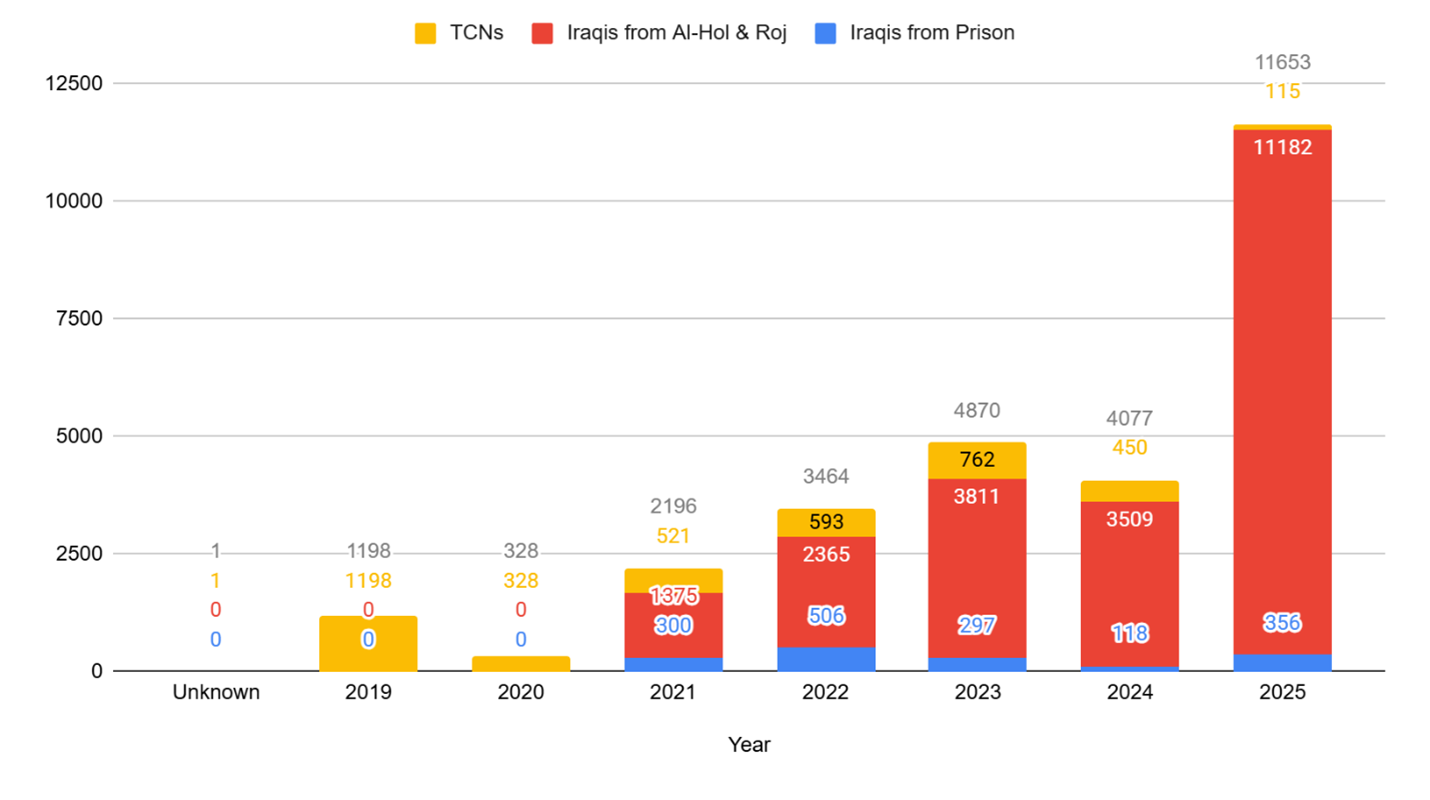
Figure 4: Formal Repatriations from Syria and Iraqr by Year from 2019-2025 (data compiled by author)
Furthermore, while Iraqi nationals once constituted the largest population in Al-Hol and made up 30 percent of those in detention facilities, that share has significantly declined. Since 2021, Baghdad has repatriated more than 23,000 of its citizens from detention facilities and detention camps, conducting 33 repatriation operations from Al-Hol alone.67 This has significantly reduced populations detained in detention facilities and detention camps, alleviating some of the security concerns that arose due to their unmanageable size.
Who is being repatriated also has impacted accountability. As most of the TCN adults repatriated are women, they are facing the highest rates of prosecution, even if most were relegated to peripheral roles under the Islamic State’s gendered system of control.68 Moreover, some states who prosecute adult women have turned to the use of core international crimes against some female defendants as nations’ counterterrorism laws failed to encapsulate their participation in the Islamic State.69 Other states such as Bosnia and Herzegovina and Kosovo have taken a different stance, choosing to never charge or give suspended sentences to adult women.70
While between 2019 and 2024 the process of TCN repatriation remained slow, the fall of the Assad regime at the end of 2024 made TCN repatriation almost stagnant. This was compounded by the fact that the end of the Assad regime, and the rise of new interim President al-Sharaa, also created an opening for the incoming Trump administration to pursue withdrawing U.S. forces from Syria, an objective from its first term. To achieve this aim, the Trump administration cut funds to counter-Islamic State activities, pushed the United Nations to take over administrative oversight of Al-Hol and Roj camps, encouraged reconciliation between the SDF and Damascus, and called for the new Syrian government to join the Coalition—which it eventually did.71
But the Trump administration also wanted Damascus to assume responsibility for Islamic State detention sites, despite it clearly lacking both the capacity and political willingness to do so. Detention sites were seemingly caught in the middle, and the result was chaos.72 In early January 2026, after almost a year of failed talks between Damascus and the SDF, the Syrian army proceeded into the long Kurdish-controlled parts of the northeast of Syria. Rampant disinformation and violence between the factions led to disorder, in an area holding thousands of Islamic State-affiliated fighters and their families.73
Despite an agreement for the SDF to handover the detention sites to Damascus, early clashes led to a prison break on January 19, 2026, at a detention facility near the town of Shadadi, with both the SDF and Damascus pointing fingers and deflecting blame, prompting fears of further escapes.74 While many of those who escaped were recaptured, to mitigate future threats between January 21 and February 13, CENTCOM transferred 5,700 adult men from detention facilities in northeast Syria to Iraq, including Syrians, Iraqis, and TCNs.75
Concurrently, on January 20, after an hours-long break in control after the SDF retreated, the Syrian army took control of Al-Hol camp. During this time, disinformation swelled, centering on who was being held in the camp,s which at the end of 2025 was 15,000 Syrians, though Al-Hol also held around 2,300 Iraqis and 6,000 TCNs.76 Over the course of a chaotic few weeks at the end of January into early February, Al-Hol’s population was emptied, with many of the 20,000 individuals previously held in Al-Hol unaccounted for. The responses of the United Nations, the Coalition, the SDF, and the Syrian government have been mostly to point fingers, deflect blame, and seemingly move on. As for Damascus, which was long reluctant to take control of Al-Hol, over the last year questions emerged over if the government even defined those 20,000 held in Al-Hol as part of the counter-Islamic State mission.77
Today, all that is known to remain of the northeast Syrian detention network is Roj camp with approximately 2,500 primarily third-country women and minors. Information surrounding those previously held in the two youth rehabilitation centers remains murky.
What Comes Next?
As this article has highlighted, the chaos that emerged in northeast Syria at the start of 2026 was both predictable and preventable, and was the result of many of the counterterrorism decisions—or lack thereof— made by the Coalition, its partners in the region, and the international community as a whole. For those studying indefinite detention over the past seven years, the consequences of neglect were clear. Now, international actors face three central questions: What comes next for these populations? What does this mean for the threat posed by the Islamic State? And what should the international community do about it? As with the detention system itself, the issue must be broken into categories: male detainees to Iraq, those missing from Al-Hol, the future of Roj, and questions surrounding missing teenage boys.
First, the Coalition’s transfer of 5,700 male detainees from Syria to Iraq—including not only Iraqi citizens but also Syrians and third country nationals—and the announcement that Iraq will prosecute those transferred, is deeply controversial.78 While the move reflects the genuine security concerns of the Coalition, it also raises human rights criticisms, including Iraq’s rapid trials, high conviction rates, and use of the death penalty. Moreover, reports have emerged that roughly 150 minors were among those transferred.79 For example, Iraq has already returned a minor from Finland who it decided not to prosecute; the Finnish embassy has noted that the minor was brought as a child to Syria and ended up in Al-Hol, before later being brought to Iraq as part of the 2026 transfers.80 t
The detainee transfers come as Iraq already faces overcrowded prisons, sectarian tensions, and a history of prisons serving as incubators for the Islamic State. Iraq also has a history of prison breaks including during the “breaking the walls” campaign in 2012 to 2013, which helped the Islamic State resurge before declaring its caliphate.81 Moreover, current regional instability—particularly tensions with Iran—has heightened concerns, with airstrikes reported near detention facilities holding Islamic State detainees in Baghdad, setting off fears of more escapes.82 Such an event could trigger serious security implications, not only for Iraq, but it could also once again help the group redevelop its networks.
Questions also remain about those left behind: While the Coalition long cited 9,000 detainees in Syria, only 5,700 were transferred. Those left behind likely include women, minors, and those unable to be moved due to being sick or injured. They also indicate that the SDF could have inflated the numbers of those held in detention facilities or conflated political detainees with those associated with the Islamic State. The move raises real concerns that international actors are again deferring responsibility to increasingly unstable Iraq, even if unlike the SDF it has formal legal authority to investigate and prosecute detainees.
Second are the approximately 20,000 individuals formerly held in Al-Hol, now reportedly “at large” according to U.S. intelligence services.83 The lack of transparency surrounding the camp’s rapid emptying poses risks to both regional stability and the individuals themselves.84 This population—largely women and children, including around 6,000 TCNs—represents a wide spectrum of experiences, from victims of the Islamic State to committed adherents to somewhere in between, a tension that continues to hinder effective policy responses.
Reports suggest many former Al-Hol residents have relocated within Syria, particularly to Idlib and Aleppo.85 Addressing these populations is particularly challenging, and compounded by the limited capacity and unclear policies of the Syrian government—within whose territory this population has disappeared—to find, detain, adjudicate cases, or otherwise manage individuals previously held in Al-Hol. For those who remain in Syria, Damascus views those that escaped Al-Hol as a humanitarian rather than security issue,86 and has yet to establish mechanisms for documentation, tracking, repatriation, prosecution, or reintegration. Moreover, the lack of a post-detention framework for former Al-Hol residents—especially children—leads them to face risks of trafficking or engagement with extremist networks.u
For those who did remain in al-Hol—only a few hundred Syrians and Iraqis—were either repatriated to Iraq or transferred to a repurposed camp for IDPs in Akhtarin, Aleppo province. Early reports of gaps in healthcare, protection, and assistance highlight the Syrian government’s limited capacity to manage these populations, let alone those unaccounted Al-Hol populations.87 As international actors continue to avoid responsibility for their own citizens, compounding Syria’s ability to address this problem, the likely outcome is both a humanitarian crisis and a more diffuse, harder-to-track security threat, in an evolving security environment, and one in which the new Syrian government appears to be preoccupied with other important matters.
Still others who escaped Al-Hol may seek to return home or move across borders. Such mobility follows well-established patterns among foreign fighters and their families of either seeking to return home or moving to different theaters of instability. For example, among the TCNs that escaped Al-Hol was Albanian Eva Dumani, now 21, who was brought by her father to Syria when she was nine, as well as an unnamed Belgian woman who returned to Belgium in February 2026 and was arrested upon arrival.88 For others who choose to return to their countries of origin, a previous lack of proactive planning for such events could lead to devastating consequences.
Notably, the collapse of indefinite detention risks feeding into Islamic State narratives that emphasize endurance, liberation, and the strategic importance of detention sites. Prisons have played a central role in the group’s evolution—serving as sites of recruitment, networking, and operational consolidation. The sudden dispersal of these populations, without a framework for accountability or monitoring, complicates efforts to track residual networks and the ability to assess the group’s capacity to regenerate. After almost two years of silence, the Islamic State’s spokesman Abu Hudhayfa al-Ansari released a new speech on February 21, 2026, in honor of Ramadan, in which among other things called on Islamic State fighters to continue to target the new “apostate” government in Damascus. That said, the collapse of indefinite detention—at the hands of someone other them themselves—does not appear to be a windfall for the group, at least not yet. The threat posed by the Islamic State is nowhere near what it once was, but it is not gone, especially as thousands remain unaccounted for and thousands more remain detained in Iraq and Syria.
The future of two additional groups remains unclear. The first is the population in Roj, which still holds around 2,500 TCNs. Although Damascus announced plans to close both al-Hol and Roj, the timeline for Roj remains unclear.89 Again, the counterterrorism decisions made by the Coalition and its partners in the region have had reverberating implications. Many states with citizens in Roj still remain reluctant to repatriate their citizens either due to political reasons or a dearth of counterterrorism laws that consider women’s roles within the Islamic State. Without a clear plan, the future for those in Roj will likely be similar to those who were at Al-Hol.
The second group consists of teenage boys, potentially up to 1,000, whose whereabouts are uncertain. Some were reportedly transferred to Iraq, while others from youth “rehabilitation” centers such as Houri and Orkesh may have been moved to Panorama detention facility—which the SDF is reportedly still controlling—or reunited with family members in Roj. Teenage boys, already a vulnerable population, remain unaccounted for. Teenage boys should be treated as victims, though not without acknowledging potential security risks. One issue that has arisen is that most in the international community have only focused on their security risk, which oversimplifies a complex reality shaped by coercion, age, and lived experience under the Islamic State and then indefinite detention under the consequences of counterterrorism decisions made by the Coalition and its partners.
As this study has explored, many of the counterterrorism decisions made by the Coalition and the international community—including continued indefinite detention and a reluctance to repatriate—had secondary and tertiary implications that make the Islamic State threat today more disperse and harder to combat. Moreover, the current security environment provides plenty of excuses to focus on other important issues. Faced with these facts, the international community faces a crossroad. Despite a clear inclination of the international community to move on from this chapter, such a decision could have devastating consequences. Formerly detained Islamic State-affiliated individuals are at large in Syria, while others have crossed its borders to unknown places. Others face humanitarian hurdles and are at risk of trafficking or radicalization. Still others are held in prisons in Iraq at risk of another breakout event. A clear and coordinated international effort remains essential to counter the Islamic State, as the group has—and will continue—to exploit breakout events and turn to its supporters to rebuild and expand its networks. CTC
Dr. Devorah Margolin is the Blumenstein-Rodan Senior Fellow at The Washington Institute for Near East Policy and an Adjunct Professor at Georgetown University and Pepperdine University. Her research primarily focuses on terrorism governance, the role of propaganda and strategic communications, countering/preventing violent extremism, and the role of women and gender in violent extremism. She is the co-editor of Jihadist Governance and Statecraft (The Washington Institute for Near East Policy, 2024). X: @DevorahMargolin
© 2026 Devorah Margolin
Substantive Notes
[a] Detention facilities primarily held adult men and teenage boys presumed to be fighters of the Islamic State, while detention camps mostly held women and children presumed to be family members of Islamic State fighters. Together referred to as detention sites, this encompasses both detention facilities (sometimes referred to as prisons by news sources) and detention camps (sometimes referred to as Internally Displaced Person camps). However, due to presumed affiliation with the Islamic State, all detention facilities and detention camps were closed, meaning that individuals could not freely leave. Moreover, most individuals held in detention facilities and detention camps in northeast Syria—including Iraqis and Third Country Nationals (TCNs)—have been held without charge, trial, or legal standing.
[b] Third Country Nationals (TCNs) refers to individuals from around the world (specifically from outside of Syria and Iraq) who traveled to join jihadi groups in Syria and Iraq. Today, some TCNs include individuals born under the Islamic State or while in detention to parents who are TCNs.
[c] The attacks also led to the death of 77 prison employees, 40 SDF personnel, four civilians, and 374 Islamic State affiliates (including at least two minor boys). See “Operation Inherent Resolve Lead Inspector General Report to the United States Congress January 1, 2022-March 31, 2022,” U.S. Department of Defense, May 3, 2022, pp. 18-19; “Northeast Syria: Fate of Hundreds of Boys Trapped in Siege Unknown,” Human Rights Watch, February 4, 2022; Jane Arraf and Sangar Khaleel, “Teenage Inmates Found Among the 500 Dead in Syria Prison Attack,” New York Times, January 31, 2022; “Sixteenth report of the Secretary-General on the threat posed by ISIL (Da’esh) to international peace and security and the range of United Nations efforts in support of Member States in countering the threat,” S/2023/76, United Nations Security Council, February 1, 2023.
[d] In 2024, after allegations of humanitarian abuse were made by Amnesty International, General Mazloum of the SDF told CNN, “Instead of these organizations condemning what we are doing and calling it human rights violations, these organizations should give us help when it comes to our program that we have in place for years.” See Brent Swails, Clarissa Ward, and Mohammad Hasan, “‘In prison because of our parents’: Children of ISIS fighters coming of age in detention ask what they’re being punished for,” CNN, June 11, 2024.
[e] For example, between 2019 and January 2022, detainees were only able to communicate externally via the Red Cross. However, this was suspended after the January 2022 Panorama detention facility attack. See “Operation Inherent Resolve Lead Inspector General Report to the United States Congress April 1, 2022-June 30, 2022,” U.S. Department of Defense, July 29, 2022.
[f] The majority of the women who were detained in detention facilities were held in sites run by the DAANES, while only around a handful of women were held in SDF-run facilities. See “Aftermath: Injustice, torture and death in detention in north-east Syria,” Amnesty International, April 17, 2024; Fionnuala Ní Aoláin, “Position of the United Nations Special Rapporteur on the promotion and protection of human rights and fundamental freedoms while countering terrorism on the human rights of adolescents/juveniles being detained in North-East Syria,” United Nations Office of the High Commissioner of Human Rights, May 2021; and “Operation Inherent Resolve and Other U.S. Government Activities Related to Iraq & Syria October 1, 2024-December 31, 2024,” U.S. Department of Defense, February 19, 2025.
[g] Panorama detention facility was purpose-built in Hasakah by the U.S.-led Coalition, replacing a makeshift prison on the same site.
[h] While Sini Detention facility used to hold almost 4,000 detainees, by August 2023, only approximately 800 detainees remained. At the end of 2025, most detainees—around 4,500, including around 600 teenage boys and young men detained as minors—were held at Panorama detention facility. Data provided by SDF, August 2023, on file with Amnesty International. “Aftermath: Injustice, torture and death in detention in north-east Syria;” Ghaith Alsayed, “U.S. military transfers first 150 Islamic State group detainees from Syria to Iraq,” PBS/Associated Press, January 21, 2026.
[i] “People’s Defence Courts” prosecuted more than 8,000 Syrians for both allegedly being connected to the Islamic State or for having committed crimes under the DAANES. See “Report of the Commission of Inquiry on Syrian Arab Republic to the 54th regular session of the Human Rights Council,” A/HRC/54/58, United Nations Human Rights Council, August 14, 2023; “Arbitrary Imprisonment and Detention – Report of the Commission of Inquiry of the Syrian Arab Republic,” A/HRC/46/55, United Nations Human Rights Council, March 11, 2021.
[j] For example, since 2019 the Coalition has acknowledged the movement of at least 1,600 Iraqi detainees from detention facilities in northeast Syria to Iraq. See “Operation Inherent Resolve Lead Inspector General Report to the United States Congress” quarterly reports and the author’s data on repatriation.
[k] For example, over the years the SDF, with Coalition support, sought to biometrically enroll all the populations held in detention facilities, with attempts to enroll these populations failing in 2021, 2022, and 2023. See “Operation Inherent Resolve Lead Inspector General Report to the United States Congress April 1, 2021-June 30, 2021,” U.S. Department of Defense, August 11, 2021, p. 73; “Operation Inherent Resolve Lead Inspector General Report to the United States Congress October 1, 2022-December 31, 2022,” U.S. Department of Defense, February 7, 2023; “Operation Inherent Resolve and Other U.S. Government Activities Related to Iraq & Syria October 1, 2023-December 31, 2023,” U.S. Department of Defense, February 9, 2024.
[l] While Houri held TCNs and Syrians, Orkesh only held TCNs. See “Operation Inherent Resolve Lead Inspector General Report to the United States Congress January 1, 2021-March 31, 2021,” U.S. Department of Defense, May 2, 2021; “Report of the Commission of Inquiry on Syrian Arab Republic to the forty-eighth regular session of the Human Rights Council,” A/HRC/48/70, United Nations General Assembly, August 13, 2021; “Aftermath: Injustice, torture and death in detention in north-east Syria,” p. 125; “Punishing the Innocent.”
[m] After backlash over the SDF policy to move minors from detention camps into adult detention facilities, the SDF began to move younger boys to “rehabilitation centers.” See Devorah Margolin and Gina Vale, “In the Shadow of the Caliphate: A Decade of Islamic State Gendered Violence,” CTC Sentinel 17:7 (2024); “Fourteenth report of the Secretary-General on the threat posed by ISIL (Da’esh) to international peace and security and the range of United Nations efforts in support of Member States in countering the threat,” S/2022/63, United Nations Security Council, January 28, 2022; “Operation Inherent Resolve Lead Inspector General Report to the United States Congress October 1, 2021-December 31, 2021,” U.S. Department of Defense, February 8, 2021, p. 27; “Syria: Repatriations Lag for Foreigners with Alleged ISIS Ties;” Hogir Al Abdo and Bassem Mroue, “Teenagers from Islamic State families undergo rehabilitation in Syria, but future still uncertain,” Associated Press, May 30, 2023.
[n] Several camps closed after a Turkish incursion into Syria in October 2019, including Ayn Issa camp in Raqqa, which held 13,000 individuals, including a foreign annex holding approximately 250 women and 700 minors affiliated with the Islamic State. Eight hundred of these individuals fled the camp during the hostilities and remained unaccounted for. See “Operation Inherent Resolve Lead Inspector General Report to the United States Congress July 1, 2019-October 25, 2019,” U.S. Department of Defense, November 19, 2019; Ben Hubbard, Charlie Savage, Eric Schmitt, and Patrick Kingsley, “Abandoned by U.S. in Syria, Kurds Find New Ally in American Foe,” New York Times, October 13, 2019.
[o] For example, in 2019, when discussing reluctance to repatriate detained individuals, the European Union’s counterterrorism coordinator referred to the children of Islamic State-affiliated individuals as “the next generation of suicide bombers.” See H.J. Mai, “Why European Countries Are Reluctant To Repatriate Citizens Who Are ISIS Fighters,” NPR, December 10, 2019.
[p] The author would like to thank Michelle Fan and Gabriel Wein for their research assistance in helping maintaining this dataset over the years.
[q] The remaining 8.5 percent were not identified by age or gender. See dataset created and maintained by the author.
[r] The vast majority of cases of repatriation occurred from Syria. However, a handful of recorded cases were repatriated from Iraq in 2019.
[s] For example, after years of wrongful detention under the Assad regime, feelings of detention—specifically of women and children—were heated. See “Syrian President Sharaa grants amnesty giving partial reprieve to convicted criminals,” New Arab, February 19, 2026.
[t] It remains unclear how the minor came to be included in the transfer to Iraq, raising questions about whether he was transferred from a youth “rehabilitation” center or from an adult facility.
[u] Syrian security forces told Le Figaro that it arrested a 14-year-old boy (before January) who was previously in Al-Hol on his way to carry out an attack for the Islamic State. See Margaux Benn, “The Lives in Limbo of Families Freed from Syria’s Al-Hol Camp,” Figaro, March 12, 2026.
Citations
[1] Devorah Margolin and Joana Cook, “From Bad to Worse in Northeast Syria,” Foreign Policy, February 25, 2026.
[2] “U.S. Forces Complete Mission in Syria to Transfer ISIS Detainees to Iraq,” U.S. Central Command, February 13, 2026.
[3] “Arbitrary Imprisonment and Detention – Report of the Commission of Inquiry of the Syrian Arab Republic,” A/HRC/46/55, United Nations General Assembly, March 11, 2021; “Fifteenth report of the Secretary-General on the threat posed by ISIL (Da’esh) to international peace and security and the range of United Nations efforts in support of Member States in countering the threat,” S/2022/576, United Nations Security Council, July 26, 2022; “2022 Country Reports on Human Rights Practices: Syria,” U.S. Department of State, Bureau of Democracy, Human Rights, and Labor, March 20, 2023.
[4] Charlie Winter and Abdullah Alrhmoun, “A Prison Attack and the Death of its Leader: Weighing Up the Islamic State’s Trajectory in Syria,” CTC Sentinel 15:2 (2022).
[5] Devorah Margolin, “Syria Crisis Leaves Islamic State Prisons and Detention Camps Vulnerable,” Washington Institute for Near East Policy, December 9, 2024; Devorah Margolin, “Setting Expectations with Syria on Countering the Islamic State,” Washington Institute for Near East Policy, May 27, 2025.
[6] Kiriloi Ingram, “An Analysis of Islamic State’s Gendered Propaganda Targeted Towards Women: From Territorial Control to Insurgency,” Terrorism and Political Violence, 2021; Nelly Lahoud, “Empowerment or Subjugation: An Analysis of ISIL’s Gendered Messaging,” UN Women, June 2018.
[7] For more on life under the Islamic State, see the George Washington University’s ISIS Files Digital Repository at isisfiles.gwu.edu
[8] Joana Cook and Gina Vale, “From Daesh to ‘Diaspora’: Tracing the Women and Minors of Islamic State,” International Centre for the Study of Radicalisation, 2018; Joana Cook and Gina Vale, “From Daesh to ‘Diaspora’ II: The Challenges Posed by Women and Minors After the Fall of the Caliphate,” CTC Sentinel 12:6 (2019): pp. 30-45.
[9] Devorah Margolin and Charlie Winter, “Women in the Islamic State: Victimization, Support, Collaboration, and Acquiescence,” The ISIS Files, George Washington University, June 2021.
[10] Devorah Margolin and Joana Cook, “The Agency and Roles of Foreign Women in ISIS,” Center for Justice and Accountability, August 2023; Gina Vale, “Piety Is in the Eye of the Bureaucrat: The Islamic State’s Strategy of Civilian Control,” CTC Sentinel 13:1 (2020).
[11] Devorah Margolin and Gina Vale, “In the Shadow of the Caliphate: A Decade of Islamic State Gendered Violence,” CTC Sentinel 17:7 (2024); Kara Anderson, “‘Cubs of the Caliphate’: The Systematic Recruitment, Training, and Use of Children in the Islamic State,” International Institute for Counter-Terrorism, January 2016; Gina Vale, “‘Cubs in the Lions’ Den: Indoctrination and Recruitment of Children Within Islamic State Territory,” International Centre for the Study of Radicalisation, July 2018, pp. 19-22; Amy-Louise Watkin and Seán Looney, “‘The Lions of Tomorrow’: A News Value Analysis of Child Images in Jihadi Magazines,” Studies in Conflict & Terrorism 42:1-2 (2019): pp. 120-140.
[12] Arie Perliger and Daniel Milton, From Cradle to Grave: The Lifecycle of Foreign Fighters in Iraq and Syria (West Point, NY: Combating Terrorism Center, 2016).
[13] Margolin and Vale.
[14] “Punishing the Innocent: Ending Violations Against Children in Northeast Syria,” Independent International Commission of Inquiry on the Syrian Arab Republic, March 19, 2024; Fionnuala Ní Aoláin, “Gendering the Boy Child in the Context of Counterterrorism: The Situation of Boys in Northeast Syria,” Just Security, June 8, 2021; “Aftermath: Injustice, torture and death in detention in north-east Syria,” Amnesty International, April 17, 2024.
[15] “Lead Inspector General for Operation Inherent Resolve Quarterly Report to the United States Congress January – March 2019,” U.S. Department of Defense, May 7, 2019.
[16] Cook and Vale, “From Daesh to ‘Diaspora.’”
[17] “Between two fires: Danger and desperation in Syria’s Al-Hol camp,” Médecins Sans Frontières, November 7, 2022.
[18] “Operation Inherent Resolve Lead Inspector General Report to the United States Congress April 1, 2019-June 30, 2019,” U.S. Department of Defense, August 9, 2019; “Operation Inherent Resolve Lead Inspector General Report to the United States Congress July 1, 2022-September 30, 2022,” U.S. Department of Defense, November 1, 2022; Ian Moss, “Repatriating FTF and Displaced Persons from Northeast Syria,” United States Department of State, September 29, 2022.
[19] Christine Asetta, “Progress in Repatriations: How Foreign Assistance Is Addressing the Humanitarian and Security Crises in Northeast Syria: Part 1 of 2,” DipNote: Countering Terrorism, U.S. Department of State, Bureau of Counterterrorism, December 4, 2023.
[20] “Understanding the Lives of the Women, Men, and Children of Al-Hol Camp,” UN Women, October 2025; “Twelfth report of the Secretary-General on the threat posed by ISIL (Da’esh) to international peace and security and the range of United Nations efforts in support of Member States in countering the threat,” S/2021/98, United Nations Security Council, January 29, 2021; “Report of the Special Rapporteur on the promotion and protection of human rights and fundamental freedoms while countering terrorism, Fionnuala Ní Aoláin,” A/78/520, United Nations Office of the High Commissioner of Human Rights, October 10, 2023; “Operation Inherent Resolve and Other U.S. Government Activities Related to Iraq & Syria January 1, 2024-March 31, 2024,” U.S. Department of Defense, April 30, 2024, p. 28; “Operation Inherent Resolve and Other U.S. Government Activities Related to Iraq & Syria October 1, 2023-December 31, 2023,” U.S. Department of Defense, February 9, 2024; “Operation Inherent Resolve Lead Inspector General Report to the United States Congress January 1, 2023- March 31, 2023,” U.S. Department of Defense, May 2, 2023; “Seventeenth report of the Secretary-General on the threat posed by ISIL (Da’esh) to international peace and security and the range of United Nations efforts in support of Member States in countering the threat,” S/2023/568, United Nations Security Council, July 31, 2023; “Punishing the Innocent.”
[21] “Twelfth report of the Secretary-General on the threat posed by ISIL (Da’esh) to international peace and security and the range of United Nations efforts in support of Member States in countering the threat.”
[22] “Twenty-first report of the Secretary-General on the threat posed by ISIL (Da’esh) to international peace and security and the range of United Nations efforts in support of Member States in countering the threat.”
[23] “IS leader calls on fighters to free jailed members,” Deutsche Welle, September 17, 2019.
[24] Islamic State, “The Gweiran Battle,” Al Naba #323, January 27, 2022; Charlie Winter and Abdullah Alrhmoun, “A Prison Attack and the Death of its Leader: Weighing Up the Islamic State’s Trajectory in Syria,” CTC Sentinel 15:2 (2022).
[25] “Report to Congress on An Interagency Strategy with Respect to ISIS-affiliated Individuals and ISIS-related Detainee and Other Displaced Persons Camps in Syria,” U.S. Department of State, 2023.
[26] “Aftermath: Injustice, torture and death in detention in north-east Syria.”
[27] “Aftermath: Injustice, torture and death in detention in north-east Syria,” p. 144; “Syria: Repatriations Lag for Foreigners with Alleged ISIS Ties,” Human Rights Watch, December 15, 2022.
[28] Data provided by SDF to Amnesty International, August 2023, on file with Amnesty International, cited in “Aftermath: Injustice, torture and death in detention in north-east Syria,” p. 45.
[29] “Operation Inherent Resolve Lead Inspector General Report to the United States Congress April 1, 2020-June 30, 2020,” U.S. Department of Defense, August 4, 2020.
[30] “Punishing the Innocent: Ending Violations Against Children in Northeast Syria;” “Aftermath: Injustice, torture and death in detention in north-east Syria;” “Report of the Commission of Inquiry on Syrian Arab Republic to the forty-eighth regular session of the Human Rights Council,” A/HRC/48/70, United Nations General Assembly, August 13, 2021.
[31] “Aftermath: Injustice, torture and death in detention in north-east Syria,” p. 174.
[32] “United Nations Standard Minimum Rules for the Administration of Juvenile Justice (‘The Beijing Rules’),” United Nations Human Rights Office of the High Commissioner, General Assembly A/RES/40/33, November 29, 1985.
[33] “Report of the Commission of Inquiry on Syrian Arab Republic to the forty-eighth regular session of the Human Rights Council.”
[34] “Technical Visit to the Northeast of the Syrian Arab Republic: End of Mission Statement,” United Nations Office of the High Commissioner of Human Rights, Human Rights Special Procedures, July 21, 2023; “Punishing the Innocent.”
[35] “Operation Inherent Resolve Lead Inspector General Report to the United States Congress April 1, 2022-June 30, 2022,” U.S. Department of Defense, July 29, 2022.
[36] “Punishing the Innocent;” Hogir Al Abdo and Bassem Mroue, “Teenagers from Islamic State families undergo rehabilitation in Syria, but future still uncertain,” Associated Press, May 30, 2023.
[37] Margolin and Vale.
[38] “Punishing the Innocent;” Al Abdo and Mroue.
[39] “Aftermath: Injustice, torture and death in detention in north-east Syria,” p. 47.
[40] “Islamic State children in Syria face a lifetime in prison,” BBC, July 14, 2021; “Europe’s Guantanamo: The Indefinite Detention of European Women and Children in North East Syria,” Rights and Security International, February 17, 2021; Margolin and Vale; “Syria: Repatriations Lag for Foreigners with Alleged ISIS Ties.”
[41] “Syria: Humanitarian Response in Al Hol camp, Situation report No. 1,” UN Office for the Coordination of Humanitarian Affairs (OCHA) via ReliefWeb, April 2, 2019; interview, by Amensty International with deputy co-chair of social affairs in northeast Syria, and Al-Hol camp manager, September 27, 2022, Al-Hol camp. They reported there were approximately 5,000 Iraqis and 4,000 Syrians. “Aftermath: Injustice, torture and death in detention in north-east Syria.”
[42] “Fifteenth report of the Secretary-General on the threat posed by ISIL (Da’esh) to international peace and security and the range of United Nations efforts in support of Member States in countering the threat.”
[43] Lili Bayer, “EU memo raises security concerns over mass escape from IS-linked Syria camp,” Reuters, February 24, 2026.
[44] Devorah Margolin, “U.S. Funding Cuts Risk Jeopardizing Counter-Islamic State Operations,” Lawfare, June 4, 2025.
[45] “Between two fires: Danger and desperation in Syria’s Al-Hol camp,” p. 9.
[46] “Ninth report of the Secretary-General on the threat posed by ISIL (Da’esh) to international peace and security and the range of United Nations efforts in support of Member States in countering the threat,” S/2019/612, United Nations Security Council, July 31, 2019; “Syria: Humanitarian Response in Al Hol camp, Situation Report No. 4 – As of 29 May 2019,” United Nations Office for the Coordination of Humanitarian Affairs, May 29, 2019.
[47] “Lead Inspector General for Operation Inherent Resolve Quarterly Report to the United States Congress January – March 2019.”
[48] “Operation Inherent Resolve Lead Inspector General Report to the United States Congress July 1, 2025-December 31, 2025,” U.S. Department of Defense, February 17, 2026; “Understanding the Lives of the Women, Men, and Children of Al-Hol Camp.”
[49] “Understanding the Lives of the Women, Men, and Children of Al-Hol Camp.”
[50] Ibid., p. 57.
[51] Devorah Margolin, “Detention Facilities in Syria, Iraq Remain Vulnerable to Islamic State Attacks,” Washington Institute, PolicyWatch 3653, September 29, 2022; “U.S. Central Command statement on Thwarted Suicide Bomber Attack near Um Fakik Village, Syria,” U.S. Central Command, September 22, 2022.
[52] “Insomnia, nightmares, and wanting to die: Al Hol’s children,” Save the Children, April 25, 2022.
[53] “Operation Inherent Resolve Lead Inspector General Report to the United States Congress January 1, 2020-March 31, 2020,” U.S. Department of Defense, May 13, 2020.
[54] Daniel Gorevan and Kathryn Achilles, “When am I Going to Start to Live?” Save the Children, 2021; “Twelfth report of the Secretary-General on the threat posed by ISIL (Da’esh) to international peace and security and the range of United Nations efforts in support of Member States in countering the threat.”
[55] “Operation Inherent Resolve Lead Inspector General Report to the United States Congress July 1, 2020-September 30, 2020,” U.S. Department of Defense, November 3, 2020; “Report of the Commission of Inquiry on Syrian Arab Republic to the forty-eighth regular session of the Human Rights Council;” “Humanitarian Update Syrian Arab Republic – Issue 18 / November 2023 [EN/AR],” United Nations Office for the Coordination of Humanitarian Affairs via ReliefWeb, January 3, 2024.
[56] “Operation Inherent Resolve Lead Inspector General Report to the United States Congress July 1, 2025-December 31, 2025.”
[57] “Technical Visit to the Northeast of the Syrian Arab Republic.”
[58] “Operation Inherent Resolve Lead Inspector General Report to the United States Congress January 1, 2022-March 31, 2022,” U.S. Department of Defense, May 3, 2022, p. 77.
[59] Fionnuala Ní Aoláin, “Position of the United Nations Special Rapporteur on the promotion and protection of human rights and fundamental freedoms while countering terrorism on the human rights of adolescents/juveniles being detained in North-East Syria,” United Nations Office of the High Commissioner of Human Rights, May 2021; “Syria: Repatriations Lag for Foreigners with Alleged ISIS Ties;” “Technical Visit to the Northeast of the Syrian Arab Republic;” “Punishing the Innocent.”
[60] “Aftermath: Injustice, torture and death in detention in north-east Syria,” p. 21.
[61] “Operation Inherent Resolve Lead Inspector General Report to the United States Congress April 1, 2024-June 30, 2024,” U.S. Department of Defense, August 1, 2024; “Operation Inherent Resolve Lead Inspector General Report to the United States Congress July 1, 2023-September 20, 2023,” U.S. Department of Defense, November 9, 2023; “Operation Inherent Resolve Lead Inspector General Report to the United States Congress October 1, 2022-December 31, 2022,” U.S. Department of Defense, February 7, 2023.
[62] “Operation Inherent Resolve Lead Inspector General Report to the United States Congress July 1, 2025-December 31, 2025.”
[63] “CENTCOM – Year in Review 2022: The Fight Against ISIS,” U.S. Central Command, December 29, 2022.
[64] “Operation Inherent Resolve Lead Inspector General Report to the United States Congress July 1, 2025 – December 31, 2025,” U.S. Department of Defense, February 17, 2026.
[65] “Operation Inherent Resolve Lead Inspector General Report to the United States Congress July 1, 2019-October 25, 2019,” U.S. Department of Defense, November 19, 2019.
[66] “Syria: Repatriations Lag for Foreigners with Alleged ISIS Ties.”
[67] Dataset created and maintained by the author.
[68] For comparative legal responses, see “Foreign Terrorist Fighters Knowledge Hub,” International Centre for Counter Terrorism; Margolin and Vale.
[69] “Cumulative Prosecution of Foreign Terrorist Fighters for Core International Crimes and Terrorism-Related Offenses,” Eurojust, July 2, 2020.
[70] Erinda Bllaca Ndroqi, “Dealing with returned women in the Western Balkans: challenges and opportunities from a practitioner’s perspective,” European Commission Radicalization Awareness Network, European Union, August 31, 2022; Avdimetaj Teuta and Julie Coleman, “What EU Member States can learn from Kosovo’s experience in repatriating former foreign fighters and their families,” Clingendael Policy Brief, May 2020.
[71] Margolin, “U.S. Funding Cuts Risk Jeopardizing Counter-Islamic State Operations;” James Jeffrey and Devorah Margolin, “Time to Unify the Kurdish Northeast with the Rest of Syria,” Washington Institute for Near East Policy, October 7, 2025.
[72] Margolin and Cook, “From Bad to Worse in Northeast Syria.”
[73] Urooba Jamal, Faisal Ali, Zsombor Peter, and Caolán Magee “Syria updates: SDF, government trade ceasefire violation accusations,” Al Jazeera, January 19, 2026.
[74] Ghaith Alsayed, “U.S. military transfers first 150 Islamic State group detainees from Syria to Iraq,” PBS/Associated Press, January 21, 2026.
[75] “U.S. Forces Complete Mission in Syria to Transfer ISIS Detainees to Iraq,” USCENTCOM, February 13, 2026; “US says over 5,700 suspected ISIL detainees relocated from Syria to Iraq,” Al Jazeera, February 15, 2026.
[76] “Operation Inherent Resolve Lead Inspector General Report to the United States Congress July 1, 2025-December 31, 2025,” p. 29.
[77] Devorah Margolin, “Caught in the Crossfire: Islamic State Detention Sites at Risk,” Washington Institute for Near East Policy, January 22, 2026.
[78] Anne Charbord and Fionnuala Ní Aoláin, “A Legal Black Hole: Does Iraq Have the Right to Detain Prisoners Transferred from Syria?” Just Security, February 11, 2026.
[79] Sinan Mahmoud, “Dozens of minors among ISIS prisoners transferred to Iraq from Syria, judiciary authorities say,” National, February 17, 2026.
[80] “Iraq repatriates Finnish minor, US national after ISIS probe,” New Region, April 14, 2026.
[81] Tim Arango and Eric Schmitt, “Escaped Inmates From Iraq Fuel Syrian Insurgency,” New York Times, February 12, 2014; Bennett Clifford and Caleb Weiss, “‘Breaking the Walls’ Goes Global: The Evolving Threat of Jihadi Prison Assaults and Riots,” CTC Sentinel 13:2 (2020): pp. 30-40.
[82] “Iraq Fears Prison Holding ISIS Fighters Could Be Breached as Strikes Intensify Near Baghdad Airport,” Kurdistan24, March 15, 2026.
[83] Jared Malsin and Dustin Volz, “U.S. Intelligence Says at Least 15,000 at Large After ISIS Detention Camp Collapses in Syria,” Wall Street Journal, February 20, 2026.
[84] Margolin and Cook, “From Bad to Worse in Northeast Syria.”
[85] William Christou, “NGOs sound alarm as foreign families flee camp holding suspected IS members,” Guardian, February 13, 2026; Margolin and Cook, “From Bad to Worse in Northeast Syria.”
[86] Syrian Arab News Agency, “[The official spokesperson for the Ministry of Interior stated in a press conference: The humanitarian situation inside Al-Hol camp was shocking by all standards …],” X, February 25, 2026.
[87] “After years of detention former Al Hol residents face uncertain future,” Medecins Sans Frontiers, February 27, 2026; Margaux Benn, “The Lives in Limbo of Families Freed from Syria’s Al-Hol Camp,” Figaro, March 12, 2026.
[88] Arbjona Cibuku in Tirana, William Christou, and Ashifa Kassam, “‘We waited 12 years’: escapees from Syria’s camps face an uncertain future,” Guardian, April 12, 2026.
[89] “Syria to close camps housing thousands linked to Islamic State,” Reuters, January 30, 2026.
