
From the Editors
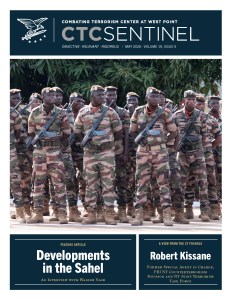
Developments in the Sahel so far this year have underscored the persistence and severity of the jihadi threat in Africa—chief among them, the January attack in Niamey, Niger, by Islamic State Sahel Province and Islamic State West Africa Province and the coordinated attacks across Mali in April by al-Qa`ida affiliate JNIM and the Tuareg rebel group Azawad Liberation Front. To better understand the strategic objectives of the groups in the region as well as their implications for the international community, we spoke with journalist and longtime analyst Wassim Nasr for the cover article of this month’s issue.
Our interview is with Robert Kissane, former Special Agent in Charge of the Counterterrorism Division of the FBI’s New York Field Office. Among other topics, the 23-year FBI veteran explains why one of his greatest concerns “is the convergence of the nation-state threat with traditional terrorism actors.”
Crispin Smith and Michael Knights provide an in-depth profile of alleged Kata’ib Hezbollah senior operative Mohammad Baqer al-Saadi who was extradited to the United States earlier this month and has been indicted for terrorism-related offenses, including attacks conducted in the name of Harakat Ashab al-Yamin al-Islamiya (HAYI). “Drawing on U.S. Department of Justice filings, open-source intelligence, archived Arabic-language social media content, and interviews with Iraqi sources,” they outline “al-Saadi’s unusually trusted position within Iran-backed militant structures,” including Iran’s Islamic Revolutionary Guard Corps-Quds Force.
Andrew Glazzard, David McIlhatton, and Paul Martin consider whether generative artificial intelligence will genuinely transform terrorist capability or if the risks are being overstated. Drawing on James J. Gibson’s theory of affordance and acknowledging that Gen AI tools “can improve the efficiency, accessibility, and scale of certain terrorist activities,” they argue there is “limited evidence that they fundamentally alter the nature of terrorism or significantly enhance operational capability.”
Akonkwa Ghislaine and Caleb Weiss offer a rare glimpse into Islamic State Central Africa Province’s (ISCAP) internal gendered structure and daily camp life through findings from almost 400 interviews conducted with returnees from ISCAP camps. “Women play a central role in sustaining the internal functioning of ISCAP,” they find. “Far from occupying purely domestic roles, women participate in governance structures, logistical operations, and demographic reproduction that enable the organization to maintain resilience despite sustained military pressure against it.”
Don Rassler and Kristina Hummel, Editors-in-Chief
