
From the Editors
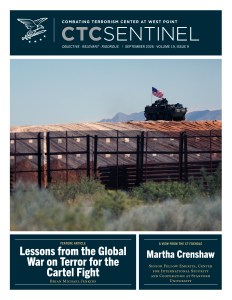
This month, the United States will mark 25 years since the terrorist attacks of September 11, 2001. That tragic day set into motion a long and arduous Global War on Terrorism, the impacts of which are still being felt today. To reflect on the lessons learned from the GWOT and how they might apply to the United States’ current fight against cartels, we turned to terrorism expert Brian Michael Jenkins who has been studying the phenomenon for more than 50 years. “While the circumstances differ significantly,” he writes, “the campaigns against al-Qa`ida and its Taliban allies, its affiliates, and its successors are instructive. They also offer some cautionary notes.”
We also sought insights from leading terrorism scholar Dr. Martha Crenshaw, whose academic career spans more than five decades. She discusses the evolution of the terrorism studies field since 9/11 and reflects on its current focus. “Over the intervening years, we have, if not eliminated, at least severely diminished, the particular threats from al-Qa`ida and ISIS. At the same time, we can always be taken by surprise,” she explains. “It’s critical to avoid complacency.”
Peter Bergen examines the long history of concern surrounding terrorist use of weapons of mass destruction in the post-9/11 years and considers whether, given the current accessibility of extraordinary technologies and capabilities, that concern is more justified today than ever before. “History suggests that terrorists could not deploy true weapons of mass destruction because the barriers to entry were so high,” he writes. “But will those barriers be lowered now that we are in the age of AI and synthetic biology?”
Sandra Pellegrini provides a data-driven overview of the shifting criminal landscape in Mexico. She finds that “between January and August 2026, non-state armed group violence decreased by 19 percent nationwide compared to the same period in 2025.” But she cautions that security operations have corresponded with uneven shifts in patterns of violence in the country, and “in some states, they have likely contributed to violence spreading or even intensified criminal competition. Elsewhere, reduction in violence likely reflects criminal adaptation rather than the dismantling of criminal organizations and networks.”
On a final note, we wish to dedicate this issue of CTC Sentinel to the memory of those we lost on September 11, 2001, and in the months and years that followed in the Global War on Terrorism. We dedicate it as well to the professionals who work daily—in a variety of capacities, in ways known and unknown—to keep us safe from terrorism.
Don Rassler and Kristina Hummel, Editors-in-Chief
