
From the Editors
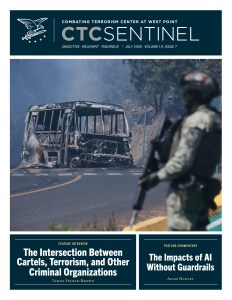
In what ways do the objectives and motivations of cartels differ from those of more traditional terrorist organizations? What lessons from the global war on terrorism are applicable to the current fight against cartels? These were among the questions we posed to Dr. Vanda Felbab-Brown, one of the leading scholars on conflict, criminal organizations, drugs, and illicit economies, for our cover article this month. “More and more,” she says, “a lot of the traditional understandings and distinctions between terrorist and criminal groups don’t hold and haven’t held for a long time.” Those distinctions have a bearing on strategies to combat cartels, as Felbab-Brown notes how “middle-layer targeting is—in my view—a far more useful strategy, promising far greater payoffs than the high-value targeting” over the longer term.
In this month’s feature commentary, the founder and executive director of Tech Against Terrorism, Adam Hadley, identifies significant gaps in AI safety that could be exploited by terrorist actors, particularly the risk of ‘abliteration’—or removal of an AI model’s capacity to refuse—on open-weight models. “The artificial intelligence safety community has largely not engaged with abliteration resistance,” Hadley writes. “Part of the reason it has not landed is that the policy conversation still assumes that all AI models are closed. When a government judges a closed AI to present a security concern, they have a control lever. The lever exists because the model runs in one place, under one operator, where it can be audited, restricted, or withdrawn. On the other hand, a frontier open-weight release with removable guardrails attracts no equivalent scrutiny before publication. It has no control lever.”
Lucas Webber, Riccardo Valle, Colin Clarke, and Daniele Garofalo trace the historical evolution of the Islamic State’s anti-China propaganda—from early Uyghur grievances through COVID-era narratives to current criticism over China’s economic expansion into Africa. “China now occupies a structurally embedded position within the Islamic State’s global enemy hierarchy,” the authors find. “Beijing is increasingly portrayed as a systemic adversary, an ascendant power whose political, economic, and security activities in Muslim-majority regions are interpreted as forms of imperial expansion.”
Finally, Francesco Marone provides important context and analysis on a string of recent nihilistic violent extremist (NVE) cases in Italy. From March to May 2026, four NVE cases across the country reveal what he describes as “the first publicly visible links of a domestic mimetic chain, unfolding over a matter of weeks.” The cases underscore that a youth can be “at the same time a vulnerable child and a potential source of serious public violence,” he writes. “Ultimately, while effective counterterrorism is essential, an even deeper challenge concerns prevention.”
Don Rassler and Kristina Hummel, Editors-in-Chief
