
Abstract: Amid the ongoing war against Iran and the systematic weakening of Tehran’s Axis of Resistance, Yemen’s Houthi movement confronts growing internal threats to its grip on power. Tribal alliances are fundamental to political authority in Yemen, a reality the Houthis recognized from their earliest days. Accordingly, they built a substructure of tribal support—through strategic intermarriage, mediation, and intelligence-driven co-option—well before seizing Sana’a in 2014. After taking power, they absorbed Yemen’s intelligence agencies and state tribal management structures, gaining vast troves of data on tribal networks, which they then weaponized to deepen their control. However, this compact was always transactional, and today it is under pressure from a failing economy, narrative fatigue, generational shifts, and leadership changes. An older generation, having accumulated wealth, now prioritizes self-preservation over the esprit de corpsthat once defined the movement. The Houthis are responding with increasingly harsh methods. Yet, they remain formidable: adaptive, battle-hardened, and with significant escalatory leverage.
The U.S. and Israeli strikes on Iran that began on February 28, 2026, are an existential threat to the Iranian-backed Axis of Resistance.1 Yemen’s Houthi rebels, also known as Ansar Allah, are now the best armed and largest force within the Axis. The fragility of the Iranian regime threatens the Houthis’ domestic order. Iranian support for the Houthis has never been limited to weapons. It has included oil shipments, cash routed through IRGC-linked intermediaries, commodities sent through shell corporations, and technical assistance. Together, these have helped sustain the Houthis’ military wing and the patronage networks that keep select tribal elite compliant. Recognizing the risks of overdependence on Iran, the Houthis have spent much of the last four years diversifying critical supply chains and revenue streams to reduce their dependence on Iran.2 However, a near or total loss of Iranian support—especially for their missile program—will intensify already mounting domestic pressures.
The Houthis’ reaction to the war highlights their current dilemma. On February 28, they threatened to resume attacks on shipping in the Red Sea and Gulf of Aden in solidarity with Iran.3 However, as of mid-March, they had not attacked targets outside Yemen.4 This restraint, by the same leaders who engaged U.S. warships in 2024 and 2025, signals a new calculation: They must now weigh whether their domestic base can withstand further escalation as Iranian support wanes.5 This change in approach underscores the profound effect the war against Iran has had on their decision-making.
One of the primary constraints on Houthi escalation is rising discontent within their tribal alliances. Yemen is not a state with tribes; it is a nation of tribes that has intermittently had a state. When former Yemeni President Ali Abdullah Saleh was asked whether Yemen had moved from tribalism to statehood, he replied: “The state is part of the tribes, and the Yemeni people are an ensemble of tribes.”6 Recognizing this dynamic, the Houthis from the outset wove themselves into the fabric of tribal society through intermarriage, mediation, patronage, and force. The key question is whether this carefully woven tapestry, crafted over three decades, can withstand current pressures; a weakened Iranian regime and the potential loss of support could accelerate its unraveling.
This article examines the Houthis’ tribal compact and the pressures threatening it. It begins by tracing how the Houthis built their substructure of tribal support through intermarriage, co-option, and the absorption of state intelligence structures. It then analyzes the five key pressure points—economic strain, narrative fatigue, generational shifts, ideological constraints, and leadership changes—that endanger that compact. The article concludes by assessing why, despite these pressures, the Houthis remain adaptive and formidable, and what their trajectory means for regional stability.
Building the Tribal Compact
The Houthis’ engagement with Yemen’s tribal system began long before they seized power. Badr al-Din al-Houthi—a respected Zaydi scholar,a father of the movement’s founder, Hussein al-Houthi, and the current leader, Abdulmalik—built a dense social network around the Zaydi revivalist movement in the 1980s and 1990s.7 Strategic intermarriage was central to this effort.b Sayyids, claiming descent from the Prophet Mohammad’s family, ruled north Yemen as imams until the 1962 republican revolution. In Yemen, sayyid men often married women from tribal and sheikhly families. The Houthi family used this tradition to build durable alliances. Badr al-Din’s sons married into prominent tribal families. Notably, they spent much of their childhoods with maternal uncles and were raised as de facto members of their mothers’ tribes.
These bonds went beyond politics. Badr al-Din reinforced these ties as a traditional sayyid notable. He mediated tribal conflicts, arbitrated family disputes, and taught youth in religious study circles. These circles later became the Believing Youth Movement, which formed the core of the Houthis (Ansar Allah).8 Badr al-Din’s reputation, combined with his sons’ tribal ties, was a strong investment in lasting relationships. By 2004, when the six Saada wars began, the Houthis had a solid substructure of tribal alliances rooted in kinship and shared family culture. Each war deepened these ties. Tribes that fought alongside the Houthis against Yemeni government forces and, in the final war of 2009-2010, against Saudi forces, developed a mutual sense of defending tribal territory. The Houthi family’s military competence, willingness to lead from the front, and role as protectors of tribal lands gave the movement legitimacy that religious teaching alone could not.9
The seizure of Sana’a on September 21, 2014, marked a turning point for these alliances: A guerrilla support network transformed into a new governing order. The Houthis capitalized on their alliance with Saleh,c whose patronage networks and tribal clients provided vital access to major tribal confederations.10 Over the next four years, the Houthis systematically co-opted tribal governance—appointing new sheikhs without consensus, imposing compliant figures by force, and granting economic concessions to collaborators. Those unwilling to comply were subjugated.11 Critically, they imposed Hashemite supervisors (mushrifeen) above tribal and state structures, overriding the authority of traditional sheikhs.12
The most significant gain, however, was institutional. When the Houthis took Sana’a, they absorbed much of Yemen’s intelligence and internal security apparatus. This included the Political Security Organization (PSO), the National Security Bureau (NSB), and the state apparatus for managing tribal relations. In addition to these organizations, the Houthis also seized decades’ worth of files on tribal networks, hierarchies, alignments, and personal vulnerabilities accumulated under Saleh’s presidency.13 Moreover, they acquired not just data but also many officers who ran the networks. Many of these men had in-depth knowledge of tribal families’ loyalties, debts, feuds, and leverage points. As the Houthis took over the agencies, some of these officers joined them or were otherwise co-opted.14 The tribal affairs files listed every sheikh’s relationship with the Saleh government: payments, disputes, and which of their sons held government posts. This information, along with the intelligence officers themselves, became key resources for the Houthis’ efforts at tribal co-option.15
The Houthis then wired compliant tribal leaders into their financial and business networks. In doing so, they repurposed many of the Saleh-era patronage structures.16 Cooperative tribal elites received access to smuggling revenues, government salaries, import licenses, and positions in the Houthi bureaucracy and military. The most favored or key tribal figures received stakes in fuel import operations and qat distribution networks. They also gained the authority to tax goods moving through Houthi territory. As a result, these arrangements made tribal leaders financially enmeshed with the Houthis, making defection costly.17 The result was a functioning tribal order that was fundamentally transactional. Most tribal elites did not embrace Houthi theology or supremacy. Instead, they were bought, coerced, or left with no alternatives. Many who refused were jailed or killed.18
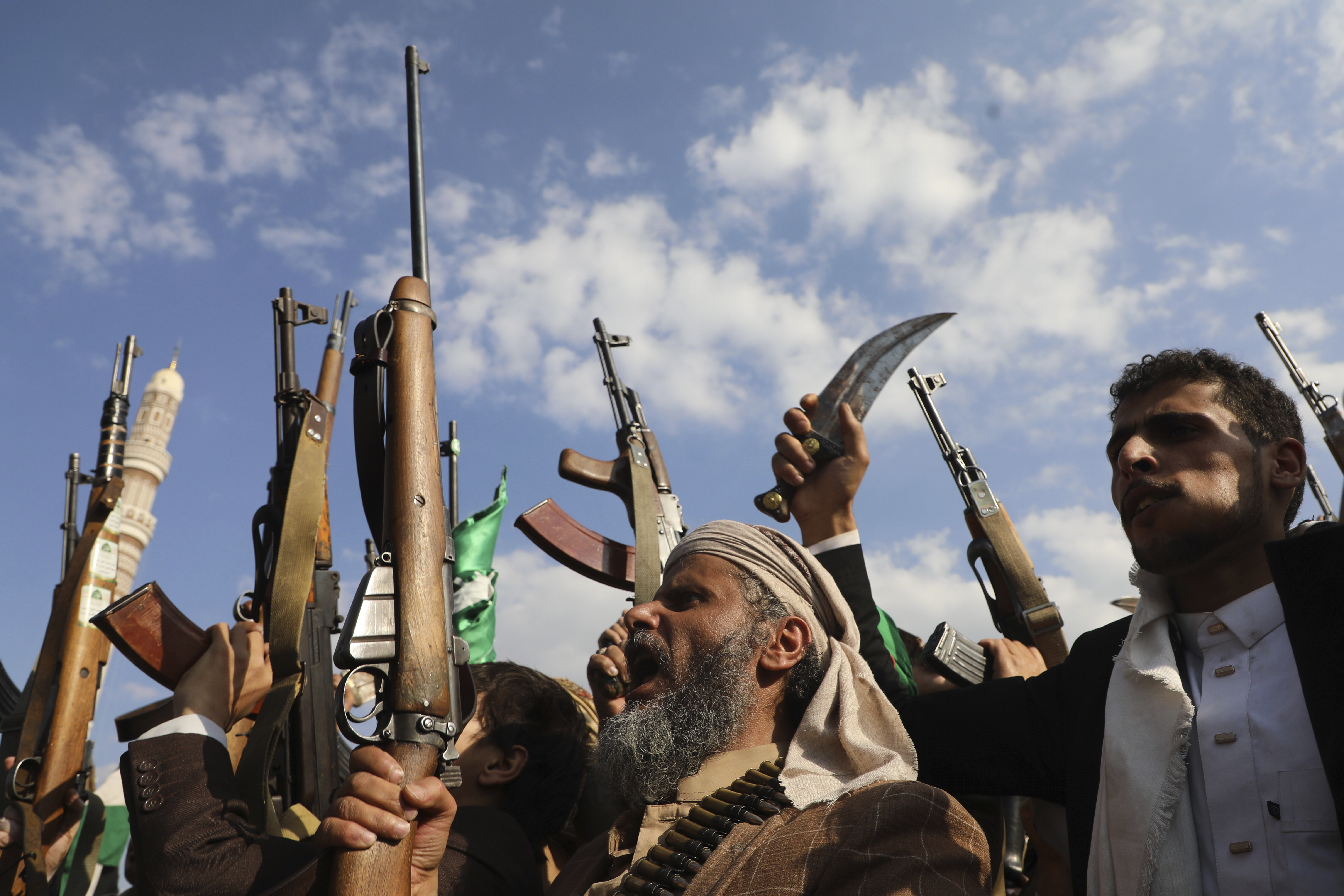
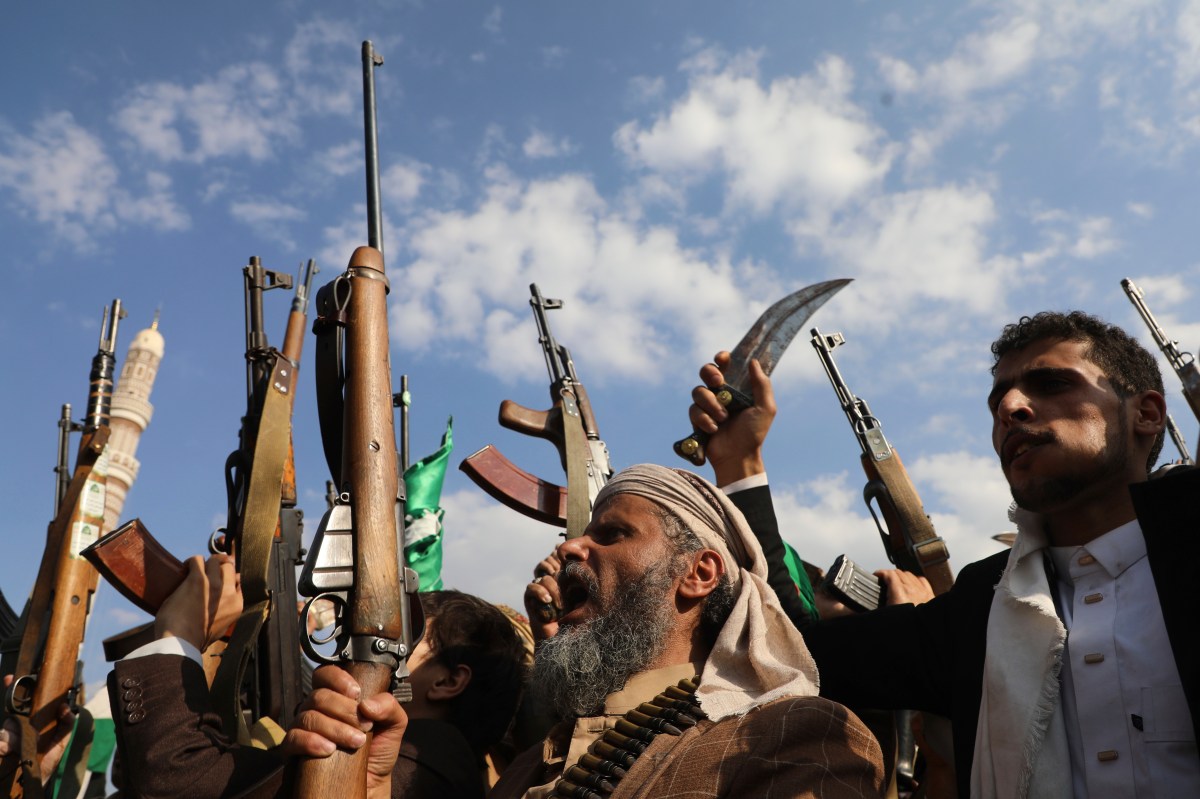
on September 12, 2025. (AP Photo/Osamah Abdulrahman)
Why the Compact Is Fraying
The Houthi tribal compact is now under strain from five key pressure points. The first is economic. Israeli strikes on ports, airports, and infrastructure have disrupted some of the revenue streams that fund the Houthis’ patronage networks. Most specifically, damage to ports and oil and refined product offloading infrastructure has reduced the Houthis’ ability to collect duties on imported oil and refined products, as well as to sell them. This damage, along with U.S. Treasury sanctions on the import of oil and refined products into Houthis-controlled ports, has had a significant impact on the Houthis’ finances, as duties on imports and the sale of refined products accounted for as much as 50 percent of their estimated income.19 Tankers continue to dock at Houthi-controlled ports, but volumes are estimated to have been reduced by half.20 Efforts by the reconstituted Yemeni Coast Guard and other Government of Yemen (GoY) forces have also begun to curtail some of the smuggling that the Houthis benefited from, both by reducing the taxes and fees the Houthis collect on smuggled goods and by reducing the weapons and materiel that supply the Houthis.21 The Houthis are attempting to compensate by diversifying their financial and procurement networks.
While the flow of Iranian-sourced and funded refined products had already declined due to greater sanctions oversight and damage to oil handling and port infrastructure in Yemen, the war with Iran and partial closure of the Strait of Hormuz will further limit the Houthis’ revenue streams at a time when the overall Yemeni economy is under severe stress. The World Bank reported in 2025 that Houthi-controlled areas are experiencing deflation and a shift toward informal barter-based transactions.22 This growth of the barter economy undermines the Houthis’ ability to collect and impose an array of taxes and fees on transactions. With the reduction in imported refined petroleum products, these taxes and fees are even more critical sources of funding for the Houthis. The Houthis’ response to funding constraints is to resort to even harsher collection methods, which include expanded property seizures and the imposition of ever-higher levies on businesses and wealthy families.23 These measures further stifle the private investment that might otherwise offset declining revenue. The result is a vicious cycle: Economic contraction drives predatory extraction, which in turn fuels barter and capital flight, deepening the contraction. The Houthis’ severe financial crisis will put further pressure on the group’s extensive and vital patronage networks. Tribal leaders, imposed or otherwise, who were bought with economic concessions may become liabilities demanding payment that the Houthis can no longer afford.
The second pressure point is narrative fatigue. The Red Sea campaign and strikes against Israel generated significant propaganda value for the Houthis from late 2023 onward.24 This allowed the Houthis to frame themselves as defenders of the Palestinians. That narrative papered over economic failure, justified wartime austerity, and drew support from tribes and political figures who had previously opposed the Houthis.25 But the October 2025 Gaza ceasefire and the costs of intermittent U.S. and Israeli retaliation have stripped the narrative of much of its power. The Houthis are now left with domestic governance and economic prosperity as the tests of their authority. They are failing at both. The war against Iran presents an additional complication. The Houthis are attempting to pivot to a solidarity-with-Iran narrative, but, so far, this lacks the mobilizing force of the Palestinian cause.26 Many Yemenis, including within the Houthis’ own tribal base, regard Iran—a Persian, majority Shi`a nation—with suspicion. Anger toward Israel remains pronounced across Yemeni society, and the Houthis can still tap into it.27 But Iran’s retaliatory strikes on Saudi Arabia, the UAE, Bahrain, Jordan, and Qatar in the current war have made it harder for the organization to cast Tehran as an ally of the Arab and Muslim street.
The third pressure point is generational, and it cuts in two directions. The Houthis have invested heavily in reshaping the ideological and cultural terrain of northwest Yemen. Youth indoctrination is a long-running first-tier priority alongside the drone and missile programs. The Houthis’ Believing Youth camps date to the 1990s, when Hussein al-Houthi and his brothers built a network of associations, sports clubs, and summer camps that funneled thousands of boys each year through Zaydi revivalist programming.28 Since 2014, this project has accelerated into an attempt to reshape Yemeni understandings of their shared history and even religious beliefs. School curricula have been rewritten.29 Mandatory ideological courses and military training are imposed on tribal leaders, teachers, and students.30 Republican symbols—including the September 26 revolution anniversary—have been systematically suppressed and replaced with Houthi and Zaydi Shi`a-oriented commemorations.31 The end goal is to produce a generation that places allegiance to the Houthis above tribal and national affiliations.
The Houthis are having some success: Many younger fighters in their ranks display a commitment to the movement’s ideology that their fathers, who were recruited through patronage rather than conviction, rarely possessed.32 But the same generation is exposed to an array of countervailing influences that, at least to some degree, undermine Houthi propaganda. Social media, which the Houthis cannot consistently block access to, gives young Yemenis a window into the prosperity of the Gulf Cooperation Council (GCC) nations and Asian countries—a prosperity the Houthis have conspicuously failed to deliver. A revivalist republican counter-ideology, amplified through social media, is gaining traction among urban youth who see the September 26 anniversary as a vehicle for expressing dissent against Hashemite rule.33
The fourth pressure point is ideological. The Hashemite claim to primacy was never universally accepted and was repudiated by the 1962 republican revolution.34 In Sunni Shafi’i-dominant areas such as Ibb, Taiz, and parts of the Tihama, the imposition of Hashemite supervisors is experienced as sectarian colonization.35 Even within Zaydi communities, the historical relationship between tribesmen and sayyids was one of negotiated reciprocity. Zaydi doctrine permits khuruj—rebellion against unjust rule—a principle the Houthis have suppressed but not erased.36
The fifth pressure point lies within the movement itself. The older generation that fought through the Saada wars has accumulated significant wealth through the war economy and rampant corruption.37 Houthi-affiliated officials have used fraudulent legal pretexts to seize state and private assets worth hundreds of millions of dollars.38 These men now have personal fortunes to protect. The esprit de corps among top-tier leaders that once defined the Houthis is no longer what it used to be. Instead, the leadership is increasingly focused on self- and regime-preservation rather than the carefully calibrated tribal management that kept the compact functional.39 The gap between what the Houthi elite extracts and what it redistributes to the tribal base is widening.
The pattern of fraying is geographically instructive. It is most visible at the periphery of Houthi control. In the border districts of Nihm, Bani Dabyan, and Arhab east of Sana’a, sporadic anti-Houthi tribal unrest persists despite years of security operations.40 Meanwhile, in the northern reaches of the Tihama coastal lowlands, where tribal and social structures were less robust, the Houthi takeover has been more seamless. However, even there, the Houthis’ pursuit of economic extraction without providing services or economic opportunity is generating resentment among lowland communities that have been marginalized for decades.41 Sana’a remains the most secure governorate in Yemen, locked down by layered concentric defenses, comprehensive surveillance, and a highly capable intelligence apparatus. But the peripheries of areas under Houthi control are increasingly vulnerable to unrest.
The evidence of simmering unrest and the harsh responses by Houthi security forces is visible across multiple governorates. On July 1, 2025, Houthi forces killed Sheikh Saleh Hantos, a prominent tribal leader in Raimah, and then detained and tortured 12 of his relatives.42 On October 28, 2025, at least 200 men, accused of being members of the Islah Party, were arrested in Dhamar on specious charges. The arrests further inflamed anti-Houthi sentiment in the governorate.43 In Taiz, Houthi militias launched raids following the defection of a loyalist tribal sheikh.44 In Ibb—where ACLED recorded 40 percent of all Houthi-controlled infighting between January 2022 and January 2025—the movement has meddled directly in tribal disputes, pitting one tribe against another to weaken resistant groups.45 The UN Panel of Experts documented at least 403 cases of arbitrary detention and enforced disappearance from August 2024 to July 2025, 306 attributed to the Houthis.46 Houthi security forces cracked down on celebrations of Yemen’s republican revolution anniversary in September 2025, making arrests across Sana’a and other areas under the group’s control.47 After the August 2025 Israeli assassination of Houthi-appointed Prime Minister Ahmed al-Rahawi, the Houthis launched internal purges due to security breaches. They demanded new oaths of loyalty from tribal figures and began detaining U.N. staff ostensibly on suspicion of espionage.48 Consequently, the World Food Program and many other NGOs suspended operations in Houthi-controlled areas.49 This created a self-reinforcing cycle: Repression drove away the humanitarian organizations that partially mitigated economic hardship, further deepening tribal resentment and prompting further repression.
Adaptive, Dangerous, and Not to Be Underestimated
Any assessment that treats the fraying of the Houthis’ tribal compact as a prelude to the movement’s collapse would be an analytical error. The Houthis have survived and evolved for more than three decades. They have outlasted six wars with the Yemeni government, a Saudi-led coalition campaign that cost Riyadh an estimated $200-300 billion USD, and U.S. and Israeli aerial campaigns, including Israeli strikes that killed their prime minister, chief of staff, and the commander of their missile and drone unit.50 They remain firmly in control of most of northwest Yemen and the majority of the country’s population.
Their resilience is partly structural. The Houthi leadership operates through a nodal system in which local commanders possess considerable authority over military operations, tribal management, and resource allocation.51 This authority does not diminish when senior leaders are killed. Instead, it increases, as decision-making devolves to commanders with deep knowledge of local terrain and tribal dynamics. The Saada wars produced a generation of such commanders. These commanders were accustomed to operating without central direction, to improvising logistics, selecting targets, and making battlefield decisions on their own authority. While many of the commanders who fought in the Saada wars are dead or now members of the Houthi elite, the organizational ethos of taking the initiative and leading from the front is alive and well among the younger generation of commanders.52 The Houthis’ nodal system mirrors what Iranian strategists call mosaic defense, which is now operational in Iran.d Israeli strikes on leadership and a decade of intermittent aerial bombardment have reinforced these approaches. In addition to nodal leadership structures, the Houthis have spent years refining their ability to conceal key hardware and assembly facilities for their missiles and drones. Many of these facilities are now located in civilian areas and in hardened underground facilities spread across much of Yemen’s mountainous northwest.53
The Houthis also retain significant escalatory leverage. They have attacked more than 130 vessels in the Red Sea and Gulf of Aden, targeted multiple sites in Saudi Arabia, and their missiles and drones have evaded Israeli air defenses on at least six occasions.54 In late August 2025, they targeted a tanker near Yanbu, Saudi Arabia’s major Red Sea crude export terminal, which handles approximately a million barrels per day—a volume set to increase as shipments are rerouted from the Persian Gulf to avoid the Strait of Hormuz.55 If pushed by the collapse of Iranian support, intensified Israeli strikes, a GoY-led offensive, and/or the loss of key leadership nodes, the Houthis may pursue a scorched earth posture.56 Such a posture would see the Houthis attack key infrastructure in and outside of Yemen. The Houthis possess both the capability and the demonstrated willingness to target Saudi and Yemeni energy infrastructure. Houthi drone strikes on Yemeni oil and gas facilities in Shabwa and Hadramawt since late 2022 have effectively shut down the GoY’s oil exports, eliminating the internationally recognized government’s only significant source of independent revenue.57 In a full scorched-earth scenario, high-value targets would include the East-West pipeline, Saudi refineries within drone range, and mothballed Yemeni facilities such as the Balhaf LNG terminal, whose destruction would further compromise any post-war economic recovery for Yemen.
The movement’s external alliances continue to expand. The Houthis have deepened their relationships with AQAP and al-Shabaab, both of which have evolved into logistical partners that help move weapons components and other materiel through Horn of Africa smuggling corridors.58 At the same time, the movement continues to develop alternative supply chains for its drone program. In August 2025, Yemeni authorities in Aden intercepted a container from China containing what investigators described as a complete drone and missile manufacturing kit.59 The Houthis are hedging against the loss of any single patron by cultivating redundant relationships across state, sub-state, and criminal networks. The result is an organization that is simultaneously more vulnerable domestically and more dangerous externally than at any point in its history.
Outlook
The Houthis know that the tribes are their foundation. The movement’s entire domestic strategy has been built on this understanding. But the compact they constructed was transactional, not ideological, and transactional compacts require ongoing payment, in whatever form it takes. Increasing financial pressures are driving more confiscatory measures that, in turn, require harsher crackdowns on anyone or any group that opposes their rule. At the same time, a generation is coming of age whose frame of reference is repression and economic hardship, not the shared sacrifice of the Saada wars or the sense of victory that accompanied the takeover of Sana’a. The ideological settlement the Houthis are attempting to impose—Hashemite supremacy enforced through a supervisory apparatus that overrides tribal custom—contradicts centuries of negotiated reciprocity between tribesmen and sayyids.60 The Houthi leadership itself is also changing. Many top-tier leaders and commanders are now wealthy, more invested in the regime and self-preservation, and likely less willing to take the risks that built the movement. And now the Iranian regime, a key backer, is being tested.
For tribal leaders across northern Yemen, these pressures are producing a calculus that has not existed in a decade. The Houthis’ ability to sustain tribal compliance has always rested on two pillars: the patronage flows that buy acquiescence and the military capabilities that deter and punish resistance. If either of these pillars is compromised, the compact weakens. If both weaken simultaneously, the instability may lead to a meaningful reordering of power in Houthi-dominated areas. Members of the tribal elite in peripheral areas watch the same indicators and likely ask: Can the Houthis still pay? Can they still punish? Are there viable alternatives to Houthi rule? For the first time in years, the answer to the third question is not an unqualified no.
The January 2026 Saudi-backed counter-offensive against a December 2025 Southern Transitional Council (STC) offensive to take over all of south Yemen restored limited GoY authority across most of southern Yemen. Critically, extensive Saudi support for the GoY demonstrated that Riyadh is again prepared to fully back the government’s security objectives.61 Ahead of and following the Saudi-backed counteroffensive, significant progress has been made toward recentralizing chains of command within the GoY’s armed forces. The oil-producing areas of the governorate of Marib—long a key Houthi objective and essential to the organization’s economic viability—remain under GoY control. The prospects of a successful Houthi offensive to seize the governorate are lower than at any point since the 2020-2021 drive.62 The GoY continues to face serious challenges: fragmented authority, limited revenue, corruption, and dependence on external patrons. But the GoY is, for now, on a trajectory toward greater capability. For tribal leaders weighing their options, a positive trajectory may matter as much as the present capacity. The answers to all three questions are shifting—slowly, but measurably—against the Houthis.
Yet, the Houthis are also more sophisticated than ever. Their supply chains are diversifying. Their alliances with AQAP and al-Shabaab provide redundant logistics and new sources of intelligence and leverage. Their security apparatus gives them granular control over tribal networks that any successor regime would struggle to replicate in the short- and medium-term. And their escalatory leverage ensures that any effort to exploit their internal vulnerabilities through kinetic means carries the risk of retaliatory strikes on energy infrastructure with global economic consequences. The Houthis are weakening. But they remain dangerous in ways that constrain the options of every actor in the region.
The tapestry of tribal support on which the Houthis rely is fraying, at least at the edges. But the Houthis are not passive weavers waiting for the fabric to unravel. They are adaptive, understand asymmetric warfare, and possess escalatory leverage. The question for policymakers is not whether the Houthis are weakening. They are. The question is whether anyone can accelerate that weakening faster than the Houthis can compensate for it, and at what cost to Yemenis and the region. CTC
Michael Horton is a fellow at the Jamestown Foundation and a co-founder of Red Sea Analytics International (RSAI). He has advised senior members of the U.S. and U.K. governments and is a frequent visitor to the region.
© 2026 Michael Horton
Substantive Notes
[a] Zaydi Shi`ism, the branch practiced in the highlands of northern Yemen, differs from Jafari (Twelver) Shi`ism—the dominant form in Iran and Iraq, and the primary Shi`a tradition in Lebanon—in several important respects. Zaydis recognize only five imams, halting their line of succession at Zayd ibn Ali, the grandson of Husayn and great-grandson of the Prophet’s cousin and son-in-law, Ali. Unlike Jafari Shi`ism, Zaydi doctrine holds the imam is neither hidden nor infallible, and the office lapses when no qualified claimant rises. Theologically and legally, Zaydism sits closer to Sunni Islam than any other Shi`a school: It maintains its own legal tradition that frequently converges with Sunni jurisprudence, rejects the institutionalized use of taqiyya and the shrine veneration characteristic of Jafari practice. There is tension within the Houthi movement, and likely within the family itself, over perceived and real attempts to shift or morph Zaydism into a hybrid sect combining aspects of Zaydism with Jafari wilayat al-faqih. Wilayat al-faqih vests governing authority in a qualified jurist in the absence of a legitimate imam. The doctrine is incompatible with classical Zaydi conceptions of the imamate. The Houthis have never explicitly endorsed it but use similar language and reasoning to justify Abdulmalik’s absolute authority. The Houthis have jailed many Zaydi religious scholars, including Hashemites, who have criticized the movement’s drift toward Jafari Shi`ism. There is also a tension within the research on to what degree the Houthis have attempted to alter Zaydi doctrine. See Ebrahim Mohammad Abdo Mousi, “The Houthi Phenomenon and Their Ideological Shift from Zaidism to Shi’Ism: An Analytical Descriptive Study,” Al-Qanatir: International Journal of Islamic Studies 23:1 (2021) and Marieke Brandt, Tribes and Politics in Yemen: A History of the Houthi Conflict (London: Hurst/OUP, 2017).
[b] In the years following Hussein al-Houthi’s death on September 10, 2004, and the death of Badr al-Din al-Houthi on November 25, 2010, the Houthi family also broke with traditional practice by allowing their daughters to marry men from tribal backgrounds, a significant departure from the centuries-old norm of sayyid endogamy in which sayyid women married only within the Hashemite sada. Gabriele vom Bruck, Islam, Memory, and Morality in Yemen: Ruling Families in Transition (New York: Palgrave, 2005), pp. 139-168 documents the broader post-1962 erosion of sayyid endogamy norms, providing context for the Houthi family’s strategic exploitation of this shift in recent years.
[c] Ali Abdullah Saleh served as president of the Yemen Arab Republic (North Yemen) from 1978 and then as president of unified Yemen following the merger of North and South Yemen in 1990 until his resignation under pressure in 2012 following the Arab Spring uprisings. He spent much of his presidency fighting the Houthis across six wars in Sa’ada between 2004 and 2010. His subsequent alliance with them was one of convenience: Sidelined from power, Saleh saw in the Houthis a vehicle for reasserting influence, while they gained access to his patronage networks, tribal clients, and the loyalty of some of the military and security elements personally tied to him. With aid from Saleh, the Houthis seized Sana’a in September 2014 and drove the internationally recognized government into exile. The alliance between Saleh and the Houthis was always uneasy. Saleh retained influence in what had been the ruling party, his own party, the General People’s Congress, and maintained back-channel communications with foreign governments. By late 2017, with the war stalled and with increasing pressure from the Houthis on his family and networks, Saleh broke publicly with the Houthis on December 2 and called on Yemenis to turn against them. The Houthis responded with overwhelming force and assassinated Saleh on December 4 as he attempted to flee the capital. His death allowed the Houthis to consolidate control over Sana’a and most of northwest Yemen.
[d] Iran’s mosaic defense doctrine (defa-e mozaiki) or decentralized mosaic defense (DMD) was developed by IRGC strategists in the 2000s as a response to the perceived vulnerability of centralized command structures to U.S. precision-strike capabilities. The concept fragments military authority into semi-autonomous provincial units—likely including even smaller divisions—each capable of conducting operations independently without central approval. Iranian FM Araghchi publicly invoked the doctrine in March 2026 (“Iran’s war doctrine revealed: ‘Decentralized Mosaic Defense’ – what it means for US, Israel,” Gulf News, March 2, 2026). The Houthis’ own decentralized command structure, forged during the Saada wars (2004-2010), predates their awareness of the formal Iranian concept but mirrors the same logic. See Marek Adam Brylew, “Basij-Iranian Militia as an Element of ‘Mosaic Defense’ and the Guarantee of the Islamic Regime,” Journal of Modern Science 62:2 (2025): pp. 529-551.
Citations
[1] Sanam Vakil et al., “US and Israel attack Iran, killing Khamenei: Early analysis,” Chatham House, February 28, 2026.
[2] Michael Horton, “Looking West: The Houthis’ Expanding Footprint in the Horn of Africa,” CTC Sentinel 17:11 (2024); Peter Salisbury, Henry Thompson, and Veen Ali-Khan, “From Smugglers to Supply Chains: How Yemen’s Houthi Movement Became a Global Threat,” Century Foundation, February 9, 2026.
[3] “Iranian-backed Houthis Say They’ll Resume Attacks on Israel and on Shipping Routes,” Times of Israel, February 28, 2026.
[4] “Why Yemen’s Houthis are staying out of Israel-US fight Iran for now,” Al Jazeera, March 7, 2026.
[5] Edward Beales and Wolf-Christian Paes, “Operation Poseidon Archer: Assessing one year of strikes on Houthi targets,” International Institute for Strategic Studies, March 18, 2025.
[6] Gabriele vom Bruck, Islam, Memory, and Morality in Yemen: Ruling Families in Transition (New York: Palgrave, 2005), p. 9.
[7] Marieke Brandt, Tribes and Politics in Yemen: A History of the Houthi Conflict (London: Hurst/OUP, 2017), pp. 131-150; Barak Salmoni, Bryce Loidolt, and Madeleine Wells, Regime and Periphery in Northern Yemen: The Huthi Phenomenon (Santa Monica, CA: RAND, 2010), pp. 98-107.
[8] See Salmoni, Loidolt, and Wells, pp. 216, 254.
[9] See Brandt.
[10] “Entrenched Power: The Houthi System of Governance,” Yemen Review, Sana’a Center for Strategic Studies, June 2022; “The Houthi Supervisory System,” ACAPS, June 2020.
[11] “The Myth of Stability: Infighting and Repression in Houthi-Controlled Territory,” ACLED, February 2021.
[12] “Power in Yemen: From Formation to Appropriation,” Middle East Council on Global Affairs, July 2024.
[13] Michael Horton, “Yemen’s Fragmented Future,” Jamestown Foundation, February 28, 2023.
[14] Author interviews, multiple former members of the Yemeni government, November 2025.
[15] See Brandt.
[16] “Entrenched Power;” author interviews, multiple former members of the Yemeni government, November 2025.
[17] Peter Salisbury, “Yemen: National Chaos, Local Order,” Chatham House, December 2017.
[18] Maysaa Shuja Al-Deen, “The Houthi Tribal Conflict in Yemen,” Carnegie Endowment for International Peace, April 23, 2019.
[19] “Final Report, S/2025/807,” UN Panel of Experts on Yemen, October 15, 2025; “Treasury Sanctions Houthi Illicit Oil Trading and Shipping,” U.S. Department of the Treasury, June 20, 2025.
[20] Author interview, official from the Yemeni government, January 2026.
[21] Leonardo Jacopo Maria Mazzucco, “Yemen’s Breakthrough against Iran’s Arms Smuggling to the Houthis,” Gulf International Forum, August 7, 2025; Eleonora Ardemagni, “Yemen: Counter-Smuggling is Now Key to Tackling the Houthis,” Italian Institute for International Political Studies, November 24, 2025.
[22] “Yemen Economic Monitor,” World Bank, Spring 2025.
[23] Multiple author interviews, Yemeni businessmen and government officials, February-March 2025.
[24] Gerald Feierstein, “Houthis see domestic and regional benefit to continued Red Sea attacks,” Middle East Institute, January 11, 2024.
[25] “Regional Power Struggles Fuel Simmering Tensions Across the Red Sea,” Conflict Watchlist 2026, ACLED, December 11, 2025; Horton, “Looking West,” footnote C, which documents tribes and former opponents rallying to the Houthis during the Red Sea campaign.
[26] “Houthi leader vows support for Iran, says group ready for any escalation,” Middle East Monitor, March 13, 2026.
[27] Author interview, former Yemeni government official, March 2026.
[28] Salmoni, Loidolt, and Wells, pp. 216, 254; Brandt.
[29] Manel Ghanem, “Curriculum Changes to Mold the Jihadis of Tomorrow,” Sana’a Center for Strategic Studies, Yemen Peace Forum, June 9, 2024; Michael Knights, “Assessing the Houthi War Effort Since October 2023,” CTC Sentinel 17:4 (2024).
[30] “Beyond the Battlefield: How Houthi Ideology Prolongs Armed Conflict and Obstructs Peace,” Mokha Center for Strategic Studies, December 27, 2025.
[31] “Yemen: Houthis Arrest Dozens Commemorating National Holiday,” Human Rights Watch, October 6, 2025.
[32] Author interview, a former Yemeni government official as well as a Yemen-based analyst, December 2025.
[33] Ibid.; “Yemen: Houthis Arrest Dozens Commemorating National Holiday.”
[34] Vom Bruck, Islam, Memory, and Morality in Yemen, p. 9; Gabriele vom Bruck, “Regimes of Piety Revisited: Zaydi Political Moralities in Republican Yemen,” Die Welt des Islams 50:2 (2010).
[35] Author interview, Tihama-based analyst, January 2026.
[36] Bernard Haykel, Revival and Reform in Islam (Cambridge: Cambridge University Press, 2003).
[37] “Entrenched Power;” author interviews, multiple former members of the Yemeni government, as well as members of the Yemeni Chamber of Commerce, January-March 2025.
[38] See “Treasury Sanctions Houthi Illicit Revenue and Procurement Networks,” U.S. Department of the Treasury, September 11, 2025: The Houthis use “fraudulent legal pretenses to seize state and private assets.”
[39] Author interviews, Yemen-based analysts as well as former Yemeni government officials, November 2025.
[40] “Tribes of Arhab, Nehm, and Bani Al-Harith Declare Readiness to Support the Battle to Restore the Yemeni State,” Yemen Monitor, February 2, 2025.
[41] Abduljabbar Salman and Abdulmajeed Zubah, “Yemen’s Tihama People: A Forgotten Story Under Houthi Rule,” Washington Institute for Near East Policy, July 22, 2025; Michael Horton, “Gateway to Yemen: The Battle for the Tihama,” Terrorism Monitor, July 17, 2020.
[42] “Yemen: Houthis’ Widespread Detentions,” Human Rights Watch, November 27, 2025; “Systematic Houthi Crimes Against Assassinated Cleric’s Family,” Women Journalists without Chains, July 18, 2025.
[43] “Yemen: Houthis’ Widespread Detentions.”
[44] “The Yemen Review Quarterly: July–September 2025,” Sana’a Center for Strategic Studies, October 28, 2025; “Houthi Militias Launch Raids in Taiz Following Defection of Loyalist Tribal Leader,” Yemen Online, 2025.
[45] Andrea Carboni, “A Barometer of Houthi Repression: Governance and Infighting in Ibb Governorate,” ACLED, March 4, 2025.
[46] “Final Report, S/2025/807.”
[47] “Military and Security,” Yemen Review, Sana’a Center for Strategic Studies, July-September 2025.
[48] “Yemen’s Houthis Confirm Prime Minister Killed in Israeli Strike on Sanaa,” Al Jazeera, August 30, 2025; Niku Jafarnia, “New Houthis Arrests of UN Staff,” Human Rights Watch, September 8, 2025.
[49] “WFP Suspends All Operations in Houthi-Controlled Areas of Yemen,” Yemen Online, September 2025.
[50] Bilal Saab, “Saudi Arabia eyes the exit in Yemen, but Saudi-Houthi talks alone won’t resolve the conflict,” Middle East Institute, 2020; “The U.S.-Houthi Ceasefire,” Real Clear Defense, May 22, 2025; Gregory D. Johnsen, “An Assessment of Operation Rough Rider,” CTC Sentinel 18:6 (2025).
[51] Extensive author interviews, Yemen and region-based analysts, 2023-2025.
[52] Author interviews, Yemen-based analysts, November-December 2025.
[53] Sam Cranny-Evans and Dr. Sidharth Kaushal, “Securing the Red Sea: How Can Houhti Maritime Strikes be Countered?” Royal United Services Institute, January 10, 2024; author interview, Yemen-based analysts, October 2025.
[54] “18 months of Houthi attacks on more than 100 vessels that caused 60 percent of commercial shipping to divert,” Soufan Center, July 8, 2025; Uzi Rubin, “Few Missiles, Large Strategic Impact: The Dynamics of the Houthi Missile Campaign Against Israel,” Jerusalem Institute for Strategy and Security, September 5, 2025.
[55] “Houthis launch missile at Israeli-owned tanker near Saudi port of Yanbu,” National, September 1, 2025; “Armaco evaluates Red Sea route for crude export flows,” Logistics Middle East, March 4, 2026.
[56] Author interviews, Yemen-based analysts and former government officials, March 2026.
[57] Nichols Brumfield, “Fueling Instability: Hydrocarbons, Protests, and the Limits of Yemen’s Internationally Recognized Government,” Arab Center Washington DC, November 14, 2025.
[58] See Michael Horton, “Looking West: The Houthis’ Expanding Footprint in the Horn of Africa,” CTC Sentinel 17:11 (2024); “Expanding al-Shabaab-Houthi Ties Escalate Security Threat to Red Sea Region,” Africa Center for Strategic Studies, May 28, 2025; Ardemagni, “Yemen: Counter-Smuggling is Now Key to Tacking the Houthis.”
[59] Mohammed al-Basha, “From China to Yemen: Seized Shipment Reveals Houthi Drone Factory in a Box,” Basha Report (Substack), August 7, 2025.
[60] See Shelagh Weir, A Tribal Order: Politics and Law in the Mountains of Yemen (Austin: University of Texas Press, 2007).
[61] Eleonora Ardemagni, “Riyadh takes the helm in Yemen,” Middle East Institute, February 25, 2026.
[62] Author interview, Yemen and region-based analysts, January 2025.
