
From the Editors
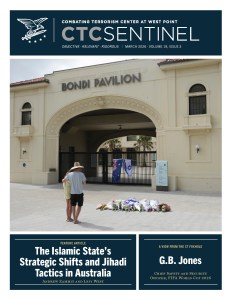
On December 14, 2025, two supporters of the Islamic State conducted the first mass casualty terrorist attack in Australia, at a Hanukkah celebration at Bondi Beach in Sydney. As Andrew Zammit and Levi West write in our cover article this month, “It was also the deadliest jihadi attack in a Western country since 2017, and the deadliest Islamic State attack targeting Jewish people in the movement’s history.” The authors outline what is known so far about the attack and then situate it in the context of over 25 years of jihadi activity in the country, “showing how it differs from earlier plots and attacks in crucial respects and what this means for the threat environment.”
Our interview is with G.B. Jones, the chief safety and security officer for the FIFA World Cup 2026. Jones, who previously served as the international security director for the National Football League, brings decades of law enforcement experience to the role, including 23 years with the FBI. “No one government has oversight of the entire footprint,” he explains of the tri-country tournament that gets underway in June. “So even as a private partner, FIFA has to be the one that’s laying over the top as the honest broker, ensuring that we’ve got all of the resources necessary from the public and the private side to fully integrate on private security and public law enforcement, fire, EMS, homeland security across the entire footprint. So, we have a much larger role than historically we’ve seen in World Cups.”
Michael Horton explores how the Houthis’ tribal alliances are fraying, particularly amid the ongoing war against Iran and the weakening of Tehran’s Axis of Resistance. The Houthis’ tribal compact, he explains, is endangered by “five key pressure points—economic strain, narrative fatigue, generational shifts, ideological constraints, and leadership changes.” “The Houthis from the outset wove themselves into the fabric of tribal society through intermarriage, mediation, patronage, and force,” Horton writes. “The key question is whether this carefully woven tapestry, crafted over three decades, can withstand current pressures; a weakened Iranian regime and the potential loss of support could accelerate its unraveling.”
Finally, Jesse Humpal reviews 50 years of extremist attacks and plots against U.S. critical infrastructure and industrial/commercial targets. Across analysis of an original open-source dataset (1970 to mid-2025), he “traces tactical evolution from arson and clandestine cells to digitally networked mobilization, firearms, and higher-casualty-risk methods.” Humpal finds “that critical infrastructure and adjacent industrial/commercial targets have become a shared battlefield for extremist movements motivated by differing ideologies.”
Don Rassler and Kristina Hummel, Editors-in-Chief
