
Abstract: The multiplication and diffusion of jihadi networks within Nigeria is an important component of the broader spread of jihadi violence from the Sahel into coastal West Africa, a trend that has caused significant international concern. Yet, an understanding of the factors that facilitate or impede jihadi expansion in Nigeria, and Africa more broadly, remains limited and often unnuanced. Drawing on extensive fieldwork and interviews with non-state actors, the authors analyze how different jihadi groups, including various factions of Nigeria’s “Boko Haram” insurgency as well as so-called “Lakurawa” militants from neighboring Niger, have each attempted to expand into northwestern, central, and southern Nigeria over the past five years. In detailing these efforts, some failed and others successful, two key trends are identified. First, jihadis tend to expand into regions that are impacted by banditry (which is rampant in rural Nigeria) yet simultaneously not dominated by any overly powerful bandit leaders. The authors dub this the “Goldilocks effect” to reflect how jihadis seek areas with an ‘optimal’ level of banditry so that they can reap certain benefits from bandits without risking confrontation with powerful warlords. Second, jihadis try to expand in areas where the commanders have existing social or religious ties, and these ties are typically more important for gaining new recruits than appeals to factional affiliation per se. The authors demonstrate this through a case study of Kogi state in central Nigeria, where both Islamic State West Africa Province (ISWAP) and Ansaru (an al-Qa`ida-aligned faction) have recruited from the same local religious networks.
In November 2024 and April 2025, respectively, Nigerian and international media reported with consternation the emergence of two new terrorist groups operating in the country’s northwestern and north-central states,a known as “Lakurawa”1 and the “Mahmuda group,”2 respectively. Neither of the groups were exactly “new,” however. Lakurawa—a local Hausa term for militants from neighboring Sahel states—had been making incursions into communities in Nigeria’s Sokoto state near the Nigerien border since late 2017, while the group led by “Mallam Mahmuda” had operated in central Nigeria near the border with Benin since approximately 2020. Indeed, when Nigerian authorities arrested Mahmuda in August 2025, marking one of the country’s biggest counterterrorism successes in recent years, the country’s national security advisor linked Mahmuda to Ansaru, an early al-Qa`ida-aligned splinter faction of Boko Haram, and said that he had been active in various groups, Nigerian and foreign, for over a decade.3
The arrests raised important questions about the evolution of jihadi violence in Nigeria and West Africa more broadly:b How are jihadi groups entering ‘new’ regions? Are Nigerian jihadi groups and groups from the Sahel converging and cooperating? How relevant are the remaining veteran commanders of the Boko Haram conflict (now in its second decade4) to dynamics today?
As this study argues, the geography of jihadi violence in Nigeria has not been confined to Borno state in the country’s northeast, the geographic origin point and longstanding locus of the Boko Haram insurgency,c for some time. Nigeria faces threats from various jihadi factions operating in far-flung corners of the country, even as the two main jihadi groups operating in the northeast have also escalated their attacks in 2025, putting hard-won military gains at risk.5
Yet to say, as most analysts do, that jihadis have “expanded” into northwestern, central, or even southwestern Nigeria—what the authors broadly refer to as “western” Nigeria for the purposes of this study—is also only partially correct. In some cases, jihadi groups from neighboring Sahelian states—the Islamic State’s Sahel Province, and Jama’a Nusrat ul-Islam wa al-Muslimin (JNIM, al-Qa`ida’s affiliate in the Sahel)—are in the process of establishing or consolidating actual contiguous stretches of free movement and influence across Nigeria’s borders, expansion in a truer sense of the word. Yet in other cases, long-dormant Nigerian jihadi cells have been reactivating in locations far removed from any other jihadi-controlled territory or simply relocating to remote patches of forest on the other side of the country. Some of these networks have had significant success in these endeavors, while others have faced setbacks. Examining these jihadi failures alongside the successes, the authors believe, offers important lessons with relevance beyond Nigeria.
This study, based on months of collaborative fieldwork across Nigeria, aims to provide a detailed assessment of the extent to which different Nigerian and Sahelian jihadi groups have either expanded into or relocated within different parts of the country over the past five years. The authors uncover a far more nuanced phenomenon at play than is sometimes depicted in media and analytical reports, although they do not downplay the risks that Nigeria faces of further and more widespread jihadi violence in the coming months and years. In particular, the authors identify two key trends that can help observers and analysts understand where jihadis find success and where they face setbacks.
Key Findings and Primary Arguments
The first finding builds on a previous study by the first author6 related to the volatile relationship between jihadis and Nigeria’s bandits, the latter a powerful and deadly set of militants who dominate swaths of rural northwestern and central Nigeria (albeit highly fragmented among dozens of gangs).d The authors find that jihadis appear cognizant of both the benefits that they can achieve by collaborating with bandits as well as the drawbacks—the benefits being financial and operational, the drawbacks being friction with territorial bandit gangs as well as reputational liability in the eyes of the rural communities in northern Nigeria whose loyalty they are trying to earn. Far from seeing bandits as a means of consolidating their insurgent hub,7 as many analysts and officials have worried for several years, jihadis have probed new areas in northwestern Nigeria and found the most amenable conditions in areas where bandits are present but somewhat weaker in their influence, suggesting that there is a “Goldilocks effect”—areas of equilibrium (some bandits, but not too many) in which jihadis can reap the benefits of banditry without as much of the attendant risk. Relatedly, the authors find that Nigeria’s jihadis rarely adopt wholly consistent approaches to banditry, in contrast to neighboring countries in the Sahel where jihadis have been largely successful in mass cooptation of local bandit networks;8 in Nigeria, the most successful jihadi groups instead aim to strike a balance between selectively cooperating with bandits for tactical gain and fighting other bandits to establish themselves as security providers for neglected rural communities. As will be shown, achieving this balance is difficult. In this regard, this study adds to a growing body of literature on the ‘crime-terror nexus’ that underscores some of the risks and liabilities that ideological insurgent movements such as jihadis may incur by working with criminals.e
The second finding reinforces the importance of what one might call the “micro-” and “meso-social” dynamics of jihadi insurgencies in shaping their trajectories of expansion. Much of the analysis on jihadi expansion in Africa focuses on “macro” factors such as porous borders,9 climate change,10 or the role of jihadi strategy at a high level,11 all of which are indeed important elements. However, the present research also underscores the extent to which jihadis typically choose to expand, relocate, or build cells in regions where their commanders have existing social ties, mirroring findings from studies of jihadi group formation, recruitment, and expansion in places such as Indonesia,12 Somalia,f and Iraq and Syria.13 g The expansionary efforts of each of the groups analyzed in this study have typically been overseen by autonomous commanders who rely on kinship, ethnicity, and other shared social networks (sometimes centered around specific mosques and Islamic schools) in their endeavors. The authors demonstrate this through a case study of Kogi state in central Nigeria, where both Islamic State West Africa Province (ISWAP) and Ansaru have tapped into an important, if long overlooked, local jihadi scene. This extremist ‘milieu’ in Kogi first emerged in the 1990s with a hyper-local agenda rooted in disputes among different Muslim sects and traditional religion worshippers, with these social networks eventually forming the backbone of respective ISWAP and Ansaru campaigns decades later. Ideological conditions in Kogi were conducive to the emergence of jihadism in the area, as both Ansaru and later ISWAP recruited from a subset of the local salafi community that was, in some ways, already quite radicalized. But the authors argue that social ties are an equally significant part of the story, as personal relationships between members of this community have persisted and, in some cases, transcended the organizational and ideological divisions that would eventually emerge in the Nigerian jihadi scene.
Structure of the Study
The study continues below with a short note on the methodological strengths and limitations of this research. It then offers a brief explanation of Nigeria’s geography and ethnoreligious complexity and how this influences jihadi expansion.
The subsequent sections of this study establish its empirical basis through five case studies of jihadi groups/networks that have operated in ‘western Nigeria’ in recent years. The five principal groups analyzed in this study are as follows:
Mahmudawa: a jihadi group led by a commander, Mallam Mahmuda (real name Abubakar Abba), who was active in Niger and Kwara states as well as parts of Benin between 2020 and 2025
JAS: Jama‘at Ahl al-Sunna li-Da‘wa wal-Jihad, the direct successor to the original “Boko Haram”h insurgency begun in 2009, led by Abubakar Shekau until his death in May 2021 and now led by Bakura Doro,i which is based in different remote corners of the northeast; the main JAS commander in the northwest is known as Sadiku.
ISWAP: the Islamic State West Africa Province (ISWAP), the strongest jihadi group in Nigeria and a provincial affiliate of the Islamic State, which first emerged in a 2015 split with Boko Haram/JAS14
Ansaru: Jama’at Ansar al-Muslimin fi Bilad al-Sudan (“Vanguard for the Protection of Muslims in Black Africa”), better known as Ansaru, an early al-Qa`ida-affiliated splinter group of Boko Haram/JAS that was active in the early 2010s and has resurfaced in northwestern and north-central Nigeria in recent years; Ansaru seems to have further factionalized in recent years, with one network being active in Kaduna state in 2020-2022 and another centered in Kogi state and southwestern Nigeria in recent years; the factions may have been in the process of reconciling as of early 2025, but there is much conflicting information on the current status of the group(s).
“Lakurawa”: the local Nigerian term for militants from Mali, Niger, and Burkina Faso, most of whom are likely affiliated with the Islamic State’s Sahel Province (ISSP) and who have been intermittently active in border regions of northwest Nigeria since 2017
In the section on Mahmuda’s group, the authors also provide a shorter analysis of JNIM (Jama’a Nusrat ul-Islam wa al-Muslimin), the al-Qa`ida-affiliated group active across the region from northern Mali to Benin that is estimated to be the most powerful jihadi group in West Africa.15 This group recently claimed its first attacks in Nigeria and appears to have ties with Mahmuda’s group, which merits a brief discussion in that section.
In the second half of the study, the authors elaborate on their key arguments regarding the factors behind jihadi expansion in Nigeria: the centrality and complexity of bandit-jihadi relations, and the importance of social and religious ties in building durable networks of expansion.
A Note on Methods
This study draws on fieldwork conducted across Nigeria and interviews with key sources who have first- or second-hand information on the dynamics in question. These sources include senior jihadi defectors, former bandits who have collaborated with various jihadis, members of communities that live under jihadi control or influence, security officials who have been tracking these groups, and individuals who have communicated with members of these groups—sometimes extensively—in the course of negotiating (e.g., the release of hostages or the defection of a senior commander), whom the authors refer to in citations as “intermediaries.”j In this effort, the research team (which includes several anonymous contributors) conducted dozens of interviews and several focus group discussions across 12 states in four of Nigeria’s six sub-national regions (geopolitical zones).k The authors also leveraged media reports, original open-source research on conflict incidents, data from the Armed Conflict Location & Event Data (ACLED), as well as propaganda published by different jihadi groups to augment the analysis. For the purposes of visualizing certain conflict incidents and armed group control, the authors also utilized conflict data collected by the Clingendael Institute and ExTrac.l
Fieldwork and primary source research on conflict are invariably difficult and pose limitations. This study references secondary literature wherever possible and insofar as such secondary sources seem reliable. However, given the fact that the expansionary efforts of the groups in this study have not been written about in extensive detail, the study relies to a large extent on original interviews and fieldwork. In many cases, the authors were able to independently interview multiple sources with first-hand knowledge of a specific jihadi commander because they had, for example, served under that commander, resided in their camp (for example, as a wife of a fighter), or were a relation or old friend of the individual.m While not without their biases or shortcomings, these sources typically provided insights that were specific, detailed, and—when multiple testimonials were compared together—corroboratory. In other cases, the authors struggled to identify sources who were as close to the key individuals in question and instead relied on sources who have interacted with jihadis but may not have as detailed information.n The authors have characterized the sources in the endnotes (while maintaining their anonymity) to give a sense of how ‘proximate’ the sources are to the individual/group in question.
The level of empirical insight into each of these groups is admittedly somewhat uneven: Some groups, such as JNIM, appear to have had an inconsistent presence in Nigeria and thus limited contact with the sources interviewed. Furthermore, the chronology of jihadi networks can be hard to establish with any certainty when relying even on the testimony of former members of these networks, as sources often struggle to remember precise dates from years ago. Consequently, the assessments of certain groups’ or individuals’ histories herein are vague in places because the authors received contradictory dates for key events, or because their sources would use organizational labels and distinctions that exist today (e.g., Ansaru and ISWAP) to refer to events that predate the emergence of such groups. While cognizant of the limitations of this research, the authors endeavor to present their best assessment of the groups in question.
The Complexity of Identities and Geography in Nigeria
Nigeria unfortunately faces a fluid and diverse array of threats from non-state armed groups, which is reflective of the country’s size and complexity. While ethnic and religious identities are as complex in Nigeria as anywhere else,o they are also inescapable in this analysis, as many armed groups have mobilized around explicit ethnic or religious grievances. Contra simplistic framings of Nigeria as a country merely divided between a Muslim north and a Christian south,16 the relationship between ethnic and religious identities is much more complex than many analysts—and apparently some jihadis—might assume. If one is to presume that the ultimate objective of jihadis is the “destruction of current Muslim societies through the use of force and creation of what they regard as a true Islamic society”17 and that jihadis seek to exploit existing social fault lines to do so,p then this ethnoreligious complexity is bound to present opportunities, but also plenty of challenges, to jihadis in these strategic efforts.
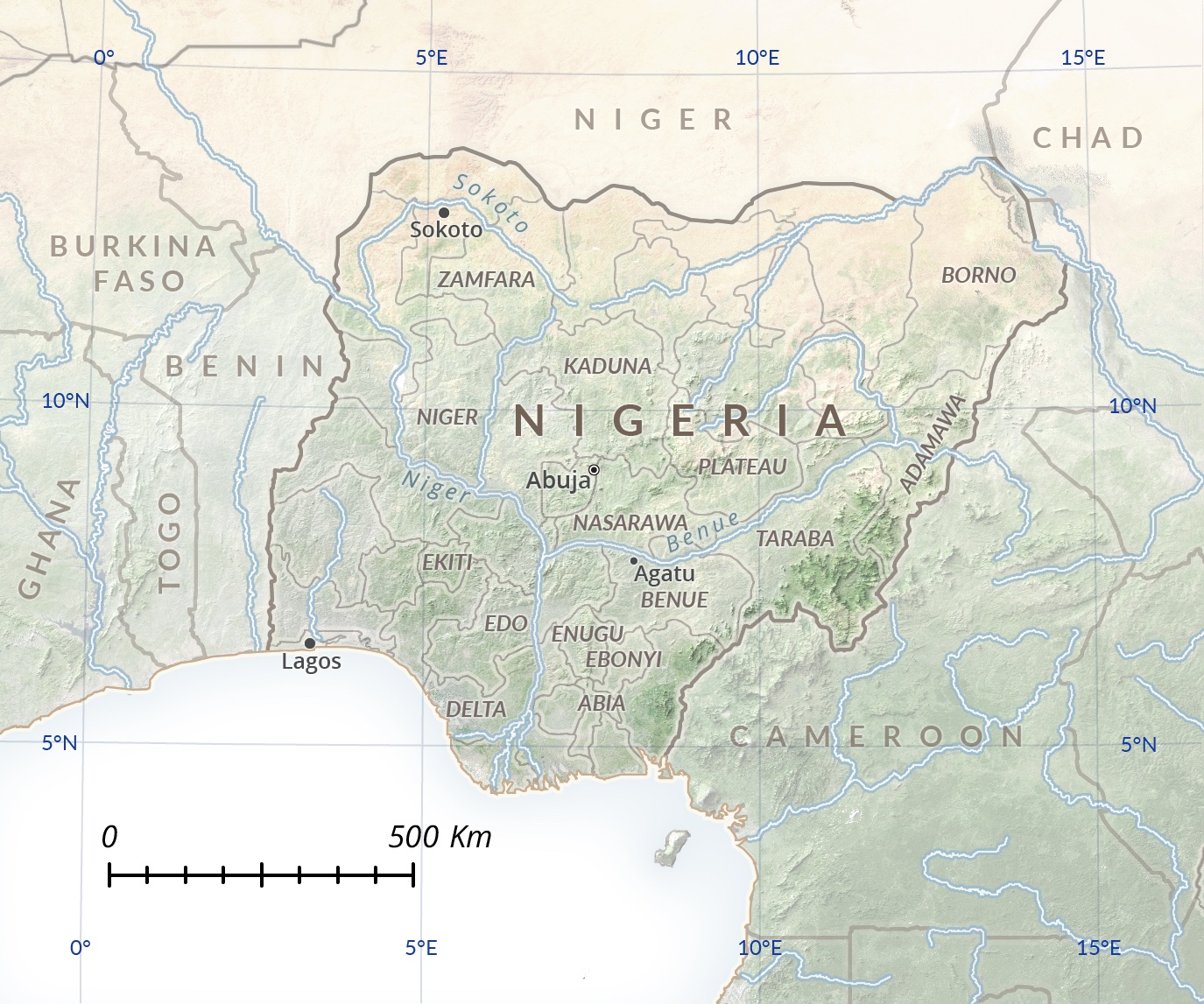
Importantly, in the northwest, many of Nigeria’s bandits are ethnic Fulani herdsmen who claim to have taken up arms as a result of the government’s neglect of pastoralist rights amid growing conflict with farming communities (these farmers typically identify as Hausa, although many other ethnic groups reside in states such as Kaduna, Kebbi, or Niger).18 This is notable insofar as Nigeria’s jihadi insurgencies have typically drawn from a different, non-Fulani ethnic base in the country’s northeast. Moreover, Nigeria’s most destructive bandit gangs largely hail from and operate in Muslim-majority areas in the northwestern states of Zamfara, Sokoto, and Katsina as well as parts of Kaduna, Niger, and Kebbi states (refer to map in previous section). Consequently, Muslim civilians constitute a sizable portion, if not the clear majority, of both the perpetrators and victims of banditry in the northwest.
As this study will show, this simple yet important fact poses a challenge to jihadi groups whose strategies rely on a population-centric insurgency aimed at winning support of vulnerable Muslim communities against the Nigerian state. This lack of shared ethnic identity and differing treatment toward northern Nigeria’s Muslim populations have, among other factors, impeded a greater degree of cooperation and convergence between Nigeria’s bandits and jihadis to date.19 By contrast, the two Sahelian jihadi groups of note, ISSP and JNIM, have both successfully exploited Fulani pastoralist grievances in Mali, Niger, and Burkina Faso and consequently recruited from those communities.20 It might stand to reason, in that case, that Sahelian groups like “Lakurawa” have had more success recruiting bandits to their cause in the course of expanding into Nigeria than Nigerian jihadis have. But as the authors will show, this has not necessarily been the case.
As such, in most northwestern states like Sokoto and Zamfara, jihadis are, to oversimplify somewhat, inserting themselves into communal conflicts between Muslim ethnicities (Hausa and Fulani). Because both communities are Muslim, jihadis should theoretically prefer to see both sides lay down their arms and join the jihadis in their fight against the Nigerian government. But if this approach does not work, as it often does not, it forces jihadis to effectively pick sides in a complex communal crisis. Because there are benefits and drawbacks to aligning with one side over another and because local conflict dynamics are fluid, jihadis in the northwest typically adopt pragmatic and flexible approaches to the banditry crisis. This forms the first key finding of this study, which the authors will demonstrate through several case studies.
Conversely, in Kogi state in central Nigeria, jihadi networks have formed as a result of intra-Muslim sectarian tension within an ethnic group (the Ebira) in which Muslims and Christians have traditionally coexisted. In other words, if in, for example, Sokoto, jihadis principally navigate ethnic divisions among Muslims, in Kogi (and, increasingly, southwestern Nigeria), they seek to accelerate and exploit religious and sectarian divisions within the same ethnic community. Ebira jihadis in Kogi have had some success in this regard, while still constituting a fringe movement within their community. Thus, despite being geographically far removed and quite socially distinct from the locus of the jihadi insurgency in the northeast, Kogi has become an important launching pad for jihadi expansionary efforts, as detailed in the penultimate section of this article.
The Mahmuda Group
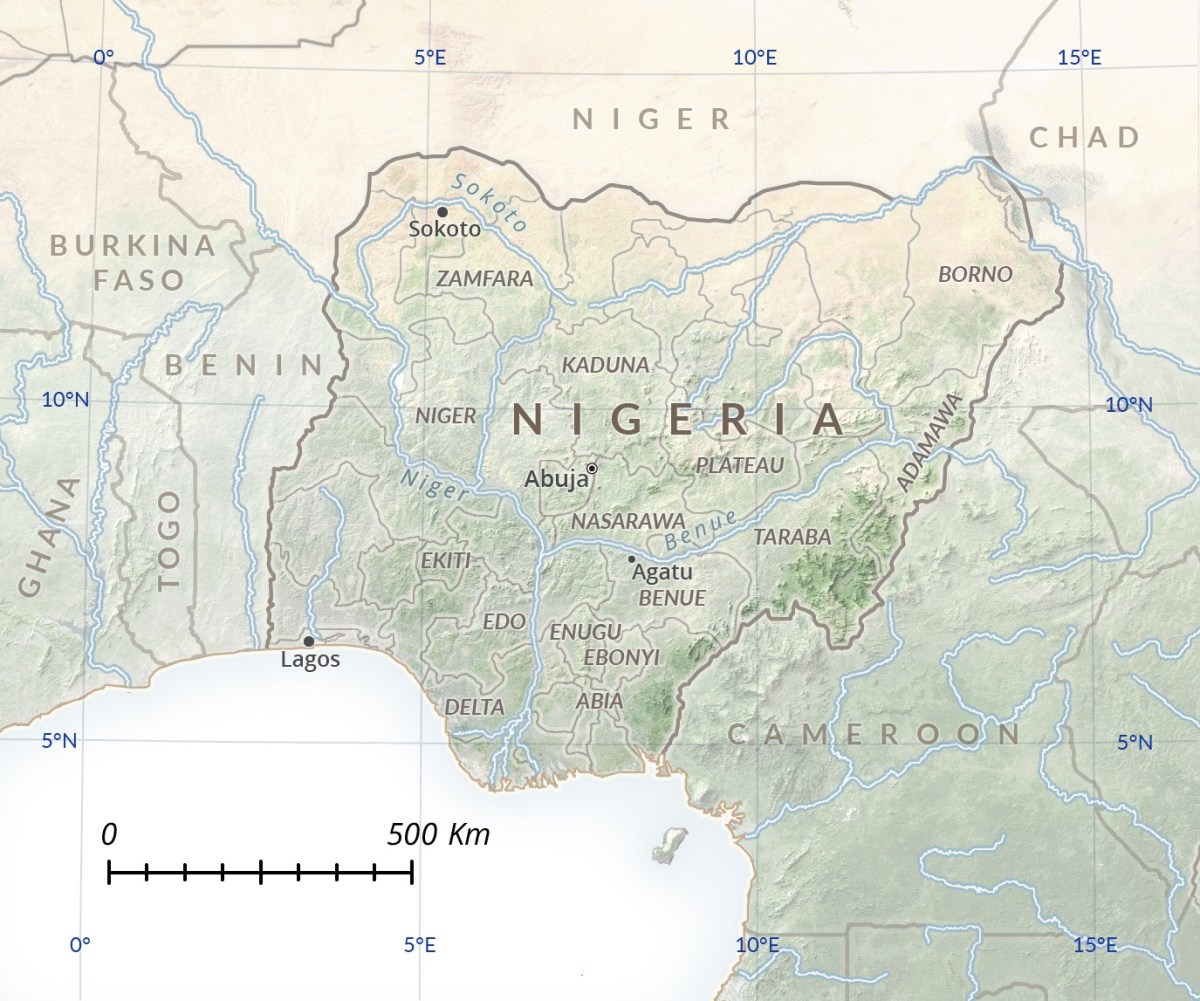
Around 2021, residents in the Borgu emirateq that surrounds Kainji Lake National Park in Niger state began to witness armed men traversing the forests outside their communities on motorbikes, occasionally stopping in villages to purchase goods and warn residents against informing the security forces of their presence.21 Locals could often tell that the militants were not bandits, as these men tended to preach diatribes against local traditional rulers and “non-Islamic” gender norms that were common to the region.r The militants did not identify themselves, but eventually, some communities began referring to the group as Mahmudawa after its leader, Mallam Mahmuda.22 Over the next few years, this group gradually moved southward from Niger state into the Kaiama and Baruten communities in neighboring Kwara state, and eventually as far south as the northern fringes of Old Oyo National Park in Nigeria’s southwest, taking advantage of the extensive forest cover connecting Niger, Kwara, and Oyo states.23 (See Figure 2.)
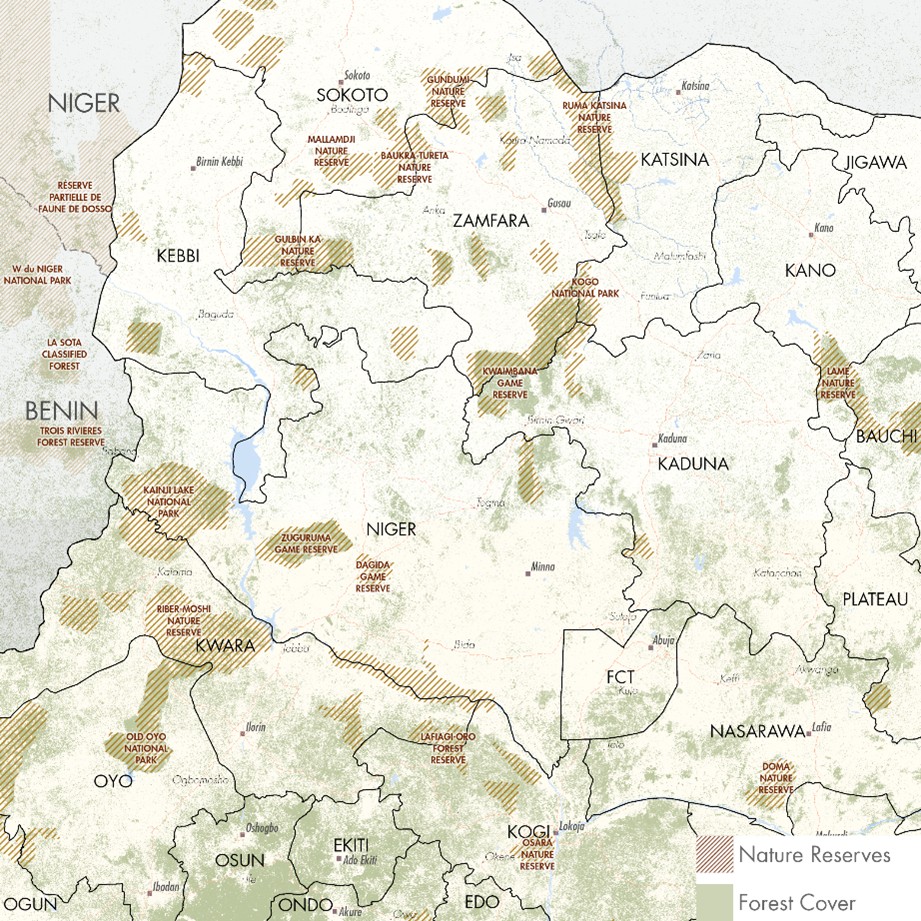
The identity and affiliation of Mahmuda’s men remain a matter of debate. The data collected from the authors’ fieldwork in 2024-2025 strongly suggested that Mahmuda’s faction was independent of any other jihadi group and that it could at least partially trace its lineage to a splinter of Darul Salam,s an Islamist rejectionist sectt that first emerged in Niger state as early as the 1990s (first as a non-violent movement) and later reached a temporary accommodation with the JAS commander Sadiku before being dislodged from Nasarawa in 2020 and splintering further (see subsequent section). However, since Mahmuda’s arrest in August 2025 by Nigerian intelligence operatives, the authorities have publicly listed him as the deputy commander of Ansaru subordinate to Abu Baraa (see section on Ansaru for more).26 u The authors have admittedly not seen any concrete evidence that he was previously a member of Darul Salam, although his exact relationship with Ansaru remains equally unclear, and the authors’ sources indicate that he knew various factional commanders in Nigeria, suggesting that he may have had fluid alliances or affiliations.
Rather than attempt to provide a definitive assessment of the question of Mahmuda’s affiliations at this stage, the authors instead treat him as the leader of an independent group for the purposes of this study, while also recognizing that he has had relationships with other jihadi commanders in Nigeria (and apparently abroad). Mahmuda’s group operated with a high degree of autonomy, with Mahmuda himself acting like a local powerbroker in his dealings with communities. It is therefore useful to think of his movement as effectively its own minor insurgency in the western fringes of Niger and Kwara states.
Mahmuda’s Emergence and Modus Operandi
Mahmuda is a Hausa from Daura in Katsina state in the country’s northwest, the son of a religious and well-respected former ward councilor.27 Former neighbors from Katsina describe him as smart, honest, and passionate about religion,28 and Nigerian newspapers have reported that he used to sell audio and video tapes of Islamic preachers, including the late Mohammed Yusuf, founder of the “Boko Haram” insurgency.29 Precise details of his trajectory within the jihadi orbit are unclear, but his neighbors report that he disappeared from home around 2010 or 2011 after intelligence agents attempted to arrest him, indicating that he was likely an early member of JAS,30 although he seems to have eventually left the group. Mahmuda reportedly traveled to Somalia, Niger, and Libya at various points in the 2010s,31 which would indicate that he was likely an early member of Ansaru, which was the more international-oriented faction of Boko Haram.
The precise reasons behind his group’s emergence in Niger state around 2021 are unclear, but it is notable that this was a time when various jihadi networks were relocating to or moving around within the broader northwest, including the JAS cell under Sadiku, the Ansaru group under Mala Abba, and possibly militant members of the Darul Salam sect. If Mahmuda knew some of these other networks as well those whom the authors interviewed claim, then he might have sensed an opportunity to establish his own jihadi enclave in western Niger state, a remote region far from other, potential rival groups.
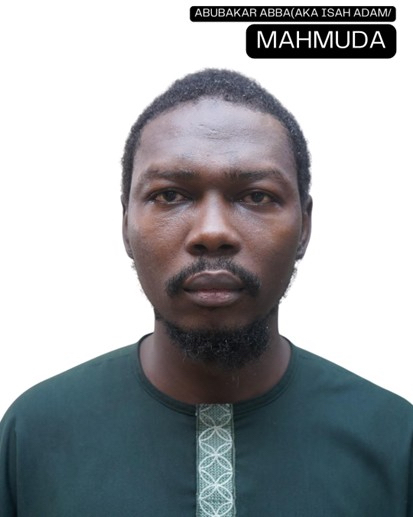
Prior to his arrest, Mahmuda and his brother, Aiman, oversaw a relatively small but influential network that operated across a wide swath of forests and nearby communities (Aiman typically assuming day-to-day management of operations as Mahmuda traveled frequently).32 Witnesses described Mahmuda as a skilled orator well-versed in the Qur’an.33 Mahmuda’s group never produced any formal propaganda, the closest thing to official statements being a series of audio messages from Mahmuda circulated on WhatsApp to communities surrounding his group’s camps, in which he explains his group’s religious mission and justifies his actions. In these audios, he typically refers to his group as “people of the forest” and his fighters as “students,”34 although one individual who witnessed Mahmuda open a school in the forest in Kwara state said that he called it Darul Salam.35
Initially, Mahmuda’s group focused on dawa (proselytization) by preaching to the communities within the Borgu emirate and was relatively non-confrontational. One vigilante member from Kwara state recalls:
When they captured two of my vigilantes, insisting they would take them if I didn’t come, I decided to meet them. I was greeted by their members, who claimed they were not there to cause violence. They requested that we send our boys to teach them, assuring us that as long as we did not attack them, they would not attack us. After our meeting, they did not come into our villages or attack us, but they would stop people on the road to ask questions.36
In keeping with the group’s initial preference for dawa over violence, Mahmuda made overtures to the local salafi community (often referred to colloquially as Izala, after the name of the most prominent Nigerian salafi-adjacent organizationsv) during his first months in Borgu. This was an unusual step for a Nigerian jihadi group: Ever since Mohammed Yusuf had fallen out with the salafi mainstream by the late-2000s, salafi clerics have consistently condemned the takfiri violence of Yusuf’s successors.37 Perhaps unsurprisingly, therefore, Mahmuda’s approach was unsuccessful. As one respondent recalled: “Since Mahmuda’s group operates in the forest, all the Izala people refused to work with them.”38
Mahmuda had more luck with traditional rulers in the Borgu area. Jihadi commanders often seek arrangements with traditional rulers, who might be desperate for alternative sources of security provision.w But in Mahmuda’s case, it seems that the traditional rulers were simply looking to collect the fees that such rulers often feel they are entitled to for conducting any meeting or business with outsiders. As one source in Kaiama explained, “[The traditional ruler] took money for sheltering them. They told him they came to preach and gave him ten million naira [approximately 6,800 USD] … Traditional leaders generally like visitors because they pay them a sheltering levy; Fulani and migrants do it a lot.”39
It would be a mistake to characterize Mahmuda’s group as having ever been truly non-violent, however. Dawa was a way of recruiting people into a movement that was clearly preparing for a conflict of one sort or another, as one source recalled: “Wherever he went, he told people he wanted to teach them religious books. But after two weeks, he would persuade them to train with weapons and join his group.”40
Moreover, his group combined efforts at outreach with violence against individuals or communities who refused to cooperate. Mahmuda seemed to employ abductions as a tool of coercion, with traditional rulers or vigilante members being targeted for “detention,” as Mahmuda called it, until they would agree to work with the group, although the lines between coercive abduction and kidnapping-for-ransom were somewhat blurred in practice.x
Mahmuda employed a common jihadi strategy of attempting to win popular support by defending communities against bandits. As detailed further in this study, such a strategy poses a complex balancing act for jihadis and contains many potential pitfalls. In addition to being highly mobile and operating across the border in Benin (see below), one cell of Mahmuda’s group was reportedly rebuffed by vigilantes when it attempted to move southward into Kishi in the northern part of Oyo state in 2023 or 2024.41 It is possible that members of the group hoped to establish a small presence in Old Oyo National Park (where bandits operate and illegal mining takes place42 y) as part of a broader effort to establish a corridor near the Benin border, or simply as a fallback area after operations in Kwara. It is unclear, however, if they ever managed to sustain a cell in the park.z
Mahmuda’s audios and the authors’ interviews indicate that Mahmuda was generally confident in his popular acceptance among communities in Borgu emirate until early 2025, when the Nigerian and Beninois began intensifying operations against his camps. These operations prompted Mahmuda to lash out against the communities he perceived as complicit.43 In one of his last audios released in April 2025, Mahmuda spoke specifically to the communities around Baruten and Kaiama local government areas (LGAs)aa in Kwara, claiming that his group had sought good relations with the communities but that they had betrayed him by collaborating with the military.44 Finally, following months of military operations against the group,ab Nigerian Department of State Services (DSS) agents captured Mahmuda in August 2025.45 While the authorities have not released many details about Mahmuda since his arrest, it is possible that more will be learned about his group in the coming months. As of this writing, it remains an open question whether his group will fracture or if a new commander will assume control.
An Insurgency Cut Short, or JNIM’s Newest Affiliate?
Given the confusion among analysts regarding Mahmuda’s affiliation and mounting evidence of JNIM encroachment into Nigeria, the authors believe a brief discussion on Mahmuda’s potential ties to JNIM is merited. However, the analysis here is somewhat more speculative than in other parts of this study given the difficulty in getting verified information regarding JNIM’s presence in Nigeria.
Since early 2025, analysts have speculated about links between Mahmuda’s group and JNIM given the proximity between the two groups on different sides of the Benin-Nigeria border.46 There is indeed some evidence pointing to a relationship with JNIM. One security source noted that communications showed Mahmuda was in touch with a JNIM cell in Burkina Faso.47 Furthermore, Mahmuda and his fighters frequently crossed into Benin, visiting various locations in the Borgou and Alibori departments such as Kandi, Kalalé, and Nikki.ac While Nikki is farther south than JNIM has historically operated in Benin, the group has had a strong presence around Kandi, the northernmost of the three towns. Furthermore, JNIM claimed its southernmost attack within Benin to date in Basso (near Kalalé) along the Nigerian border on June 12, 2025,48 indicating that the group is gradually establishing freedom of movement within central Benin.ad (See Figure 4.)
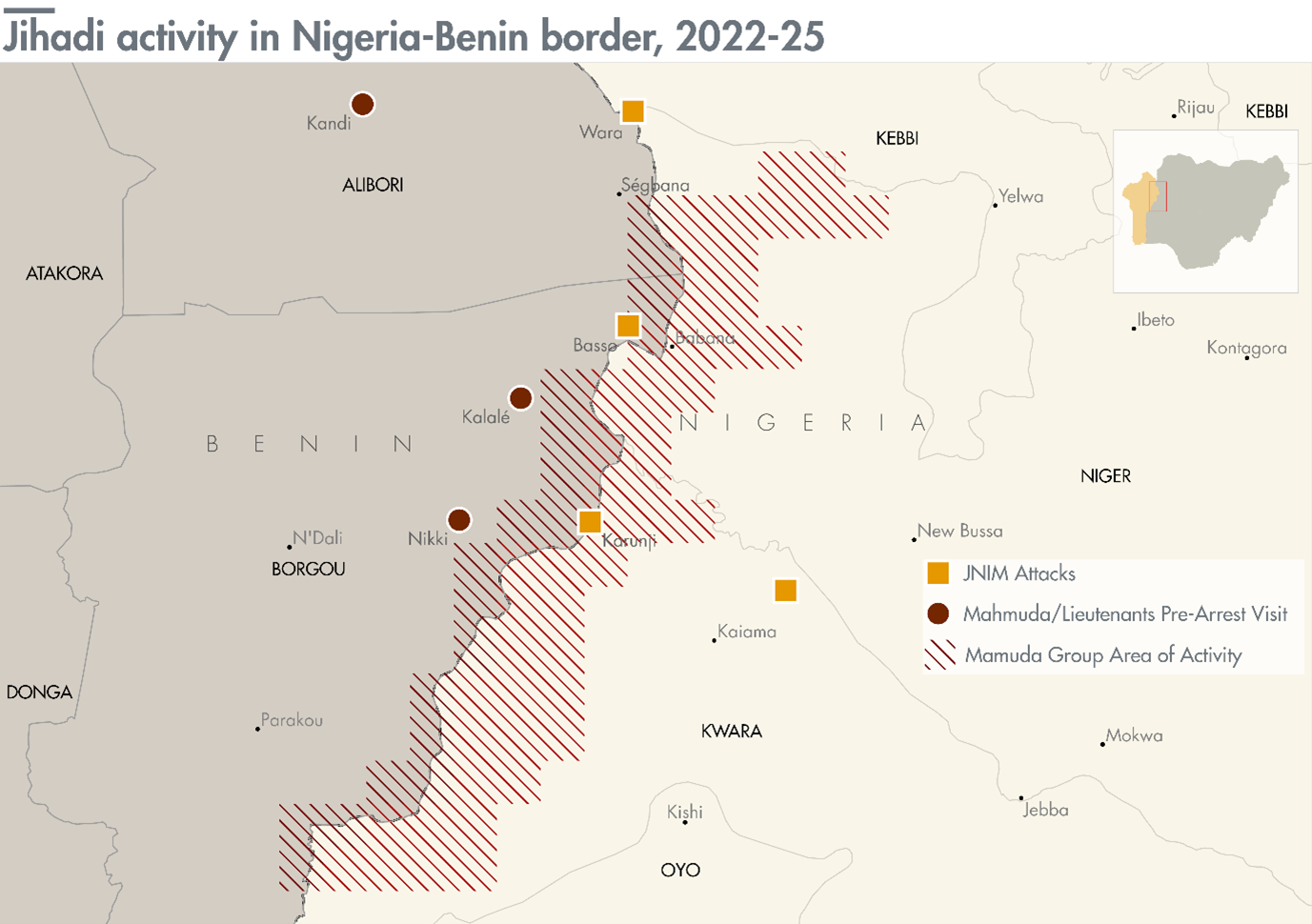
As for JNIM, it is safe to say that the group is now operating on Nigerian territory, but it remains an open question how large and consistent a presence it maintains in the country. A video circulated on JNIM supporter channels in July 2025, shortly before Mahmuda’s arrest, that showed a group of seven fighters, at least one of them non-Nigerian in appearance, who claimed to be a JNIM cell in Nigeria.49 Then, on October 28, 2025, a video emerged that appeared to show JNIM fighters participating in their first attack in Nigeria, during which the fighters ambushed a small group of Nigerian soldiers in Kwara state. JNIM did not officially claim the attack through its formal media platform, but the video circulated on JNIM-affiliated channels and featured fighters self-identifying as JNIM taking responsibility for the operation.50 Less than a month later, on November 22, JNIM officially claimed (via its official al-Zallaqa media platform) an attack on a military position in Karonji, a community in Baruten LGA of Kwara along the Benin border.51
Given the limited number of fighters featured in the July 2025 video and the small scale of the October 2025 attack and later the November 2025 attack claimed by JNIM, it is not unreasonable to speculate that the group’s presence in Nigeria might be relatively small at the moment. But the fact that the October and November attacks, as well as reports of suspected movements by JNIM fighters into Nigeria since as early as 2020,52 coincide with the rough area of operations of Mahmuda’s group also raises the possibility that the two groups are collaborating or at least tolerating each other’s presence. Once again, the authors do not have hard evidence and can only speculate, but it is fair to presume that collaboration between the two groups would be one way for an otherwise small JNIM cell to operate in Nigeria—for example, Mahmuda’s group providing a base and logistical support to JNIM. The arrest of Mahmuda creates yet another layer of uncertainty as the authors are not presently certain of the group’s new leader, let alone their dispensation toward JNIM. These questions are quite significant given the implications of a larger JNIM presence in Nigeria amid all the other challenges the country faces. As such, this issue bears further research and monitoring.
Sadiku’s Jihad: The JAS Experiment in Northwest Nigeria
A JAS commander known as “Sadiku” (a nom de guerreae) has been one of the most successful Nigerian jihadi entrepreneurs outside the northeast, carving out a niche in the hills that bound Kaduna and Niger states since approximately 2020 and engaging in some of the most successful operations of any jihadi in the region. Sadiku’s group serves as a fascinating case study of how jihadis navigate unfamiliar terrain in their efforts at expansion, and for this reason, his group is the subject of a separate, forthcoming study.af For the purposes of this study, it suffices to provide some brief background on Sadiku’s group and assess his approach toward managing relations with bandits and the local population.
Sadiku has been a mysterious figure, and the first author has in fact mistakenly identified him as a native of the northwest in the past.ag However, it is now clear from speaking to six former associates of his that he is an ethnic Babur, a minority found in southern Borno, and an early member of Yusufiyyaah with a relatively advanced degree of Western and Islamic education by the standards of JAS commanders.53 Around 2020, then JAS leader Abubakar Shekau designated Sadiku (or Sadiku and another commander, as some former associates recall54) as his envoy to the Darul Salam sect based in Nasarawa. While Sadiku seems to have worked closely with Darul Salam, helping their members learn bombmaking skills in an attempt to win their loyalty, he seems to have also been working to establish a JAS cell in Shiroro LGA of Niger state around this same period, with reports of jihadi-like attacks on villages beginning in early 2020 and escalating in 2021.55
When the military launched operations against Darul Salam’s communes in Nasarawa in 2020, Sadiku’s base of operations shifted to the hilly area straddling Shiroro LGA of Niger state and Chikun LGA of neighboring Kaduna state. At least a few Darul Salam members relocated with Sadiku to Kaduna/Niger and joined his JAS network,ai but others refused to join JAS while others still were detained in the military raids.56
It seems Sadiku took little time to broker two sets of agreements, broadly defined, in order to establish his group’s new bases in Chikun and Shiroro LGAs. This area is principally inhabited by the Gwari, also known as Gbagyi, a minority community in central Nigeria who have largely been displaced from their homes since the 1990s when the government moved the federal capital to Abuja. These communities were suffering from bandit attacks when Sadiku stepped in, offering his group as a security provider to those communities in return for their cooperation and support.57 That many of the Gwari are Christian mattered little to Sadiku who, in stark contrast to JAS’ approach in the northeast, did not interfere with the Gwari villages around his bases in Chikun, allowing them to attend their churches and more or less go about their lives unimpeded.58 aj In return, these villagers would help Sadiku’s group gather supplies, transport fighters (and sometimes hostages) along rural roads, and provide intelligence of any security forces in the region.59
The second group that Sadiku needed to find an arrangement with were the local bandits. The region where his group operates is home to numerous gangs, including some that are linked to several of the biggest warlords in the northwest. Beneficial relations with these bandits could allow Sadiku to tap into the lucrative illicit economy of the region—dominated by cattle rustling, kidnapping for ransom, logging, and gold mining—while hostility toward the bandits could result in his still-small group being overrun in their new bases. Yet, embracing the bandits wholeheartedly would not only have undermined Sadiku’s own credibility as a jihadi60 but also harmed his effort to win the trust of the local Gwari communities.
Sadiku’s approach to banditry was thus to employ both carrot and stick: Early in his foray into the region, he called a number of bandits who had been raiding Gwari villages in Chikun LGA and encouraged them to join his group to gain sophisticated weapons (e.g., IEDs) in return for reaching an arrangement with the local Gwari villages.61 Some agreed, while those who refused became valid targets for Sadiku’s group, who began attacking the bandits as a way of earning the support of the local Gwari (a similar tactic to what Ansaru was doing in another part of Kaduna around this time,62 as well as Lakurawa in parts of Sokoto63). At the same time, Sadiku formed pragmatic alliances with some of the stronger bandit warlords in the northwest, such as Dogo Gide, the late Ali Kawaje, and Dankarami (aka Gwaska),64 although his relationship with Dogo Gide deteriorated and resulted in conflict in early 2025, as detailed in a subsequent section.
Sadiku’s group was responsible for an audacious March 2022 attack on the rail line that connects Abuja to Kaduna. With the support of some bandits,65 ak his fighters used explosives to sabotage the rail track before taking dozens of passengers hostage.66 After months of negotiations, his group secured hundreds of millions of Naira (tens of thousands of dollars) as ransom along with the release of several associates who had been in detention (including children of Sadiku and his associates who had been picked up by the military in Nasarawa in 2020 and subsequently housed in an orphanage).67 The windfall from the train kidnapping helped Sadiku keep his commanders, bandit partners, and even members of the local Gwari community satisfied, although it also strained his relationship with the overall JAS leader in the northeast, Bakura, who expected that some of the proceeds would make their way to the northeast.68 (The authors’ understanding is that Sadiku remains loyal, as of this writing, to Bakura and at least nominally part of JAS, although he operates highly autonomously.)
Yet, despite its limited popular outreach, Sadiku remains a violent militant. His group appears to be more hostile to parts of the population in Shiroro in Niger state than in Kaduna, where his relationship with local communities seems strongest (see Figure 5 below for a comparison of recorded attacks, per ACLED).al One resident of a community in Shiroro described the group’s relationship toward residents as one of “fraud” because the jihadis are often requisitioning goods from the communities without paying market price.69
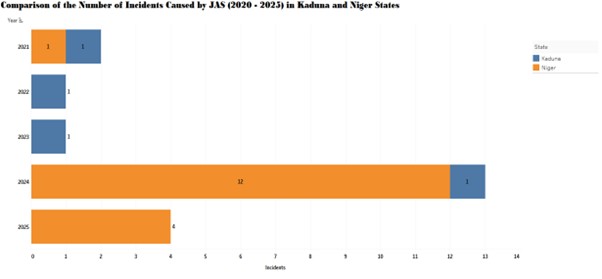
Figure 5: Conflict incidents related to JAS in Kaduna and Niger states, January 2020 to July 2025 (Source: Armed Conflict Location & Event Data)am
The reasons for this discrepancy are unclear, but one possibility is that his lieutenants in Shiroro are perhaps more aggressive than the lieutenants who oversaw the camps in Kaduna.70 Moreover, some of the communities in Niger state where Sadiku’s group operates fall under the influence of the bandit Dogo Gide,71 with whom Sadiku has had an inconsistent relationship (detailed later in this article). It is possible that Sadiku’s group has consequently viewed the communities in Niger with greater suspicion given their links to Gide. While Sadiku’s fighters have been forced to relocate within and outside Niger state since early 2025 due to clashes with Dogo Gide’s gang, his network has proven resilient in and will likely continue to operate in the northwest so long as it can find the right balance of influence with bandits and local populations.
ISWAP
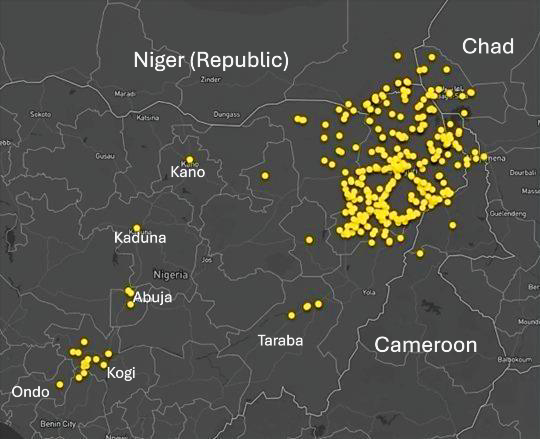
No group has achieved more notoriety for its operations outside northeastern Nigeria than ISWAP. While always principally focusing its efforts on the insurgency against the Nigerian military in the northeast,72 in 2022, the group began claiming attacks in central and even southern Nigeria. The group claimed attacks in nine states outside of the northeast as well as in the Federal Capital Territory in 2022 and early 2023. (See Figure 6.) The most spectacular of these, a July 2022 attack (conducted with support from other jihadi groups) on Kuje prison in a suburb of Abuja that freed over 60 high-profile Boko Haram detainees,73 briefly led to a panic in the nation’s capital and was followed a few months later by another (thwarted) attempt in Abuja, this time to attack the country’s Defence Headquarters with a suicide vehicle-borne IED (SVBIED).74 an
Understanding how and why ISWAP undertook this campaign in 2022-2023 provides necessary context to one of the key findings of this study, which is that jihadis seek where possible to coopt existing social and religious networks in their efforts at expansion. According to defectors, ISWAP’s senior leadership had long debated whether to undertake the risk of a terrorist campaign targeting urban centers across northern Nigeria or whether to focus resources and energy in the northeast, where they felt they were gradually gaining ground.75 ISWAP experienced a power struggle around 2021 in which Habib Yusuf (aka Abu Musab al-Barnawi, son of the late Boko Haram founder Mohammed Yusuf) succeeded in purging an internal rival, Mustapha Kirmima, and reasserted himself as overall leader of the group.76 ao
Habib reportedly felt ISWAP should undertake a campaign in “Nigeria” (what ISWAP fighters call the rest of the country, as opposed to the northeast—i.e., part of the broader Islamic State “caliphate”77) and had a relationship with a two key commanders, Abu Qatada and Abu Ikrima, whom he felt could oversee the campaign.78 As Habib saw it, the benefits of a campaign outside the northeast could be manyfold—including gaining additional revenue from kidnapping and money laundering, winning new recruits (including by freeing veteran jihadis from prisons),ap tying down military forces far from ISWAP’s base of operations, and simply exacting revenge against the Nigerian state.aq After ISWAP killed Shekau in May 2021, Habib likely also felt that a campaign in western Nigeria could rally the remaining Nigerian jihadis outside his fold, namely the Ansaru faction that was reasserting itself in Kaduna at the time (see subsequent section), thereby reunifying the Nigerian jihad under one banner as it had (briefly) been under his father.ar
Abu Qatada and Abu Ikrima were both ethnic Ebiras from Kogi state.79 Kogi was an ideal hinge-point for ISWAP’s expansion both because of its geography—situated beneath Abuja and on the edges of the southwest—and because of its small but important jihadi scene within the Ebira community that could potentially be rallied for ISWAP’s campaign. The authors’ sources offer somewhat conflicting reports as to whether Habib chose Abu Qatada to oversee operations, with Abu Qatada then deputizing Abu Ikrima to relocate to the north central region for day-to-day management of the campaign, or if Abu Ikrima took the initiative to propose a campaign based in Kogi to Habib, with Habib urging both Abu Qatada and Abu Ikrima permission to collaborate. In either case, according to one defector, Abu Qatada was nominally Ikrima’s superior, while Abu Ikrima spent much of 2022 and 2023 on the move across Nigeria while overseeing a network of fighters based in Kogi.80
Ikrima’s network was highly active in the second and third quarters of 2022, conducting a string of ISWAP-claimed shootings and bombings in Kogi and parts of neighboring Ondo and Edo states as well as participating in the Kuje prison break.81 Ikrima’s network helped plan the latter, representing the highwater mark of ISWAP’s Kogi-based campaign (although some reports suggest many of the attackers were ISWAP fighters dispatched from Lake Chad for the operation,82 while members of other jihadi groups also likely took part83).
Following the success of the Kuje assault, Ikrima promised Habib that his network could strike a series of more ambitious targets, including targets in Abuja and other detention facilities across northern Nigeria.84 According to defectors, Habib agreed to lend Ikrima dozens of AK-47 rifles and provided funds for the operations.85
However, Nigerian intelligence agencies were on alert after the Kuje attack and learned of the impending operations.86 Additionally, one source claims that Ikrima’s network had to recruit new fighters from Kogi and neighboring states in order to have sufficient manpower to conduct the operations, leaving these fighters with little time to train or even learn the true nature of their operations until the last minute, which resulted in the fighters making a string of tactical and operational security mistakes.87 In late October 2022, Nigerian authorities thwarted several simultaneous plots by Ikrima’s network, killing or capturing several dozen of the fighters in his network.88 Ikrima’s star within ISWAP tanked after the failure of this second round of attacks.89 Unable to return the rifles ISWAP had lent him, Ikrima reportedly avoided returning to the northeast for fear of being branded a traitor and instead moved around different parts of north central Nigeria where he had contacts among fellow Kogi jihadis, including members of Ansaru.90
ISWAP’s expansion into central Nigeria lost momentum by 2023: While Abu Qatada and another ISWAP commander from Kogias reportedly continued the effort after Ikrima’s falling out, Nigerian security agencies managed to arrest and neutralize various members of their networks.91 Additionally, growing conflict between ISWAP and the Bakura-led JAS faction around Lake Chad in late 2022 forced ISWAP to divert energy and resources away from expansion toward the factional conflict closer to home.92 ISWAP ceased claiming attacks outside the northeast in early 2023, with the exception of a shooting at a supermarket in an Abuja suburb in January 2024.at
However, since mid-2023, Nigerian intelligence agencies have arrested apparent ISWAP cells in various locations across central and even southwestern Nigeria,93 indicating that the group has continued trying to build a network of urban cells to leverage for future campaigns outside the northeast.au These cells, dispersed as they are across the country, may be intended to offset the risks that came with relying on a network based principally in one state, Kogi, that had a history of operating autonomously and fragmenting, as detailed further in this study.
Two Ansarus? Kaduna and Kogi
Ansaru was one of the first groups to splinter from Boko Haram, forming around 2011-2012, and it has long been a subject of debate and speculation among analysts given its more secretive nature and apparent ties to al-Qa`ida in the Islamic Maghreb (AQIM).94 The early group conducted several attacks across Nigeria’s northwestern and north-central states between 2012 and 2013, including multiple kidnappings of Western nationals, before Nigerian security forces began dismantling the group’s cells in 2014, culminating in the arrest of founding member Khalid al-Barnawi in the Kogi state capital in 2016.95
This section briefly analyzes two distinct and contrasting campaigns that have each been attributed by analysts and Nigerian officials to Ansaru, one being an overt insurgency seemingly inspired by JNIM that took over a small patch of Kaduna state between 2020 and 2022 and seemingly signaled Ansaru’s reemergence as a regional jihadi actor; and the other being a clandestine and unclaimed campaign of terrorist attacks, kidnappings, and bank robberies that has occurred across Kogi state and parts of southwestern Nigeria over the past decade. The modus operandi of these two apparent networks—the one in Kaduna, reportedly led by one Mala Abba, and the one in Kogi, reportedly led by one Abu Baraa—were so different that the authors assess that the two groups actually split from each other for a time, a rift that is further attested to by one public communication released by the Kaduna-based group (see below).
Ansaru’s insurgency in Kaduna was detailed in two previous studies by the first author. The group adopted a ‘hearts and minds’ approach to communities in the Birnin Gwari LGA of the state that had long been suffering from banditry. Aligning itself with the Hausa communities in those villages, Ansaru began fighting the surrounding smaller gangs, all while boasting of its exploits on al-Qa`ida-linked Telegram channels and preaching to communities about the necessity of jihad and the failures of democracy and the Nigerian government.96 The group was successful for a time, earning some genuine popular support from otherwise desperate villagers, and members of the group began intermarrying with local communities as part of a broader effort at integration.97 However, this overt insurgency was abruptly cut short in the summer of 2022 when the bandits that Ansaru had been antagonizing teamed up and drove the jihadis out of their enclaves in Birnin Gwari.98 The group has since gone quiet,99 making no public statements since that time. The authors have received sporadic reports since 2022 that suspected Ansaru members are still active around the northwest, including in neighboring Shiroro LGA of Niger state as well as parts of Zamfara, but their presence seems to be diminished, and it is difficult to determine if they are even operating as discrete cells or if the fighters have instead joined other jihadi outfits or even bandit gangs.
The authors have limited insight into the membership of the Kaduna-based Ansaru, except that locals who interacted with the group report that the fighters seem to have come from the northeast, which leads the authors to believe they were likely fighters in Shekau’s JAS who defected to form this new group in the late 2010s/early 2020s rather than members of the original Ansaru.av Details about the leader of this network, known as Mala Abba,100 are scant. Among bandits and jihadi defectors, he is rumored to have been captured and/or extrajudicially killed by security forces, though they provide differing dates between 2021 and 2024.101 It is possible that security forces have captured the wrong individual on multiple occasions, and it is likewise possible that Mala Abba is a nom de guerre used by whoever leads the network at a given time, in which case the network may have already seen multiple leaders come and go. Despite operating in relatively close proximity to Sadiku’s cell in Kaduna, a former member of that group recounted fighting Ansaru on several occasions and otherwise keeping their distance from them, underscoring the degree to which some of the factionalism of the early Boko Haram conflict (Ansaru having split from JAS as early as 2011) persists years later even in relatively “new” theaters of the jihad.102
Abu Baraa and Ansaru in Kogi
When Nigerian authorities announced the arrest of Abu Baraa in August 2025 alongside that of Mahmuda (although the two had been arrested in different locations at different times), they hailed it as the dismantling of the long-running Ansaru network in the country. The authors assess that Abu Baraa’s network had in fact operated separately from the rest of Ansaru in Kaduna for at least several years, although he may have been in the process of reconciling with the Mala Abba faction (or what remained of it) at the time of his arrest. This assessment is based on what the authors have learned about the highly autonomous nature of his associates in the period around 2020-2023. Moreover, Mala Abba’s network released an audio in 2022 in which they refuted claims, reportedly circulating in jihadi circles after the Abuja-Kaduna train attack, that Abu Baraa was their leader.103 Researcher Malik Samuel also noted reports of a rift between Abu Baraa and the rest of Ansaru.104
The arrest of Abu Baraa was nevertheless significant as he was a veteran jihadi commander. Daniel Prado Simón and Vincent Foucher provide a useful biography of Abu Baraa that largely corroborates what the authors learned about him from their sources.105 To briefly summarize, Abu Baraa (real name Mahmud Muhammad Usman) was born to an ethnic Ebira Islamic scholar from Kogi state (the present authors’ sources add that his mother is Fulani106), though he grew up in Maiduguri.107 He received secondary education and attempted to join the National Defence Academy but was rejected, to his frustration.108 He was soon drawn to Mohammed Yusuf and became a member of the amniyat or internal security forces of Yusuf’s movement.109 When Ansaru split over disagreements with Yusuf’s successor, Abubakar Shekau, in 2011-2012, Abu Baraa reportedly joined the network.110 He received training from AQIM in Libya in the 2010s alongside other Ansaru associates111 and would eventually become its emir after Khalid al-Barnawi, an early AQIM-linked jihadi and one of the faction’s founding members, was arrested in 2016 in Kogi.112
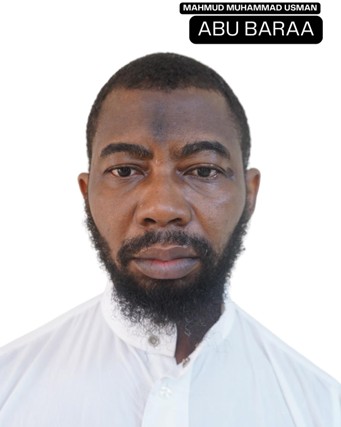
(Source: Bayo Onanuga/X)
Baraa was highly mobile within Nigeria, narrowly avoiding escape on at least one occasion.113 By 2022, if not earlier, he had apparently fallen out with Mala Abba and the Ansaru group in Birnin Gwari, as previously noted. Despite this rift, he apparently continued to hold sway over a faction of the jihadi community in Ebiraland in Kogi (detailed later in this study) and networks in southwestern Nigeria, with cells in locations such as Shaki in northern Oyo, Owo in northern Ondo, and various parts of Kogi state alongside major northern cities such as Kaduna, Zaria, and Kano.114 The network was involved in criminal activities such as bank robberies, kidnapping for ransom of both Nigerians and expatriates (including attacks on highways in the southwest),115 and may have been responsible for a gruesome massacre at a Catholic church in Owo in 2022 that was widely attributed to ISWAP but never claimed.116 aw
Indeed, in notable contrast to ISWAP and the Ansaru network operating in Birnin Gwari, Abu Baraa’s network never claimed any attack. Per one security source, he “eschew[ed] publicity,” preferring instead to raise funds for future operations through criminal activity and radicalizing new recruits into his cause.117 His network was technologically savvy and better educated than the rank-and-file of other Nigerian jihadi groups. He and his associates were early users of Telegram in Nigeria to conduct outreach and radicalization aimed primarily at university students.118 Despite principally comprising ethnic Ebira and Yorùbá,ax his network may have conducted outreach to some Fulani communities in the southwest that felt aggrieved by growing anti-pastoralist sentiment and harassment from Amotekun, a vigilante group created by southwestern governors in 2020 amid growing farmer-herder conflict.ay This is in notable contrast to the Ansaru of Mala Abba, which effectively aligned with Hausa communities against Fulani in the course of its intervention in the banditry crisis in Birnin Gwari.119
It is unclear how much direct oversight Abu Baraa exercised over his network, as he was reportedly not based in Kogi in recent years.120 As noted previously, the exact relationship between Mahmuda and Abu Baraa remains somewhat unclear to the authors, although they clearly knew each other and had been in contact before their arrests.121 Interestingly, despite being in Ansaru, Abu Baraa may have also played an indirect role in the growth of Sadiku’s JAS network in Kaduna, as several of Sadiku’s future lieutenants undertook Islamic studies at one point or another in the Kinkinau neighborhood of Kaduna state where Abu Baraa was based for a time and expressed familiarity with him, indicating that he may have helped play a role in radicalizing them.az
The authors’ interviews in the first half of 2025, shortly before his arrest, indicated that Abu Baraa was likely in the process of attempting to reconcile the different factions of Ansaru that had previously split and possibly conducting outreach to other jihadi cells in north central Nigeria.122 In this sense, the authors may concur at least in part with Simón and Foucher’s assessment that at the time of his arrest, Abu Baraa was “attempting to coordinate among Nigeria’s many jihadi factions and their Sahelian counterparts … among whom he enjoyed considerable respect.”123 Indeed, it may have been because Abu Baraa was consistently relocating to mediate between factions that he proved vulnerable to arrest.124
Lakurawa
“Lakurawa” is the colloquial term used by Nigerians to describe Sahelian militants who first appeared in the borderlands of northwest Nigeria in 2017-2018 (although the militants were earlier known as Lakuruje).ba Notably, it was traditional authorities in Sokoto state who first invited Lakurawa to provide protection to their communities from Zamfara-based bandits.125 The militants soon overstayed their welcome, however, clashing with some of the community leaders who first welcomed them and enforcing a harsh interpretation of sharia law that alienated much of the rural population.126 These militants have been highly active once again in the northwest since late 2024, generating significant media attention within Nigeria and internationally127 and prompting the Nigerian military to reframe its operations in the northwest, at least partially, as an offensive against the group.128
The identity and affiliation of Lakurawa have been much debated among analysts. As described in a separate article by the first author, some of the confusion stems from the fact that the original Lakurawa group seems to have been quite heterogenous, comprising both Malian and Nigerien militants who came from different Fulani clans and had differing modus operandi.129 Furthermore, given the fluidity of jihadi alliances and fracturing in the Sahel, some of the original members of Lakurawa may have been affiliated with JNIM in 2017-2018 but are now affiliated with ISSP.130 Nonetheless, the present evidence points to the majority of so-called Lakurawa activity, particularly in Sokoto and northern Kebbi states, as being the work of ISSP militants. Among other evidence, United Nations experts have identified ISSP activity in these states as well as an ISWAP logistics hub in Sokoto reportedly used to facilitate coordination between the two Islamic State affiliates.131 As Héni Nsaibia demonstrates in a recent ACLED report on the southward expansion of Sahelian jihadis, ISSP has been pushing steadily from southern Niger into northwestern Nigeria in 2024-2025, and the ingress points of Lakurawa into Nigeria (e.g., Tangaza and Gudu LGAs of Sokoto) correspond with known ISSP bases on the Nigerien side of the border.132 (See Figure 8 below from the ACLED report.) At the same time, some evidence suggests that JNIM may also be intermittently operating in parts of Kebbi and Niger states (see the previous section on Mahmuda’s group for more) under the guise of “Lakurawa,” as at least one former Nigerian jihadi has been approached for collaboration by self-described al-Qa`ida-affiliated Lakurawa members.133 Nevertheless, for the purposes of this study, most of the authors’ analysis focuses on the activity of Lakurawa in Sokoto and parts of Kebbi state where, the authors can reasonably assume, so-called Lakurawa activity is the work of ISSP.
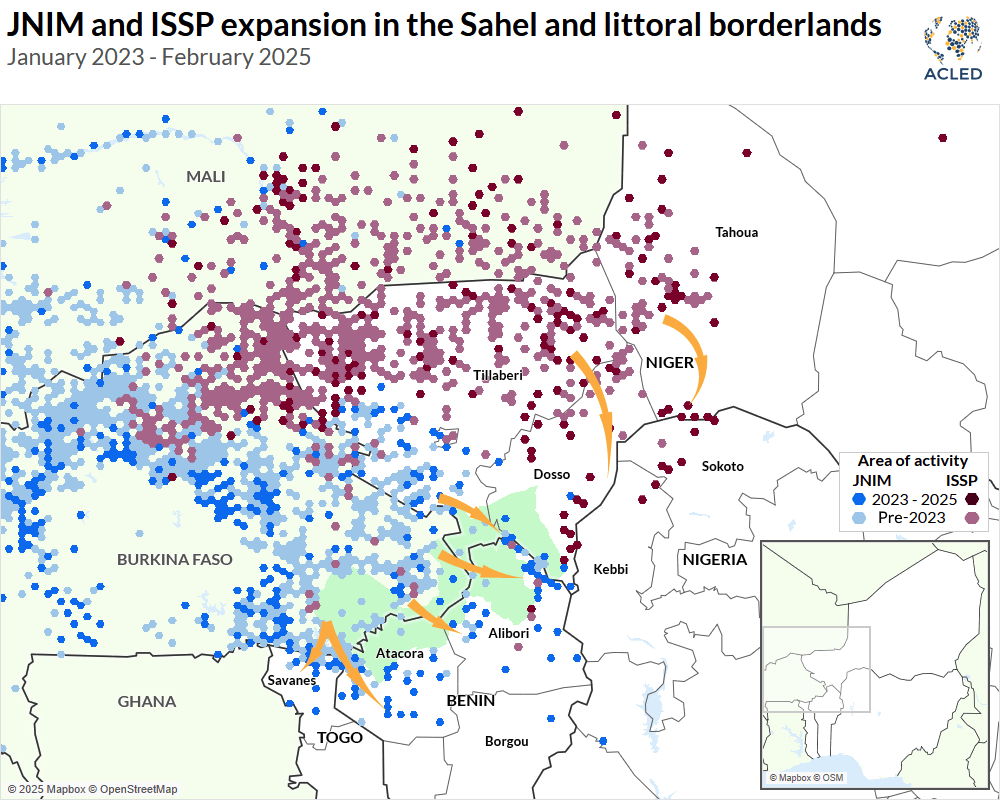
Despite their growing notoriety within Nigeria, the militants work hard to maintain operational security, never telling communities whether they belong to ISSP, JNIM, or any other faction, likely because the confusion surrounding their identity benefits them.135 The composition of Lakurawa therefore remains rather unclear, and analysts and journalists have floated several names of potential leaders since late 2024.136 A July 2025 article by Mondafrique, citing unnamed sources, said that one Namata Korsinga, a Nigerien Fulani from the commune of Abala Filingue in Tillaberi, is the leader of the Lakurawa subgroup while his younger brother, Saadu Korsinga, is the leader of the ISSP Katiba that has been active in western Niger in recent months.137 A colleague the authors consulted had also heard reports of one Kousanga (likely an alternative spelling of Korsinga) in Lakurawa, but as a deputy of the group beneath a more senior ISSP commander, and noted that sources gave conflicting names of the overall Lakurawa leader.138 The authors had heard from their contacts in Sokoto earlier in 2025 that leaders of Lakurawa included one Namata—lending weight to Mondafrique’s reporting—as well as Abu Muslim, Abu Anas, Manu (possibly a former ISWAP associate, according to some of the authors’ sources), and Abdulkarim.139 A very rough picture of the group’s leadership thus may be starting to emerge, but much work remains to be done to clarify the leadership as well as overall size and composition of the group.
2024-2025: A New Modus Operandi?
While Lakurawa is not a new group, its operations since late 2024 have differed from its initial incursions in notable ways that point to a more aggressive campaign of expansion. This could be explained by several factors, including ISSP’s desire to break out of the Liptako-Gourma tri-border region of the Sahel (where it has long been contained) and establish a corridor to Benin via northwestern Nigeria as part of its competition with its JNIM rivals.140 bb The militants may also be taking advantage of the breakdown in relations between Nigeria and Niger following the July 2023 coup in Niamey that has hindered cross-border cooperation.141 In these efforts, the group’s approach to local Nigerian communities varies from protection to hostility.
Lakurawa is currently operating across a much wider swath of northwestern Nigeria than it did previously. Whereas the group previously operated almost exclusively in Tangaza and Gudu LGAs in Sokoto state along the border with Niger, in late 2024, it began operating farther within the interior of Sokoto, particularly in a stretch of sparse forest across Binji and Silame LGAs that extends to within 20 miles of the Sokoto state capital.142 More worrying still, the group has been active in neighboring Kebbi state, particularly in Augi, Arewa Dandi, and Argungu LGAs down to Bunza, Dandi (Kamba), and Bagudo LGAs (which share a border with Benin).143 Wherever they operate, according to locals, “they tend to move through various villages during the day without much interaction … They do not ask for directions, suggesting they might already know the area.”144
The group appears to have consolidated influence in the border regions of Sokoto where it first appeared in the late 2010s: In Gudu LGA and Tangaza LGA, respondents said the group has closed down public schools145 and replaced existing imams by appointing their own their own (either from the community, or by appointing members of the group to preach themselves).146 bc The group prevents civil servants and security personnel from entering the area147 (with an exception for health professionals, at least in the case of Balle in Gudu LGA148). As one source in Tangaza explained, “In so far as you have anything that identifies your relations with the government like ID cards, [a certain] vehicle plate number, they will seize it and even threaten to kill you.”149 Lakurawa is also still, as it was in 2018, fighting bandits selectively in a manner that allows it to present itself as a defender of vulnerable Muslim communities. The group is also adjudicating land disputes and conflicts between farmers and herders, supplanting the role of traditional authorities.150
Unfortunately, this approach seems effective to some extent. Various respondents spoke more favorably of Lakurawa than bandits, particularly in the northernmost parts of Sokoto state. One resident in Tangaza recounted how his friend had been kidnapped by bandits and freed by Lakurawa in October 2024 when the latter attacked a bandits’ camp. As he recalled: “They asked him for the contact of his people, and they called us to inform that the man is in safe hands. The following day, they arranged for his returning back home … and he was dropped off.”151 These sorts of experiences can cumulatively contribute to building a degree of popular support. As a community leader Tangaza LGA frankly remarked, “The reality is whoever saved you from kidnappers, you will never forget him. This is the true picture of what transpired: the Lakurawa saved us from the bandits when the government could not do anything.”152
But at the same time, the group is once again attempting to impose its extreme interpretations of the sharia that many residents find excessive and harsh. In rural parts of Augi LGA of Kebbi state, many shops have ceased selling cigarettes (which are often but not exclusively consumed by bandits, providing some income to local vendors) out of fear of incurring Lakurawa’s wrath,153 while elsewhere in the northwest, Lakurawa has flogged residents for having haircuts deemed “un-Islamic.”154 Even the foreignness of the militants poses some basic stumbling blocks to their expansion, at least in certain communities in the region, as one of the authors’ interviewees in Sokoto bluntly observed:155
Q: Have you ever listened to them preach?
A: Yes, they preach in French, Fulfulde, Zabarmanci, and Buzanci, but not in Hausa. Those are their native languages.
Q: Do people here understand those languages?
A: No. They just form a circle and listen without truly understanding.
The group has also shown less compunction about attacking and stealing from civilians whom it deems to have disobeyed its injunctions. The authors’ interviewsbd suggest a geographic correlation to Lakurawa’s relative hostility toward local communities, with respondents in Kebbi state and the interior of Sokoto state recounting more abuse at the hands of the group than those in northern Sokoto (e.g., Tangaza and Gudu LGAs) during fieldwork in early 2025.be This could be a function of different commanders within the group adopting different strategies in their respective areas, but it is also likely rooted in the fact that the group has longer-standing ties with communities in northern Sokoto and thus less need to enforce compliance violently. In Kebbi and central Sokoto, by contrast, Lakurawa has stolen cattle from communities under the auspices of zakat collection156 and attacked villages that raise vigilante groups,157 indicating that its violence is largely aimed at asserting dominance over populations in the frontiers of its new expansion.
As a result of these more recent and aggressive tactics, many respondents in Kebbi and Sokoto distinguished between the “original” Lakurawa and what they perceive as a different, current manifestation of the group. As one source in Kebbi claimed, “the first set claimed to be preaching Islam, while the second set engages in violent attacks on people’s lives and livestock.”158 Yet other respondents went further and speculated that Lakurawa are in fact bandits using the jihadi label as a guise for their operations. One claimed: “These recent people I believe are a distortion of the Lakurawa we know. We believe [they are] the bandits that were raided by security forces that changed to become the new Lakurawa, since the main Lakurawa have forced them out of kidnapping and cattle rustling.”159 Another source noted differences in the appearance and ethnicity of the present Lakurawa and those of the first militants who emerged in 2018:
The Lakurawa we knew wore turbans. This new group also wears turbans but has facial markings, and the turbanning is very different. They appeared to be a mix of Fulani and Tuaregs before, but now even Hausa and Zabarma are among them. The old Lakurawa used to pay for what they took from shops. If their cattle destroyed your crops, they would come, assess the damage, and pay you. This new group does not pay; they simply seize everything.160
The authors do not agree with the assessment that Lakurawa are merely bandits by another name, nor is there strong evidence to suggest that the current Lakurawa are a fundamentally different set of militants than the first group (although the heterogeneity of the militants circa 2017-2018 and limited insight into the group’s current membership make it difficult to assess with any confidence). Nonetheless, the aforementioned quotes underscore the challenges that Lakurawa faces in upholding the reputation for defending communities from banditry that it has tried to cultivate in the northwest, as discussed in the following section.bf
Facilitators or Impediments to Expansion? The Interplay between Bandits and Jihadis
The preceding sections have provided brief overviews of the key jihadi groups that are operating in western Nigeria at present. In this section, the authors elaborate on the first of two factors that they identify as being critical to facilitating jihadi operations in western Nigeria, which they dub the banditry “Goldilocks effect.”
Understanding Bandits, Jihadis, and their Interplay
The ongoing banditry crisis in northern Nigeria constitutes an immensely fragmented and complex conflict that has not received as much analytical or scholarly attention as the Boko Haram conflict in the northeast. For the purposes of this study, it suffices to emphasize two key characteristics of contemporary banditry in northern Nigeria.
First, bandit leadership and hierarchies are decentralized and fluid—but banditry is hardly egalitarian, and not all bandits are equal in their power or influence. There is no precise or reliable estimate of the total number of bandits operating in northwestern Nigeria—which could be complicated by the fact that some fighters are “part-time” bandits161—although officials have often given a (likely excessive) estimate of up to 30,000 armed bandits.162 The number of gangs is similarly difficult to gauge, although there are undoubtedly dozens and possibly several hundred,163 depending on how one distinguishes one gang from another. This is difficult, as underscored by a recent study co-authored by one of the present authors that argues:
Unlike armies or insurgencies with formalised chains of command, banditry operates through a delicate interplay of autonomy and allegiance, resulting in a centrifugal dynamic of radical fragmentation and a centripetal logic based on specific forms of ‘capital’ that hold currency in bandit society… A major bandit leader may occupy a camp with a group of loyal bandits no bigger than 50. But spread in his area of influence are minor kachallas [commanders] with their own groups, who are independent in their actions but nonetheless pledge allegiance to the oga [top bandit].164
For example, that study shows that in one LGA alone in eastern Sokoto state bordering Zamfara (Sabon Birni LGA), there are 30 different notable bandit commanders, yet all of them have traditionally been loyal to Bello Turji, one of the most infamous bandits in the northwest.165
The fluid organizational nature of banditry—coupled with the previously described challenges of conducting field research in any conflict zone—make mapping bandit influence and power more difficult than mapping even jihadi areas of attack or control in Nigeria, given that the latter operate more like classic insurgents and (contra bandits) often claim their attacks in one way or another. Consequently, this section of the present study employs some admittedly vague or subjective labels regarding the relative influence of bandits, as such traits are quite difficult to quantify.
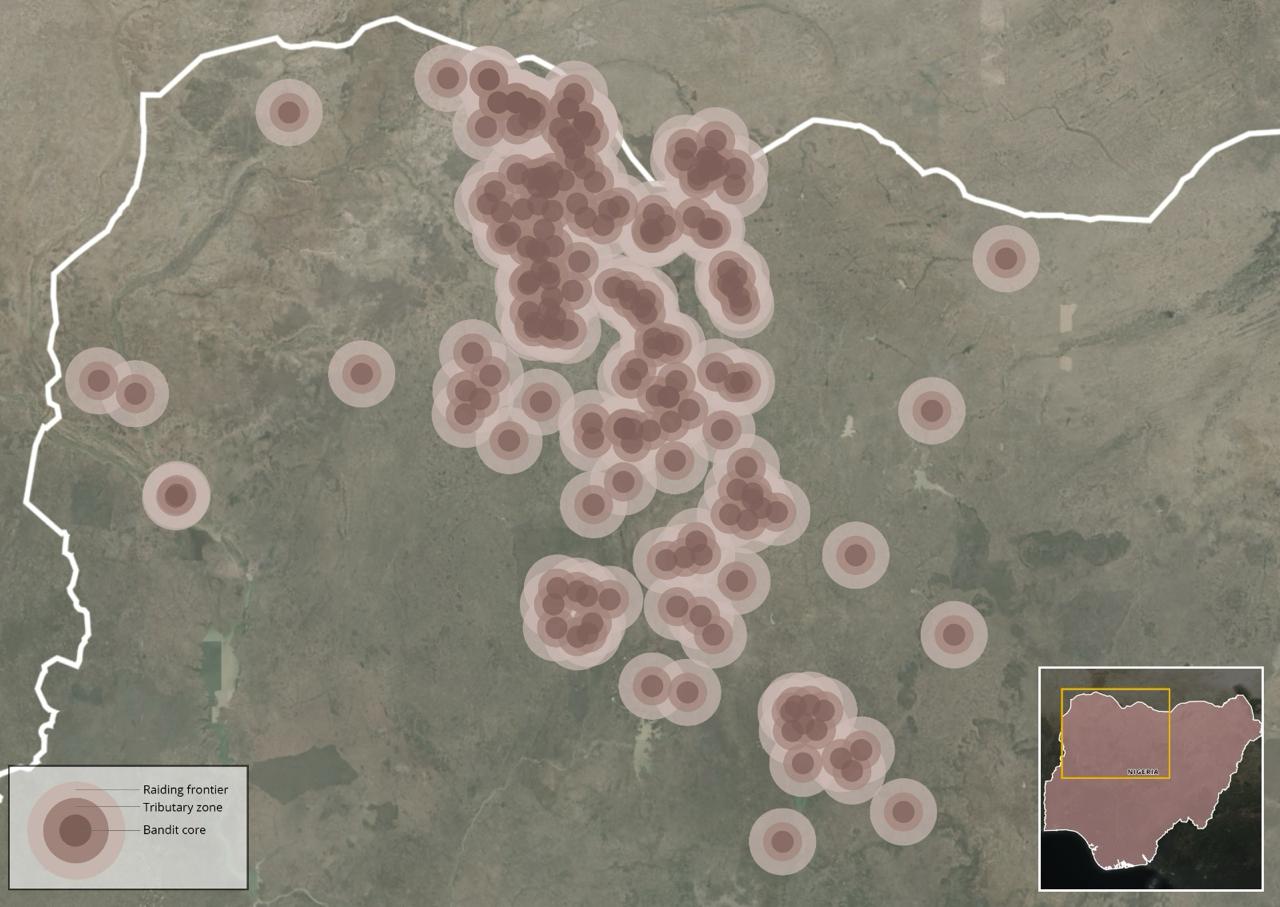
However, the authors’ assessments reflect the views of the dozens of respondents whom they interviewed in the banditry-afflicted regions of the northwest, many of whom articulated a clear consensus that certain bandits are highly powerful (one might call them warlords166) and exercise influence over many smaller but still deadly gang leaders. These respondents also noted that certain regions and states are bandit “strongholds.” Specifically, the epicenter of the banditry crisis has long been in Zamfara state,167 which respondents also stated constitutes the base for most of the warlords in the region. In the states neighboring Zamfara (Katsina, Sokoto, Kaduna, Niger, and Kebbi), those LGAs that are adjacent to the boundaries with Zamfara are typically more impacted by banditry than those LGAs that are further removed, which itself represents an emerging political geography of banditry that can be divided into overlapping and shifting zones of bandit “cores,” “tribute zones,” and “raiding territories.”168 (See Figure 9.)
The second aspect of banditry that is relevant here, as detailed in a previous study in this publication, is that banditry presents opportunities and challenges for jihadis who seek to expand into western Nigeria.169 On the one hand, those parts of Nigeria suffering from banditry present advantages to jihadis that are seeking to expand or relocate. For starters, banditry erodes what little state presence previously existed in rural Nigeria, contributing to the inability of security forces to establish a permanent and widespread presence across rural communities and thereby creating what might be dubbed “illicitly governed enclaves.”170 In such enclaves, there are ample opportunities for jihadis to make a profit, typically by partnering with bandits in activities such as kidnapping for ransom and cattle rustling or by selling weapons to gangs or instructing them in IED making (for a price). Finally, and perhaps most importantly, bandits offer jihadis a foil: In their effort to earn popular support for their insurgencies from Muslim communities, jihadis present themselves as a contrast to—and, indeed, protection from—those bandits who indiscriminately raid and terrorize communities across Nigeria’s northwest without any ideological pretense. Whether in the case of Ansaru in Kaduna, Mahmuda in Niger and Kwara, or Lakurawa in Sokoto, time and again jihadis have presented themselves as security providers to desperate rural communitiesbg that the state has been unable to protect. In other words, the presence of banditry not only provides jihadis with financial opportunities, but also the opportunity to develop new constituencies within the broader population.
On the other hand, Nigerian banditry presents an immensely complex set of conflict dynamics that jihadis often struggle to navigate. Jihadis have struggled to coopt bandits due to an array of factors, including a lack of ideological and strategic alignment between bandits and jihadis; the bandits’ reluctance to surrender their autonomy to jihadis who hail from a different part of Nigeria (and are typically of different ethnicitiesbh); friction over the behavior of bandits, such as drug and alcohol use and even bandit hairstyles that jihadis consider vices; and the loose organization and frequent fracturing of bandit gangs.171 In short, bandits make for difficult partners and may quickly become enemies.
Moreover, there is an obvious tension between the different benefits that jihadis seek to accrue from operating in areas affected by banditry. Jihadis seek to profit from banditry, which necessitates some degree of cooperation, while at the same time they position themselves as superior to bandits and indeed as a defense against them. In other words, to garner both sets of benefits from banditry, jihadis would need to both cooperate and fight with bandits.
Examples of Jihadi-Bandit Relations
Sadiku’s JAS cell struck what was likely the most effective balance of profiting from banditry while still presenting itself as a superior alternative and security guarantor to local communities, particularly the Gwari villages of Chikun LGA in Kaduna. Upon his relocation to the northwest, Sadiku developed a close relationship with Dogo Gide among several other bandits. Underpinning this arrangement, at least initially, was Sadiku’s flexible approach to the bandits. As one of his former associates described it:
Sadiku brought his own soldiers and weapons from Shekau and said to the bandits, “You have your own space, we have our own space. This is our camp, and you can have your own. You won’t be under us, we won’t be under you.” So, they agreed to stay in the same area but operate independently.172
Sadiku was careful not to preach jihadi ideology too much to the bandits (although Dogo Gide expressed some interest),173 and he cautioned his fighters not to be overly judgmental of the bandits and their un-Islamic ways, noting that in Kaduna, “[the situation] was different from Sambisa” where the jihadi project was “more advanced.”174
Yet even Sadiku’s lax attitude toward the bandits could not sustain this modus vivendi forever, as a bandit that is an ally one day might become an enemy the next. Dogo Gide and Sadiku fell out in late 2024 and began clashing, reportedly because Sadiku was “arrogant [and] demands respect” from the bandits, according to a former associate of Sadiku’s.175 “But to the bandits, Sadiku is an immigrant,” this source continued. “The forest belongs to them, so how can someone from Borno come and take over the forest?”176
All of the jihadi groups profiled in this study have pursued both carrot and stick in managing relations with bandits, sometimes simultaneously. Operating in a stretch of Niger and Kwara states that are suffering from banditry yet relatively far removed from the epicenter of the banditry crisis in Zamfara, Mahmuda’s group set about fighting local bandits as part of the accommodation it reached with local communities (including Fulani community leaders). In a lengthy 2025 audio message circulated within Borgu, one of Mahmuda’s associates, identifying himself as Idi Gurmu, boasted about a time when he and three of Mahmuda’s “students” rescued seven people from Kemanji community in Kwara who had been kidnapped by a small gang of a dozen bandits, a favor that Mahmuda did for the people of Kemanji without demanding “even 10 Naira” (less than a dollar) in return.177 Even a local vigilante leader acknowledged that “[Mahmudawa] even intervened to stop banditry in Kemanji. If someone was kidnapped, they would fight the bandits to rescue the victim.”178
One source in Kwara attributed these efforts against the bandits to Mahmuda’s reputational concerns:
One notable bandit leader was Babuga Dogo, who was eventually killed. Initially, there was an agreement between Malam Mahmuda and the bandits, but that changed when an attack occurred. Malam Mahmuda had been accused of colluding with them, although he denied it. As a result, he attacked the bandits and successfully drove them away from Kaiama … The relationship between Malam Mahmmudou’s followers and the bandits has soured; they are now enemies. Mallam Mahmuda feels that the bandits have tarnished his reputation.179
Yet at the same time, the jihadis have been unable to resist the allure of profiting from banditry. Mahmuda’s men, whether with their commander’s knowledge or without, appear to have colluded with local bandits for profit. One source recounted an incident in Kwara state:
There was one man that was kidnapped, so his brother went to the traditional leader … The traditional ruler said when he spoke to Mahmuda, [Mahmuda] told him it was done by Fulani but that he will look for them … After [the traditional ruler] arrested the Fulani, the culprit said it was Mahmuda’s boys that asked them to do [the kidnapping] and share the money since Mahmuda will not allow his boys to do it.180
To speak of a general approach of jihadis toward bandits or vice versa, therefore, is to miss the point, as none of these jihadi groups have ever been entirely consistent or categorical in their approach toward bandits. Rather, necessity, proximity, personality, and other factors all combine to determine which bandit gangs jihadis cooperate with and which they confront.
A “Goldilocks Effect”?
If banditry presents both opportunities and challenges for jihadis, then it is not a stretch to presume that jihadis, provided they are rational actors, would seek to maximize the benefits of operating in regions afflicted by banditry while minimizing attendant risks. Given the fluid nature of the banditry crisis, this might be reflected geographically (i.e., some areas within western Nigeria might prove more fertile grounds for a jihadi insurgency than other areas depending on various local conflict dynamics). At the start of this research, the authors hypothesized that jihadis find more success, either as part of a conscious strategy or simply through repeated probing of new environs (i.e., a “trial and error” approach), in areas where bandits have sufficiently weakened the state and created desperation in rural communities but are insufficiently organized to resist the jihadis. This is because, as the cases of Lakurawa, Ansaru in Kaduna, and Sadiku’s network show, jihadis seem to have more success when they fight smaller gangs to gain popular support yet avoid direct confrontation with—and maybe even cooperate with—more powerful bandits.
Leveraging a combination of qualitative and quantitative data that they have been collecting on non-state actors in western Nigeria over the past four years, the authors attempt to capture these dynamics in the figure below, which shows the area of operations of different jihadi groups between 2020 and 2025 alongside the areas of influence of major bandits. Crucially, the map does not attempt to show all bandit gangs operating in the region but instead focuses on the most influential warlords, an admittedly subjective judgment that is nonetheless informed by significant collective research experience in the region. The locations of bandits indicated on the map are approximate and refer to those bandits’ main areas of influence, though bandits are highly mobile, meaning that their operations are not necessarily confined to those locations.
As the map indicates, jihadi groups have been more successful in establishing a presence along the peripheries of the region where bandits operate as opposed to in its epicenter. Notably, Zamfara, the aforementioned bandit “stronghold,” has not witnessed a sizable or stable jihadi presence in the past five years. Lakurawa and Mahmuda’s group have both operated in neighboring states affected by banditry—Sokoto, Kebbi, and Niger states, respectively—but they have operated principally in the fringes of these states closer to the international borders with Benin and Niger, while the parts of those states that are most heavily impacted by banditry (typically the LGAs sharing boundaries with Zamfara) are not associated with as meaningful or sustained a jihadi presence. While at least two jihadi networks, Sadiku’s group and Ansaru, established a presence in parts of Kaduna and Niger states that arguably form part of the core territory of the banditry crisis, both of these jihadi experiments ultimately proved unstable, with bandits attacking and at least partially dislodging them, as described previously.
The authors’ thesis would benefit from further testing (hopefully facilitated by organizations investing more in collecting and publishing relevant conflict data), but the findings from their fieldwork also strongly point to some sort of “Goldilocks effect:” Whether as part of a conscious strategy or simply as a consequence of probing, jihadis are finding it easiest to operate in parts of western Nigeria where bandits are antagonizing local communities and creating profitable “illicit enclaves” but are relatively removed from the core base of bandit power, i.e., Zamfara and adjacent parts of neighboring states. In the latter territories, the major warlords increasingly view jihadis as potential threats to their local influence.
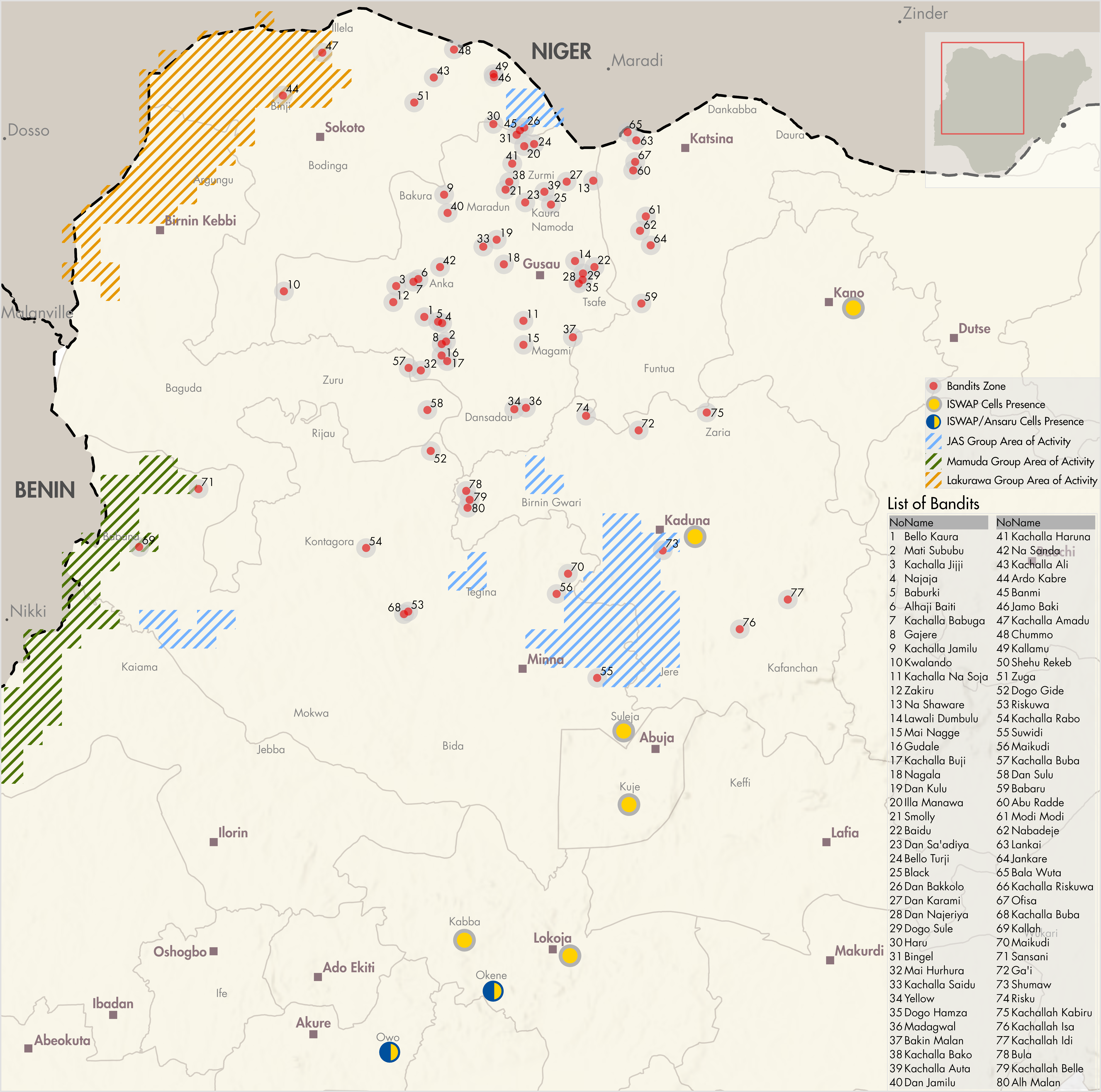
Lakurawa’s experience has been indicative of this trend. In parts of Sokoto (e.g., Balle) and Kebbi (e.g., Argungu) where there is a degree of banditry driven by an assemblage of (relatively) smaller gangs, Lakurawa appears to have succeeded. Respondents noted that in Balle, for example, Lakurawa had largely “displaced” the bandits, allowing local farmers to “return to their fields without fear.”181 In the epicenter of the banditry crisis in Zamfara, by contrast, Lakurawa has not established the same degree of presence to date. As one respondent in Zamfara stated: “The Lakurawa cannot easily establish their base in Zamfara as they did in Sokoto. This is because in Sokoto they came en masse, and you know the bandits there are not as strong as those in Zamfara State.”182 A source in Kebbi similarly explained, “Bandits view Lakurawa with caution. Lakurawa utilizes informants among the bandits to navigate their movements. When bandits commit attacks, it often reflects poorly on Lakurawa, as the community associates such violence with them.”183 Lakurawa therefore seems to have had more success operating in areas occupied by less powerful bandits whom they have an easier time overpowering or recruiting into their fold as opposed to having to negotiate an uneasy relationship with powerful warlords (see subsequent section). As one local researcher in the northwest summarized the situation, “Any area you see an established bandit, Lakurawa will avoid it. They are targeting the emerging bandits [for recruitment] instead.”184
Jihadis Coopting Bandits, or Bandits Using Jihadis?
While this study has primarily adopted a jihadi-centric lens, it might be helpful to flip perspectives and consider briefly how bandits potentially view jihadi expansion. The authors have suggested that jihadis find more success in a sort of “middle-ground” area with regard to banditry (i.e., where bandits are present and harming communities but not at their strongest). This could be further explained by considering two sets of bandits—more powerful warlords and smaller gangs (notwithstanding the aforementioned caveats regarding the subjectivity of those labels)—and how their relative positions might shape their decisions to either accommodate or resist jihadi encroachment.
More powerful bandit warlords might selectively cooperate with jihadis up until a point when they fear excessive jihadi encroachment will undermine their own influence, at which point they might adopt a hostile attitude toward the jihadis. This can be illustrated through the case of the notorious warlord Dogo Gide (discussed below). Conversely, smaller gang leaders or those in more vulnerable positions vis-à-vis rival gangs may align with jihadi groups due to an inability to resist the jihadis or as a means of gaining leverage over their more powerful bandit rivals i.e., out of a position of relative weakness. Yet even in those situations, bandits still exercise agency and might end up being less-than-ideal partners for jihadis, as demonstrated by Lakurawa’s experience with bandits, also detailed further below.
The powerful bandit warlord Dogo Gide demonstrates the challenges that jihadis face in expanding into ‘core’ bandit territory (i.e., Zamfara state and adjacent LGAs in neighboring states). Dogo Gide, a native of the northwest and officially one of the ‘most-wanted’ bandits in the region, has long attracted the interest of Nigerian officials and analysts of Nigeria’s banditry crisis given rumors of his alignment with different jihadi factions and his occasional adoption of jihadi rhetoric in audios and videos.185 Yet, as the first author has previously argued, Dogo Gide’s relationship with jihadis has historically been opportunistic and lacking the strong ideological alignment that some analysts assumed.186 Indeed, in recent years, his gang has emerged as a major rival to multiple jihadi factions in the northwest.
The authors’ understanding is that Dogo Gide facilitated the arrival of several jihadi groups into the northwest after 2018, when he was alleged to have killed the then-most powerful bandit, Buharin Daji, in a personal dispute.187 Gide’s welcoming of jihadis at this time may have been partially reflective of a sincere desire to transform into a more ideologically motivated and credentialed militant. As a former pastoralist lacking any significant Islamic (or Western) education, interlocuters suggest that he may genuinely wish to become seen as a more pious individual, which may have made him receptive to some elements of jihadi preaching by groups like Ansaru and Sadiku’s JAS.188 bi Gide has also undoubtedly used his relations with jihadis to boost his own stature among fellow bandits and leverage this in his dealings with local communities and state authorities, however, indicating a pragmatic interest in forging jihadi ties as well.189
Moreover, not only has Dogo Gide recently been deeply involved in intra-bandit politics in a manner that a full-fledged member of a jihadi group would not,bj he has also emerged as a staunch defender of bandit “turf” from jihadi encroachment in recent years, as demonstrated by clashes with Ansaru in 2024190 and with Sadiku in early 2025. A source who knows Dogo Gide explained:
[Ansaru] and Sadiku’s group have both asked Dogo Gide to accept the ideology and surrender control of the environment to the jihadists. But Dogo Gide disagreed, he said he can’t allow that to happen because they’re not from here. They came from the northeast.191
In a video that Dogo Gide filmed following his gang’s ambush of Sadiku’s men, the bandit can be heard justifying his feud on the grounds that the jihadis have harmed civilians under Dogo Gide’s protection through their use of roadside IEDs.192 Interestingly, he appears to have indeed taken rhetorical cues from the jihadis, but in this instance, he flips it against the jihadis, accusing them of hypocrisy by harming Muslims and urging Sadiku to “repent before it’s too late.”193
One should not entirely discount the potential for Dogo Gide (or another powerful warlord) to undergo a genuine ideological transformation into a jihadi entrepreneur in the future. But for now, the evidence strongly suggests that Dogo Gide, despite having benefited from his past cooperation with jihadis, sees himself as in control of that relationship. He has indicated that he is not interested in surrendering influence over the northwest and has the power to, at minimum, complicate jihadi efforts to expand there, if not necessarily halting them altogether.
Yet, few bandits in the northwest have the same influence as Dogo Gide apart from several other of the most powerful warlords such as Bello Turji, the aforementioned “oga” (top bandit boss) in most of eastern Sokoto and parts of western Zamfara. Most other gang leaders navigate a complex landscape in which they operate largely autonomously on a day-to-day basis with their group of core fighters but must maintain alliances with and provide occasional support to more powerful bandits. Bandit alliances are constantly shifting, and these dynamics, in turn, influence the success or failure of jihadi probing.
In Sokoto state, the authors’ research suggests that several of the less powerful bandits have begun working with Lakurawa out of a position of relative weakness amid the shifting landscape of bandit competition and power. In Binji in central Sokoto, one of the communities where Lakurawa has had a growing presence since 2024 as part of their southward expansion, a respondent recalled how one gang leader, reportedly “unaffiliated” with a larger warlord, joined Lakurawa but then attempted to use his new position to his advantage:
Some of the bandits in this community that joined the Lakurawa include Kwalho, who has joined Lakurawa because he was overpowered by them and he could have been killed he if refused to join them. But mind you, despite [Lakurawa’s] positive aim of handling banditry, Kwalho used the opportunity to his advantage as well [to continue his banditry].194
In another case the authors heard of, a bandit known as Lawali Zakiru began cooperating with Lakurawa in Sokoto as a means of exacting revenge on the powerful warlord Bello Turji. Zakiru had previously been aligned with Turji’s biggest local rivals in Sokoto state, the gang of the brothers Dullu and Bashari Maniya.195 Turji’s gang killed Dullu in 2022,196 causing the latter’s gang to fragment, which left Zakiru to align with various bandits in Zamfara before eventually aligning with Lakurawa at some point in 2025 with the aim of fighting Turji.197 This underscores an interesting phenomenon, in which a weaker bandit (Zakiru) aligned with jihadis to fight a more powerful warlord (Turji). Moreover, aligning with jihadis is merely one possible option available to bandits looking to get back at a rival or reposition themselves vis-à-vis other bandits. Other members of the late Dullu’s gang joined different bandits in Zamfara.bk Meanwhile, Dullu’s brother, Bashari, defected to the government and assisted the security forces in operations against Turji in 2025 (these operations failed, and Turji killed Bashari in a confrontation in June 2025).198
The authors’ research would indicate that Lakurawa has, for the most part, not recruited bandits en masse.bl Doing so could undermine its efforts to gain popular legitimacy in the northwest amid heightened intercommunal tensions. Yet, the limited cases the authors heard of in which the group has begun cooperating with bandits offer insight into the different ways in which bandits may attempt to leverage jihadi presence to their own ends, just as Dogo Gide’s experience shows the reasons why bandits might switch from an accommodating attitude to a hostile one. Among other implications, these findings would suggest that jihadis are likely to face significant continued resistance to expansion and consolidation in Zamfara and parts of neighboring states in the near future, the region the authors would argue constitutes ‘core’ bandit territory. Unfortunately, this has not diminished the threat of jihadi activity elsewhere in ‘western Nigeria,’ as the following section intends to make clear.
The Social Glue of Expansion: Commanders, Kinship, and Clerics
Jihadis have managed to establish a presence outside northeastern Nigeria, and not merely or even principally in the most conflict-affected regions where one might expect the Nigerian state to have the weakest remit and limited capacity to stop jihadi expansion (e.g., swathes of the northwest). Jihadi networks have also emerged in relatively stabler areas such as Kogi and southwestern Nigeria. The ethnic and religious makeups of these states are quite different than in either the northeast or the northwest, such that one might expect the jihadi groups examined in this study to face skepticism as they attempt to recruit in those states.
Two groups, ISWAP and Ansaru, have circumvented this challenge to an extent by leveraging old connections to an overlooked local jihadi scene in Kogi state, which has, in turn, established a presence in southwestern Nigeria and begun to recruit there. These connections are at once ideological—Kogi jihadis have been recruited from segments of the local salafi community that already held highly exclusivist views of other Muslims (e.g., Sufis)—and social, with personal relationships between members of the Kogi jihadi scene persisting despite—and sometimes overriding—the organizational divides between ISWAP and Ansaru. The result is a complex jihadi scene that, in ISWAP’s case, formed the hinge of an ambitious expansionary effort that at one point threatened to destabilize Abuja, as detailed previously. Yet the genesis of this strategic jihadi effort can be traced back to a handful of clerics engaged in often hyper-local religious debates in the 1990s.
From Rival Mallams to ‘Frenemy’ Jihadis: The Shared Roots of Jihad in Kogi
As in other parts of northern Nigeria, Kogi state, and particularly the Ebira community, had experienced significant intra-Muslim turbulence from the 1990s onward, with the rise of different salafi and “reformist” groups (broadly defined) challenging traditional Sufi dominance of key mosques.199 The Ebira community had embraced Islam later than many other communities in northern Nigeria, which widespread conversion to Islam only occurring in the early 20th century.200 Parts of the community have maintained a strong attachment to traditional religion,201 which led to tensions between Muslim activists and salafis on the one hand and traditional spiritualists on the other from the 1970s onward—for example, clashes between traditional masquerade dancers and Muslim activists had occurred in Okene town (the de facto administrative headquarters of Ebiraland) during annual festivals since the early 1990s.202 Many figures in the Ebira salafi community had studied outside of the state at major northern universities such as Bayero University Kano (BUK) or Ahmadu Bello University (ABU) in Zaria,203 where Muslims are a larger majority than in relatively heterogenous Kogi and where, by the 1990s, there was growing Muslim student activism on campus.204 Ebira students in the northern universities, being far from home, found a sense of community by joining existing salafi organizations or even forming their own Ebira groups for dawa, and some of them are believed to have connected with Yusufiyya members in this way.205 bm
Two figures emerged as major players in the Ebira salafi scene in the 1990s: Mallam Baba and Mallam Mustapha (real name Mustapha Idris), initially partners and eventually enemies whose rivalry continues to influence the Ebira jihadi milieu to this day. While Baba had studied at BUK, Mustapha studied in Maiduguri in the 1990s.206 Baba showed a proclivity for extremist activism from early on, and one associate claims his followers were the first to kill a traditional masquerader in 1993,bn which forced him to flee Okene for some years due to the risk of reprisal from traditionalists.207 After Baba returned from exile to Okene sometime between 1998 and 2000,bo he found himself with few followers and began attending the sermons of Sheikh Luqman Musa Galadima (a prominent figure in the Kogi salafi scenebp and in state politics).208 Mallam Mustapha likewise returned to Okene from the northeast sometime between 1996 and 2000209 bq and, along with other salafis, established a congregation at the self-named Markaz Alhus Sunnah wal-Jama’ah in Okene.210 Baba, dissatisfied with Luqman’s “quietist” approach, was drawn to Mustapha’s preachings on jihad and the two became “close friends.”211 Mustapha was vehemently anti-Sufi—more so than Mohammed Yusuf, whose ideological disputes were often with his erstwhile salafi mentors—and would organize and film his supporters destroying Sufi shrines in Ebiraland.212
Baba and Mustapha fell out sometime around 2005, however—reportedly over Baba’s accusation that Mustapha was having an affair with a local prostitute whom he was supposed to be leading in ruqya (Islamic spiritual healing).213 After a failed mediation effort by Sheikh Luqman, the two clerics’ supporters eventually clashed, resulting in Mallam Baba’s death,br while Mallam Mustapha was apparently eventually arrested by DSS for inciting his supporters to violence.214
Some of the Okene jihadis eventually joined JASbs (and later ISWAP) or Ansarubt and possibly even went for training abroad with the latter,bu but it seems that most did not go to the northeast. They instead focused their ultra-takfiri attitudesbv on fighting local authorities, Sufis, and traditionalists within Kogi state.215 Their parochial vision and extreme animosity toward other Nigerian Muslims was apparently off-putting to some Yusufiyya: One Nigerian analyst, Fulan Nasrullah, had described meeting some of the “Okene brothers” in the mid-2000s to discuss the possibility of traveling to Iraq or Afghanistan to fight U.S. forces.216 He recalled being perplexed by Okene jihadis’ reverence of Anwar al-Awlakibw and wrote that “they terrified us to the extent that we cut short our stay and afterwards broke contact with them.”217
As such, between 2012 and 2015, while JAS was waging its own insurgency in the northeast, a local network of jihadis in Okene began carrying out a series of bombings and shootings in Okene and Lokoja that were never formally claimed but were attributed by locals to the “Mallam Baba terrorist group” (despite Baba being dead by this time).218 The targets of the attacks—masqueraders, traditional rulers, and churches219—pointed to the perpetrators’ localized focus. After 2015-2016, when the military attacked a number of mosques and houses reportedly belonging to “Mallam Baba’s” associates,bx these networks appeared largely dormant, until Kogi was again the epicenter of a local jihadi insurgency by 2022.
The ‘Kachalla’ Model of Jihad?
This historical context is crucial for understanding the subsequent reemergence in the 2020s of multiple jihadi networks in central Nigeria. Yet, these overlapping jihadi networks appear to have never fully consolidated under a single banner, and they appear prone to a degree of fragmentation. These dynamics bear additional examination.
From what the authors can discern, there is a good degree of overlap in the Venn diagram of ISWAP cell members in Kogi (particularly Abu Ikrima’s network) and Ansaru members led or inspired by Abu Baraa. Members of each network know each other, and in some instances studied at the same salafi madrassas or had even participated in the Markaz Alhus Sunnah wal-Jama’ah together. One security official described the relationship between the two cells as that of “cousins” and explained that this is sometimes literally the case, with members of an extended family spread across the two cells.220 The legacies of Mallam Baba and Mallam Mustapha seemingly continue to shape their interactions with each other and their approach to jihad.
From what the authors can piece together of Abu Ikrima’s biography, it seems that he studied alongside future Ansaru and ISWAP members at a secondary school in Okene in the 2000s run by the prominent salafi cleric Sheikh Luqman,221 the same cleric whom Mallam Baba and Mallam Mustafa had split from in the early 2000s for being insufficiently sympathetic to jihad.by Members of this secondary school and mosques affiliated with Sheikh Luqman were in turn recruited into study groups led by associates of Mallam Baba and Mallam Mustapha,222 underscoring the fluidity between the hardline/proto-jihadi networks and the more ‘mainstream’ salafi community in Okene that still existed in the 2000s.
Abu Ikrima first came into the Nigerian jihadi orbit in the mid-/late 2000s through one of these members of Luqman’s mosque, who would later become an Ansaru recruiter known by the nom de guerre Abu Junid.223 He also spent time in Maiduguri in this period as a computer science student, in which context he likely came into contact with the Yusufiyya before returning to Kogi.224 Whether Abu Ikrima then joined the emerging Ansaru network in Kogi in the early 2010s as one Crisis Group report has suggested225 is somewhat unclear to the authors, as the sources consulted in this research offer contradictory and vague details about this period of his life. When he was back in Kogi in the early/mid-2010s, sources said he became close to the future ISWAP commander Abu Qatada, who fled Okene after authorities attempted to arrest him for his role in what was then still dubbed the “Mallam Baba terror group” and eventually found his way to Lake Chad (where he joined ISWAP).226 bz Crisis Group notes that Ikrima himself returned to the northeast sometime in the late 2010s, this time to join ISWAP, but was detained by ISWAP commander Mustapha Kirmima on suspicions of his links to Ansaru until 2021, when Habib Yusuf (Abu Musab al-Barnawi) purged Kirmima and released Ikrima.227
In any case, the somewhat confusing information the authors received from sources, if anything, underscores the extent to which, in the 2010s, the exact organizational affiliation of the different members of the Okene jihadi community were not always clear. Some of the Ebiraland jihadis were operating under the label of Ansaru in Kogi and several others traveling to the northeast to join JAS and later ISWAP, all while local authorities referred simply to “Mallam Baba’s” terrorists causing disturbances in Okene.
By 2022, when Habib had tasked Ikrima with activating its network on behalf of ISWAP’s expansionary agenda, Abu Baraa appears to have become the de facto leader of the remaining Ansaru network in Kogi and parts of the southwest (if separated from the Ansaru in Kaduna). Even after Abu Ikrima’s network had begun conducting attacks on behalf of ISWAP, members of that network participated in operations conducted by Abu Barra’s network and vice versa.228 In some cases, there may have been a profit incentive to such cooperation—Ansaru engaged in a string of bank robberies from the late 2010s onward, and at least some members of the Kogi jihadi scene had a criminal background229—while in the case of the July 2022 Kuje prison break, cooperation between the different Kogi networks could have brought the benefit of extra manpower. But this does not fully explain the dynamic. Rather, it appears that Ikrima and Abu Baraa—or perhaps their subordinate commanders—saw their networks as largely autonomous and rooted in a common socioreligious community. Thus, Ikrima, despite his role within ISWAP, did not object to his men participating in Ansaru operations or Ansaru members participating in his own.
The question of whose jihad was being waged in Kogi might have looked quite different from the perspective of those fighting on the ground, far removed from the Lake Chad Basin, than it does to outside analysts, who often have a tendency to categorize jihadis into discrete groups and factions. One source who has debriefed former members of ISWAP and Ansaru in Kogi and the southwest explained, “There is more loyalty from fighters to particular commanders rather than to a specific group … These fighters don’t necessarily understand the differences between the groups too much.”230 The source compared the dynamics to banditry, in which allegiances are fluid and cooperation between gangs is commonplace: “A bandit can sleep in Kaduna and then some guys come up and say they’re doing a raid in [Zamfara] and so he joins.”231
One might dub this the ‘kachalla’ model of jihad after the term bandits use to describe gang leaders. Eschewing the more formalized hierarchy of jihadi groups, bandit gangs are organized loosely around individual kachallas, or commanders, who may themselves have overlapping loyalties—e.g., a gang leader might be a kachalla to his foot soldiers even as he sees himself as an associate of a more influential or senior bandit.232 The authors’ understanding of the ISWAP and Ansaru cells in Kogi, and the broader southwest and north central regions, paints a similarly complex picture.
Despite the apparent symbiosis between ISWAP and Ansaru in Kogi, they never fully merged. One might have assumed that in 2022, Abu Baraa, then seemingly devoid of any serious external sponsor, would have joined Ikrima in rallying to ISWAP, the group appearing dominant within the Nigerian jihadi scene after its killing of Shekau in 2021. Instead, Abu Baraa’s network continued operating independently, even as its members apparently supported Ikrima and vice versa. Unfortunately, the authors could not discern with any precision why this was the case. It may have been that some of the Kogi jihadis, still as hyper-focused on the local jihad in Ebiraland as Fulan Nasrullah recalls them being, were not enticed by the prospects of being affiliated with a global jihadi group like the Islamic State via ISWAP (while others clearly were, as described below). Relatedly, if the fragmentation and continuous evolution of the Nigerian jihadi landscape is any indication, it may have been the case that Abu Baraa simply opted to maintain autonomy rather than subordinate himself to ISWAP—which would track with the aforementioned evidence that he had fallen out with the Ansaru faction in Kaduna (and would also not make Abu Baraa the only jihadi entrepreneur operating outside the northeast with an independent streakca). Other sources indicated that the old divisions between Mallam Baba and Mallam Mustapha also played a role in preventing a full merger between the networks. As one security official noted, “Extremism and certain views bind [Ansaru and ISWAP], ethnicity and previous experience and clerics bind them … Sheikh Mustapha and Sheikh Baba, issues like this bind but also separate them.”233
Ideological and organizational divisions are not irrelevant to dynamics in Kogi. Rather, the case of Kogi shows how ideological and organizational divisions interact with the meso-social factors the authors have described to influence the trajectory of jihadi networks. Put differently, ideological debates and organizational distinctions might matter to some individuals more than others. For example, the individual who reportedly brought Abu Ikrima into the jihadi sphere, Abu Junid, was originally a member of Ansaru but defected to ISWAP over the issue of the ‘caliphate,’ i.e., because he felt it was obligatory for Muslims to serve the entity that was proclaiming itself to be the true Islamic state.234 Ikrima too believed that he was fighting on behalf of a rightful caliphate, according to his associates.235
But this did not stop Ikrima from continuing to work closely with Ansaru, and many of the fighters under him might not have been so attuned to any ideological differences between ISWAP’s leadership and Abu Baraa and may have instead seen their work as a more-or-less common jihad fought under different commanders. Moreover, when Ikrima fell out with ISWAP following the failure of his second phase of attacks in central Nigeria in late 2022, he relied on Ansaru networks to shelter him, as he feared retaliation from ISWAP.236 Thus, while Ikrima’s support for ISWAP’s ideology was likely not superficial, it was his old social networks, rather than any allegiance rooted in ideological conviction, that he fell back on when he was most in need.
The current state of the jihadi scene in Kogi is difficult for the authors to discern, especially following Abu Baraa’s arrest in 2025. As noted previously, ISWAP appears to have shifted away at least temporarily from a Kogi-centered expansion after several setbacks, but there are signs that jihadi cells of one affiliation or another remain active in Kogi and neighboring states.cb With ISWAP and possibly what remains of Abu Baraa’s Ansaru network likely looking to expand farther into the southwest in the future,237 the kachalla model will continue to be a relevant (if necessarily imperfect) frame of understanding expansion. While ISWAP could conceivably rally more jihadi factions to its banner, ISWAP’s Lake Chad-based leadership would nonetheless be unlikely to micromanage operations on the other side of the country and would instead rely on relatively autonomous cell commanders who, in turn, would aim to coopt existing social networks in the region.
Conclusion
The relocation and expansion of jihadis within Nigeria is a highly complex phenomenon. Beyond the challenges of finding reliable sources and assessing conflicting data, studies such as this one struggle with trying to ‘hit a moving target’ so to speak, as developments on the ground often outpace efforts to collect insights from the field, analyze them, and produce a publishable assessment. The authors humbly suggest that this research, however, has value beyond the particular details of individual group movements or commanders’ histories and has notable implications for strategies aimed at containing and curtailing jihadi violence in the region, and likely beyond.
The authors’ findings on the importance of social dynamics in jihadi expansion have significant bearing on threat forecasting and attendant policy responses. Much of the discourse around jihadi expansion in West Africa centers around the ‘spillover’ of jihadi violence from the Sahel into ‘coastal’ West Africa, yet these terms can be somewhat misleading: Nigeria is arguably part of both the Sahel and coastal West Africa, depending on whether one is referring to the country’s far north or south. For several years, Nigeria’s counterterrorism strategy, supported by partners such as the United States and United Kingdom, has effectively been to contain the jihadi threat to the northeast and degrade it there, to prevent jihadis from exploiting insecurity and limited state presence elsewhere in Nigeria that could allow them to expand their influence and link up with Sahelian jihadis. Moreover, by containing jihadi violence to the northeast, the thinking goes, the state can protect the federal capital and other population centers as well as vital economic infrastructure throughout the country (e.g., roads, pipelines, and the ports in southern Nigeria) from terrorism and the associated political and economic costs. These concerns of spillover, whether in Nigeria or ‘coastal’ West Africa as a whole, are valid, yet the question remains about which parts of Nigeria/the region are at highest risk.
It seems clear that southwestern Nigeria faces a higher risk of jihadi violence in the coming years than the other regions of ‘coastal’ Nigeria, and this cannot simply be reduced to the fact that the southwest is home to a more sizable Muslim population than the rest of southern Nigeria. Those jihadis already operating in the southwest are not necessarily distinguishing between Muslims and Christians among the Yorùbá population as they attempt to stoke farmer-herder tensions, as the analysis of Ansaru in this study suggests. Rather, the risk stems to a large extent from the long and overlooked history of jihadi mobilization in parts of Kogi state, with those networks extending into different parts of the southwest—as well as other parts of north-central Nigeria—over the years. Another risk stems from the terrain of the long Nigeria-Benin border, which is favorable to militants given the large stretches of forest that can serve as a geographic bridge between northern and southern Nigeria (loosely defined).
Another, perhaps more surprising finding from this research is that bandits have been a partial check on jihadi expansion under certain conditions, namely in regions where bandits are more consolidated (if still quite informally) under the biggest warlords who recognize the influence they risk losing if they allow jihadis to grow too powerful. This does not preclude bandits and jihadis from cooperating for mutual gain, and it certainly is no halt on jihadi expansion as a whole. It bears repeating that, for example, the “Lakurawa” and Mahmuda groups have managed to operate across wide stretches of western Nigeria in areas affected by banditry though outside the influence of major warlords, while the authors’ examination of dynamics in Kogi should make clear that jihadis have also found ways to evolve and expand that do not directly involve coopting bandits.
Nonetheless, this research reinforces how volatile relationships within the supposed ‘crime-terror nexus’ can exist in countries where the ‘criminals’ are themselves already quite powerful and/or are drawn from a different social base than jihadis. It challenges observers to avoid thinking simplistically that all threats necessarily converge or that all militants, if they draw from a Muslim social base, necessarily evolve into jihadi groups.
To recognize banditry as a pseudo-buffer against jihadis reflects the great tragedy of the current Nigerian predicament, however, as bandits have perpetrated waves of horrific violence against communities and are a highly destabilizing force in their own right. The fact that some communities have welcomed jihadis as their only defense against banditry should dispel any illusions that the status quo in the northwest is somehow acceptable if it manages to prevent total jihadi consolidation. The successive mass kidnappings of students and worshippers in Kebbi, Kwara, and Niger states within days of each other in November 2025,238 underscores just how dangerous the situation in Nigeria’s western states has become. Nigerian policymakers, community leaders, and their partners face the difficult but critical task of addressing two complex and overlapping threats in banditry and jihadism, with the risk that addressing one problem in isolation might inadvertently exacerbate the other. CTC
James Barnett is a PhD (DPhil) candidate at the University of Oxford and a non-resident fellow at Hudson Institute and the Centre on Armed Groups specializing in the study of non-state actors and conflict in Africa. A former Fulbright fellow at the University of Lagos, he has lived in Nigeria for several years and has extensive fieldwork experience across the country.
Umar Musa* (pseudonym) is a researcher based in northern Nigeria with extensive fieldwork experience focused on rural insecurity and non-state actors.
Authors’ Note: This research was generously supported by the U.K.’s Foreign, Commonwealth & Development Office (FCDO) through the Institute for Integrated Transitions (IFIT). This research would not have been possible without the work of colleagues in different parts of Nigeria who provided invaluable research support, most of whom requested anonymity given the sensitive nature of security dynamics.
The authors would like to thank Kars de Bruijne and his colleagues at Clingendael Institute for sharing relevant data on conflict actors as well as ExTrac for making available the use of its data visualization tools. The authors would also like to thank Vincent Foucher, Mathias Khalfaoui, Malik Samuel, and Héni Nsaibia for sharing relevant insights from their research and/or reviewing earlier drafts of this study. All assessments and any mistakes are the authors’ alone.
© 2026 James Barnett, Umar Musa
Substantive Notes
[a] Nigeria is divided into six subnational regions known as geopolitical zones, with the northeast zone being the longstanding hub of the Boko Haram insurgency. This report largely focuses on developments in three other geopolitical zones—known as the northwest, the north central, and the southwest, which the authors collectively refer to as “western Nigeria” in places.
[b] An article in the Nigerian newspaper Premium Times after the arrests did a good job encapsulating some of the confusion and debates among analysts about jihadi groups operating in western Nigeria. See Yakubu Mohammed, “Tracing Al-Qaeda’s Footprints in Nigeria: From war-torn Sahel to Nigeria’s forest reserves,” Premium Times, August 20, 2025.
[c] Several scholars have attempted to explain why jihadi violence emerged specifically in Borno state in the northeast as opposed to other parts of northern Nigeria. See, for example, Abubakar K. Monguno and Ibrahim Umar, “Why in Borno? The History, Geography & Sociology of Islamic Radicalization” in Abdul Raufu Mustapha and Kate Meagher eds., Overcoming Boko Haram: Faith, Society and Islamic Radicalization in Northern Nigeria (Woodbridge, U.K.: Boydell & Brewer, 2020), pp. 64-92 and Scott MacEachern, Searching for Boko Haram: A History of Violence in Central Africa (New York: Oxford University Press, 2018).
[d] Nigeria’s bandits consist of dozens of well-armed, predominantly ethnic Fulani gangs that engage in kidnapping for ransom, extortion, illegal mining, and other criminal activities, with the major bandit leaders acting as warlords with significant de facto political and economic influence in the rural hinterlands (particularly in northwestern states, including Niger state). For more, see James Barnett, “The Bandit Warlords of Nigeria,” New Lines Magazine, December 1, 2021; Kingsley L. Madueke, Olajumoke Ayandele, Lawan Danjuma Adamu, and Lucia Bird, “Armed Bandits in Nigeria,” GI-TOC and ACLED, July 2024; and Peer Schouten and James Barnett, “Divided They Rule? The Emerging Banditry Landscape in Northwest Nigeria,” Danish Institute for International Studies (DIIS), DIIS Report 2025, no. 7 (August 2025).
[e] For example, in his survey of the African jihadi landscape, Stig Jarle Hansen cautions against assuming that jihadis and criminals naturally work together, while Vanda Felbab-Brown shows how the Taliban’s early history as an enforcer of sharia law in warlord-dominated Afghanistan influenced its later policies toward the poppy trade. Stig Jarle Hansen, “Into Darkness: Scrutinizing Economic Explanations for African Jihad,” Current Trends in Islamist Ideology 29 (2021): pp. 23-46; Vanda Felbab-Brown, “Pipe Dreams: The Taliban and Drugs from the 1990s into Its New Regime,” Small Wars Journal, September 15, 2021. For a broad quantitative survey of the data on the crime-terror nexus, see Brian J. Phillips and Alexander Schiele, “Dogs and Cats Living Together? Explaining the Crime-Terror Nexus,” Terrorism and Political Violence 36:5 (2023): pp. 699-715.
[f] Al-Shabaab provides a troubling case study of how insurgents can infiltrate the state (an admittedly disfunctional one in Somalia’s case) by leveraging kinship connections to key political elites and exploiting their grievances. See Ken Menkhaus, “Elite Bargains and Political Deals Project: Somalia Case Study,” HMG Stabilisation Unit, February 2018 and Stig Jarle Hansen, “An In-Depth Look at Al-Shabab’s Internal Divisions,” CTC Sentinel 7:2 (2014).
[g] Similar dynamics are often at play in foreign fighter recruitment to jihadi groups, with foreigners making decisions about which group to join based on the advice and support of friends from their home country who have already relocated to a theater of jihad. This resulted, for example, in different Syrian rebel/jihadi groups receiving recruits in batches formed around friend/family circles back home. See Patrick Haenni and Jerome Drevon, Transformed by the People: Hayat Tahrir al-Shama’s Road to Power in Syria (London: Hurst, 2025), pp. 22-28.
[h] At no point in history have these insurgents called themselves “Boko Haram.” This name, which translates loosely from Hausa (the lingua franca of northern Nigeria) as “Western education is haram (forbidden),” was initially a pejorative used by the movement’s detractors and has since become the popular name among Nigerians and many analysts for Shekau’s JAS faction, if not all jihadis in Nigeria. For an early discussion of the group’s name and the origins of “Boko Haram,” see Andrew Walker, “What Is Boko Haram?” United States Institute of Peace, June 2012.
[i] The military of Niger claimed to have killed Bakura in an airstrike in August 2025. As of this writing, Bakura’s death has not been confirmed, with some researchers reporting that he is alive. See Malik Samuel, “Multiple sources insist that Bakura Doro is alive and well …,” X, August 22, 2025.
[j] Most interviews were conducted in person, while several interviews were conducted by phone. Given the wide geography the authors attempted to cover in their fieldwork, the three authors sometimes each traveled to different locations simultaneously. As such, most of the interviews cited in this study were conducted by one author alone (or with the support of a research assistant/translator) rather than by all three of the authors. With a few exceptions for fellow researchers whom the authors consulted with and who wished to be credited for their insights, the identities of all of the respondents as well as local research assistants are anonymized for safety reasons.
[k] These states were: Borno (northeast zone); Kaduna, Kano, Katsina, Kebbi, Sokoto, Zamfara (northwest zone); Kogi, Kwara, Nasarawa, Niger (north central zone); Oyo (southwest zone); and the Federal Capital Territory (Abuja). Most fieldwork was conducted between November 2024 and June 2025.
[l] ExTrac is a U.K.-based decision intelligence company. For more information, see extrac.ai and/or Paul Cruickshank, “A View from the CT Foxhole: Charlie Winter, Co-Founder, ExTrac AI,” CTC Sentinel 18:4 (2025).
[m] The authors interviewed several security operatives who have been involved in tracking senior jihadi figures. As a general rule, security sources may have professional or political incentives to limit or skew the information that they provide to researchers (e.g., understating certain threats while overhyping others). However, the authors are keenly aware from their past experiences of how these factors can shape official narratives around insecurity in Nigeria, and some of the security sources who were interviewed acknowledged many of these factors in private. The purpose of these interviews (conducted in such a way as to preserve source anonymity) was to elicit more detailed and nuanced assessments of jihadi group dynamics and expansion than officials would be able to make on the record. Moreover, the authors have only cited interviews with security sources who could provide concrete and specific details about the groups or individuals in question, details that the authors were typically able to corroborate from other sources such as jihadi defectors. Given the sensitive nature of the topic and the requests of some sources, certain specific details regarding individuals or operations have been omitted.
[n] For example, many community members in western Nigeria whom the authors have interviewed had seen jihadis visit their community to, for example, buy supplies, preach to the public, or punish residents for supposed un-Islamic transgressions. However, these community members may have only a vague sense of who the jihadis are—in part a product of the complexity and factionalism of jihadi militancy in the region—and may refer to them by generic labels that may in fact be misleading (e.g., “Boko Haram” or “Yan Ansar,” which often gets misreported as Ansaru). In some cases, however, such as communities in Niger or Kaduna states where Sadiku’s group operates, the authors found that the jihadis are slightly more integrated into the community or may be more relaxed about operational security, and community members can therefore more confidently identify specific commanders.
[o] The formation and delineation of ethnic identities and ethnic “homelands,” respectively, in the case of Africa were complex and contested historical processes. For somewhat differing views on this topic, see Mahmood Mamdani, Citizen and Subject: Contemporary Africa and the Legacy of Late Colonialism, 2nd ed. (Princeton, NJ: Princeton University Press, 2018) and Ike Okonta, When Citizens Revolt: Nigerian Elites, Big Oil and the Ogoni Struggle for Self-Determination (Trenton, NJ: Africa World Press, 2008). For a review essay covering some recent literature on nationalism and post-colonialism, see also James Barnett, “The Inescapable Nation,” Los Angeles Review of Books, May 12, 2021.
[p] Many studies have shown how jihadis attempt to exploit existing religious or social divisions to recruit and expand. See, for example, Caleb Weiss, AQIM’s Imperial Playbook: Understanding al-Qa’ida in the Islamic Maghreb’s Expansion into West Africa (West Point, NY: Combating Terrorism Center, 2022). For related analysis regarding the jihadi movement in East Africa, see James Barnett, “The Evolution of East African Salafi-Jihadism,” Current Trends in Islamist Ideology, July 2020, and Matt Bryden and Premdeep Bahra, “East Africa’s Triple Helix: The Dusit Hotel Attack and the Historical Evolution of the Jihadi Threat,” CTC Sentinel 12:6 (2019).
[q] The Borgu kingdom was a powerful pre-colonial state that encompassed the present-day territories of western Benin and Nigeria’s Niger and Kwara states. The current Borgu emirate refers to parts of Niger and Kwara states that were once part of this kingdom and continue to fall under the symbolic authority of the Emir of Borgu. Traditional rulers such as emirs do not have formal political authority in contemporary Nigeria but often hold significant informal authority and influence. Because the Mahmuda group operated across both Niger and Kwara states, the Borgu emirate is a useful descriptor for its area of operations. For a historical analysis of pre-colonial Borgu that resonates with the region’s contemporary security challenges, see Olayemi Akinwumi, “Princes as Highway Men. A Consideration of the Phenomenon of Armed Banditry in Precolonial Borgu,” Cahiers d’Études Africaines 41:162 (2001): pp. 333-350.
[r] In contrast to other Nigerian jihadi factions, in his audio messages, Mahmuda tended to criticize local cultural practices rather than preaching explicitly against the Nigerian government, democracy, or Western education. In particular, he criticized the practice of women working on farmlands, women’s “immodest” fashion, the practice of bathing outside in local rivers, as well as alcohol consumption. Audios and transcripts on file with authors.
[s] An April 2025 report by Nigeria’s national center for coordinating early warning and response mechanisms likewise suggested that Mahmuda’s group was a resurgence of Darul Salam. See Office for Strategic Preparedness and Resilience (OSPRE), “The Mahmuda Group: The Rising Extremist Threat and Escalating Violence Encircling the Kainji Lake National Park,” Office for Strategic Preparedness and Resilience (OSPRE), April 2025.
[t] The authors draw on Thomas Hegghammer and Stéphane Lacroix’s concept of rejectionist Islamists as ones “characterized by a strong focus on ritual practices, a declared disdain for politics, and yet an active rejection of the state and its institutions.” The history of Darul Salam and its early rejectionist nature is beyond the scope of this article, and much remains unclear about its transition from being a non-violent sect to jihadism. A forthcoming publication by the first author will provide more insight on the sect’s early history and relationship with Sadiku’s faction. For more on rejectionist Islamism, see Thomas Hegghammer and Stéphane Lacroix, “Rejectionist Islamism in Saudi Arabia: The Story of Juhayman Al-‘utaybi Revisited,” International Journal of Middle East Studies 39:1 (2007): pp. 103-122.
[u] Some local sources in Kwara and Niger states expressed doubt that the individual arrested by Nigerian authorities was the true “Mahmuda” as they claimed that they had interacted with Mahmuda and that he appeared lighter-skinned, like a foreigner. However, given the details released about Mahmuda to date and the authors’ own investigation, it is more likely that the Nigerian authorities arrested the correct leader of the group, and that Mahmuda had used different lieutenants as interlocuters with local communities, hence the confusion.
[v] Izala, formally Jama’atu Izalatil Bid’ah Wa Iqamatus Sunnah (JIBWIS), was founded in 1978 as an anti-Sufi movement and remains a prominent Islamic organization to this day. Many Nigerians refer to all salafi-leaning Muslims as Izala despite the fact that many clerics who could arguably be considered salafis are not formally part of Izala. Alexander Thurston indeed argues that Nigerian salafism emerged as a distinct ideological trend that began to split from Izala by the 1990s, although he acknowledges that “dividing lines between the two groups remain blurry.” Alexander Thurston, Salafism in Nigeria: Islam, Preaching and Politics (Cambridge: Cambridge University Press, 2016), p. 92. See also Alexander Thurston, “Muslim Politics and Shari’a in Kano State, Northern Nigeria,” African Affairs 114:454 (2015): pp. 28-51.
[w] This was the case for the traditional ruler in Balle, Sokoto, who first invited Lakurawa to his community around 2018. See Murtala Ahmed Rufa’i, “Importing Militant Jihadists: Analyzing the Response of Traditional Authorities to Muslim Youth Extremism in the Nigeria-Niger Border Areas of Sokoto State” in David Ehrhardt, David O. Alao, and M. Sani Umar eds., Traditional Authority and Security in Contemporary Nigeria (London: Routledge, 2024), pp. 151-168.
[x] Mahmuda forcefully collected “donations” from loggers and farmers. Several sources recounted how the Gbenya community of Kaiama initially refused this arrangement, and in response, Mahmuda’s group kidnapped several surveyors sent by the federal government as part of a road-building project near Karonji, because Mahmuda claimed that the road was going to benefit the Gbenya community. However, Mahmuda’s group eventually released the abducted surveyors for a ransom, rendering the claim that the abductions were purely a form of punishment rather than profit somewhat tenuous. Author’s interview in Niger state #1, January 2025; author’s interviews in Kwara #6 and #7, February 2025.
[y] While respondents noted a growing presence of insecurity emanating from the park, they generally attributed this to Fulani bandits and illegal gold miners and said there were no instances of an “ideological” group operating in the state (i.e., one that would preach to communities in Mahmuda’s manner).
[z] The authors would like to thank Janet Ogundairo for her extensive research support in Oyo state.
[aa] Referring to the administrative level in Nigeria below states and above districts or wards.
[ab] Notably, the Beninois military conducted operations against Mahmuda’s fighters along their side of the border in the Borgou department. Two sources also mentioned that Beninois and Nigerian military forces conducted joint operations against the group on Nigerian soil. Author’s interview in Niger state interview #2, January 2025; author’s interview in Kwara interview #4, January 2025.
[ac] One source claimed that Mahmuda had recruited a number of almajiri students from one of these locations in Benin, including some Ghanaian migrants, and brought them back to Nigeria to study in his Islamiyah school in the bush, possibly indicating broader regional aspirations on Mahmuda’s part. Author’s interview in Kwara #4, January 2025; author’s interview in Kwara #8, February 2025. Some of these movements are also referenced in relation to “Darul Salam” in Kars de Bruijne and Clara Gehrling, “Dangerous Liaisons: Exploring the risk of violent extremism along the border between Northern Benin and Nigeria,” Clingendael, June 2024 and Kars de Bruijne, “Trouble at the border: a Nigerian extremist group has also entered Benin,” Clingendael Institute, November 14, 2025.
[ad] Interestingly, the researcher Mathias Khalfaoui, who has extensive contacts in Benin, informed the authors that the attackers attacked Basso from Nigeria, pointing to at least a marginal JNIM staging area on the Nigerian side of the border. Authors’ communication, Mathias Khalfaoui, June 2025.
[ae] His real name is either Adamu Yunusa, according to the United Nations, or Yunusa Kwaya, according to the Maiduguri-based journalist Ijasini Ijani. “Letter dated 6 February 2025 from the President of the Security Council acting in the absence of a Chair of the Security Council Committee pursuant to resolutions 1267 (1999), 1989 (2011) and 2253 (2015) concerning Islamic State in Iraq and the Levant (Da’esh), Al-Qaida and associated individuals, groups, undertakings and entities addressed to the President of the Security Council,” United Nations Security Council, February 6, 2025, p. 8; authors’ correspondence, Ijasini Ijani, August 2025.
[af] An article by James Barnett, Vincent Foucher, and Murtala Ahmed Rufa’i on Sadiku’s group is forthcoming as of the time of this publication. The authors would like to thank Vincent Foucher for permitting them to use some of the data from his interviews for this present analysis of Sadiku’s group.
[ag] Sadiku became so entrenched in the militant landscape of the northwest that many local figures who have interacted with his group, as well as some ex-JAS associates, believed him to be ethnically Fulani. The first author of this present study reported as much in previous studies based on what his sources were reporting at the time, although he is now confident that Sadiku in fact hails from the northeast. For previous reporting on Sadiku, see James Barnett, Murtala Ahmed Rufa’i, and Abdulaziz Abdulaziz, “Northwestern Nigeria: A Jihadization of Banditry, or a ‘Banditization’ of Jihad?” CTC Sentinel 15:1 (2022) and James Barnett and Murtala Ahmed Rufa’i, “A ‘Sahelian’ or a ‘Littoral’ Crisis? Examining the Widening of Nigeria’s Boko Haram Conflict,” Current Trends in Islamist Ideology 32 (2023): pp. 5-46.
[ah] The name that followers of Mohammed Yusuf’s preferred to use before Yusuf’s death in 2009 and the movement’s rebranding as JAS under Abubakar Shekau.
[ai] Some sources insist that Sadiku had himself been a member of the original Darul Salam commune in Mokwa, as the first author previously reported, but this now seems unlikely in light of new information. Some individuals who joined Sadiku’s group from Darul Salam may include Umar Taraba, an influential commander whom some ex-JAS sources described as having first met Sadiku while in the Nasarawa camps after making hijrah from Taraba state to an Islamic “community.” Baba Adamu, another of Sadiku’s senior lieutenants, had been an earlier member of JAS but also intimated to interlocuters during the Abuja-Kaduna train negotiations that he had been a member of Darul Salam at some point in his youth (despite being a Yobe indigene, he spent much of his youth in the northwest and north central). This will be discussed in the forthcoming study on Sadiku.
[aj] Sadiku’s relative tolerance of the Christian Gwari is notable given the ultra-violent approach the JAS has taken toward Christians (and indeed most Muslims) in the northeast. Sadiku’s attitude of relevant tolerance seems to be rooted in pragmatic calculations and a sense that Shekau’s hardline attitude led to excesses that backfired for JAS. These dynamics are detailed further in the forthcoming study on Sadiku.
[ak] Former hostages from the kidnapping described how the assault teams themselves were clearly divided into two: one comprised of local bandits and one led by Sadiku’s group. For example, some hostages recalled that one group of fighters were dressed in turbans and had their faces covered (typical of jihadis) while the other group were dressed more casually and did not cover their faces (typically of many bandits), while other sources described that, based on their facial markings, some of the abductors could be easily identified as Fulani (and thus more likely to be bandits from the northwest). This is drawn from the authors’ interviews and interactions with the former train hostages between 2022 and 2025.
[al] ACLED does not record a number of attacks in this time frame that the authors have knowledge of and have high confidence can be attributed to Sadiku’s group. Because ACLED relies on local media reporting, a number of attacks conducted by Sadiku’s group are coded as being the work of ISWAP or bandits in the ACLED dataset based on Nigerian media reports. For the purposes of this graph, the authors included some incidents in Niger and Kaduna states that were coded as such (e.g., ISWAP or bandits) if the authors had high confidence that the attacks in question had actually been the work of the Sadiku faction based either on their location or the reporting of other sources.
[am] The authors would like to thank Eugenia Igwe for her help analyzing and visualizing ACLED’s data.
[an] The actual intended ISWAP target in Abuja at this time was the Defence Headquarters, located close to the U.S. embassy, according to several diplomats and security sources in the capital.
[ao] In a 2023 study, the first author also hypothesized that the campaign at expansion was driven by disagreements within ISWAP over whether to sustain a Borno-focused status quo or adopt a more aggressive strategic expansion, with the latter camp winning out. See Barnett and Rufa’i, “A ‘Sahelian’ or a ‘Littoral’ Crisis?”
[ap] A number of senior jihadi commanders from earlier years of the Boko Haram conflict were housed in different facilities across Nigeria as a safeguard against potential prisonbreaks. Members of Ansaru and Abu Ikrima’s network reportedly provided intelligence for the Kuje prison break in part because one of their old associates from Kogi, Idris Ojo, was in the prison. Author’s interview, ex-ISWAP fighter #2, January 2025. See also Barnett and Rufa’i, “A ‘Sahelian’ or a ‘Littoral’ Crisis?” and Taiwo Hassan Adebayo, “Addressing the Threats of Expanding Boko Haram Groups,” Centre for Journalism Innovation & Development, August 2024.
[aq] Some of the first targets ISWAP bombed in “western Nigeria” in 2022—a church, bars, a military barracks—point to these various motivations for the campaign. Barnett and Rufa’i, “A ‘Sahelian’ or a ‘Littoral’ Crisis?”
[ar] Indeed, of the 64 terror suspects, mostly former JAS and Ansaru members, who escaped during ISWAP’s Kuje prison attack, several reportedly joined ISWAP, partially vindicating Habib’s belief that a campaign outside the northeast could help rally different figures to ISWAP. See “JAS vs. ISWAP: The War of the Boko Haram Splinters,” Africa Briefing no. 196 (Brussels: International Crisis Group, 2024).
[as] The authors were informed that the commander’s name is Ohida. He was publicly designated in 2024 by the Nigerian government as a terrorist financer, though the profile contained in the sanctions document is sparse: Apart from his full name (Abdulsamat Abdulkareem Ohida) and rank (a qaid in Okene for ISWAP), the authors of the document do not appear to know any other personal details about him, though they allege that he took part in the Kuje prison attack and the June 2022 attack on a church in Ondo. A copy of the sanctions document can be found online on the Nigeria Sanctions Committee’s website.
[at] According to sources the authors spoke to, members of the Kogi network reportedly committed the attack in revenge for the arrest of one of their commanders.
[au] In one case in May 2023, a flat in Keffi in Nasarawa state was being used to assemble explosive devices, indicating an impending attack. Amos Tauna, “Two die of bomb explosion in Nasarawa,” Daily Post, May 29, 2023.
[av] The original Ansaru was reportedly formed by members of the Yusufiyya movement and early JAS who hailed from the northwestern and north-central regions. Their defection from JAS in 2011-2012 was reportedly motivated in part by concerns that Shekau was sidelining non-Kanuri commanders. See Jacob Zenn and Caleb Weiss, “Ansaru Resurgent: The Rebirth of Al-Qaeda’s Nigerian Franchise,” Perspectives on Terrorism 15:5 (2021): pp. 187-199. For more on “Ansaru 2.0” in Kaduna and its differences from the original Ansaru, see Barnett, Rufa’i, and Abdulaziz, “Jihadization of Banditry;” and Barnett and Rufa’i, “A ‘Sahelian’ or a ‘Littoral’ Crisis?”
[aw] The Nigerian authorities have begun a trial of five suspects arrested in connection with the Owo church attack, whom the DSS accuses of being members of the Somalia-based “al-Shabaab” group, although the DSS also noted that the five suspects operated from a cell in Kogi state (and all five suspects appear to be Kogi locals). It is possible that the apparent al-Shabaab connection is due to their having reportedly received training in Somalia through Abu Baraa’s international connections, or it may be the case that the “al-Shabaab” label is an informal one that the cell used to refer to itself (similar to how the Islamic State-linked insurgency in Mozambique was originally known by locals as “al-Shabaab,” literally “the youth” in Arabic). One can hope that the trials underway of both the five suspects as well as Abu Baraa will shed more light on the matter. See Ignatius Igwe, “DSS Confirms Prosecution of Owo Church Attack Suspects, Others,” Channels TV, November 4, 2025.
[ax] The latter is one of Nigeria’s most populous ethnic groups and the majority in the southwest.
[ay] According to the authors’ research, the attack on the Catholic church in Owo in June 2022 was conducted by Kogi jihadis in Abu Bara’s network who had come to know several Fulani pastoralists who had been evicted from Owo by the community amid deteriorating farmer-herder relations in the region. In this telling, the attack on Owo was conducted by Ansaru members (not the herders) who, being familiar with local pastoralist grievances, hoped to further accelerate farmer-herder conflict in the region and thereby push more Fulani to join the jihad. Author’s interview, security official #4, March 2025; author’s interview, Ondo-based source #1, April 2025.
[az] Three of Sadiku’s lieutenants, Baba Adamu, Mohammed Kabir, and Mohammed Mohammed, either claimed or implied during the course of negotiations over the Abuja-Kaduna train kidnapping to have once been students of Ahmad Adam al-Garkawi, a salafi cleric in Kinkinau. It is possible that Abu Baraa even recruited some of these future commanders of Sadiku’s into the jihadi orbit from al-Garkawi’s Islamic schools. Author’s interviews, intermediaries #2 and #3, February 2025; author’s interview, Abu Baraa former associate, June 2025.
[ba] Some Nigerian sources place the militia’s emergence as early as the 1990s, though it is likely that any continuity between herders’ militias in the Sahel then and the present Lakurawa is minimal. See Zagazola, “Origins of the Lakurawa,” Zagazola, March 13, 2025.
[bb] A January 2025 attack on a customs and immigration checkpoint in Arewa Dandi LGA of Kebbi was likely conducted by ISSP/Lakurawa fighters and would point to the group’s interest in establishing a corridor to Benin. Nafisat Abdulrahman, “Lakurawa Kills 2 Immigration Officers, 1 Civilian in Kebbi Border Attack,” Leadership, January 12, 2025.
[bc] As one member of a focus group discussion from Tangaza narrated: “They usually move into the village and gather people to tell them [Lakurawa] are better than the governments or the religious clerics there. They can meet people during prayer and change the imam claiming he cannot lead or teach, and they replace him with someone among them to lead and teach.”
[bd] This is based on a sample size of more than 50 respondents interviewed (individually or in focus group discussions) across six LGAs in Sokoto state and seven LGAs in Kebbi state between January and February 2025, as well as several additional interviews conducted in the two states in May 2025.
[be] A recent study by the Bonn International Centre for Conflict Studies similarly emphasized the flexible nature of Lakurawa and noted that their attitudes toward local communities are shaped by the degree to which those communities accept them. Consequently, Hausa communities in Kebbi state reported more instances of cattle rustling to the study authors than those in Tangaza and Gudu. See Mustapha Alhassan, Oyewole Oginni, and Claudia Breitung, “Countering Lakurawa Recruitment in Northwest Nigeria,” Bonn International Centre for Conflict Studies, September 2025.
[bf] Nevertheless, in the course of conducting this research, the authors had several experiences interviewing sources outside the main areas of Lakurawa operations in Sokoto and Kebbi in which sources described an attack as being perpetrated by Lakurawa but, when pressed as to how they could identify the perpetrators, acknowledged that they could not be certain and that it was more likely the assailants were bandits. Based on their understanding of how conflict incidents in the northwest are reported, the authors suspect that some of the attacks that have been reported in Nigerian media (or on social media) since late 2024 as being the work of Lakurawa may have in fact been the work of bandits. For the purposes of this section on Lakurawa, the authors draw only from interviews with sources who had first-hand experiences with Lakurawa and whose descriptions of the militants clearly indicated that they were jihadis (e.g., preaching, sharia enforcement) rather than bandits.
[bg] These are almost exclusively Muslim communities, with the exception of Sadiku’s relationship with Christian Gwaris in Kaduna. Barnett, Rufa’i, and Abdulaziz, “Jihadization of Banditry;” Barnett and Rufa’i, “A ‘Sahelian’ or a ‘Littoral’ Crisis?”; and Rufa’i, “Importing Militant Jihadists.”
[bh] This is notable insofar as bandits typically justify their militancy through the lens of ethnic conflict, echoing the grievances of Fulani pastoralist communities in the northwest. Since the Nigerian jihad has largely drawn from a different set of communities in the northeast, bandits often find that the grievances that motivate Nigeria’s jihadis are quite different from their own.
[bi] One individual who had negotiated hostage releases with Dogo Gide, quoted in Schouten and Barnett, also commented on Dogo Gide’s poor upbringing and continued dishevelled appearance in the bush: ‘If you see Dogo Gide, you’ll pity him [because he looks poor]. He’s nothing to write home about. For three months, he cannot even change his clothes.” See “Divided They Rule?” p. 25.
[bj] The authors’ sources have shown evidence that Dogo Gide remains active in an informal network of senior bandits in the northwest who coordinate to some extent on strategy and messaging among the gangs, and that he is actively trying to recruit jihadi defectors (notably, specialists such as bombmakers) to his group, rather than volunteering his men for a jihadi cause.
[bk] For example, several members of this gang joined the bandit Jammu Smally in Maradun LGA of Zamfara, while others relocated to Kaura Namoda LGA of Zamfara. Author’s interviews, Zamfara repentant bandits #1 and #2, July 2025.
[bl] Other researchers are of the view that Lakurawa has recently begun recruiting more bandits, including Malik Samuel, who engaged in fieldwork in the northwest on this topic in late 2025. Author correspondence, Malik Samuel, November 2025.
[bm] A March 2025 speech by Sheikh Yaqeen as-Shinqitee, a salafi cleric and former associate of the jihadi cleric Mallam Baba, likewise emphasized the significance of studying at ABU Zaria in the “awakening” of religious activism. As the Sheikh says of his own experience: “So, we were into this, when we went to Zaria, we started discovering that there were so many things we believed in that do not have any evidence in Islam … So, when we came home, and we started hearing [Mallam Raji] had accepted tareeqah [Sufism], we decided to fight him, so that if God loves him but if he goes to accept the jinn we can leave him.” MASWAJ Da’wah Nigeria, “A brief history; The struggles and birth of Markaz Ahlis-sunnah wal’Jamā’ah, Okene, Kogi state,” Facebook post, March 28, 2025 (video in Ebira language, translation on file with authors).
[bn] The source the authors interviewed (Ebira mallam #2) placed the incident in 1992, but a recent newspaper column by an Okene resident who was a young man at the time places the incident in 1993, while Sheikh as-Shinqitee likewise places the killings around 1993-1994 and notes that the killings forced Mallam Baba’s group to leave Ebiraland. See “Yelwata massacre: Between terrorism and communal crisis,” Sun, June 25, 2025; and MASWAJ Da’wah Nigeria, “The struggles and birth of Markaz Ahlis-sunnah wal’Jamā’ah.”
[bo] The authors’ sources were not sure of the exact year of Mallam Baba’s return to Okene.
[bp] Sheikh Luqman is affiliated with the Ansarul Islam movement rather than with Izala, and his followers are sometimes referred to locally as either “Ansarudeen” or the “Sunni” group. His father was, in fact, a prominent cleric in the Tijaniyya Sufi order who was chief imam of the Okene central mosque before his death in 2019. According to the authors’ interviews, Sheikh Luqman’s teachings have diverged from those of his father, and following the late Imam Galadima’s death in 2019, Ebira salafis (referred to as Izala by local sources and media, although some of them may not formally be affiliated with Izala) supported Sheikh Luqman’s candidacy to replace his father against a Tijanniya candidate. The dispute turned violent and resulted in scores of injuries. For more, see Ahmed Tahir Ajobe, “Tension Mounts Over Succession Battle in Okene Central Mosque,” Daily Trust, May 31, 2020. See Footnote V for more on the “blurry” definition of salafis in Nigeria.
[bq] The authors’ source claims that Mallam Mustapha returned to Okene in 2000, but a post from a long-deleted Facebook page belonging to Mallam Mustapha’s markaz claims that the markaz formed in 1996, although it also notes that Mustapha had other associates at the time, which indicates that the center could have been opened before Mustapha had returned to Okene. A screenshot of the Facebook post can be found on Jacob Zenn’s web archive of Boko Haram-related material at “Unmasking Boko Haram: Exploring Global Jihad in Nigeria.”
[br] Other sources say he was detained or “disappeared” by the security agencies (e.g., author’s interview, Kogi official #3, November 2024). In any case, Baba’s group continued to operate in the 2010s after his death, while Mallam Mustapha seems to have publicly preached from his markaz until at least August 2012, as he delivered a sermon criticizing Baba’s supporters for an August 2012 attack on a church in Okene. Video and translation of the speech on file with the authors.
[bs] One former student of Mallam Mustapha who was arrested in 2019 claimed in a media confession to have partaken in bombings (which were claimed by JAS) in and around Abuja in the mid-2010s as well as participating in bank robberies in Owo in neighboring Ondo (where Ansaru and ISWAP would later operate/reactivate). However, confessions such as these staged by police for the media are not always reliable as authorities sometimes conflate different plots and groups and push the suspects to do the same. Afeez Hanafi, “We used proceeds of bank robberies to buy explosives—Suspected Boko Haram commander,” Punch, January 5, 2019.
[bt] Ansaru claimed a January 2013 attack in Kogi on a military convoy heading for peacekeeping mission in Mali, underscoring the group’s early presence in the state. Daniel Prado Simón and Vincent Foucher, “The Life and Capture of Abu Bara, Leader of Ansaru,” SARI Global, August 18, 2025. However, Ansaru recruited several ethnic Igala from a different part of Kogi state, who could have potentially facilitated the group’s initial Kogi-based operations rather than the Mallam Baba/Mustapha networks. Jacob Zenn, Unmasking Boko Haram: Exploring Global Jihad in Nigeria (Boulder, CO: Lynne Rienner, 2020), p. 202.
[bu] Sheikh as-Shinqitee suggests that his movement (which is focused on dawa rather than jihad and had therefore split with Mallam Baba) encouraged those who wanted to “hasten” the struggle (i.e., embark on jihad) to leave Okene for “Maiduguri or Sokoto, or if [they] are still not satisfied, go to Chad or Libya” but then worked to bring home some of those who had “gone to Libya” (possibly a reference to joining Ansaru, given AQIM’s camps in Libya where Abu Baraa and others trained). As with most aspects of the Okene jihadi scene, references are often vague and details of specific individuals are difficult to verify. MASWAJ Da’wah Nigeria, “The struggles and birth of Markaz Ahlis-sunnah wal’Jamā’ah.”
[bv] Takfir refers to the practice of excommunicating fellow Muslims. It is a highly contentious practice in Islam and a frequent source of disagreement among different salafi-jihadis. For example, opposing views regarding the scope of which Muslims can be considered apostates and thus valid targets for jihadi violence have contributed to the ideological and organizational divides between al-Qa`ida and the Islamic State as well as between different jihadi factions in Nigeria. See, for example, Mohammed Hafez, “The Crisis Within Jihadism: The Islamic State’s Populism vs. al-Qa’ida’s Populism,” CTC Sentinel 13:9 (2020). For a history of the Boko Haram conflict that insightfully emphasizes its “ultra-exclusivist” strain, and the debates and fissures within the movement this engendered, see Alexander Thurston, Boko Haram: The History of an African Jihadist Movement (London: Hurst, 2016). For a deeper history of the centrality of takfir to earlier militant Islamic movements, see Cole Bunzel, Wahhabism: The History of a Militant Islamic Movement (Princeton: Princeton University Press, 2023), particularly chapters 2-3 and the conclusion.
[bw] Nasrullah and his associates did not consider al-Awlaki a serious Islamic scholar and actually suspected him of being a CIA plant to entrap Muslims. Fulan Nasrullah, “Okene: The Long Awaited Battleground Between Nigeria and the Takfiris,” Fulan’s SITREP, October 13, 2015.
[bx] Former governor Yahaya Bello, who is himself from Okene, ordered the military to bulldoze several mosques belonging to the militants upon taking office. Author’s interview, Ebira Mallam #2, February 2025; author’s interviews, Kogi officials #1 and #2, November 2024. Other sources alleged the governor recruited some of Mallam Baba’s associates to be his own political thugs as a condition for their release from detention. Author’s interviews, Ebira civil society activists #1 and #2, November 2024; author’s interview, intermediary #2, February 2025.
[by] Some sources claimed that these jihadis continue to send their children to Sheikh Luqman’s school. The sheikh is known as “Abul Yatama” (the father of orphans) as his school often caters to orphans, which could be one reason that jihadi commanders find it easy to send their children there (i.e., people do not typically inquire about the students’ parents). Author’s interview, ex-ISWAP fighter #1 interview, October 2024; author’s interview, intermediary #1 interview, January 2025.
[bz] Ikrima was also said to have attended study sessions under one Abu Muslim, another figure in the Mallam Baba/Mustapha networks. Author’s interview, ex-ISWAP fighter #1, October 2024; author’s interview, intermediary #1, January 2025.
[ca] While it is beyond the scope of this article, a former ISWAP qaid known as Adam Bitri appears to have been an important early figure in jihadi efforts at expansion in the northwest, and his experience may be illuminating. As the first author noted in a previous study, Bitri defected to the Nigerian intelligence services around 2017 before escaping from a government safehouse and joining Ansaru, from which he again defected and attempted to join Sadiku’s JASDJ outfit, only to be killed by Sadiku for having betrayed Abubakar Shekau earlier in his jihadi career. See Barnett, Rufa’i, and Abdulaziz, “Jihadization of Banditry” as well as Malik Samuel, “Boko Haram teams up with bandits in Nigeria,” Institute of Security Studies ISS Today, March 3, 2021. Several of the former jihadis interviewed for this research were former associates of Adam Bitri and one, a childhood friend, referred to Bitri as “[being] tempted by worldly things … he was proud.” (Author’s interview, ex-JAS fighter #5.) While it is unclear what relationship Bitri had to Abu Baraa personally beyond the former’s brief association with Ansaru circa 2019, Bitri’s case is telling of the degree to which pride, fear, or other personal interests can motivate how jihadi commanders align or break with different factions. The relative distance of jihadi cells in western Nigeria from the core of the jihadi conflict in the northeast may also afford commanders in the former more freedom in how they associate and operate, since they are typically far removed from the leadership of the groups that might punish them for intransigence.
[cb] Beyond various reports of kidnappings and bank robberies in the region since 2024 that could well be the work of Kogi jihadis, the authors’ sources in Kogi noted that there have been ongoing disputes between salafis and Sufis in Kogi over control of key mosques, which are the sorts of intra-Muslim tensions that contributed to the radicalization of parts of the Ebira salafi community in the period of Mallam Baba and Mallam Mustapha.
Citations
[1] Timothy Obiezu, “Security analysts concerned as Nigeria warns of new terror group,” Voice of America, November 8, 2024.
[2] “New Terrorist Group Mahmuda Planning Escape to Benin Republic Through Kwara Border Communities,” Sahara Reporters, April 24, 2025.
[3] Towoju Raphael, “Nigeria captures top leaders of Ansaru terrorist group,” National Counter Terrorism Center (Nigeria), August 18, 2025.
[4] See Michael Nwankpa, “Boko Haram 2.0? The Evolution of a Jihadist Group since 2015,” Current Trends in Islamist Ideology 36 (2025): pp. 95-120.
[5] Vincent Foucher, “‘Burn the Camps’: Jihadist Resurgence in the Lake Chad Basin,” ISPI, July 16, 2025; Malik Samuel, “Unseen advances, quiet offensives: ISWAP’s strategic resurgence and the limits of Nigeria’s military response,” Good Governance Africa, July 22, 2025.
[6] James Barnett, Murtala Ahmed Rufa’i, and Abdulaziz Abdulaziz, “Northwestern Nigeria: A Jihadization of Banditry, or a ‘Banditization’ of Jihad?” CTC Sentinel 15:1 (2022): pp. 46-67.
[7] “From Criminality to Insurgency: The Convergence of Bandits and Jihadists in Nigeria’s Northwest,” IntelBrief, The Soufan Center, August 22, 2025.
[8] Héni Nsaibia, “Insecurity in Southwestern Burkina Faso in the Context of an Expanding Insurgency,” Armed Conflict Location & Event Data Project, January 17, 2019.
[9] OECD/Sahel and West Africa Club (SWAC), Borders and Conflicts in North and West Africa, West African Studies (Paris: OECD Publishing, 2022).
[10] From Crisis to Conflict: Climate Change and Violent Extremism in the Sahel (London: Tony Blair Institute for Global Change, 2024).
[11] For some of the best analysis on this topic, see Caleb Weiss, AQIM’s Imperial Playbook: Understanding al-Qa’ida in the Islamic Maghreb’s Expansion into West Africa (West Point, NY: Combating Terrorism Center, 2022).
[12] Julie Chernov Hwang and Kirsten E. Schulze, “Why They Join: Pathways into Indonesian Jihadist Organizations,” Terrorism and Political Violence 30:6 (2018): pp. 911-932.
[13] Anne Speckhard and Molly D. Ellenberg, “ISIS in Their Own Words: Recruitment History, Motivations for Joining, Travel, Experiences in ISIS, and Disillusionment over Time – Analysis of 220 In-Depth Interviews of ISIS Returnees, Defectors and Prisoners,” Journal of Strategic Security 13:1 (2020): pp. 82-127.
[14] For more, see “JAS vs. ISWAP: The War of the Boko Haram Splinters,” Africa Briefing no. 196 (Brussels: International Crisis Group, 2024).
[15] Rachel Chason and Adrián Blanco Ramos, “A Powerful, Opaque alQaeda Affiliate Is Rampaging across West Africa,” Washington Post, June 8, 2025.
[16] For a typical example, see the editorial board of The Wall Street Journal’s piece on U.S. President Donald Trump’s designation of Nigeria as a “country of particular concern” over religious freedom issues: “Trump and Nigeria’s Persecuted Christians,” Wall Street Journal, November 3, 2025.
[17] Katherine Zimmerman, America’s Real Enemy: The Salafi-Jihadi Movement (Washington, D.C.: American Enterprise Institute, July 2017), p. 1.
[18] Peer Schouten and James Barnett, “Divided They Rule? The Emerging Banditry Landscape in Northwest Nigeria,” Danish Institute for International Studies (DIIS), DIIS Report 2025, no. 7 (August 2025).
[19] Barnett, Rufa’i, and Abdulaziz, “Jihadization of Banditry.”
[20] Weiss.
[21] Drawn from authors’ interviews with residents in Niger and Kwara, January to March 2025.
[22] Drawn from authors’ interviews with residents in Niger and Kwara, January to March 2025.
[23] Drawn from authors’ interviews with residents in Niger and Kwara, January to March 2025.
[24] Hansen/UMD/Google/USGS/NASA
[25] UNEP-WCMC and IUCN (2025), Protected Planet: The World Database on Protected Areas (WDPA) [Online], December 2025, Cambridge, U.K.: UNEP-WCMC and IUCN. Available at www.protectedplanet.net
[26] Raphael.
[27] Author’s interviews, two Daura residents, August 2025. One source described him as Hausa-Fulani, indicating he may have a Fulani parent or grandparent.
[28] Author’s interviews, two Daura residents, August 2025.
[29] “Kwara, Niger towns jubilate over speculated DSS’ capture of wanted leader of Mahmuda terror group,” Vanguard, August 6, 2025.
[30] Author’s interviews, two Daura residents, August 2025.
[31] Raphael; author’s interview, security official #6, August 2025.
[32] Author’s interviews in Kwara #3 and #9, January and February 2025.
[33] Author’s interviews in Kwara #1 and #2, January 2025.
[34] Audios and transcripts on file with the authors.
[35] Author’s interview in Kwara #2, January 2025. The interviewee is quoted here: “The name Darul Salam was mentioned by Mahmuda in his first speech in Kemanzi, I think almost 6 months ago, in October 2024, when he gathered people on a Friday when he established a school. But the school is still not very active.”
[36] Author’s interview in Kwara #8, February 2025.
[37] See Alexander Thurston, Salafism in Nigeria: Islam, Preaching and Politics (Cambridge: Cambridge University Press, 2016), particularly chapters 7 and 8.
[38] Author’s interview in Niger state #1, January 2025.
[39] Author’s interview in Niger state #1, January 2025.
[40] Author’s interview in Niger state #1, January 2025.
[41] Author’s interview in Niger state #1, January 2025.
[42] Author’s interviews, Amotekun authorities in Oyo and vigilantes around Old Oyo National Park, March 2025.
[43] Mumini Abdulkareem, “Seven Killed In Fresh Attack On Kwara Community,” Daily Trust, April 22, 2025.
[44] Audio and transcript on file with authors.
[45] “Kwara, Niger towns jubilate over speculated DSS’ capture of wanted leader of Mahmuda terror group.”
[46] See, for example, OSPRE’s report, “The Mahmuda Group: The Rising Extremist Threat and Escalating Violence Encircling the Kainji Lake National Park,” Office for Strategic Preparedness and Resilience (OSPRE), April 2025 and Kars de Bruijne and Clara Gehrling, “Dangerous Liaisons: Exploring the risk of violent extremism along the border between Northern Benin and Nigeria,” Clingendael, June 2024.
[47] Author’s interview, security agent #6, August 2025.
[48] MENASTREAM, “#Benin: #JNIM just claimed its first attack in the Borgou department, specifically in Basso (Kalalé) …,” X, June 12, 2025.
[49] Brant, “JNIM fighters published a video reportedly from Nigeria, the greenery checks out …,” X, July 12, 2025.
[50] MENASTREAM, “#Nigeria: #JNIM just claimed its first attack in Nigeria (on 28 October) …,” X, October 30, 2025; Boubacar Haidara, “Sahel terror group JNIM hits Nigeria for the first time—a sign of expansion plans,” Africa Report, October 31, 2025.
[51] MENASTREAM, “#Nigeria: 1st official JNIM statement claiming an attack in Nigeria, saying …,” X, November 22, 2025.
[52] See de Bruijne and Gehrling for details on suspected JNIM movements into Nigeria since 2020, some of which involved transiting through Mahmuda’s general area of operations.
[53] Author’s interviews, ex-JAS fighters #4 and #7, February 2025; author’s interview, Fulani elder in Kaduna, March 2025; Vincent Foucher interviews with two former lieutenants of Sadiku and two wives of former Sadiku lieutenants, 2023 and 2024 (transcripts shared with authors).
[54] Transcript of interview with former JAS member shared by Vincent Foucher.
[55] “Violence in Nigeria’s North West: Rolling Back the Mayhem,” International Crisis Group, report no. 288, May 18, 2020; James Barnett, “Investigating the ‘Boko Haram’ Presence in Niger State,” HumAngle, April 30, 2021.
[56] Kingsley Nwezeh, “Darul Salam Terror Group Defeated, Says DHQ,” This Day, September 4, 2020; author’s interviews with community leaders, authorities, and vigilantes in Toto LGA, March 2025.
[57] Author’s interviews in Chikun LGA #1-#3 and focus group discussion, February 2025; author’s focus group discussion in Shiroro LGA, March 2025.
[58] Drawn from authors’ fieldwork in Chikun and Shiroro, February and March 2025.
[59] Author’s fieldwork in Chikun and Shiroro, February and March 2025.
[60] As detailed in the forthcoming study on Sadiku’s group.
[61] Author’s interviews, ex-JAS fighters #3 and #5, February 2025. Additional details in transcripts of interviews conducted by Vincent Foucher.
[62] James Barnett and Murtala Ahmed Rufa’i, “A ‘Sahelian’ or a ‘Littoral’ Crisis? Examining the Widening of Nigeria’s Boko Haram Conflict,” Current Trends in Islamist Ideology 32 (2023).
[63] Barnett, Rufa’i, and Abdulaziz, “Jihadization of Banditry.”
[64] Author’s interviews, ex-JAS fighters #3 and #5, February 2025; Barnett and Rufa’i, “A ‘Sahelian’ or a ‘Littoral’ Crisis?”
[65] Barnett and Rufa’i, “A ‘Sahelian’ or a ‘Littoral’ Crisis?”
[66] Ibid.
[67] Ibid.
[68] Author’s interview, ex-JAS fighter #5, February 2025.
[69] Author’s interview in Shiroro LGA #3, March 2025.
[70] Author’s interviews in Shiroro #1-#3 and Shiroro focus group discussion, March 2025. Commanders that sources listed included Ibnu Hassan, Alhaji Idris, Baba Saidu, Ali Mai-Doki, Umar Bin-Sale, Mallam Musa, and Mallam Shafi’e.
[71] Author’s interviews in Shiroro #1-#3 and Shiroro focus group discussion, March 2025.
[72] Malik Samuel and Ed Stoddard, “Resurgent jihadist violence in northeast Nigeria part of a worrying regional trend,” New Humanitarian, June 2, 2025.
[73] Taiwo-Hassan Adebayo, “Investigation: Why terror attack on Nigeria’s Kuje prison was successful,” Premium Times, September 27, 2022.
[74] Michael Conte and Nimi Princewill, “US orders families of embassy employees to depart Nigeria due to heightened risk of terrorism,” CNN, October 28, 2022.
[75] James Barnett, “Remaining Without Expanding? Examining Jihadist Insurgency in Northeastern Nigeria,” Caravan 2132, September 21, 2021.
[76] See “JAS vs. ISWAP.”
[77] Based on observations from repeated interviews with ISWAP defectors.
[78] Author’s interview, ex-ISWAP fighter #3, March 2025; authors’ interview, security official #3, March 2025.
[79] Author’s interviews, security officials #1 and #3, November 2024 and March 2025; author’s interview, ex-ISWAP fighter #3, March 2025.
[80] Author’s interview, ex-ISWAP fighter #3, March 2025; author’s interview, security official #3, March 2025.
[81] Taiwo Hassan Adebayo, “Addressing the Threats of Expanding Boko Haram Groups,” Centre for Journalism Innovation & Development, August 2024.
[82] Ibid.
[83] Barnett and Rufa’i, “A ‘Sahelian’ or a ‘Littoral’ Crisis?”
[84] Author’s interview, ex-ISWAP fighter #2, January 2025; authors’ interview, security official #6, August 2025.
[85] Author’s interview, ex-ISWAP fighter #2, January 2025; authors’ interview, security official #6, August 2025.
[86] Barnett and Rufa’i, “A ‘Sahelian’ or a ‘Littoral’ Crisis?”
[87] Author’s interview, intermediary #2, February 2025.
[88] Author’s interview, ex-ISWAP fighters #1 and #2, November 2024 and January 2025; author’s interview, security official #1, November 2024; author’s interview, intermediary #2, February 2025.
[89] Author’s interview, ex-ISWAP fighter #1, November 2024; author’s interview, security official #3, March 2025.
[90] Author’s interview, ex-ISWAP fighter #1, November 2024; author’s interview, security official #3, March 2025.
[91] Author’s interviews, ex-ISWAP fighters #1 and #2, November 2024 and January 2025; author’s interviews, security officials #1 and #3, November 2024 and March 2025; author’s interview, intermediary #4, April 2025. Much of this success owes to a specialized counterterrorism cell within DSS created in 2022.
[92] “JAS vs. ISWAP.”
[93] Okiki Adeduyite, “Military uncovers plot to establish ISWAP bases in Plateau, Bauchi,” Punch, April 13, 2025; Taiwo Adisa, “How security operative burst ISWAP’s plan to establish camps in Oyo,” Nigerian Tribune, January 10, 2025. See also “Secret Police DSS Reveals Imminent ISWAP Terrorist Attacks in Ondo, Kogi States,” Sahara Reporters, October 22, 2025.
[94] Jacob Zenn and Caleb Weiss, “Ansaru Resurgent: The Rebirth of Al-Qaeda’s Nigerian Franchise,” Perspectives on Terrorism 15:5 (2021): pp. 187-199.
[95] Ibid.
[96] Barnett, Rufa’i, and Abdulaziz, “Jihadization of Banditry.”
[97] Barnett and Rufa’i, “A ‘Sahelian’ or a ‘Littoral’ Crisis?”
[98] Ibid.
[99] Ibid.
[100] Barnett, Rufa’i, and Abdulaziz, “Jihadization of Banditry.”
[101] Author’s interview, security official #2, November 2024; author’s interview, ex-JAS fighter #3, February 2025; author’s interviews, Kaduna ex-bandits #1 and #2, February 2025.
[102] Author’s interview, ex-JAS fighter #3, February 2025.
[103] Barnett and Rufa’i, “A ‘Sahelian’ or a ‘Littoral’ Crisis?”; for a transcript of the audio, see Ibrahim Hassan-Wuyo, “Ansaru terrorists deny attacking Kaduna-Abuja train,” Vanguard, June 4, 2022.
[104] Malik Samuel, “An excellent read from Daniel Prado Simón and @VincentFoucher on the arrested Abu Bara …,” X, August 18, 2025.
[105] Daniel Prado Simón and Vincent Foucher, “The Life and Capture of Abu Bara, Leader of Ansaru,” SARI Global, August 18, 2025.
[106] Security official #1, November 2024; author’s interview, Abu Baraa former associate, June 2025.
[107] Simón and Foucher.
[108] Ibid.
[109] Ibid.
[110] Ibid.
[111] Ibid.; author’s interview, security official #6, August 2025.
[112] Simón and Foucher.
[113] Author’s interview, security official #3, March 2025.
[114] Author’s interviews, security officials #1 and #3, November 2024 and March 2025.
[115] Author’s interview, security official #3, March 2025. For context, see Musliudeen Adebayo, “Fear heightens over upsurge of attacks, abductions on Lagos-Ibadan Expressway,” Daily Post, November 13, 2022.
[116] Author’s interview, security official #3, March 2025; author’s interview, Ondo-based source #1, April 2025. For context on the attacks in and around Kogi that coincided with ISWAP’s 2022 campaign but were never claimed, see Barnett and Rufa’i, “A ‘Sahelian’ or a ‘Littoral’ Crisis?”
[117] Author’s interview, security official #3, March 2025.
[118] Author’s interview, security official #3, March 2025.
[119] Barnett, Rufa’i, and Abdulaziz, “Jihadization of Banditry.”
[120] Author’s interviews, security officials #3 and #4, March 2025.
[121] Author’s interview, security official #6, August 2025.
[122] Author’s interview, security official #3, March 2025.
[123] Simón and Foucher.
[124] Author’s interview, security official #7, August 2025.
[125] Murtala Ahmed Rufa’i, “Importing Militant Jihadists: Analyzing the Response of Traditional Authorities to Muslim Youth Extremism in the Nigeria-Niger Border Areas of Sokoto State” in David Ehrhardt, David O. Alao, and M. Sani Umar eds., Traditional Authority and Security in Contemporary Nigeria (London: Routledge, 2024).
[126] Barnett, Rufa’i, and Abdulaziz, “Jihadization of Banditry.”
[127] Shola Lawal, “Lakurawa, the new armed group wreaking havoc on the Nigeria-Niger border,” Al Jazeera, January 10, 2025; Chris Ewokor and Mansur Abubakar, “New Nigerian jihadist group declared terrorists,” BBC, January 24, 2025.
[128] “Nigeria’s military launch offensive on new rebel group,” Al Jazeera, January 6, 2025.
[129] James Barnett and Vincent Foucher, “Who are Nigeria’s ‘new’ Lakurawa militants?” Jihadology, October 15, 2025.
[130] Ibid.
[131] “Letter dated 19 July 2024 from the Chair of the Security Council Committee pursuant to resolutions 1267 (1999), 1989 (2011) and 2253 (2015) concerning Islamic State in Iraq and the Levant (Da’esh), Al-Qaida and associated individuals, groups, undertakings and entities addressed to the President of the Security Council,” July 22, 2024.
[132] Héni Nsaibia, “New frontlines: Jihadist expansion is reshaping the Benin, Niger, and Nigeria borderlands,” ACLED, March 27, 2025.
[133] Barnett and Foucher, “Who are Nigeria’s ‘new’ Lakurawa militants?”
[134] Nsaibia, “New frontlines.”
[135] Ibid.
[136] See one November 2024 reference to Ameer Habib Tajje by the Nigerian defense blogger Zagazola: Seun Opejobi, “Renounce criminal activities – Lakurawa warns Bello Turji,” Daily Post, November 12, 2024.
[137] “L’Etat islamique trace sa route du Mali vers le Nigeria via le Niger,” Mondafrique, July 2, 2025.
[138] Author’s correspondence, Héni Nsaibia, July 2025.
[139] Author’s interviews in Balle (Sokoto) #1 and #2, January 2025; author’s interview in Tangaza (Sokoto) #4, January 2025; author’s interview in Silame (Sokoto) #1, January 2025.
[140] Nsaibia, “New frontlines.”
[141] James Barnett, “West Africa’s Compounding Security Challenges,” Orion Policy Institute, November 29, 2023.
[142] Insights drawn from the authors’ three interviews and two focus group discussions/group interviews in Binji and three interviews and a focus group discussion in Silame, January 2025.
[143] Insights drawn from the authors’ 11 interviews and six focus group discussions conducted across these five LGAs in Kebbi state, January-February 2025.
[144] From one of the author’s focus group discussion in Arewa Dandi (Kebbi) #2, February 2025.
[145] Author’s focus group discussion with residents of Balle (Sokoto) #1, January 2025.
[146] Author’s focus group discussions with residents of Tangaza (Sokoto) #1-#3, January 2025.
[147] Author’s focus group discussions with Tangaza (Sokoto) residents #1-#3, January 2025; author’s focus group discussion, Balle (Sokoto) residents #1, January 2025.
[148] Author’s focus group discussion, Balle (Sokoto) residents #1, January 2025.
[149] Author’s focus group discussion, Tangaza (Sokoto) residents #3, January 2025.
[150] Authors’ interview, Balle (Sokoto) resident #2, January 2025; authors’ interview, Sokoto pastoralist, February 2025; author’s interview, Gudu (Sokoto) elder, May 2025.
[151] Author’s focus group discussion, Tangaza (Sokoto) residents #2, January 2025.
[152] Author’s focus group discussion, Tangaza (Sokoto) residents #1, January 2025.
[153] Author’s focus group discussion, Augi (Kebbi) residents #1, February 2025.
[154] Author’s interview, Sokoto pastoralist, May 2025.
[155] Author’s interview, Gudu (Sokoto) elder, May 2025.
[156] Author’s focus group discussion, Binji (Sokoto) residents #1, January 2025; author’s focus group discussion, Silame (Sokoto) residents #1, January 2025; author’s focus group discussions, Augi (Kebbi) residents #1 and #2, February 2025; author’s interview, Gudu elder, May 2025.
[157] Secmxx, “Reports coming out of Mera, in kebbi state indicating a possible fight between locals and preachers (lakurawa) …,” X, November 9, 2024. The authors’ interviews in Kebbi likewise indicated that the November attack against Mera community, one of Lakurawa’s deadliest to date in the state, was due to a conflict with vigilantes.
[158] Author’s focus group discussion, Augi (Kebbi) residents #2, February 2025.
[159] Author’s focus group discussion, Silame (Sokoto) residents #2, January 2025.
[160] Author’s interview, Gudu elder, May 2025.
[161] Schouten and Barnett, pp. 13-14.
[162] Ibid., pp. 13-14.
[163] See, for example, a list of just under 200 bandit gangs in Schouten and Barnett, p. 25. See also chapter 6 of Sulaiman Y. Balarabe Kura et al., Armed Banditry and Community Resilience in Northwest Nigeria: Mitigation Strategies, Conflict Resolution and Peace-Building (Sokoto: Usmanu Danfodiyo University Sokoto, 2024).
[164] Schouten and Barnett, pp. 15-16.
[165] Ibid., p. 16.
[166] James Barnett, “The Bandit Warlords of Nigeria,” New Lines Magazine, December 1, 2021.
[167] For more on the geography of banditry, see Schouten and Barnett. See also Idayat Hassan and James Barnett, Northwest Nigeria’s Bandit Problem: Examining the Conflict Drivers (Abuja: Centre for Democracy and Development, 2022).
[168] Schouten and Barnett. See also the interactive mapping feature that accompanies the report on the DIIS website: “Bandits in Nigeria.”
[169] Barnett, Rufa’i, and Abdulaziz, “Jihadization of Banditry.”
[170] Adapted from Anette Idler, Borderland Battles: Violence, Crime, and Governance at the Edges of Colombia’s War (London: Oxford University Press, 2019).
[171] Barnett, Rufa’i, and Abdulaziz, “Jihadization of Banditry.”
[172] Author’s interview, ex-JAS fighter #5, February 2025.
[173] Author’s interview, ex-JAS fighter #3, February 2025.
[174] Transcript of interview with former member of Sadiku’s camp shared by Vincent Foucher as part of a forthcoming collaborative study.
[175] Author’s interview, ex-JAS fighter #5, February 2025.
[176] Author’s interview, ex-JAS fighter #5, February 2025.
[177] Audio and transcript on file with authors.
[178] Author’s interview in Kwara #8, February 2025.
[179] Author’s interview in Kwara #9, February 2025.
[180] Author’s interview in Kwara #1, January 2025.
[181] Author’s focus group discussion, residents of Balle (Sokoto), January 2025.
[182] Author’s focus group discussion in Maru (Zamfara), February 2025.
[183] Author’s interview in Kaingiwa Arewa (Kebbi) #1, February 2025.
[184] Author’s correspondence, Sokoto-based researcher, October 2025.
[185] See, for example, Bulama Bukarti’s 2023 Twitter thread on Dogo Gide, which underscored the bandit’s growing threat and claimed that he is emerging as a new Abubakar Shekau. Bulama Bukarti, “Dogo Gide: Curtailing the Emergence of a New Shekau …,” X, August 16, 2023.
[186] Barnett, Rufa’i, and Abdulaziz, “Jihadization of Banditry.”
[187] Ibid.
[188] Author’s interview, intermediary #3, February 2025.
[189] See Barnett, Rufa’i, and Abdulaziz, “Jihadization of Banditry.”
[190] “Notorious bandit, Mudi, son, others killed in Kaduna,” Vanguard, April 2, 2024.
[191] Author’s interview, Kaduna ex-bandit #1, February 2025.
[192] Video and translation on file with the authors.
[193] The Nigerian blogger Zagazola shared the untranslated video on his X account along with commentary. Zagazola, “Rivalry: Dogo Gide Eliminates 20 Sadiku Boko Haram terrorists in North West …,” X, January 23, 2025.
[194] Author’s focus group discussion, Binji (Sokoto) residents #2, January 2025.
[195] Author’s interviews, Sokoto repentant bandits #1 and #2, August 2025.
[196] Idris Mohammed, “Dullu, a notorious bandit from Maniya village of Shinkafi. He was killed yesterday after he clashed with ….,” X, June 1, 2022.
[197] Author’s interviews, Sokoto repentant bandits #1 and #2, August 2025.
[198] Video and transcript in possession of the authors.
[199] For more on these trends in Nigeria, see Thurston, Salafism in Nigeria and Abdul Raufu Mustapha, “Understanding Boko Haram” in Abdul Raufu Mustapha ed., Sects & Social Disorder: Muslim Identities & Conflict in Northern Nigeria (Rochester, NY: James Currey, 2014).
[200] See Mukhtar Umar Bunza and Abdullahi Musa Ashafa, “Religion and the New Roles of Youth in Sub-Saharan Africa: The Hausa and Ebira Muslim Communities in Northern Nigeria, 1930s–1980s,” Journal for the Study of Religions and Ideologies 9:27 (2010): pp. 302-331.
[201] Author’s interview, Ebira mallam #1, February 2025.
[202] Author’s interview, Ebira mallam #2, February 2025.
[203] Jacob Zenn, Unmasking Boko Haram: Exploring Global Jihad in Nigeria (Boulder, CO: Lynne Rienner, 2020), 201-203; Ebira civil society activists #1 and #2 interviews, November 2024.
[204] For more on religious tensions on campuses in the 1980s and 1990s, see Jibrin Ibrahim, “Religion and Political Turbulence in Nigeria,” Journal of Modern African Studies 29:1 (1991): pp. 115-136.
[205] Author’s interview, Kogi officials #1 and #2, November 2024; author’s interview, Ebira civil society activists #1 and #2, November 2024.
[206] Author’s interview, Ebira mallam #2, February 2025.
[207] Author’s interview, Ebira mallam #2, February 2025.
[208] Author’s interview, Ebira activist #1, November 2024; author’s interview, Ebira mallam #2, February 2025.
[209] Author’s interview, Ebira mallam #2, February 2025.
[210] Author’s interview, Ebira mallam #2, February 2025.
[211] Author’s interview, Ebira mallam #2, February 2025.
[212] Zenn, Unmasking Boko Haram, pp. 135, 200-203. Videos produced by Mallam Mustapha’s markaz in the 2000s show his students destroying Sufi shrines. Several of the videos are available on Jacob Zenn’s web archive at “Unmasking Boko Haram: Exploring Global Jihad in Nigeria.”
[213] Author’s interview, Ebira mallam #2, February 2025.
[214] Author’s interviews, Kogi officials #1-#3, November 2024; author’s interview, Ebira mallam #2, February 2025.
[215] Zenn, Unmasking Boko Haram, pp. 201-203.
[216] Fulan Nasrullah, “Okene: The Long Awaited Battleground Between Nigeria and the Takfiris,” Fulan’s SITREP, October 13, 2015.
[217] Ibid.
[218] “Ten killed in clash between Nigerian troops, militants in Kogi,” Premium Times, October 13, 2015.
[219] Barnett and Rufa’i, “A ‘Sahelian’ or a ‘Littoral’ Crisis?”
[220] Author’s interview, security official #3, March 2025.
[221] Author’s interview, ex-ISWAP fighter #1, October 2024; author’s interview, intermediary #1, January 2025. Additional details in this section are from security reports seen by the authors.
[222] Author’s interview, Ebira mallam #2, February 2025; author’s interview, Kogi officials #1 and #3, November 2024; author’s interview, intermediary #1, January 2025.
[223] Author’s interview, ex-ISWAP fighter #1, October 2024.
[224] Author’s interview, ex-ISWAP fighter #1, October 2024; author’s interview, intermediary #1, January 2025.
[225] “JAS vs. ISWAP.”
[226] Author’s interview, ex-ISWAP fighter #1, October 2024.
[227] “JAS vs. ISWAP.”
[228] Author’s interview, security officials #1 and #3, November 2024 and March 2025; author’s interview, ex-ISWAP fighter #1, October 2024; author’s interview, intermediary #1, January 2025.
[229] See Barnett and Rufa’i, “Sahelian or Littoral Crisis?”, particularly the endnotes, for more on Idris Ojo, a central figure in the Kogi jihadi scene who had been arrested earlier in his life for his involvement in a local carjacking syndicate.
[230] Author’s interview, intermediary #1, January 2025.
[231] Author’s interview, intermediary #1, January 2025.
[232] Schouten and Barnett.
[233] Author’s interview, security official #3, March 2025.
[234] Author’s interview, ex-ISWAP #1, October 2024.
[235] Author’s interview, ex-ISWAP #1, October 2024; author’s interview, intermediary #1, January 2025.
[236] Author’s interview, ex-ISWAP #1, October 2024; author’s interview, intermediary #1, January 2025; author’s interview, security official #3, March 2025.
[237] For another perspective on jihadi expansion into southwest Nigeria, see Adebayo, “Expanding Boko Haram Groups.”
[238] “Nigeria declares security emergency after wave of mass kidnappings,” RFI, November 27, 2025.
