
From the Editors
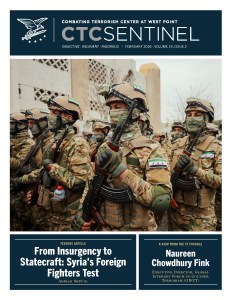
Ahmed al-Sharaa’s ongoing consolidation of power in Syria will depend to a great extent on the integration of the battle-hardened foreign fighters in the country, Adrian Shtuni writes in our cover article this month. He explains: “These foreign fighters—especially their ideologically driven leaders—represent a classic double-edged sword. While they currently remain valuable to al-Sharaa’s project, the long-term viability of this relationship is far from assured. Their loyalty to him should not be regarded as unconditional; its future will likely depend heavily on al-Sharaa’s continuing ideological evolution as well as practical considerations.”
Our interview is with Naureen Chowdhury Fink, executive director of the Global Internet Forum to Counter Terrorism (GIFCT), which works to prevent terrorists and violent extremists from exploiting digital platforms. In less than a decade, the organization has grown from four to over 35 members. “Working with different stakeholders teaches you a lot about how the same problem can look to different stakeholders and where you can actually find points of commonality,” Fink says. “Divergence is easy to find. There’s a lot of noise about where we all disagree on things, but finding that convergence, which is there, has been one of the most exciting parts of working with so many different stakeholders.”
Peter Smith, Cat Cadenhead, and Clara Broekaert map the tiered online ecosystem that is the True Crime Community and situate it—when at its most extreme—within the nihilistic violent extremist landscape. “The TCC,” they write, “illustrates a form of digitally mediated participation in which violence becomes a symbolic language rather than an ideological act. Its tiered structure shows how individuals may move from mainstream true-crime interest into more insular, transgressive subcultures that celebrate perpetrators and aestheticize harm.”
Finally, Nuno Tiago Pinto—after reviewing more than 8,000 pages of court documents—describes in great detail how Portuguese authorities investigated, arrested, and successfully prosecuted two Iraqi brothers for their involvement with the Islamic State. It marked the first time Portugal had convicted an individual for war crimes. “The outcome,” Pinto writes, “was made possible due to extensive and unprecedented international cooperation involving the Iraqi authorities; UNITAD – the Investigative Team to Promote Accountability for Crimes Committed by Da’esh/ISIL; … and Operation Gallant Phoenix.”
Don Rassler and Kristina Hummel, Editors-in-Chief
