
Abstract: This article examines the evolving role and implications of foreign fighters in Syria’s fragile post-war transition. It analyzes efforts to integrate these combatants into unified national security forces, while highlighting emerging tensions between President al-Sharaa’s increasingly pragmatic governance agenda and the ideologically rigid positions of veteran jihadi fighters. Amid converging security threats, their integration tests the new leadership’s ability to balance loyalty demands, international legitimacy concerns, and the consolidation of centralized authority within a multi-front security environment. Ultimately, the security challenges posed by foreign fighters are best understood and addressed within the broader regional equation of stability, counterterrorism, and geopolitical competition. Cautious, targeted engagement with al-Sharaa’s government—through strict oversight, conditional incentives, and calibrated support—offers the most viable path toward fostering a Syria that denies safe havens to terrorist groups, mitigates regional instability, diminishes the influence of Russia and Iran, and aligns with the strategic and security interests of the United States, the European Union, and neighboring regional allies.
On December 1, 2025, Syria’s President Ahmed al-Sharaa received a cordial handwritten note from U.S. President Donald J. Trump pledging American support and hailing him as a future “great leader.”1 This would have been unimaginable prior to al-Sharaa’s dramatic pivot one year earlier from an insurgency commander who carried a $10 million U.S. bounty for his past al-Qa`ida ties2 to a pragmatic West-leaning statesman who talks about inclusivity and institutional reform. What preceded this transformation was a major Hay’at Tahrir al-Sham (HTS)-leda offensive operation codenamed “Deterrence of Aggression” to overthrow the regime of Bashar al-Assad. After an 11-day blitz, the rebel leader—then known by his kunya Abu Muhammad al-Jolani—entered Damascus as Assad fled to Moscow. This rapid collapse ended nearly 14 years of civil war, over five decades of the Assad family’s dynastic rule, and the deeply entrenched Russian and Iranian domination that had long propped it up. With HTS formally dissolving itself to enable a broader power-sharing arrangement, the upheaval also cleared the path for al-Sharaa’s transitional government. Yet, it has also intensified international scrutiny and urgent policy debates over the opposition coalition’s lingering extremist elements, particularly the thousands of battle-hardened foreign jihadi fighters who retain the most uncompromising global-jihadi agendas and, in some cases, persisting ideological ties to al-Qa`ida.b
Various options have been discussed and/or pursued to handle this cohort, including: repatriate and prosecute, integrate foreign fightersc into Syrian security forces under strict oversight (as has been partially done, despite Western concerns), expel quietly, or risk allowing ideologically irreconcilable elements to regroup and destabilize the fragile post-war order. All these considerations are influenced by practical, historical, and ideological factors. This article examines these factors and the slow-burning tensions emerging between these hardline foreign veterans and al-Sharaa’s bold Western-leaning nationalist agenda. Rather than treating the foreign fighter challenge in isolation, this analysis contextualizes it within Syria’s converging security threats: recurring sectarian violence with Kurdish, Druze, and Alawite communities; persistent Islamic State activity; and continued Israeli airstrikes and ground incursions. Against this complex backdrop, the article assesses what lies ahead for the foreign fighter contingent in Syria and al-Sharaa’s prospects for consolidating power and preventing multi-front volatility—including potential confrontation with hardline jihadi foreign fighters.
The Foreign Fighters in Post-Assad Syria
Although the Syrian insurgency began in 2011 as a popular uprising against the Assad regime, it gradually attracted large numbers of foreign fighters. While the scale of this foreign presence has fluctuated over the years, it has remained a persistent and defining feature of the conflict. During the “Deterrence of Aggression” offensive leading to the fall of Assad’s beleaguered regime, foreign-dominated groups were mostly organized into specialized battalions or units allied with, embedded in, or operating under the umbrella of HTS.3 Key elements included:
Turkistan Islamic Party (an al-Qa`ida-affiliated, ethnic Uyghur-led jihadi organization whose overall emir Abdul Haq is based in Afghanistan);4
Mujahideen Ghuroba Division (also known as Katibat al-Ghuraba al-Turkistan; another ethnic Uyghur-led jihadi group);5
Katibat Imam al-Bukhari (the largest primarily ethnic Uzbek fighting force in Syria, with ongoing ties to al-Qa`ida and the Taliban);6
Katibat Tawhid wal Jihad (another Uzbek- and Kyrgyz-led jihadi militant group with ongoing ties to al-Qa`ida and the Taliban);7
Jaysh al-Muhajireen wal-Ansar (also known as Liwa al-Muhajireen wal-Ansar, composed primarily of fighters from the North Caucasus, such as Chechens and Dagestanis)8
Ajnad al-Kavkaz (a Chechen-led group);9
Xhemati Alban (an ethnic Albanian-led jihadi group composed primarily of nationals of North Macedonia, Kosovo, and Albania);10
Ansar al-Tawhid (an umbrella group for mixed local and foreign jihadis);11
Firqat al-Ghuraba (a French-speaking group led by dual French Senegalese national Oumar Diaby).12
Thousandsd of foreign fighters—many drawn to the global jihadi cause as evidenced by the overtly jihadi names of the units they joined—played a decisive role in securing al-Sharaa’s victory through HTS and allied coalition groups.13 Yet, in his victory speech on December 8, 2024, from Damascus’ historic Ummayad Mosque, al-Sharaa conspicuously avoided any rhetoric of holy war or enforcement of sharia law. Instead, the address centered on themes of collective triumph, unity, and “purification” of Syria from sectarianism, oppression, criminality, and Iran’s meddling.14 Even his subsequent public statements, including his landmark September 24, 2025, speech to the United Nations General Assembly, consistently doubled down on his inclusive national renewal narrative.15
When asked during an interview on January 31, 2025, if Syria will become a democracy, al-Sharaa responded: “If democracy means that the people decide who will rule them and who represents them in the parliament, then yes Syria is going in this direction.”16 This carefully worded statement is quite significant. At face value, it endorses a core principle of popular sovereignty—namely, that legitimate political authority derives from the consent and choice of the governed rather than from divine mandate, clerical diktat, or an immutable religious hierarchy. If taken literally, the statement marks a striking departure from the foundational salafi-jihadi doctrine that has dominated the movement for decades, which insists that sovereignty belongs to God alone (hakimiyyah lillah) and that divine law (sharia) must be implemented in its entirety without submission to man-made systems or popular will, in order to escape the condition of pre-Islamic ignorance (jahiliyyah.)e
This sharp pivot from jihadi commander to a pragmatic, West-leaning statesman that prioritizes institutional reform, transitional justice, minority protections, elections, and U.S. security cooperation over ideological purity and imposition of sharia law has begun to alienate hardline segments of his base, especially foreign fighters.17 Some now openly brand him a “sell out.”18 Media reports of secret deals to forcefully repatriate them to their countries of origin, though denied by Syrian authorities,19 have only deepened the resentment, layering personal safety concerns atop ideological frustration.20 The firepower of foreign fighter elements was reported to be instrumental in toppling the old regime and remains critical to stabilizing a still-fractious Syria and consolidating al-Sharaa’s grip on power.21 Yet, the widening ideological divergence and mounting distrust risk turning what was once a loyal asset into a serious liability.
As of mid-February 2026, the foreign fighter landscape in Syria remained in flux, despite ongoing efforts to unify all armed forces under the Ministry of Defense. At the Syrian Revolution Victory Conference on January 29, 2025, transitional authorities ordered the formal dissolution of armed opposition factions—including HTS and many allied groups containing foreign fighter units—and their integration into a new national army under the Ministry of Defense.22 In practice, however, this process has been partial and largely nominal rather than substantial.f Although the Kurdish-led Syrian Democratic Forces (SDF) eventually signed an agreement in March 202523 to merge as a cohesive group into the national army, little was implemented, leading to increased tensions with Damascus.24 Meanwhile, many former opposition groups have undergone a process of reflagging—replacing unit designations (e.g., as divisions, brigades, or battalions)—while retaining much of their original structure, personnel, and equipment.25
This rudimentary integration under the Syrian army’s chain of command reflects ongoing distrust and tensions among factions, resulting in a fragmented force prone to disciplinary issues and sectarian frictions. Full, meaningful dissolution and professionalization would require years of investment in training, resources, and political reconciliation—steps the transitional government has only partially pursued amid competing priorities and international pressures.26
Foreign fighters have also been subject to this restructuring. Starting from June 2025, multiple sources reported that approximately 3,500 foreign fighters, primarily Uyghurs affiliated with groups such as the Turkistan Islamic Party as well as Chechens and Dagestanis who were part of Ajnad al-Kavkaz, were assigned to the 84th division of the new Syrian Armed Forces.27 Regional media have also reported the integration of ethnic Albanians in this division.28 Although there have been no official statements on this by Xhemati Alban,29 the ethnic Albanian-led combat unit active in the Syrian civil war since late 2012, it is relevant to note that its tactical training arm, Albanian Tactical,30 stopped posting its activities on social media channels in mid-May 2025.g
The 84th division was established as a special forces unit, headquartered at the Naval Academy in Latakia, with a primary deployment focus on the mountainous area of northwestern Syria.31 According to various reports, as of mid-2025, the unit was under the joint command of three prominent foreign fighters: Abdulaziz Dawood Khodabardi (also known as Abu Muhammad Turkistani), Omar Muhammad Jiftchi (also known as Mukhtar al-Turki), and Dhul-Qarnayn Zannur al-Basr Abdul Hamid (also known as Abdullah al-Daghestani).32
Both Abdulaziz Dawood Khodabardi and Omar Muhammad Jiftchi were promoted to the rank of brigadier general in the initial wave of military promotions issued by al-Sharaa in late December 2024.33 The same high promotion was awarded to another foreign commander, Abdul Rahman Al-Khatib (also known as Abu Hussein al-Urduni), a Jordanian national who was appointed Commander of the Republican Guard.34 These individuals are among at least 12 foreign fighters who have been appointed to high-ranking military positions within the Ministry of Defense.35 Other nationalities represented include a Dagestani, an Egyptian, Tajiks, and an ethnic Albanian from North Macedonia.36
These promotions can be interpreted both as “tokens of recognition”37 and as a means of keeping the leadership of these foreign jihadi units (and, by extension, their fighters) tethered to al-Sharaa’s nationalist project or at least held in check. Alternatively, these appointments of non-Syrian loyalists to critical security roles—including command of the Republican Guard, responsible for al-Sharaa’s personal protection—may be intended to safeguard the new head of state against potential coups and assassination attempts, as such commanders typically lack political ambition, a domestic power base, or tribal networks that could enable challenges to his authority.h Yet, beyond the legal and procedural issues surrounding non-Syrians becoming commissioned officers in senior positions within the Syrian Army, internal tensions—whether factional or ideological—are increasingly emerging.
Emerging Slow-Burning Tensions and Ideological Rifts
The Syrian government’s directive of May 17, 2025, which mandated the integration of all militant factions, including non-Syrian combatants, into unified national military structures within a 10-day window, encountered non-compliance and factional resistance among some cohorts.38 It also led to defections.39 The Islamic State has sought to exploit and amplify these tensions, with Issue 495 of its weekly newsletter Al Naba (released on May 15, 2025) explicitly urging dissatisfied non-Syrian fighters to defect and join its ranks instead.40
Arrests of foreign fighters have also reportedly taken place. On October 15, 2025, a statement signed “from your Uzbek brothers” was posted on social media channels affiliated with Uzbek foreign fighters in Syria. The statement, written in Arabic, claimed that Abu Dujana (also known as Ayyub Hawk and Abu Dujana al-Turkistani) and Islam al-Uzbeki had been arrested approximately two months earlier—sometime in August 2025—and were being denied visitation rights. The statement also claimed that their cases had not been brought before any military or civilian court for a fair trial. In a respectful but firm tone, the statement laid out demands to the Syrian government for how these two foreign individuals should be treated: They should be provided urgent medical examinations, family visits, and a fair and transparent trial as soon as possible.
On the same day, prominent American Islamist journalist American journalist and war correspondent Bilal Abdul Kareem, who reports from Syria, posted an interview on X with a fully veiled woman introduced as the wife of Abu Dujana.41 In the interview, she raised similar concerns, emphasizing that her husband did not know why he was being held and that he should be released by Syrian authorities.42 Abu Dujana is one of the most prominent Uzbek jihadi foreign fighters in Syria with a large following across multiple social media platforms, making him a notable jihadi influencer. His videos focus on tactical training and are infused with jihadi propaganda. As of mid-February 2026, his Instagram account had over 61,000 followers. Abu Dujana was previously affiliated with Tavhid va Jihod and served as the main trainer for Muhojir Tactical, a jihadi tactical training outfit.43 As of mid-February 2026, the official reasons for his arrest remained unclear, and no formal charges have been publicly announced.
Kareem was also detained by the Syrian security forces on December 22, 2025, in al-Bab, northern Aleppo governorate.44 As of mid-February 2026, no formal charges had been publicly announced against him. His detention followed shortly after he released a video on December 18, 2025, harshly criticizing al-Sharaa’s decision to join the U.S.-led Global Coalition against the Islamic State and also raising concerns over a previous case of arrest and alleged extrajudicial execution of a Malaysian foreign fighter by HTS.45
Another significant incident involving foreign fighters occurred in October 2025 in the Harem region of Idlib Governorate, near the Turkish border. It centered on Firqat al-Ghuraba, a French-speaking jihadi group of around 50 fighters led by Franco-Senegalese Omar Diaby, also known as Oumar Omsen.46 A former criminal turned preacher from Nice, France, Diaby is regarded as one of the main recruiters of French-speaking jihadis to Syria since 2012.47 French authorities credit him with facilitating at least 200 departures.48 According to France’s National Counterterrorism Prosecutor’s Office, he remains active in recruitment, with a half-dozen departures or attempted departures from France recorded since Assad’s fall in 2024.49
On October 21, 2025, Firqat al-Ghuraba released an official statement on Telegram warning of an impending operation by Syrian security forces against its camp. The statement accused the Syrian government of collaborating with foreign powers (particularly France) against the Muhajirun and Ansar (foreign fighters and their local supporters) and defiantly declared that the group would resist any forced entry into the camp. The signature at the bottom of the statement indicated the group’s affiliation with the 82nd division of the Syrian Army.
Not long thereafter, on October 21-22, 2025, Syrian security forces surrounded the fortified camp. They were reportedly motivated by complaints from local residents about abuses, including the alleged kidnapping of a young girl by Diaby or his group, whom they refused to return.50 Armed clashes between the two forces, involving shelling and gunfire, erupted in the early hours of October 22. Government forces accused Diaby of using civilians as human shields and claimed he fired first. The fighting subsided by the afternoon of October 22, with a truce negotiated by October 23, mediated in part by other foreign fighter groups.51 It is worth noting that a group of Uzbek militants arrived in the area in response to Diaby’s call for reinforcements to defend the camp—a move that likely deterred a full-scale government assault and helped prevent a larger, deadlier clash between foreign fighters and government forces that risked triggering a broader chain reaction.52
Nevertheless, this incident marked the first publicly revealed direct armed clash since Assad’s fall between the new Syrian security forces and foreign fighter elements that have been at least nominally integrated into the Syrian army. It underscored rising tensions over loyalties, autonomy, integration into state structures, and international pressure on Damascus to address the foreign jihadi challenge more decisively, especially in the case of designated militants who continue to recruit other foreigners from abroad.53 It remains unclear whether the primary motivation for other non-Syrian jihadis to rally in defense of Diaby was a shared sense of camaraderie among fellow foreign fighters or shared ideological resentment toward al-Sharaa’s pivot toward the West. Regardless, the episode highlights how tension and resentment between the new Syrian government and foreign fighter elements appear to be building.
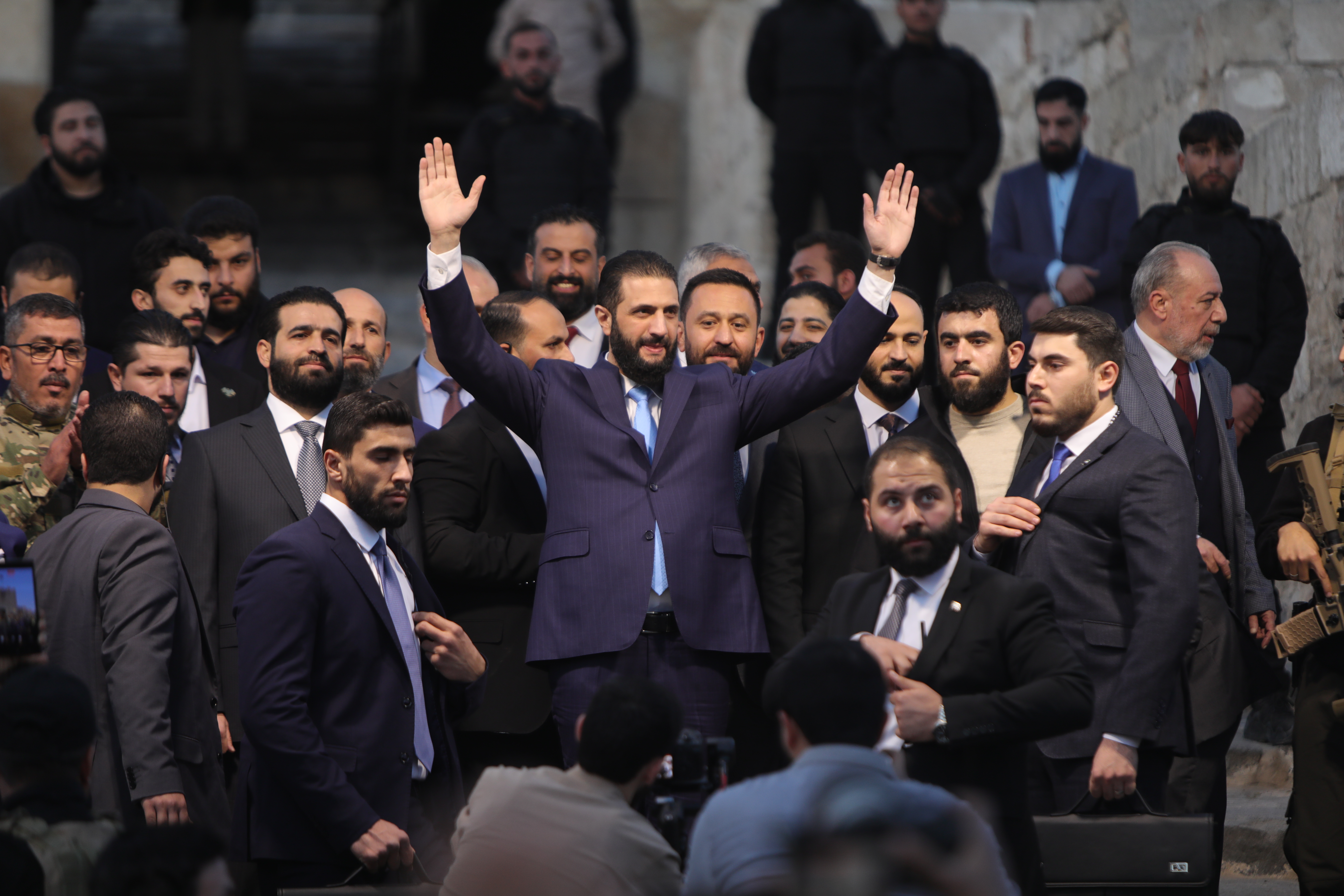
regime’s soldiers, at Citadel of Aleppo in Aleppo, Syria, on November 29, 2025. (Nabieha Altaha/Anadolu via Getty Images)
Abu Qatada al-Albani’s Signaling Statements
Abu Qatada al-Albani—whose real name is Abdul Jashari—is an ethnic Albanian militant and leader of Xhemati Alban, a small Syria-based jihadi group composed primarily of ethnic Albanians from North Macedonia, Kosovo, and Albania.54 Experienced in guerrilla warfare from his participation in the Balkan armed conflicts in Kosovo and North Macedonia during the late 1990s and early 2000s, Jashari has long been one of al-Sharaa’s closest and most trusted military advisors.55 In the summer of 2014, al-Sharaa appointed him to lead Jabhat al-Nusra’s military operations in Syria.56 In early 2019, Jashari served on an HTS reconciliation council that helped broker an accord with Hurras al-Din, an al-Qa`ida loyalist faction that had splintered from HTS over ideological differences.57 His experience and influence have also extended to training roles, including involvement in HTS-affiliated tactical and military programs at the military academy in Idlib for four years. Owing to his experience in asymmetric warfare acquired both in the Balkans and Syria, he was entrusted with establishing and leading the HTS military academy in Idlib.58 On December 28, 2024, Jashari was promoted to colonel in Syria’s restructured army—one of several foreign fighters elevated—highlighting his enduring influence in military, advising, mediation, and political roles within HTS.59
Jashari, designated a terrorist by the U.S. Treasury Department on November 10, 2016, has been frequently featured in Xhemati Alban propaganda materials since 2016, though it was a long period before his face was revealed.60 His face was first shown during an interview given to an Albanian media outlet on December 22, 2024.61 This ‘reveal’ was followed by at least three additional interviews with Kosovo media outlets between January and March 2025. In these interviews, Jashari described fighting in Syria as “a moral and religious obligation” and explained that Xhemati Alban was established on this premise in “late 2012 and early 2013 by a group of 40 ethnic Albanians from the Balkans and the diaspora.”62 However, during these interviews, Jashari kept the actual size of the unit vague, describing it as “several tens of fighters, but not more than 100.”63
When asked about the group’s plans and whether it wanted to return home, Jashari responded: “We have no intention of returning, at least in the near future, because the war is not over yet. There’s work to be done here.”64 When asked about the security situation in the Balkans, a seemingly well-informed Jashari responded: “The tense situation is clearly visible to us here as it is to you there. The situation between Serbia and the Albanians could escalate into war. In the event of war—and we pray to Allah that it does not come to that, though it is very possible—I believe that all of us who fought in Syria and have decades of experience would not only be welcomed but actively requested.”65 In one interview in March 18, 2025, when asked about Xhemati Alban’s role in suppressing the Alawite uprising of March 2025 in the coastal region of Syria and whether his unit had exceeded the rules of engagement, he responded by confirming its participation in the operations and describing his unit as “disciplined and honest.”66 As of mid-February 2026, this was Jashari’s last known televised interview.
While Jashari is disciplined and more discreet in his televised appearances—even attempting to project an image of moderation—he is far more unfiltered, radical, and overtly ideological in his social media posts and op-ed-style writings. For example, following the October 7, 2023, attacks in Israel, Jashari published an op-ed commentary on October 14, 2023, which he wrote himself and posted on his personal Telegram channel. In it, he praises the “bravery of the Palestinian offspring” and Hamas’ Qassam Brigades while harshly criticizing those Albanians who publicly condemned them and hurried “to show the kuffar—led by the Jewish criminals”—whom they support. In another similar commentary on August 4, 2024, Jashari eulogized Isma’il Haniyah, praying that he is accepted as a martyr and attacked those who question his jihad and martyrdom.
The same pattern holds for official Xhemati Alban media channels online, which openly celebrate the anniversaries of the September 11, 2001, attacks in the United States and the October 7, 2023, attacks in Israel, while sharing quotes from Usama bin Ladin’s speeches.i These posts by Jashari’s group serve as a clear indication not only of violent extremist ideological continuity but also of a deliberate choice not to conceal it, which suggests confidence in the group’s operating environment and no apparent concern for repercussions. This may not be all that surprising as HTS itself backed Hamas’ October 7 attacks and eulogized Isma’il Haniyah and Yahya Sinwar.67 On the other hand, the duality of Jashari (discreet in some mainstream media, overt in other partisan forums) highlights a calculated approach: moderation as a tool when useful, but radicalism as the core identity when addressing his base.
The same calculated approach applies to the media content disseminated by Xhemati Alban’s channels on Telegram regarding certain high-profile activities.j For example, there has been increasingly subdued coverage of al-Sharaa’s international activities, especially his visits to the United States, meetings with President Trump, al-Sharaa’s United Nations speech, and so forth. These events are barely covered, and when they are, the reactions of the channels’ users are almost entirely negative, which is indicative of an undercurrent of dissatisfaction.
Moreover, Jashari recently released two op-ed-style commentaries written by him personally on his Telegram channel with interestingly timed publication dates. The first, titled “The Reality of Democracy,” appeared on Telegram on September 29, 2025. It was a fierce anti-democratic manifesto that portrayed democracy not as a legitimate political system but as a deliberate, satanic deception—primarily orchestrated by Freemasons—to destroy natural hierarchies, enslave peoples, and install corrupt, servile, and easily manipulated leaders. In the document, democracy is described as “legalized injustice,” “the most filthy and manipulative system humanity has ever known,” and the exact opposite of what it claims to be (power becomes powerlessness, equality becomes inequality, justice becomes injustice, and freedom becomes slavery). Notably, Syria held its first post-Assad parliamentary elections under al-Sharaa’s government less than a week later, on October 5, 2025.68 While Jashari’s stance is unsurprising—given that elections and democratic participation are traditionally anathema to core salafi-jihadi ideology—the timing suggests it was a not-so-veiled rebuke and denouncement of al-Sharaa’s embrace of a (limited) electoral process.
On October 7, 2025, Jashari posted on Telegram another commentary titled “Trump between peace and war.” The cover image depicts President Trump standing before an American flag and pointing at the audience. Based on the accompanying text, his image appears to mimic the iconic Uncle Sam recruitment poster from the World Wars, which featured the caption “I Want You for U.S. Army” to encourage enlistment in the U.S. Army.69 The commentary is deeply conspiratorial, portraying the U.S. president as a master of deception who employs a false pacifist facade to conceal aggressive military preparations—centered on nuclear capabilities—that are deliberately propelling the world toward World War III, with China identified as the primary adversary. Jashari characterizes Trump’s peaceful rhetoric as an “attempt to induce enemies into negligence.” Once again, the timing of this piece is noteworthy. It followed a brief meeting on September 24, 2025, between al-Sharaa and President Trump on the sidelines of the U.N. General Assembly and preceded al-Sharaa’s historic visit to the White House on November 10, 2025—the first ever by a Syrian leader.k Such a conspiratorial assessment of President Trump’s motives reads less like a critique of him and more like a caution against—and strong opposition to—the rapprochement initiated by al-Sharaa.
Moreover, unlike the posts of Omar Diaby—which were released in both Arabic and French—Jashari’s commentaries were published exclusively in Albanian, without any Arabic versions. This choice aligns with a calculated strategy of cautious audience selectivity in public communications. It can also be interpreted as an effort to signal to his broader audience, and especially to his unit, that he remains firmly committed to his fundamental convictions and opposed, although without spelling it out, to al-Sharaa’s Western-leaning pivot, including emphasis on democracy, elections, and rapprochement with the United States.
Another noteworthy aspect of Jashari’s public posture was his complete silence surrounding the first anniversary (December 8, 2025) of the fall of Assad’s regime, on the day of the anniversary and the week that followed.l He issued no celebratory or congratulatory post, statement, or commentary, despite widespread national celebrations, military parades, and President al-Sharaa’s official addresses framing the event as “Liberation Day.” This conspicuous abstention during such a symbolically charged period is likely not accidental and indirectly underscores the ideological rift evident in his earlier commentaries. By withholding any statement, he effectively made one—signaling quiet dissent without overt confrontation.
For context on how significant Jashari’s silence was, even Mazloum Abdi, the leader of the Kurdish-led SDF—a force that has repeatedly clashed arms with al-Sharaa’s government forces throughout the past year despite the March integration agreement—issued a congratulatory statement,70 albeit shortly after the Autonomous Administration had banned public gatherings and mass celebrations in all SDF-controlled areas, citing security concerns.71
Converging Security Challenges
Accurately assessing the scale of the challenge posed by government-aligned foreign fighters to Syria’s transitional stability requires situating it within the country’s broader security threats: recurrent sectarian violence, ongoing tensions over Kurdish integration in the northeast, persistent Islamic State activity, and Israeli airstrikes and ground incursions.
One of the deadliest outbreaks of sectarian violence in post-Assad Syria struck the coastal provinces of Latakia and Tartus in March 2025, the Alawite community’s heartland. Triggered on March 6 by pro-Assad loyalist ambushes that killed dozens of government forces, the conflict escalated into brutal reprisals: Government-aligned militias, including foreign fighter factions, raided Alawite villages with house-to-house executions, looting, and arson based on sectarian identity. Monitors recorded more than 1,000 mostly Alawite civilian deaths—potentially war crimes—prompting thousands to flee amid collective punishment fears.72
A similar situation arose in the south several months later, involving another minority. In July 2025, intense clashes broke out in Druze-majority Suwayda province between local militias and government-aligned forces backed by Sunni Bedouin tribes. The fighting resulted in over 1,000 deaths, mostly civilians, further exposing deep interethnic fractures and challenging the transitional government’s minority protections.73
In early January 2026, heavy fighting erupted in Aleppo between the Syrian government forces and the Kurdish-led SDF, resulting in fatalities and widespread displacement of tens of thousands of civilians from the Kurdish majority neighborhoods of Sheikh Maqsoud and Ashrafiyeh.74 These clashes followed several failed negotiations to integrate the SDF into the national military. Government forces aided by tribal militia then launched a swift offensive against the SDF in northeastern Syria, capturing Raqqa city, all of Deir ez-Zor governorate, and other key areas east of the Euphrates by mid-January 2026—the most significant territorial shifts since Assad’s fall.75
Under military pressure, the SDF agreed to a ceasefire and a 14-point deal on January 18, ceding military, administrative, and territorial authority over much of the northeast in exchange for gradual integration of its fighters into the Syrian armed forces and police as individuals.76 It also agreed to hand over control of prisons holding over 8,000 Islamic State detainees, known to be vulnerable to breakouts.77 However, implementation disputes have persisted, accompanied by outbreaks of armed clashes and the escape of about 200 Islamic State detainees from al-Shaddadi prison in Hasakah.78 Although Syria’s Ministry of Interior announced that 8179 of these detainees were re-arrested shortly thereafter, this incident highlighted the vulnerability of the prisons under the current transitional dynamics, including contested control and ceasefire violations.
Heightened security concerns—and the risk that renewed hostilities could escalate into a full-scale armed confrontation between Damascus and a depleted SDF following the defection of Arab fighters from its ranks—prompted the United States to transfer by mid-February 2026 more than 5,700 Islamic State detainees from northeastern Syria to secure facilities in Iraq.80 Admiral Brad Cooper, commander of U.S. Central Command, described the operation as “critical to preventing a breakout that would pose a direct threat to the United States and regional security” among ongoing instability in Syria.81
This move came against the backdrop of a resurgent Islamic State threat. In late November and early December 2025, the group surged its attacks,82 claiming an ambush that killed four Syrian Ministry of Interior personnel in Idlib on December 1483 and carrying out a suspected insider attack in Palmyra on December 13 that claimed three American lives.84 Throughout 2025, U.S. and partner forces detained more than 300 Islamic State operatives in Syria and killed or captured over 20 in follow-on operations after major retaliatory strikes.85 A broader clash between the Syrian government and the remnants of SDF (essentially composed of Kurdish People’s Protection Units known as YPG forces) would severely undermine these counter-Islamic State efforts. It would also deepen ethnic divisions and likely spark an insurgency that would further jeopardize Syria’s fragile post-Assad stability and create conditions ripe for Islamic State exploitation.
Lastly, Israel’s airstrikes86 and ground incursions87 in Syria persisted throughout 2025, with increased intensity toward the year’s end,88 as Israeli forces occupied and expanded a southern buffer zone beyond the 1974 U.N.-monitored disengagement area.89 These operations have caused reported civilian casualties, including at least 13 deaths (mostly civilians, including children) in the November 2025 Beit Jinn raid.90 While providing immediate deterrence and border control after the Assad regime’s collapse, prolonged occupation risks entrenching local resistance, provoking retaliation from jihadi groups, or triggering broader Syrian responses. However, at present, al-Sharaa’s military—still in the process of consolidation and rebuilding—faces substantial asymmetries in capabilities that would make significant resistance to Israel’s considerably more advanced forces highly challenging.
Although Syria and Israel reached a U.S.-brokered security agreement in Paris in early January 2026—establishing a joint mechanism for intelligence sharing, military de-escalation, and communication coordination to reduce border tensions91—as of mid-February 2026 Israel had shown no signs of withdrawal from newly occupied territories in Syria, with raids persisting despite international criticism.92 Negotiations for a demilitarized zone could enable stabilization, but current trends point to sustained low-intensity friction.
Conclusion: What Next?
Amid escalating sectarian tensions and overlapping security threats, loyal and battle-hardened foreign fighters continue to offer significant value to Ahmed al-Sharaa’s efforts to consolidate power—especially as his emerging national army, with an estimated strength of 100,000, works to achieve broader integration and cohesion.93 As such, deepening rifts—whether ideological or organizational—and potential violent clashes, like those involving groups such as Firqat al-Ghuraba that place al-Sharaa’s security forces in direct opposition to foreign fighters, could have profound secondary and tertiary consequences. These might undermine internal unity and operational effectiveness within his core forces, weaken his command authority, trigger defections, and encourage sectarian militias, the Islamic State, and other adversaries to exploit the situation—potentially igniting broader, multi-front violence or even a relapse into civil war.
Thus, these foreign fighters—especially their ideologically driven leaders—represent a classic double-edged sword. While they currently remain valuable to al-Sharaa’s project, the long-term viability of this relationship is far from assured. Their loyalty to him should not be regarded as unconditional; its future will likely depend heavily on al-Sharaa’s continuing ideological evolution as well as practical considerations, particularly the handling of their status, citizenship, and integration within the army. In response to early 2025 pressure from the United States and other international actors to bar foreign fighters from senior military roles, the Syrian government reportedly announced a suspension of new senior-rank appointments for non-Syrians.94 It did not, however, clarify whether previously granted promotions and appointments were revoked or remained in effect.95
In December 2025, the subject resurfaced in the U.S. National Defense Authorization Act for Fiscal Year 2026, which repealed Caesar Act sanctions on Syria while mandating periodic reviews of progress on areas including the removal of foreign fighters from senior government and security positions.96 In practice, this framework incentivizes the Syrian government to demote or limit the influence of foreign fighters in senior ranks to avoid risks and sustain benefits like continued sanctions relief, potential future aid, and improved bilateral ties. Yet, as the repeal was just passed, the short-term status quo may hold, but ongoing 180-day reviews will likely drive longer-term changes to ensure compliance.
The matter of citizenship is also in flux. During a press conference with French President Emmanuel Macron in May 7, 2025, al-Sharaa assured that these foreign fighters are committed to Syrian law and pose no threat to any country, adding that the decision on granting them Syrian citizenship would be determined by the future permanent constitution once it is drafted.97 The interim constitutional declaration, signed on March 13, 2025, establishes a five-year transitional period, during which a new permanent constitution is to be prepared. This raises questions about whether the prolonged uncertainty over their legal status until at least 2030 could strain their integration in Syria or loyalty to al-Sharaa in the interim.98 On the other hand, deferring the citizenship decision to a future legal framework may be a deliberate strategy and a natural filtering mechanism. It buys time for monitoring and gradual integration, encourages continued loyalty among the committed, and provides an exit ramp for those who grow irritated. Frustration surfaced in August 2025 when journalist Bilal Abdul Kareem99 submitted a high-profile petition—on behalf of a group of foreign fighters and residents who had supported the opposition—to Syria’s Ministry of Interior, demanding citizenship for their contribution to toppling Assad.100 No significant grants of citizenship followed.
The patience of Syria’s foreign fighters and their willingness to compromise on ideology remain uncertain, with the five-year citizenship deferral likely encouraging gradual attrition through voluntary departures. While some may leave for places like Afghanistan101—where the Taliban rule offers a welcoming environment for battle-hardened jihadis and some groups such as TIP maintain a presence—no major departures were reported as of mid-January 2026. Nevertheless, leaks or quiet exits could increase if frustration mounts or new opportunities arise for those favoring continued global jihad, echoing patterns among foreign fighters in past conflicts.
The case of Bosnia and Herzegovina provides a cautionary parallel. During the 1992-1995 war, an estimated 1,000-2,000 foreign fighters joined the conflict on the side of the Army of the Republic of Bosnia and Herzegovina and were formally organized into the El Mudžahid detachment.102 Many of these mujahideen veterans went on to fight in other conflicts, such as Chechnya, Pakistan, Afghanistan, even in Syria and Iraq.m Others became involved in terrorism, including two of the 9/11 hijackers (Khalid al Mihdhar and Nawaf al-Hazmi), Khalid Sheikh Mohammed (the mastermind of the 9/11), and numerous other al-Qa`ida operatives.103
Hundreds remained in Bosnia104 after the war and were granted citizenship in recognition of their military contributions, despite the Dayton Peace Accords’ explicit requirement to expel all foreign fighters.n Eventually, Bosnia’s Citizenship Review Commission stripped citizenship from around 420 such individuals and deported them due to security risks.105 Syria’s trajectory—balancing rewards for loyalty against international demands—could follow a similar path of delayed resolutions and potential policy reversals.
An alternative for al-Sharaa would be to forgo senior promotions for foreign fighters and pursue a pragmatic integration approach—built on clear preconditions, measurable benchmarks, rigorous monitoring, and full transparency. It is impossible to predict whether this would succeed in transforming ideologically entrenched combatants into constructive, peaceful members of the inclusive society he envisions for Syria’s future. Yet, how al-Sharaa addresses this challenge will rank among the most rigorous tests of his sincerity and ability in pivoting from jihadi commander to a pragmatic and constructive statesman deserving of international legitimacy.
So far, al-Sharaa has maintained effective control over potential dissent from hardline jihadi foreign fighters, and the likelihood of violent confrontation with any significant segment of them appears low. Besides a resurgent Islamic State—estimated by high-level Syrian and Iraqi officials to have significantly grown its force to between 5,000 and 10,000 fighters106—other primary flashpoints continue to be ethnic and territorial disputes. While al-Sharaa has achieved a notable short-term consolidation of power in the fragile post-Assad era, the long-term durability of his control remains uncertain. Failure to meaningfully address deep-seated sectarian grievances—particularly among minorities such as Kurds, Alawites, and Druze who have faced reprisals, exclusion, and displacement—could erode this stability, leading to fragmented governance, renewed militia rivalries and separatist movements, and even a slide back into civil war.
Ultimately, the security challenges posed by foreign fighters form part of a much broader regional security and stability equation. A Syria at peace, free from oppression, stable, and prosperous would serve the core interests of the United States, the European Union, and neighboring countries—such as Turkey, Lebanon, and Jordan—that have shouldered the burden of hosting millions of refugees. It would deny terrorists the ungoverned spaces and societal grievances they exploit for radicalization and plotting, while containing instability within its borders and safeguarding regional security. From a geopolitical perspective, keeping Russia and Iran sidelined in Syria would constitute a significant strategic victory for Western interests and modern Arab states. In this fragile post-Assad era, cautiously supporting al-Sharaa’s transitional project through targeted engagement, rigorous oversight, and conditional incentives could yield the stability required to prevent terrorism from undermining peace and security across the region and beyond. CTC
Adrian Shtuni is CEO and Principal Consultant of Shtuni Consulting LLC. He is also an Associate Fellow with the International Centre for Counter-Terrorism in The Hague. X: @Shtuni
© 2026 Adrian Shtuni
Substantive Notes
[a] The coalition of rebel groups that participated in the operation “Deterrence of Aggression” was composed of HTS, Ahrar al-Sham, the National Front for Liberation, Jaish al-Izza, and Nour al-Din al Zenki. Other foreign fighter contingents participated in the offensive either as part of HTS or in the case of the Uyghur jihadi group Turkistan Islamic Party in Syria, with a hybrid status, namely autonomous branding and flag in combat, but embedded within the HTS coalition. “Who are Hayat Tahrir al-Sham and the Syrian groups that took Aleppo?” Al Jazeera, December 2, 2024.
[b] HTS—a name that means Organization for the Liberation of the Levant—was officially dissolved on January 29, 2025. This marked the end of the military formation as an independent armed faction and its integration into the new Syrian Armed Forces. HTS was the direct organizational and leadership successor of Jabhat al Nusra, first a branch of the Islamic State of Iraq and then al-Qa`ida’s official Syrian franchise that operated under this name from 2012 to 2016. In 2016, Ahmed al-Sharaa—known at the time as Abu Muhammad al-Jolani—announced the dissolution of Jabhat al Nusra and its replacement by Jabhat Fateh al-Sham in a strategic attempt to break external ties with al-Qa`ida and rebrand his organization that in reality remained unchanged in terms of leadership, command structure, core fighters, and funding networks. In January 2017, Jabhat Fateh al-Sham merged with several smaller Islamist factions—Nour al-Din al-Zenki, Liwa al-Haqq, Jaysh al-Sunna, and Jabhat Ansar al-Din—to create the umbrella organization HTS. See Aaron Y. Zelin, “The Patient Efforts Behind Hayat Tahrir al-Sham’s Success in Aleppo,” War on the Rocks, December 3, 2024; Martin Smith and Marcela Gaviria, “The Jihadist,” Frontline, June 1, 2021; “Tahrir al-Sham: Al-Qaeda’s latest incarnation in Syria,” BBC Monitoring, February 28, 2017; and “Thirty-sixth report of the Analytical Support and Sanctions Monitoring Team submitted pursuant to resolution 2734 (2024) concerning ISIL (Da’esh), Al-Qaida and associated individuals and entities,” United Nations Security Council, July 24, 2025.
[c] The post-Assad landscape in Syria features foreign nationals associated with multiple armed actors, including the transitional government in Damascus (led by al-Sharaa and other figures from the former HTS-led coalition), remnants or affiliates of the Islamic State, the Kurdish-led Syrian Democratic Forces, and various other militias. For the purposes of this report, however, ‘integration of foreign fighters’ specifically refers to the incorporation of non-Syrian nationals previously affiliated with the HTS-led coalition that overthrew the Assad regime into the new Syrian security structures (e.g., the Ministry of Defense and associated forces.)
[d] Determining the size of the pool of foreign fighters who fought with or alongside HTS under the leadership of al-Sharaa between 2012 and 2025—as well as the number currently residing in Syria—is beyond the scope of this article. For context, however, some publications estimate the number of fighters remaining in Syria (originating predominantly from Central Asia, the Middle East, and Europe) to range from 3,500 to up to 10,000. Other more specialized publications cite estimates of about 5,000, which is likely a more accurate number. For the 3,500 estimate, see Timour Azhari and Suleiman Al-Khalidi, “Exclusive: US gives nod to Syria to bring foreign jihadist ex-rebels into army,” Reuters, June 2, 2025. For the 10,000 estimate, see Omar Abdel-Baqui, “Foreign Jihadists Helped Syria’s Rebels Take Power. Now They’re a Problem,” Wall Street Journal, April 30, 2025. For the 5,000 estimate, see Louisa Loveluck and Zakaria Zakaria, “Syrian leader faces challenge of foreign militants who helped him win power,” Washington Post, May 31, 2025, and “Thirty-sixth report of the Analytical Support and Sanctions Monitoring Team.”
[e] Hakimiyyah lillah, usually rendered as “sovereignty belongs to God alone” or “governance/legislative authority is God’s alone,” is one of the most central and politically charged concepts in modern Islamist—especially salafi-jihadi—thought. The influential Islamic scholar Sayyid Qutb, widely regarded as the 20th century father of the contemporary salafi jihadism, developed the concept in depth in his extensive Qur’anic commentary “In the Shade of the Qur’an.” In it, he argues that allowing human beings to legislate is to associate partners with God in His most exclusive right, insisting that there exists no sovereignty except God’s, no law except the law revealed by God, and no legitimate authority to enforce anything other than what God has legislated. Qutb carried the idea to its radical conclusion in his famous manifesto “Milestones,” in which he states plainly that anyone who acknowledges the right of human beings to legislate has taken other lords beside God and has thereby exited the fold of Islam entirely.
[f] Media outlets reported that not all armed factions participated at the Syrian Revolution Victory Conference and that only 18 armed factions committed to disbanding and integrating. Notably absent were armed factions from Druze-majority province of Suwayda, the Southern Operations Room in the province of Daraa, and the Kurdish-led Syrian Democratic Forces. Ahmad Sharawi, “Ahmad al Sharaa’s Victory Conference: Syria’s new era and an exclusive translation of Sharaa’s speech,” FDD’s Long War Journal, January 30, 2025.
[g] The last pieces of content posted on Albanian Tactical’s dedicated social media channels (on Telegram, X, and Instagram) date to May 2025. On May 6, a video captioned in English “Training on how to deal with an ambush” indicates that the training was for the benefit of the #SASF (Syrian Army Special Forces). On May 13, photos with the English caption: “Training session working weapon positions around the vehicle – angles, cover, movement. Always good to sharpen the edge.” Although this does not confirm integration into the 84th Division, the lack of further posts and that the channels are not accessible likely indicates that Albanian Tactical is undergoing a transition.
[h] Throughout history, rulers have often employed foreigners for their close protection not only for their military skills and personal loyalty, but also because their detachment from local politics minimized the risk of intrigue or betrayal. Roman emperors starting from Julius Caesar used Germani corpore custodes (Germanic bodyguards) from tribes like the Batavi. Byzantine emperors relied on the Varagian Guard formed from mainly Scandinavian mercenaries, while Ottoman Sultans used Janissaries, recruited from converted Christian youths from the Balkans, as their elite bodyguards.
[i] Posts on official Xhemati Alban Telegram channels from September 11, 2025, read the same as any other year: “America and its followers will never forget our laughter while the tower was on flames;” “11 September and 7 October. Two historic dates.” Numerous posts provide imagery or videos of the attacks with quotes from Usama bin Ladin speeches. Other posts from October 7, 2025, read: “their dead in hell ours in paradise,” other reposts from the day of the attacks read: “may Allah be with our mujahedeen during this great attack,” whereas other video posts with disturbing imagery are entitled: “Shoot on the Zionists,” “Gifts for the believers in Gaza,” and so forth.
[j] Xhemati Alban has consistently invested significant effort in its branding, messaging, and outreach to Albanian-speaking audiences. It pursues these activities through official social media channels and affiliated/satellite accounts across platforms, with Telegram as the primary focus in recent years. The group and its leader maintain an active and regular Telegram presence to share news, propaganda, operational updates, combat videos, op-ed-style commentaries, and official statements. Several affiliated channels (some emphasizing developments in Gaza or Afghanistan) form part of a wider ecosystem that supports Xhemati Alban’s targeted outreach. These networks routinely cross-post material to boost visibility and engagement.
[k] The initial meeting between al-Sharaa and President Trump had occurred earlier, in Riyadh on May 14, 2025.
[l] This article’s social media research cutoff date was December 15, 2025.
[m] Reda Seyam, a German Egyptian preacher who fought in Bosnia in 1994, joined the Islamic State and became the highest-ranking German member of the group, serving as ‘emir of education’ in the Islamic State-occupied city of Mosul where he was killed in 2014. See Adrian Shtuni, “New wave of Islamic State-inspired militancy in Europe very likely to continue in 2025,” Janes, January 16, 2025; “Leading Islamist Wins Right to Name Son ‘Djehad,’” Spiegel International, September 2, 2009.
[n] The key provision is found in Annex 1-A (Military Aspects of the Peace Settlement), Article III, paragraph 2, which states: “The Parties shall ensure that all foreign forces, including individual advisors, freedom fighters, volunteers, and personnel of military training and support organizations, except for personnel referred to in paragraph 1 above [i.e., UN and IFOR/SFOR], withdraw from the territory of Bosnia and Herzegovina not later than 30 days after the Transfer of Authority from UNPROFOR to IFOR.” Additional reinforcing language appears in: Annex 1-B (Regional Stabilization), Article IV: Requires the withdrawal of all foreign forces from the territories of the Parties (Bosnia, Croatia, and the Federal Republic of Yugoslavia). Annex 4 (Constitution of Bosnia and Herzegovina), Article I, paragraph 4: Declares that Bosnia and Herzegovina “shall not permit the presence of foreign military forces on its territory except as provided for in Annex 1-A.”
Citations
[1] “Trump to Syria’s al-Sharaa: ‘Ahmed, you will be a great leader,’” Al Arabiya English, December 3, 2025.
[2] Tom Bateman, “US scraps $10m bounty for arrest of Syria’s new leader Sharaa,” BBC, December 20, 2024.
[3] Bill Roggio, “Hayat Tahrir al Sham’s terror network in Syria,” FDD’s Long War Journal, December 12, 2024.
[4] “Thirty-fifth report of the Analytical Support and Sanctions Monitoring Team submitted pursuant to resolution 2734 (2024) concerning ISIL (Da’esh), Al-Qaida and associated individuals and entities,” United Nations Security Council, February 6, 2025.
[5] Kathleen Collins, “Uzbek Foreign Fighter Groups in the Syrian Jihad: The Evolution of KIB and KTJ from 2011 through 2025,” CTC Sentinel 18:9 (2025).
[6] Roggio.
[7] “Thirty-fifth report of the Analytical Support and Sanctions Monitoring Team.”
[8] Ibid.
[9] Ibid.
[10] Doruntina Baliu and Ibrahim Berisha, “[The role of Albanians in the recent battles in Syria],” Radio Free Europe, December 13, 2024.
[11] “Thirty-fifth report of the Analytical Support and Sanctions Monitoring Team.”
[12] Ibid.
[13] Collins.
[14] “‘New history written’ says HTS leader al-Julani in Syria victory speech,” Al Jazeera, December 8, 2024.
[15] “Syrian President outlines reforms, pledges national renewal,” United Nations, September 24, 2025.
[16] “An interview with Ahmed al-Sharaa, Syria’s president,” Economist, February 3, 2025.
[17] Louisa Loveluck and Zakaria Zakaria, “Syrian leader faces challenge of foreign militants who helped him win power,” Washington Post, May 31, 2025.
[18] “Thirty-sixth report of the Analytical Support and Sanctions Monitoring Team submitted pursuant to resolution 2734 (2024) concerning ISIL (Da’esh), Al-Qaida and associated individuals and entities,” United Nations Security Council, July 24, 2025.
[19] Syrian Arab News Agency, “[An official source in the Ministry of Foreign Affairs told SANA: What was reported by …],” X, November 17, 2025.
[20] “Syria To Hand Over Uyghur Jihadist Fighters To China: Sources,” Agence France Presse, November 17, 2025.
[21] Sultan al-Kanj, “Foreign Fighters in Syria: Problem or Part of the Solution?” Asharq Al-Awsat, May 16, 2025.
[22] “Syria’s ‘Victory Conference’, its Timing and Implications,” Jussor, February 4, 2025.
[23] David Gritten and Lina Sinjab, “Kurdish-led SDF agrees to integrate with Syrian government forces,” BBC, March 11, 2025.
[24] Charles Lister, “9 months, #SDF leader Mazloum Abdi was put on a US helicopter & flown to #Damascus to sign …,” X, December 11, 2025.
[25] Kelly Campa and Brian Carter, “The New Syrian Army: Order of Battle,” Institute for the Study of War, 2025.
[26] Ibid.
[27] Timour Azhari and Suleiman Al-Khalidi, “Exclusive: US gives nod to Syria to bring foreign jihadist ex-rebels into army,” Reuters, June 2, 2025; Mohammed Hassan, “Building Syria’s new army: Future plans and the challenges ahead,” Middle East Institute, June 12, 2025.
[28] “[Division 84 in the dock… The new Syrian army on the European sanctions radar],” Eram News, July 31, 2025.
[29] Adrian Shtuni, “Western Balkans Foreign Fighters and Homegrown Jihadis: Trends and Implications,” CTC Sentinel 12:7 (2019).
[30] Farzon Muhammadi, Doruntina Baliu, Meliha Kesmer, Farangis Najibullah, and Frud Bezhan, “The Foreign Militants Among The Ranks Of Syria’s New Rulers,” Radio Free Europe, December 13, 2024.
[31] Hassan, “Building Syria’s new army.”
[32] Ibid.
[33] “Hayat Tahrir Al-Sham (HTS) Leader Ahmed Al-Sharaa Promotes Military Officers, Including Senior HTS Commanders, Uyghur, Albanian, Turkish, Jordanian, Egyptian Nationals,” MEMRI, December30, 2024.
[34] Tarek Ali, “[Syrian controversy over the appointment of foreigners to army leadership positions],” Independent Arabia, February 18, 2025.
[35] “Thirty-sixth report of the Analytical Support and Sanctions Monitoring Team.”
[36] David Schenker, “After Assad: The Future of Syria,” Washington Institute for Near East Policy, June 5, 2025.
[37] Timour Azhari, Khalil Ashawi, and Suleiman Al-Khalidi, “Syria appoints some foreign Islamist fighters to its military, sources say,” Reuters, December 31, 2024.
[38] “Thirty-sixth report of the Analytical Support and Sanctions Monitoring Team.”
[39] Ibid.
[40] “Islamic State (ISIS) Weekly Editorial Lashes Out At Al-Sharaa ‘Prostration’ ‘On Trump’s Doorstep’; Claims Syrian Leader’s ‘Betrayals’ Rewarded The ‘Pavlovian Method’: Trump Wants Foreign Fighters ‘Expelled’ – ISIS Invites Them To Join Up,” MEMRI, May 16, 2025.
[41] Bilal Abdul Kareem, “Syria Exclusive: Wife of Muhajir Abu Dujanah Speaks Out,” X, October 15, 2025.
[42] Ibid.
[43] “Militant Enterprises: The Jihadist Private Military Companies of Northwest Syria,” Syria Justice and Accountability Centre, May 9, 2024.
[44] “Syria detains prominent American Islamist journalist, sources say,” Reuters, December 23, 2025.
[45] Bilal Abdul Kareem, “Bilal Abdul Kareem to OGN: Abu Hamza Malaysi was arrested by HTS in 2019 …,” X, December 18, 2025.
[46] “Syrie: accrochages entre forces gouvernementales et jihadistes français menés par Oumar Diaby,” France24, October 22, 2025.
[47] Arthur Sarradin and Noé Pignède, “Reportage Syrie : au cœur du camp d’Omar Omsen, le dernier ‘charlot du jihad’ français,” Libération, September 19, 2025.
[48] Ibid.
[49] “Une demi-douzaine de Français ont tenté de rejoindre le jihadiste Omar Omsen en Syrie en 2025,” RadioFrance, September 19, 2025.
[50] Abby Sewell, “What to know about the French militants who clashed with Syrian forces in Idlib,” Associated Press, October 23, 2025.
[51] Ghassan Taqi, “Syria’s Foreign Fighters Have Beef with Their Old Friends,” Al Hurra, October 30, 2025.
[52] Sewell.
[53] Shelly Kittleson, “Will foreign fighters test the stability of post-Assad Syria?” New Arab, October 29, 2025.
[54] Shtuni, “Western Balkans Foreign Fighters and Homegrown Jihadis.”
[55] Adrian Shtuni, “Xhemati Alban: Hayat Tahrir al-Sham’s ethnic Albanian militant group,” Janes, June 12, 2020.
[56] “Treasury Designates Key Al-Nusrah Front Leaders,” U.S. Department of the Treasury, November 10, 2016.
[57] Shtuni, “Western Balkans Foreign Fighters and Homegrown Jihadis.”
[58] Shtuni, “Xhemati Alban.”
[59] Azhari, Ashawi, and Al-Khalidi.
[60] “Treasury Designates Key Al-Nusrah Front Leaders.”
[61] “EKSKLUZIVE | Flet komandanti shqiptar në Siri: Nuk jemi terroristë. Ja si e mposhtëm Assad-in!” A2 CNN via YouTube, December 22, 2024.
[62] Ibid.
[63] “EKSKLUZIVE: Flet Komandanti i shqiptarëve në Siri ‘Ebu Katade Albani,’” KlanKosova via YouTube, March 18, 2025.
[64] “Ebu Katada Albani: Krenarë që luftuam në Siri, po punojmë për njohjen e Kosovës,” Interactiv Talks via YouTube, February 14, 2025.
[65] Flamur Hoxha, “Komandanti i Xhematit Shqiptar: Si:ria pritet ta njohë Kosovën, të gatshëm nëse Kosova sul:mohet nga Serbia,” shenjester.net, January 2, 2025.
[66] “EKSKLUZIVE: Flet Komandanti i shqiptarëve në Siri ‘Ebu Katade Albani.’”
[67] Aaron Y. Zelin, “The Patient Efforts Behind Hayat Tahrir al-Sham’s Success in Aleppo,” War on the Rocks, December 3, 2024.
[68] Deborah Cole, “Syria holds first elections since fall of Bashar al-Assad,” Guardian, October 5, 2025.
[69] See “Uncle Sam: We Want You,” National WWI Museum and Memorial, n.d.
[70] Mazloum Abdi, “[A year ago, Syria entered a new phase with the fall of the defunct regime …,” X, December 7, 2025.
[71] See Democratic Autonomous Administration of North and East Syria’s post on its Facebook page, December 6, 2025.
[72] “Thirty-sixth report of the Analytical Support and Sanctions Monitoring Team;” “Syrian forces mass*acred 1,500 Alawites. The chain of command led to Damascus,” Syrian Observatory for Human Rights, June 30, 2025.
[73] “Syria: UN experts alarmed by attacks on Druze communities, including sexual violence against women and girls,” U.N. Office of the High Commissioner for Human Rights, August 21, 2025.
[74] Gabriela Pomeroy, “Thousands flee clashes between Syrian government and Kurdish fighters in Aleppo,” BBC, January 7, 2026.
[75] Eyad Kourdi and Tim Lister, “Syria’s military has seized swaths of Kurdish-held territory. Here’s what we know,” CNN, January 19, 2026.
[76] Bassem Mroue, “What to know about Syria’s main Kurdish-led force and its deal with Damascus after days of clashes,” Washington Post, January 19, 2026.
[77] Alissa J. Rubin, “Islamic State Camps Pose a Dangerous Problem for Syria’s Leaders,” New York Times, December 10, 2025.
[78] “US estimates 200 Islamic State fighters escaped Syrian prison, US official says,” Reuters, January 20, 2026.
[79] “Interior Ministry says it arrested 81 ISIS inmates after Hasakah prison break,” Sana, January 20, 2026.
[80] “U.S. Forces Complete Mission in Syria to Transfer ISIS Detainees to Iraq,” U.S. Central Command, February 13, 2026.
[81] “U.S. Forces Launch Mission in Syria to Transfer ISIS Detainees to Iraq,” U.S. Central Command, January 21, 2026.
[82] Charles Lister, “In the past 3 weeks, #ISIS has surged its attacks inside #Syria gov’t areas …,” X, December 13, 2025.
[83] “ISIS claims attack killing 4 Syrian government security forces in Idlib,” North Press Agency, December 15, 2025.
[84] Dearbail Jordan, “Three Americans killed by IS gunman in Syria, US military says,” BBC, December 15, 2025.
[85] “U.S. Forces Launch Mission in Syria to Transfer ISIS Detainees to Iraq.”
[86] Seth Frantzman, “Israel intensifies airstrikes on Syria to deter attacks on Druze,” FDD’s Long War Journal, July 16, 2025.
[87] Charles Lister, “NEW — for the 1st time, #Israel launched 100 ground incursions into #Syria in one month in November …,” X, December 1, 2025.
[88] Alia Chughtai and Mohammed Haddad, “Israel attacked Syria more than 600 times over the past year,” Al Jazeera, December 9, 2025.
[89] Armenak Tokmajyan, “Israel’s Ring of Buffer Zones,” Carnegie Endowment, December 4, 2025.
[90] Raffi Berg, “Thirteen killed in deadliest Israeli raid for months in southern Syria,” BBC, November 28, 2025.
[91] “Israel, Syria to set up communication mechanism after US-mediated talks,” Reuters, January 6, 2026.
[92] “Israeli occupation forces carry out new incursion in Southern Quneitra,” Sana, January 16, 2026.
[93] Hélène Sallon and Madjid Zerrouky, “Syria’s new army confronts the legacy of civil war,” Monde, December 12, 2025.
[94] Loveluck and Zakaria.
[95] Ibid.
[96] “S.2296 – National Defense Authorization Act for Fiscal Year 2026,” 119th Congress.
[97] Ruaa al-Jazaeri, “President al-Sharaa during a press conference with French President: No justification for maintaining sanctions after the fall of deposed regime,” Sana, May 8, 2025.
[98] “Constitutional Declaration of the Syrian Arab Republic,” March 13, 2025.
[99] “Foreign Jihadi Fighters In Syria Seek Citizenship: ‘We Are Neither Guests Nor Passers-By,’” MEMRI, August 17, 2025.
[100] Timour Azhari, “Foreign Islamists petition Syrian state for citizenship,” Reuters, August 15, 2025.
[101] Collins.
[102] Thomas Hegghammer, “The Rise of Muslim Foreign Fighters: Islam and the Globalization of Jihad,” International Security 35:3 (2010/2011).
[103] “Al Qaeda Aims at the American Homeland,” 9/11 Commission Report, Chapter 5, July 22, 2004.
[104] Stephanie Zosak, “Revoking Citizenship in the Name of Counterterrorism: The Citizenship Review Commission Violates Human Rights in Bosnia and Herzegovina,” Journal of Human Rights 8:2 (2010).
[105] Nicholas Wood, “Bosnia Plans to Expel Arabs Who Fought in Its War,” New York Times, August 2, 2007.
[106] Loveday Morris and Mustafa Salim, “Iraqi spy chief warns of reemerging threat from ISIS as its ranks swell,” Washington Post, January 26, 2026.
